A few weird numbers came out of yesterday's election. The main thing was that the opposition represented by the Justicialist Party (that is, the Peronists) won in Rosario, where it usually loses by a wide margin, and the Progressive Front won in Santa Fe City, where it usually doesn't do that well and was vanquished in the latest legislative election. What happened?
You need to remember this was a primary election and, although it was compulsory, many people didn't turn up. It was a local election and in Rosario, also, it was a local election pitching a diverse (some would say promiscuous) opposition party against a fairly monolithic government party whose administration is showing some wear after 14 years in office. People who are more-or-less OK with the Socialist administration didn't vote for it because the main list of candidates was seen as a bunch of yes-people ready to raise their hands on the mayor's command. I myself voted for Nire Roldán, one of the minor, dissident candidates of the Progressive Front, instead of the "loyalist" Clara García (currently a top municipal official), because I don't want a Deliberative Council with an absolute majority of the government's faction.
In any case, the Progressive Front had differences in opinion among its factions, basically regarding the closeness of the candidates to the mayor's power. On the other hand, the Peronists are profoundly divided, and so they went to the primary election: a Kirchnerist faction led by extra-partisan, former Socialist and Menemist sell-out Héctor Cavallero, with the explicit support of the now disgraced Kirchnerist mouthpiece Agustín Rossi; a faction led by one Diego Giuliano, a political unknown who answers to formerly fervent Kirchnerist, now right-wing anti-Kirchnerist Carlos Reutemann; another one led by Osvaldo Miatello, the only one with a current and established legislative career, backed by former governor Jorge Obeid; and an assortment of no-names. These will have to get along somehow — they'll all be together in a single ballot in September.
My analysis is that many people just took the Progressive Front for granted and refused to show extra support for the mayor's faction (that's what I did after all) as a way of letting them know they'll have to work harder to stay in power, while each of the various competing Peronist candidates conducted an aggressive campaign just to make themselves noticed, and their wide differences encouraged their supporters to go out and vote.We'll see what happens with those figures in September. I really can't see a traditional, conservative Peronist voting for a former Socialist with Kirchnerist backing, or viceversa.

03 August 2009
Primary election results

 Stumble it!
02 August 2009
Just voted
I've just voted on the (arguably) most boring election ever — a primary to select candidates for the city's Deliberative Council.
Not only did most people not know exactly who the candidates were, what general views (as opposed to nice specific ideas) they had, or even which party they belonged to, but also, as a result of the flu epidemic, the election should have taken place a month ago and didn't. It was postposed, but the legal ban on political advertising wasn't reset, so it's been more than a month since any of the candidates was allowed to appear on TV or be heard on the radio to explain the citizens what they intend to do if they're elected. Now I don't really love politicians broadcasting their promises along with catchy, unsubstantial slogans every ten minutes on the radio, but I do appreciate those things have a purpose.
Some of the major candidates evaded the ban by campaigning through Facebook. I think this is a very nice idea. It was pioneered, I think, by mayor Miguel Lifschitz, and spread quickly to other candidates, who apparently saw that just having a website was useless if nobody noticed it. The digital divide makes this practice a bit problematic, though.
I'll be posting the results here as soon as I have them, but nobody expects a surprise. The real election, with the candidates from each party already selected, will take place on September 27.
25 June 2009
Before the elections
It's only a few days to the legislative election, so this is a brief "state of the campaign" post. I'll refrain from emphasizing the appallingly low level of today's politics, if only because the post would turn into in a long, bitter rant if I tried to convey that.
First, my home district, Santa Fe. Here the senatorial race is the major one, because we have two great contenders: former two-time governor Carlos Reutemann, and Rubén Giustiniani, backed by current governor and former two-time mayor of Rosario Hermes Binner. Both candidates are already senators and both are sure to be reelected; the real issue is, first, who will win (even by one vote), and in a distant second place, which party will get the third senator.
Reutemann is a well-known, wealthy, conservative Peronist who for some reason (certainly not his charisma or his performance when in office) has consistently captured over a third of the vote in every election. Giustiniani is your typically neat low-profile militant of the very moderate (almost European-like) Socialist Party who ran (big mistake!) as candidate for the vice-presidency next to Elisa Carrió in 2007. Reutemann is playing the anti-Kirchnerist card, an attribute he earned by positioning himself against the ruling couple on the issue of Resolution 125, even though he barely did anything but raise his hand on command on all other issues. Since half the population of the province barely knows Giustiniani, until a few months ago Reutemann took his triumph for granted, but since governor Binner stepped into the campaign, Giustiniani has come close to his opponent, to the point that the predicted result is very close to a tie.
The leading candidates for the Chamber of Deputies are almost completely unknown; they're only getting votes because they'll be on the same paper ballot as their respective senators. Ironically, the only candidate everyone knows is the one heading for the distant third place: Agustín Rossi, by now politically disgraced in his own home turf due to his complete, unwavering submission to Néstor Kirchner.
In the Province of Buenos Aires, well... you have a contest of unscrupulous millionaires, a huge, impoverished clientele, well-oiled political machines with their filthy cogs obscenely in view and no-one doing anything about it, the government doing campaign for its party with state funds, the opposition wipping up the visceral hate for the Kirchners of the mostly right-wing citizenry, and no government proposals whatsoever except for "it's us or chaos". It's sleazy. So you'll forgive me if I refuse to take one more step into that crap.
Several problems with this election and with the system in general: first, the ballots printed by each party with their own candidates (instead of a universal ballot where you have to select what you want), which leaves ample space for fraud and many borderline illegal practices; second, the use of (linear) proportional representation in a country like Argentina, with a ridiculously skewered population distribution, which makes it possible for a party to win an election just by concentrating their efforts on a few hundred square kilometers crammed full with very poor, very influentiable people; third, the lack of political awareness of most of the citizens, understandably tired of anything to do with politics, which makes it easy for opportunists to flourish and for the unscrupulous to "disappear in the crowd".
I feel fortunate that I inhabit a district where, at least, the choices are clear-cut and the fight has not turned dirty beyond words. I won't vote for Reutemann, the love child of Carlos Menem and completely deprived of ideas besides his own plans to maintain influence; I won't vote for Rossi, a mouthpiece of the Executive Branch who would bring its own province to its knees to further the Kirchnerist agenda of centralized control; I'll vote for Giustiniani, who has some ideas I like and belongs to a structured political project that's going in the (general) right direction.
31 July 2008
Power fees going up in Buenos Aires
The national government is giving the power companies a raise, through an increase in the power fees, that will fall on those who consume more than 650 kWh every two months. The increase will range from 10% to about 30% and, while Minister Julio De Vido says it'll only affect 24% of the population, others claim the middle class will be hit hard. And it seems a further raise is due next February.
The above is the news as reported everywhere in Argentina, and many people are genuinely concerned or outraged for the wrong reasons. Why? Well, despite the big headlines and the alarming newsflashes broadcast by the media, the raise is only for Buenos Aires, its metropolitan area and the city of La Plata only. Granted, that's 40% of the consumer base and Buenos Aires is the center of the universe for the porteño and for the "national" media, but you'd think they should at least qualify their statements.
I didn't say we hinterlanders* shouldn't be concerned or outraged. We have reason to be concerned since the same inflation and the companies' lack of investments that prompted the national government to grant the raise for the Buenos Aires area utility companies is having serious effects on those that supply the provinces; many had adjusted their fees up or were considering raises before this, and now it's only a matter of time before they align themselves with the capital's companies. Our own EPE (the Santa Fe Provincial Power Company) is checking its numbers right now.
* "El interior del país" ("the interior of the country") is what they call everything but Buenos Aires. That's how Argentina was structured to begin with: a colony with a big port to interface with the world, plus a broad expanse of land ripe for primary exploitation. It's customary and it doesn't sound alright. In fact, it reminds me of the ridiculous conception of Bender's robot apartment in Futurama — Bender sleeps standing up in a 1×1-metre room with no furniture, and the place where he lets Fry live is a huge room in itself... which Bender calls "the closet".
The reason for the outrage is, partly, the outrage of the porteños at this raise, because they've been enjoying ridiculously low prices for power, natural gas and public transportation at our expense since... well, ever. Time and time again I've written about the subsidized fuel for buses. As Rosario's city council is about to take the bus ticket to AR$1.60, a bus or subway ticket in Buenos Aires still costs about AR$1.
Well, as it turns out, the average residential power fee in Buenos Aires is vastly lower than the average in the rest of the country. No wonder the system has problems — you can't expect that the power grid won't collapse when you charge the lowest fee in the place with the largest and densest population, the highest per-capita income, and the highest concentration of installed top-notch air conditioners and refrigerators. According to the article in Crítica Digital, in the capital area a home that consumes 1,700 kWh will get a bill for about 88 pesos. Checking EPE's website and doing a quick calculation, we learn that the same amount of power, in Santa Fe, will punish the wasteful ways of the unfortunate consumer with a bill for 194 pesos. (The guy who writes the Crítica article obviously has math issues. He reports that fees in Buenos Aires are "194% cheaper" than in Santa Fe. Things can't be more than 100% less anything, unless you allow for negative values. Back in 2002 journalists noted that the dollar-peso parity had gone from 1 to a rate of almost 4 pesos per dollar, and reported that the peso had therefore "devalued by 400%". I recall only one news source giving the correct figure of 75%.)
Why did the porteños get this lucky all this time? Well, first of all, no-one likes being charged more, and when you have a metropolitan area with 12 million people surrounding the government seat, you don't want to make them angry. Especially when outside the capital proper you have several huge concentric rings of increasingly impoverished areas. If you control the money, you can use it to favour those near you, while the rest of the country gets indebted. Second, if you measure inflation only in the metropolitan area, it's in your best interest (image-wise and in the short term, i.e. the Argentine way) to concentrate your anti-inflation tactics there and leave "the interior" to its own devices. When the system starts to buckle under pressure (because you subsidize the demand but do not force the companies to invest and increase the offer), you deny it for as long as you can. And then you do something. You can imagine how close to the brink we've come if you consider the government is taking this step now, after the president's image has plunged and with a cooling economy on the horizon.
So, porteños and platenses, welcome to the rest of the country. Don't complain; you're still getting lucky.
11 June 2008
I want to believe but...

This report comes after Cristina granted an audience to Santa Fe governor Hermes Binner, who had criticized the handling of the farmers' crisis and asked for a better redistribution of federal funds. Yesterday, after the audience, Cristina gave a speech next to Binner noting that Santa Fe has received a lot of funds for public works, and how that shows in Rosario's growth and prosperity. Well, while it's true that we've received funds, we're still waiting for the national government to pay for the repair of a section of our coastal park that Néstor Kirchner promised to deal with in 2005 (!) and that will be finished no sooner than 2009 (hopefully). And most of Rosario's recent prosperity, as everyone over here above kindergarten age knows, is due to the money coming in from the nearby countryside, the construction boom being just one example. Put simply, when people have money to spend, they come to the big city and splash.
Yesterday, the President rubbed her figures on Binner's face noting that federal money transfers to Santa Fe had increased 30% in a year — which is true of all provinces, because that's how much tax collection increased in nominal terms, mostly due to inflation. She also claimed Santa Fe had received over AR$42 billion since 2003. However, according to our Finance Minister Ángel Sciara, the books only show AR$15 billion on all accounts. And the federal government is behind schedule by about AR$1 billion.
The national government has legal obligations — by law Santa Fe must receive 8.84% of the federal taxes, and that's not a grant, a gift, or in any sense something we must thank for to our most gracious Cristina Kirchner.
22 April 2008
Smoked: It's blame time!
The authorities are saying that 60–80% of the fires on the islands of the Paraná river delta are under control, and given the expected wind patterns Buenos Aires is unlikely to be covered by smoke again (though some say Buenos Aires is likely to be covered by smoke again!).
Here in Rosario we've seen no more of it after the ash-filled smelly cloud that appeared last Friday evening and stayed until Saturday afternoon, though there was some smoke blowing in again on Monday evening.

The eastern and southern horizons continue to be covered with an almost uniform smoky blanket, gray during the day and turning a sick shadow of purple before sunset. It goes south, mostly, but as soon as the wind shifts it will surely come back. As I write this, National Route 9 is closed to traffic because of the smoke and an accident involving three trucks, and the Rosario–Victoria Bridge is, once again, closed as well. People keep complaining of eye and throat irritation. The fires near Victoria, across the delta, are still far from contained.
The smoke is not merely smelly, dirty or irritating, since it's not just burning plant matter — there are about 220 thousand head of cattle on the islands, each producing 21 times as much waste as a human being. All that dung is burning and raining on an area shaped like an elongated trapezoid, its shorter base, between Rosario and Victoria, being 60 km wide, and the longer one, located 300 km south-southwest at the mouth of the Río de la Plata, about double or triple that width.
Now the Uruguayans are also mad at us — first we block their international bridges in protest for a paper mill that was supposed to pollute our air and water, and, while said paper mill cleanly and flawlessly works as it should, we sit idly as the whole delta of the Paraná turns into smoke and sends that smoke their way, and then we realize the situation is grave (i.e. the smoke has reached the upper-class neighbourhoods of Buenos Aires) and desperately start trying to put the fire out with more courage than equipment.
The fires, as an official conservative estimate, have devastated 70,000 hectares (700 km² or 173,000 acres) of the delta's islands. The government of Santa Fe wants to turn the Paraná's islands and wetlands into a protected area, like a national park. Governor Hermes Binner has demanded that Sergio Urribarri, governor of Entre Ríos, do something about the whole issue, because that's their jurisdiction, and they're the ones who allowed ranchers to overpopulate the islands and burn them to clear the scrub. Binner ironically repeated what Rosario's mayor had said about the smoke — "We've lived with these problems every year. Fortunately this time the smoke reached Buenos Aires, so it's everybody's concern now."
The fires aren't just a source of smoke, but they've also killed off the whole ecosystem. Of course grass will grow again; that's the purpose of the fires. But the islands are (were) much more than simply grassy plains for cows to graze on. The destruction originally began when the numbers of cattle multiplied by 15 in a matter of years. Those cows' excrement and urine are full of nutrients that the environment cannot absorb properly. When algae get hold of them, they choke the streams where they grow, then die and rot, and this causes a proliferation of bacteria that consume all the oxygen dissolved in the water, killing the fish and the rest of the aquatic fauna (the process is called eutrophication).
A lawyer is accusing Romina Picolotti, Secretary of the Environment, for her handling (or lack thereof) of the problem. Picolotti is an environmentalist who used to counsel the Gualeguaychú Assembly regarding the Uruguayan pulp mills (remember?), and I thought she would be at least alarmed, but she acts like a bureaucrat and seems to have blended extremely well into the state of general indifference to real problems that characterizes the Argentine government. Like somebody said (I overheard on TV) she realized there was a problem when the smoke started coming in through her windows.
Among the impending failure of the negotiations with the agricultural producers, the governments has resorted to finger pointing, accusing farmers of burning fields with no regard for human life only to reap more money from crops. This is strictly true, but then the majority of the farmers who've done nothing wrong were justly enraged. The government was unsubtly trying to shift all the blame on their chosen enemies of the day.
Yesterday, grassroots agro-leader Alfredo De Angeli remarked that, back when the roads were blocked, the people were armed so as to defend themselves in case the truck drivers sent by Hugo Moyano (head of the truckers' union, allied to the government) tried to force them out. Within hours, prosecutor Guillermo Marijuán filed an accusation against De Angeli for "inciting violence". Marijuán being usually independent, one must wonder whether he sold out, or was pressured by the government, or was simply stupid. De Angeli is an aggressive activist, to be sure, but his comment was a description of the tense environment of the road block, not a call to arms.
The last ridiculous development on this sad story is the indictment of a rural worker who was found setting fields on fire. This person couldn't possibly do much on his own, and certainly not without orders from an employer or permission from the owner of the field. In our slang this is called a perejil — a kind of scapegoat, but one specifically chosen due to his complete lack of power to influence the big picture (like a street drug dealer that gets jail time because of an ounce of marijuana, while the one that brings the dope in by tons stays free).
My own impression is that the national administration is lost and, faced by problems on several fronts, behaves like a caged tiger, almost blind with fury. Ten days from now the farmers' "truce" will end, and it's quite possible that the fires, or the problems caused by them, won't have been extinguished by then. In the meantime, Secretary of Commerce Guillermo Moreno wants to seize cattle from their owners to sell on the market and keep the price down. Inflation continues to rise, and the government stays on denial. They're going to indebt the country heavily to build a bullet train that only rich people will be able to afford. Our capacity to produce electricity and natural gas is strained. The power fees are going to rise soon. Paraguay's new president wants to renegotiate the price of the energy from Yacyretá they sell to Argentina.
12 December 2007
Strike me down
The municipal public employees are on strike since yesterday, and for the nth time, asking for a raise. I've been wanting to see a photo exhibition at the Museo de la Ciudad, but since it's run by those very municipal employees, it's impossible. Last week on Tuesday I went to the museum, and only after ten minutes of looking around did I remember the employees were on strike. It wasn't a waste, because the museum is after all within a beautiful park and I was accompanied by a beautiful lady, but the exhibition (which I'm told is large and very good) remains unseen to me.
I don't know what the municipal employees are trying to do here. I understand that prices have gone up and the Christmas/New Year season brings even more expenses than usual, but everyone in the government offices has half their things packed for vacations already, and they're going to get a customary "adjustment" salary raise first thing next year.
On the other hand, I don't get why (besides tradition) government offices have to change at this time of the year. Nobody wants to dress up and hear long speeches, everyone wants to leave town and flee the scorching summer for the beach or the mountains, and no-one wants to start anything that demands work. The general consensus at my workplace is that the heavy restructuring that governor Hermes Binner will surely effect on the provincial public administration will not begin until March, which means four lost months just because the office-taking was done in December.
Binner will face troubles soon too, since now that there's a Rosario Socialist in the Grey House (the government seat, in Santa Fe City) and many Rosarinos will be moving there from the municipal administration to become provincial officials, information and gossip will travel faster, and already the news is that (as everyone suspected) the municipal employees of Rosario are much better paid than us, their counterparts in the province, and much better treated. One of the subtly stated campaign devices of Binner's was that he could do for the province what he had done for Rosario, which everyone agrees has turned into a much nicer city during the past Socialist administrations (Cavallero, twice Binner, and Lifschitz). So we (or our union) will surely be joining the municipal workers in Rosario, asking not only for a raise, but for a raise that brings us closer to them.
And of course, looming above the whole country, there's union leader Hugo Moyano, already facing up to the Presidenta — in fact saying "If you don't give us what we want, we may not continue to be your allies". Cristina K really seems to be more comfortable around industrial moguls and other businessmen than close to Moyano and his vociferously thuggish supporters, who can strike Cristina in both figurative senses of the word, since they de facto command the distribution of goods throughout the country.
And that ends today's political rant. Useless, I know. At the end of it all, I still can't go see my exhibition...
30 November 2007
"We were so good I don't get why we lost"

(Post-election advertising poster for the outgoing government,
almost identical to posters used in the campaign to boost
the government party candidate, who lost anyway.)
Reporter: "[Governor] Jorge Obeid said he'll leave you [enough] money to pay salaries and bonuses to the public employees in December, 200 million pesos from the anti-cyclical fund, 80 million from the public works fund, and 300 million for ongoing works, adding up to 1,400 million. What do you think?"
Governor-elect Hermes Binner: "That we're going to have to pay for a lot of advertising."
23 November 2007
Blackout count: 3
The Power Supply Fluctuation Watch recorded a new event yesterday. Blackout #3 of the 2007/2008 season has been assigned the name Carlos. It began with minor drops of voltage just after sunset, followed by recovery, and ending with a large loss of voltage that lasted until the morning.
In other news, the outgoing government of Santa Fe led by Governor Jorge Obeid continues to appoint scores of its own officials, political allies, and friends and relatives of the governor, his cabinet, and influential former governor Carlos Reutemann, to high-ranking vacant posts in the public administration, the judiciary and the Provincial Power Company (Empresa Provincial de la Energía, EPE).

Sorrento power plant
EPE is said to have serious shortages of personnel in certain areas, while others are overpopulated by (or were just created especially to harbour) unqualified people appointed there in violation of regulations just because they have family or political contacts in the management. Wages paid by EPE are legendarily high. The company will close 2007 with an estimated AR$90 million deficit, double the figure of 2006, and will have to be asisted with government (i.e. taxpayers') money.
Since the Front for Victory lost the election in September, the provincial government has been cutting supplies to its public offices, and the quality of its services has gone downhill. This hasn't prevented the government party to advertise itself using the same posters that appeared during the campaign — huge colour prints boasting "4 years of hard work, without raising taxes". The Peronists seem to be determined not to leave a single coin, a single spare printer ink cartridge or a single made-up vacant post on their way out, and are turning the judiciary and the (formally) independent control offices into a minefield for the next administration.
Boy, this will take years to fix...
21 November 2007
The future of the abortion issue in Santa Fe
Abortion is illegal in Argentina, and due to a clear intrusion of religious belief in the Constitution of 1994, it cannot be made fully legal under any circumstances without causing a flood of judicial injunctions, unless you change the Constitution itself. But at least you can start by not treating women who abort like murderers.
This hot potato was grabbed by Miguel Ángel Cappiello, currently the Secretary of Public Health of Rosario and soon to become Minister of Health of Santa Fe, yesterday. Cappiello publicly said that he thought abortion should be decriminalized and that, for starters, women who go to public hospitals to be treated by complications of induced abortions will never again be denounced to the police. The law is unclear in this respect, since although abortion is illegal, the physician who deals with it has the right and the obligation to keep the professional secret. The physicians surveyed support Cappiello.
The platitudes of those who claim to be "on the side of life" started right away, of course. It seems as if Cappiello had suggested that mothers should be rewarded for ripping their babies apart or something like that. Unfortunately, the most influential members of the medical and legal establishments tend to be fanatically Catholic wealthy old men who have never seen or spoken to a poor woman forced to raise a child she didn't want, so they feel perfectly fine speaking of the embryo's "right to life" as if this abstract concept superseded any other consideration, and worse.
The minister-to-be is sure to apply the same measures in the province that the Socialist administrations in Rosario have been applying for years regarding contraception and planned parenthood, so abortions should decrease. Santa Fe has the means to reduce unwanted pregnancies, including an appallingly high rate of teenage pregnancies, but the government has done nothing serious about those. Although the current lame-duck governor Jorge Obeid is a left-wing Peronist (one who had ties with extreme leftist Peronists in the 1970s), his power is based on the establishment of Santa Fe City: the reactionary rich Catholics who've been really in charge since the 16th century. Current Health Minister Silvia Simoncini is just a deputy of those higher powers (and an awfully incompetent minister, too). They're going away on December 10. Good riddance!
08 November 2007
Retentive government
That's the theory at least. In truth, what happens is that the farmers, even with a 35% tariff deduced from their sales abroad, are getting filthy rich, while screaming all the time at the top of their lungs that they're desperately poor, and that the big bad government is snatching away the bread from their children's mouths. So desperately sinking into poverty they are, they've been increasing their crops and setting higher yield records every year since 2002. One of these days I think I'll wake up and see my garden turned into a soybean field.

One assumes that, if selling abroad with such high tariffs were no good, then the farmers would stop doing it. The local market is not big enough for soybean and sunflower, but then we do need other stuff. Like tomatoes and potatoes, for example. And beef and milk. You can't have cows munching on expensive high-yield pesticide-resistant transgenic soybean, can you? (Soybean is displacing other crops, as well as cattle farming. It's also displacing natural forests, and is being planted in soils that will quickly deteriorate. See "Argentina: la cuenta regresiva para el granero del mundo" [via Pehuen.org, in turn thanks to Chileno].)
The government is keeping a lot of money that it wouldn't be getting if it weren't for the high exchange rate. If the price of the dollar in pesos went down, the national state would be deprived of much-needed funds (in fact, the fiscal surplus would evaporate), and the farmers would also get a lot less in local currency. Since it's the government that props up the dollar artificially, the perverse scheme at work is transparent. The government and the farmers yell at each other while they support each other at the same time.
I don't have an ideological problem with export tariffs, like many of their critics. I think they're perfectly fine. They should be better implemented, probably, but they're not wrong per se. The rules are not the same here as in developed countries. In a country with a weak currency and a very small and underdeveloped local market, without export taxes, it makes financial sense to screw your own and sell abroad. And if the product has little to no added value, better yet, in the short term. Oh, farmers do have to invest a lot these days, but they're not advancing technology, they're just using top-notch off-the-shelf tech to seed, care for and harvest million of tons of plants. (Argentina builds and exports very fine agricultural machines, too. That's the way to go.) Retenciones make producers think twice and pay a little attention to the local market. In the case of soybean, which is not a local staple, tariffs should serve to stop farmers from turning the whole country into a massive monoculture field.)
The problem with the tariffs is that all that money ends up in the national state's coffers and doesn't go back to where it came from, or to where it's needed most. The crop-producing provinces get nothing for their efforts, and the other provinces (typically poorer) don't see the money of their rich cousins redistributed. Instead, the money funds the government's grandiose public works scheme (plus bribes for the minister in charge and overpriced items for his friends who win the bids) and its political machine.
Last Friday, the government sent AR$140 million (~US$44M) to the municipalities of Greater Buenos Aires, to be used at the discretion of their mayors. Legal (thanks to an obscenely dependent Congress who allowed the budget to be modified freely) but fishy. The GBA has been ruled by these robber barons and virtual mafia bosses since ever, and it was them who gave Cristina half the votes she got (many of which, for all we know, were bought and paid for). The GBA surely needs those funds, being the metropolitan area with the worst quality of life in the country, but it's obvious they're not being used to make life better for the residents. This week Papa K also sent AR$80 million to some provinces. You'll also remember, surely, how K cut ribbons of dozens of public works in various states of completion throughout the campaign.
This is the usual way of favouring your loyal servants before an election, and rewarding them after it. And it's possible only because the national government has a lot of money to spend, while the local governments have little. Santa Fe is among the provinces most harmed by this. Export tariffs are not redistributable by law like other national taxes, so our province, which produces and exports a lot of the country's grains and vegetable oil, is subject to the whims of the national government. Since Santa Fe is comparatively rich, however, it can (politically) afford to be fairly independent of those whims, and it's been punished for that. The new Socialist government, we hope, will protest more than the obedient Peronist one we've had for the last four years.
22 October 2007
Photo tour to San Lorenzo
I went on a photo tour to San Lorenzo with the Rosarigasinos last Saturday. San Lorenzo is a city of 45,000 north of Rosario, within the metropolitan area. The region is densely populated and, in the case of San Lorenzo and the nearby towns, booming with light industrial development — petrochemical, vegetable oil, a cellulose plant... This combination gives the area a distinctive stench that fortunately doesn't reach the urban center of San Lorenzo, but is a pain along the road.
San Lorenzo is also known as the site of the only battle of the Wars of Independence to be fought in present-day Argentine soil. National hero, General José de San Martín, really liberated Argentina by defeating the Spanish in places located in neighbouring countries. The Battle of San Lorenzo was really a very small one (less than 1,000 troops counting both sides), but San Martín succeeded in thwarting a Spanish attack from the littoral, which was then rather wild and underpopulated. The rest of the battles he fought in Chile, Bolivia and Peru, closer to the local power centers of the time.
On Friday night there was a terrible storm, including some hail, and it still was raining from time to time when we gathered on Saturday morning, but by noon the sun was out in full force. We got on two cars and headed for San Lorenzo... it must've taken us an hour, because the road is narrow and not too good and it was being repaired and redone (they want to connect it to a highway). First we went to the Convent of San Carlos, where San Martín's forces rested.

There are Franciscans there still, but the convent is actually a museum. They preserve the room where San Martín stayed, others with objects used by the first monks, others with 19th century weapons, old letters and pictures, and all sorts of other objects up until the early 20th century. I'll let the pictures speak for themselves...
 |  |
 |  |
 |  |
We had lunch in a restaurant nearby, and then visited the coast. The provincial government is working on it, reinforcing the ravine against erosion and planning a nice park and a promenade, not unlike what's been done in Rosario. The reinforcement is needed because the river naturally eats away the ravine, and the increased traffic of large cargo ships and the 34-foot dredging of the Paraná have only made it worse. The rest is just esthetic, which is not a bad idea considering the potential for historical tourism. Schools regularly take students to visit San Lorenzo, but it's really a minor thing.
In the afternoon we visited the Municipal Museum. I was favourably surprised by it. It had a collection of everyday objects from the past of the city, nothing of great economic value or splendid appearance, but very interesting nonetheless. It was well-lit and displayed, and nobody protested when we took pictures.
We stayed until nightfall and then (since the last of us had been left behind without a car) we returned on a packed interurban bus.
05 September 2007
Santa Fe, Córdoba, Misiones
(I'll stop the politics after this. Promise.)
The election was Sunday, today's only Wednesday, and everything already seems to be upside down. Some people who were overconfident to the point of hubris are desolate. The parachuted former candidate Rafael Bielsa is going to resign from his deputy chair because "it wouldn't be ethical to represent the city of BA after I was candidate for governor of SF" (what, you mean now?). Governor elect Hermes Binner met with governor Obeid in the government house and the employees left their posts to go and greet him. The factions of Peronism in Santa Fe are at each other's throats, as they see their power structure crumbling like a house of cards. The President hasn't uttered the words "Santa Fe" (or "Córdoba") since Sunday.
And Binner is already laying out his plans, which include giving more money and more power to the municipalities, avoiding the discretional management of funds by the central provincial state, fighting tax evasion without raising taxes, ensuring that school classes start on schedule next year, and cancelling the construction of a new provincial hospital only 10 blocks away from a municipal hospital (a project that vice-governor, councilmember elect and well-connected architect María Eugenia Bielsa made up and is now defending with such foamy rage that it seems rather obvious she was going to make dirty money for herself out of it).
The situation in Córdoba after the election is a mess. Only 17,000 votes (out of more than 1.5 million valid votes) separate the two main candidates. The vote count was abnormally slow, the handling of the information was horrible, and the fraud is obvious; the only issue is whether it was a general effort, planned from the top down, or just minor tricks on the local scale (the latter are a certainty).
And, thanks to the Ley de Lemas, the elections in Misiones next Sunday will most likely be even messier: besides the board-kicking effect caused by the rejection of the constitutional reform allowing the governor's re-election, the Ley de Lemas, which allows parties to combine the votes of any number of minuscule factions and candidates, means 18,000 candidates will be running for something — one every 36 voters.
Anyway, we're done over here for now. There have been many interviews and articles about Binner's achievement, and in most of them one can realize that the media have caught the general vibe of the people and, besides the natural journalistic interest for "the first Socialist governor in history", there's a serene awareness that change for the better is coming. Nobody expects a lot, but then everybody expects something — even those who voted for Bielsa, who (for the most part, if you ask me) aren't so sure that they should be sad about the loss.
31 August 2007
The end is near
My Japanese calligraphy teacher's view of the candidates for the governor election: "There's the guy with all that beard... and the other guy who looks like Hitler." I had to laugh. It's very difficult to discuss politics in a language you're just starting to understand beyond the basics, and explaining Argentine and local politics to a foreigner from a vastly different culture is absolutely impossible. We left it at that. (Watanabe-sensei also inquired about Cristina Kirchner. I just said no.)
OK, that was just comic relief. We're right on top of the election, and that's a good thing, because I was getting tired of the incessant TV and radio ads, the childish taunts among grown men, the unsubtle campaign moves. If I hear the President is coming again to unveil yet another one of those hypothetical or half-finished public works that abound these days, I will lose it.
In case you didn't notice, I'm starting a news blog. I'm going to take news from local media and classify them with graphical labels according to their type... morbid, boring, useless filling, paid-for ads disguised as news, etc. It's en español and it's called Etiquetame todo ("Label Me All Over"). If you read Spanish, check out it.

14 August 2007
Campaign daze
There are so many ways to go about a political campaign! If you're the government, that's made easy by the fact that you can unveil public works and you can do it at the exact moment you want. If they actually serve a useful purpose, better yet.
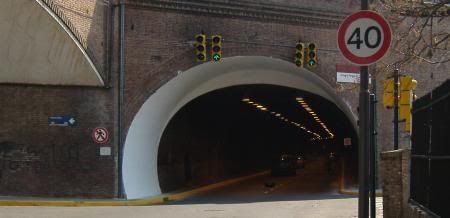
This the Arturo Illia Tunnel on Monday, August 13:
This is the same tunnel on Tuesday, August 14 (the time of the day is about the same, but the lighting and the exposure are different):
The municipality changed the lighting system of the tunnel: they took out the fluorescent lights on both sides, and installed a double row of zenital cut-off sodium lamps, "for power efficiency and safety". So far, so good. Only the mayor Miguel Lifschitz, went there to inaugurate the lights. It was a lot of work, I get it, but I don't get a will-never-be-the-same feeling from the change. Lifschitz is campaigning for his reelection, though — which explains why he not only mounted a show to unveil the lights at a scheduled event on Tuesday although they were basically ready on Monday, but also why he's also unveiling a level crossing on a very minor street in a forgotten spot of the city tomorrow, and advertising it with pamphlets carrying the internationally recognizable symbol of the rose in the fist.
In his defense, I may say these things are actually useful, and they're working already. Other government authorities have a tendency to unveil things that are not complete, or worse, to gather thousands of people just to announce future works, which may or may not be impossible to do. Think the Rosario-Buenos Aires "bullet train", which I still refuse to dismiss as pure fantasy, but also remember how Carlos Menem infamously promised we'd have an airport for "stratospheric planes", and how he "unveiled" the Rosario–Victoria Bridge four years before it was completed.

10 August 2007
Quis custodiet custodes?
The elections in Santa Fe are in three weeks. In the primaries, the opposition candidate Hermes Binner got about 2% less votes than the two ruling party candidates combined... but those were provisional numbers. Two weeks after that, the final count gave 15,000 more votes to Binner. The Peronist candidates added a few thousands as well, but the distance decreased significantly. Binner said "I want international overseers from OAS." The provincial government sneered at it: "We don't know why he's so uptight about transparency, but we'll get those overseers." So far, so far good.
Yet Government Minister Roberto Rosúa now says there's no need to bother OAS with a request of international overseers for the main elections, and proposes, instead, that we employ overseers provided by CIPPEC, a national NGO which I have nothing bad to say about a priori... except it's recommended by national Interior Minister Aníbal Fernández (that would be the Luiggi to Alberto Fernández's Mario). Fernández, I don't know why, seems to have power to decide over the transparency controls of the elections.
Not only that, but we learn that members of the provincial police force vote in special double envelopes, and those votes are not counted in the provisional tally. That's because of the special circumstances in which the police have to vote (they're on duty during the election, maybe guarding places far away from their legal addresses, etc.). Fine. Except there are 6,000 policemen in Santa Fe. That's 6,000 employees of the provincial administration, and that's also 6,000 votes that may suddenly pop out of nowhere if needed, after the polls are closed. We're talking of a party that doesn't like to lose, that hasn't lost an election in 24 years, that has people in every place where it may need them to avert a defeat, and that has a lot, a lot to lose. The ones who have to control the elections and the vote count are employees of this government, members of this party, and people recommended by a notorious member of the party.
Quis, indeed.
02 August 2007
Haunted swing
I had many news (bad news) to report on but I thought this could cheer you people up, as well as being a good chance to laugh at the whole subject. This must be the spookiest paranormal phenomenon you've ever witnessed: a swing that swings itself!
I'm always amazed of the ways people find to make their lives more interesting. I photograph things; I even go to places to photograph specific things. I read books about subjects I don't quite understand or can barely grasp. I'm learning a language where everything seems to be upside down relative to my native tongue. Other people do stranger things to get their "fix", like jumping off bridges with a rope tied to their ankles, or smoking mushrooms, or praying. But getting yourself to believe there's a swing that moves by itself must be among the most ridiculous ways to spice up your earthly life.
Some people in Firmat, a town southwest of Rosario, believe there's a swing that moves by itself. No, before you laugh at it, it's not the wind, and just in case, the other two swings in the same set aren't moving. The movement of the swing is pronounced, and it really doesn't look abnormal — the chain that holds it is not tensed or fully extended, so there's no invisible child sitting on it, and the balance is steady and shows the homogeneous deceleration that is to be expected in a simple gravity pendulum, only it regains acceleration every now and then and so continues to swing for a while (the video is not clear at all).
I'm not going to judge the simple-minded folks who believe a swing can move by itself. There are probably many people in Firmat who'd swear they see the swing moving without any force being exerted over it by natural means. I don't think it's a conspiracy to distract attention from something else. I can't really discard it as a joke. So?
So, which of these two possibilities is more likely to be true?
- The swing really moves by itself or through undetectable means outside the limits of human science and common experience.
- Somebody outside the camera's field of view is pulling the swing with a string.
People are already claiming the spirit of a child is swinging in the swing, and some say they've talked to the swing (that must have been a truly weird experience). The mayor of Firmat only said "We can't find a rational explanation", and, rather disappointedly, noted that he'd like journalists and curious visitors to come to his town for different reasons. (Maybe the ghost in the swing will take his cue from that.)
29 July 2007
Tourism in Santa Fe
I'm a fan of travel and tourism, as you may already have noticed. I'm convinced that travelling broadens the mind and (under the proper conditions) helps you relax, rethink your life strategies, plan ahead. I'm pleasantly surprised to notice how Rosario is slowly receiving an increasing trickle of tourists, who will, I assume, take the good news back to their homes, whether in Argentina or abroad (it seems to be mostly Argentina and mostly Buenos Aires, though there have been no formal surveys of that, and I've walked past groups of people speaking English and German more than once in the last few weeks).
I was also surprised, negatively and continuously, that Santa Fe as a province didn't bother to try and attract tourism. That was until now. The government, in coordination with private companies, has launched Turismo Cerca, an initiative that is (in this first stage) intended to promote tourism in the province. It's only in Buenos Aires, because it's conveniently close, accessible, and of course, because one third of the country's population lives in the metropolitan area. With hundreds of kilometers of river coast, plus eco-agricultural and historical tourism options just waiting to be exploited, it's a shame that this hasn't been done before, but better late than never.
I must say that I myself am guilty of not advertising my province by word or by example. I've stayed in places 1000 km away from here and I haven't visited the tens of small towns not 100 km around Rosario that have interesting things to show. Considering my availability of money and time, I feel like I'm wasting my time sitting here while I could be zigzagging around the province with a backpack... I think I'll be checking that touristic portal of the province more often.
03 July 2007
Blacking out from happiness!

It's so good to live in these times of economic growth, with the shopping malls full of light, and people buying around tirelessly, and the factories bustling, producing goods for the anxious consumers and for the whole world! Now, every time the power goes out, you know it's a good sign — it's just growth pains!
Or would you like to live in a country that always has energy to spare? As they say, only the mediocre are always at their best. The fact that we're having problems (which we are not) is a sign that we're doing better each day!
Now if you think otherwise, you most surely must be a neoliberal right-wing nut bent on the destruction of everything that's good about Argentina, from Sunday asados to good ol' friends' capitalism, or a poor unthinking sod deceived by the diabolic cunning of the neoliberal right-wing nuts. You're still welcome to build the country that the sensible people truly want, with us, the good guys — in fact, you're welcome to become one of us, if you have some voters that we could use.
In any case, there's something you can do to help you through the dark hours..., which means a lot of time, since you'll be often living one of those painfully glorious growth spurts when the power goes out because the power plants cannot produce, or the grid cannot handle, the tremendous amount of electricity needed to run Argentina ever-increasing productive beatitude. Just use this mantra:
There's no energy crisis... There's no energy crisis... There's no energy crisis...
Repeat ad infinitum, and you'll see the light. Eventually.
29 June 2007
Wrapping up the campaign
We're in veda electoral, that is, the common pre-election ban on political advertising, since this morning. Though next Sunday's is just a primary election, it works like a main one and it's equally a bother: it's compulsory and you can't sell (therefore can't buy) booze the night before and during the whole day (you can buy booze beforehand and save it for Sunday, though).
In Rosario, almost exactly 700,000 people have the right and the obligation to vote; in Santa Fe as a whole, about 2.3 million. We're selecting the candidates who will run for their respective parties in the main election in September. Until 2005 we had Ley de Lemas, a perverse system by which a candidate could win with fewer votes than most of their opponents (follow the link). In fact, with Ley de Lemas you could win with 2 votes against someone who had gotten 1 million votes, provided you had 999,999 other candidates of your own party running beside you and they each got 1 vote (which would make a total of 1,000,001 votes for your party as a whole).
The system was repealed and replaced by simultaneous compulsory primary elections — compulsory for the parties, even if a party has internally decided to run with only one candidate. That's the case of the Socialist Hermes Binner, the favorite to win the governorship according to all surveys. The Justicialists (Peronists) have a more complicated task ahead, since they're presenting two candidates (Agustín Rossi and Rafael Bielsa) under the name Frente para la Victoria (Front for Victory), the faction of President Kirchner, plus one more, Roxana Latorre, who rebelliously decided to run by herself, and (naturally) claims to represent the true interests of Peronism. Latorre is (or was) a pawn of Carlos Reutemann, the Formula 1 race driver turned governor by the magic of Menemist popstar politics in the 1990s, and she doesn't like how the dominant faction has taken up her space.
Now common sense tells everybody that Latorre's proclamation of independence means less votes for the "official" Peronists; it doesn't matter now in the primaries, but it will matter in September, since Latorre will draw votes (very few, but some) from either Rossi or Bielsa. Binner, who runs solo and only appears as candidate in the primaries to keep the letter of the law, doesn't have this kind of problem. Socialism is allied with the Radical Civic Union, which managed to preserve a degree of local power (smaller towns scattered throughout the province) after they blew it once and again and descended into obscurity on the larger context thanks to President Alfonsín selling out to Menem (1994) and President de la Rúa selling out to Domingo Cavallo and fleeing the Casa Rosada on a helicopter (2001), not to mention other stupid blunders and many gestures of misplaced moral authority in the meantime and up to now who would've made Alem and Yrigoyen spin in their respective graves.
In Santa Fe, most of the Radicals saw the convenience of selling out once again, this time to Binner's Frente Progresista (Progressive Front), and are therefore telling their people to vote for Binner, who has placed a number of Radicals in his associated list of provincial legislators; a sensible move that will allow them to keep a foot on the parliamentary door and maybe, in a few years' time, run their own candidate for governor. Reelection is not allowed, so if Binner wins he'll be out again in merely four years.
In Rosario the mayoral candidates will be competing as well. We have two heavyweights on the side of Justicialism, Héctor Cavallero (former mayor, former Socialist and Binner's mentor, very good in his time, sold out to Menem — a pity) and Juan Héctor Sylvestre Begnis (former Radical, migrated to Peronism, son of Santa Fe's best governor of all time, served as a very fine Minister of Health of Santa Fe, also a pity since the one we have today is a living shame). There's the usual assortment of unknowns crawling around, too. On Binner's side, the current mayor Miguel Lifschitz looking for reelection — an almost sure bet, and Carlos Comi, a concejal (city council member) who belongs to the local branch of ARI. ARI, you'll remember, is the party founded by Elisa Carrió, the party that won its first governorship last Sunday in the person of Fabiana Ríos, the rosarina that moved to Tierra del Fuego. Funny!
Comi and ARI in general are not too happy with Binner, since the Socialist ballot we'll find in the voting room next Sunday carries Binner and Lifschitz on the same piece of paper, while ARI will not have such a big name attached to its candidate. If you want to vote for Binner and Comi, you'll have to cortar boleta — cut the ballot manually (or with a scissor), while if you want Binner and Lifschitz, you just need to tuck the ballot in the envelope as it is. Lifschitz thus benefits from Binner's preference..., you know, like placing the brand of potato chips you want to sell next to the beer aisle on the supermarket. So Fabiana Ríos and Elisa Carrió came to Rosario this week to support Comi's campaign, and they mounted a kiosk with a gigantic pair of scissors. Subtle.
The official Peronist candidates have been much kinder to one another, to the point of boring us all and the media. According to both of them, everything in the province is so darn well done already they only need to continue doing what the party has been doing since 1983...