A few weird numbers came out of yesterday's election. The main thing was that the opposition represented by the Justicialist Party (that is, the Peronists) won in Rosario, where it usually loses by a wide margin, and the Progressive Front won in Santa Fe City, where it usually doesn't do that well and was vanquished in the latest legislative election. What happened?
You need to remember this was a primary election and, although it was compulsory, many people didn't turn up. It was a local election and in Rosario, also, it was a local election pitching a diverse (some would say promiscuous) opposition party against a fairly monolithic government party whose administration is showing some wear after 14 years in office. People who are more-or-less OK with the Socialist administration didn't vote for it because the main list of candidates was seen as a bunch of yes-people ready to raise their hands on the mayor's command. I myself voted for Nire Roldán, one of the minor, dissident candidates of the Progressive Front, instead of the "loyalist" Clara García (currently a top municipal official), because I don't want a Deliberative Council with an absolute majority of the government's faction.
In any case, the Progressive Front had differences in opinion among its factions, basically regarding the closeness of the candidates to the mayor's power. On the other hand, the Peronists are profoundly divided, and so they went to the primary election: a Kirchnerist faction led by extra-partisan, former Socialist and Menemist sell-out Héctor Cavallero, with the explicit support of the now disgraced Kirchnerist mouthpiece Agustín Rossi; a faction led by one Diego Giuliano, a political unknown who answers to formerly fervent Kirchnerist, now right-wing anti-Kirchnerist Carlos Reutemann; another one led by Osvaldo Miatello, the only one with a current and established legislative career, backed by former governor Jorge Obeid; and an assortment of no-names. These will have to get along somehow — they'll all be together in a single ballot in September.
My analysis is that many people just took the Progressive Front for granted and refused to show extra support for the mayor's faction (that's what I did after all) as a way of letting them know they'll have to work harder to stay in power, while each of the various competing Peronist candidates conducted an aggressive campaign just to make themselves noticed, and their wide differences encouraged their supporters to go out and vote.We'll see what happens with those figures in September. I really can't see a traditional, conservative Peronist voting for a former Socialist with Kirchnerist backing, or viceversa.

03 August 2009
Primary election results

 Stumble it!
02 August 2009
Just voted
I've just voted on the (arguably) most boring election ever — a primary to select candidates for the city's Deliberative Council.
Not only did most people not know exactly who the candidates were, what general views (as opposed to nice specific ideas) they had, or even which party they belonged to, but also, as a result of the flu epidemic, the election should have taken place a month ago and didn't. It was postposed, but the legal ban on political advertising wasn't reset, so it's been more than a month since any of the candidates was allowed to appear on TV or be heard on the radio to explain the citizens what they intend to do if they're elected. Now I don't really love politicians broadcasting their promises along with catchy, unsubstantial slogans every ten minutes on the radio, but I do appreciate those things have a purpose.
Some of the major candidates evaded the ban by campaigning through Facebook. I think this is a very nice idea. It was pioneered, I think, by mayor Miguel Lifschitz, and spread quickly to other candidates, who apparently saw that just having a website was useless if nobody noticed it. The digital divide makes this practice a bit problematic, though.
I'll be posting the results here as soon as I have them, but nobody expects a surprise. The real election, with the candidates from each party already selected, will take place on September 27.
30 June 2009
After the elections
The legislative elections are over, and if you're following the news, you'll be surely aware of the big picture: Néstor Kirchner has lost, the government's power in Congress has been cut down, and several presidenciables (that is, likely presidential candidates) are already lining up (or have been lined up by the media) for the 2011 election.
So I'll just concentrate on the small things and the analysis. First, let's get Kirchner out of the way... Néstor Kirchner lost to Francisco de Narváez by a handful of votes, a lot of votes actually, but only about two-and-a-half percent of the Buenos Aires Province vote. Of course, what happened is that the list of candidates headed by NK got a few votes less than that led by FDN; in formal terms it was a tie, but Kirchner's insistence on the paramount importance of this election worked like a self-fulfilled prophecy: almost everyone assumed positions as if it were the one and final battle of a war, and the election turned into an opportunity to bash the government. And bashed it was: Kirchner, who had achieved record levels of popularity during his term, lost to a group of the strangest bedfellows politics has inflicted on us as of late, led by a right-wing Colombian-born multimillionaire with an image constructed hastily by the media in a matter of months. Many of the so-called "barons" of Greater Buenos Aires, who rule the poorest and most densely populated parts of Argentina as virtual feudal lords and are keen observers of reality, betrayed their alliance with Kirchner, unnanounced.
In any case, after what must have been a very long night and a terrible day, Kirchner dutifully resigned from the presidency of the Justicialist Party. He released a short video accepting the defeat and I swear he looked mildly drugged.
Yesterday in the afternoon, Cristina Fernández de Kirchner gave a press conference. First she started out by reciting highly optimistic figures for the composition of the new Congress, and feigned not to have the exact numbers of her husband's defeat on hand (while, as everyone knows, she probably had the figures down to the least significant digit painfully etched in her short-term memory). Then she tried to turn the whole thing on its head, pointing out how an awful lot of people had still voted for the government's party. When a journalist pointed out that she'd gotten 45% of the vote when she was elected and now her husband got only 31%, she was upset and accused the media of having a double standard because they hadn't gone and asked that to Mauricio Macri and his candidate Gabriela Michetti (in the City of Buenos Aires, Michetti got 30% of the vote, only half of what Macri and her had gotten two years ago). She also resented the petitio principii of a journalist who asked about the manipulation of INDEC's figures of inflation — which did beg the question, of course, because the government has never admitted to that manipulation, although everyone, including some of the president's favorite economists, is certain of it.
At that point, approximately, I stopped watching the press conference. It was pointless. Either Cristina has learned nothing or she needs a few days to let it sink in, but based on previous experience, the latter is unlikely. We're left with the hope that she won't attempt something funny before December, when the new Congressmen will take their seats.
27 June 2009
Before the elections (III)
This is probably a breach of electoral law, but what the heck, these are littering the streets everywhere... This is my vote for tomorrow:

As you see, the ballot has two parts; on the left is the vote for the senators of the Progressive Front (whose major force is the Socialist Party, which rules Santa Fe Province since 2007 and Rosario since 1989), and on the right, the vote for the deputies (diputados, or what Americans would call Representatives). I'm mainly supporting Rubén Giustiniani for senator, and against the ghastly Carlos Reutemann. I don't care much about the deputies — on that department my vote is for the coalition rather than the candidates.
If I wanted to, I could vote for different parties, by manually cutting the ballots along the vertical dotted line; senators and deputies are formally separate elections after all. Or I could just vote for senator Giustiniani and leave the deputies' place blank (i.e. not placing any vote for deputies in the envelope I'll be given), but I feel it's important to strengthen the opposition in the Lower House.
I'll be voting at my old primary school, about four blocks from my house, probably just before noon as usual. Then we'll all have to wait until eight or nine in the evening to get the preliminary results. I'll blog about that as soon as I can.
26 June 2009
Before the elections (II)
I left out some details in my previous post about the upcoming legislative election, just to keep it short and avoid digression. I think I need to clarify some things, for those who don't live in Argentina and have no idea what's the voting system is like. Some general information can be found in the Wikipedia articles Elections in Argentina and Argentine legislative election, 2009, but here I'm interested in the little things that make fraud and deceitful tactics easy (or easier).
There are two kinds of problems with this election (and many past ones): what I'd call ethical problems, and systemic problems. The latter are technical details; the former are often allowed (or encouraged) by the latter. Let me explain.
The main systemic problem in legislative elections is the fact that, for Deputies (the members of the Lower House), we use proportional representation, whereby you vote for party-approved lists of candidates, rather than single candidates. The more votes a list receives, the more candidates the party gets elected. This in itself is not bad, but in a very uninformed society like Argentina's, it means most people don't know who they're voting for, beyond the first candidate in the list, who's usually chosen to be as charismatic and well-known a character as possible. Most of our current representatives never have to do any campaigning besides standing next to the "poster guy", and get elected merely because they've secured (by whatever means) a place in the list.
Compounding this, there's another problem with the system: we use paper ballots as a universal means of vote, and each party or coalition is in charge of printing and supplying the public with their ballots. When you go to vote, you're let into a cuarto oscuro (literally, a "dark room", though of course it's not dark) where you face dozens of piles of ballots, each with different logos, party symbols, colors, etc. The ballots for each party have the party name and the first candidate in the list printed in large type; the second and maybe the third and fourth candidates in the list are printed somewhat smaller, and the rest are in normal type. There's nothing to stop the sensible, concerned citizen from reading and assessing the whole list, but as I said, Argentina's political culture is very primitive, so most people only know the first candidate and will vote for him or her without paying attention to the rest of the bandwagon, or simply look for the party name among the ballots and put that into the envelope.
The different ballots thing also enables a whole host of fraudulent activities. For example, pseudo-parties created with the sole purpose of having an extra ballot in the "dark room" and confuse the voters, either by closely mimicking the name and typography chosen by another party, or by suggesting there are alternatives where there aren't (in this case the pseudo-party might be a "mirror" of another party — different name, same candidates). There are (in)famous cases of parties registered only to have a first candidate with a last name very similar to a major candidate of another party.
The state must pay for the ballots so each party has an opportunity to participate even if it doesn't have a lot of contributors. In every election, many little parties pop into existence, ask the state for money to print their ballots, and vanish. Control is absent.
If the ballots for a party run out, they have to be replenished by the delegates of the party present in the election table. If the party couldn't provide a delegate, the ballots won't be replenished and some people might have to go without voting for the party they had in mind. So it's a very common practice in some areas for voters to be sent into the voting rooms to steal or ruin other party's ballots. People can be also sent in to plant fake ballots for a competing party, differring from the real ones by minor details that won't be noticed by the voters, but will be cause for voiding them afterwards, during the count.
It's quite clear these problems exist and could be easily solved by printing a single standard ballot, with the names of all the candidates in it, and having the voters mark them with a pen, as is done in other countries. It's also very clear why this hasn't been done — the party that most benefits from these tactics is the one in power, and wishes to remain so.
Some other problems with the system derive from the fact that the laws regulating the elections are lax, and moreover, nobody respects them, and the judges are unable or unwilling to do anything about it. But mostly the remaining problem is one of ethics. There's no law forbidding a person from running as candidate to a post he or she will never accept once elected (or will accept only to resign immediately), but in a normal society such dishonest behavior would be punished by public opinion; in Argentina, however, we have "testimonial candidates" at the top of the public's preferences.
The main offender in the ethics field is, no doubt, the Front for Victory, i.e. Kirchnerism. As is regrettably usual in Argentine politics, but taken to the extreme by the ruling couple and their allies, there's a confusion and merging of the conceptual limits of state, government and party. One sees Néstor Kirchner campaigning and can almost forget he's only a candidate in a given district — the full structure of the national government has been put at his disposal (funds, transportation, official coverage, the Cabinet, the President herself), even though it's illegal (and even more so because it's just before an election). We have no president, we have a ruling cabal presided by Néstor Kirchner, and Congress is virtually non-existent.
There are many who still passionately support the Kirchners because of their past achievements regarding human rights, the renewel of the Supreme Court, and the economic recovery, as well as the idea (unfounded in my opinion) that their ethical "rough edges" will be polished in time. Despite the fact that wealth inequality hasn't decreased and that the Kirchners show no sign of changing their friends' capitalism for socialism, many in the left still believe "the model" is an ongoing revolution towards a better country. Others don't have that faith, but refuse to position themselves against the Kirchners because they know the opposition is worse.
Despite all the problems with our system, I still hope we can all change this state of affairs. Right now the battle between Kirchnerism and opposition is a zero-sum game. Maybe after next Sunday, or next year (once the candidates have taken office) the politicians who haven't done anything but fight each other will find a way to discuss and, if necessary, compromise, so we can move on.
05 December 2007
All hail la Presidenta
It seems that both our presidents (current and elect) want to celebrate, and they're going to give everybody (well, national public employees) a day off work on December 10, so they can attend, or at least watch live, the inauguration of Queen Cristina of the Unwrinkled Visage. There'll be a suggestion to the provincial governments and to the Buenos Aires City administration as well, to do the same with their own employees.
I haven't heard anything from the outgoing governor in that respect yet, but I doubt he'll resist the temptation of one last populist measure, and one that pleases the Supreme Leader in the best Peronist tradition, to boot.
Governor-elect Hermes Binner will take office the next day (Tuesday, December 11) since he, too, will be attending the Presidenta's inauguration on Monday, when he formally gets his turn. Binner has been careful not to criticize the K administration, which is a disappointment for many of us, though it's true that he's been elected to rule a province that both profits and badly needs the K economic model to continue running, and that the Socialist Party to which he belongs does in fact criticize and oppose Kirchner's policies, in Congress when it's supposed to. (Of course, opposition in Congress is a joke, since K has an "automatic majority" and the Front for Victory legislators merely do as they're told.)
I really couldn't care less about Cristina's inauguration, and I can safely bet most of my compatriots, including those who voted for her, feel the same. Who can be enthusiastic at what seems to be merely an administrative change, after a hollow campaign and a boring election with a result that was foreseeable months before?
On a last note, I hear public transport fees in Buenos Aires are going up, finally, because the incoming government wants to save on those massive subsidies that we all pay. I hear porteños complaining because a bus ticket will cost 90 cents, and all I can say is: Rosario's bus fee will be increased to AR$1.40 just before or after the year ends, so please, get real and stop whining.
05 November 2007
The cogs of the political machine
An Al-Jazeera video showing how politicians buy votes from the poor through punteros (middlemen), how they manage to confirm that those votes were actually cast, how much they pay, and how politicians hire people to fill their meetings and cheer for them... No less sickening because we've always known this is so.
29 October 2007
Four more years?

She won in the first round! Let's welcome ourselves to four years of Cristina — four more years of Kirchner-style corruption, friends' capitalism, negligence, incompetence, short-sightedness, intolerance and nepotism. And the worst of all is — she was the best candidate...
I refuse to believe that is it, but it is. Not only did she win by a wide margin, which will cause her and all her husband's minions to gloat over the victory during her whole term, but Congress, already crowded with yes-people, will now be practically a club for the Kirchnerist sect.
And yet I say she was the best candidate. In a way, many people sensed that and acted on their own interest. Cristina is the only one capable of containing and guiding the mobs that rule the most populated district in the country, her land of adoption, the province of Buenos Aires. She's the only one who can negotiate with the whole parallel chain of command (mayors, police, drug dealers, weapons dealers, gang leaders, petty thieves of all stripes) and ensure that they behave. These are the same people who are called to attend certain union assemblies and political meetings when they're needed. Cristina has already made sure that the corporatist model her husband started to draft will work — co-opt or buy the less combative unions, pay no attention to the smaller groups, and hint at the bosses of the oligopolic industrial conglomerates that run the economy that they'll be allowed to get away with murder, up to certain limits. By pulling on or loosing those two reins, she can control either side using the other as a threat.
The soul of old Peronism is now shattered for good, as are most other parties; all their candidates together couldn't have beaten Cristina Kirchner. The dissident Peronist Alberto Rodríguez Saá had a dismal performance; former minister Roberto Lavagna only served to take votes away from Elisa Carrió; former Radical Ricardo López Murphy must still be wondering why he ended up being a candidate. All these people, one presumes, will accept the defeat and go back to their homes, their fragile makeshift parties dissolving or becoming insignificant in national politics.
Carrió did quite fine, but only got half Cristina's votes, and half of her own, I bet, were votes against rather for. In any case, she seemed quite happy, and justifiably so, because she's now a force to be reckoned with. Carrió-Giustiniani won Buenos Aires City and in Rosario (they came even with Cristina in Santa Fe Province as a whole), and they got a few Senators and Deputies in.
During the celebrations, Cristina's supporters sang the Peronist March and chanted rhymes against the gorilas. A gorila, in old-fashioned Peronist parlance, is an anti-Peronist — which in Perón's time included (but was certainly not limited to) the urban middle and higher class, the wealthy landowners in the countryside, the independent intellectuals, the right-wing press, the big companies both national and foreign that didn't submit to Perón's desires. Hearing such a resentful and anachronistic term used to label the opposition (i.e. all of us) as enemies of Cristina's "national project", and the March — a textbook example of a crypto-fascist personality cult hymn — made me truly fear for this country.
This blog will resume its usual cheerful status tomorrow.
05 September 2007
Santa Fe, Córdoba, Misiones
(I'll stop the politics after this. Promise.)
The election was Sunday, today's only Wednesday, and everything already seems to be upside down. Some people who were overconfident to the point of hubris are desolate. The parachuted former candidate Rafael Bielsa is going to resign from his deputy chair because "it wouldn't be ethical to represent the city of BA after I was candidate for governor of SF" (what, you mean now?). Governor elect Hermes Binner met with governor Obeid in the government house and the employees left their posts to go and greet him. The factions of Peronism in Santa Fe are at each other's throats, as they see their power structure crumbling like a house of cards. The President hasn't uttered the words "Santa Fe" (or "Córdoba") since Sunday.
And Binner is already laying out his plans, which include giving more money and more power to the municipalities, avoiding the discretional management of funds by the central provincial state, fighting tax evasion without raising taxes, ensuring that school classes start on schedule next year, and cancelling the construction of a new provincial hospital only 10 blocks away from a municipal hospital (a project that vice-governor, councilmember elect and well-connected architect María Eugenia Bielsa made up and is now defending with such foamy rage that it seems rather obvious she was going to make dirty money for herself out of it).
The situation in Córdoba after the election is a mess. Only 17,000 votes (out of more than 1.5 million valid votes) separate the two main candidates. The vote count was abnormally slow, the handling of the information was horrible, and the fraud is obvious; the only issue is whether it was a general effort, planned from the top down, or just minor tricks on the local scale (the latter are a certainty).
And, thanks to the Ley de Lemas, the elections in Misiones next Sunday will most likely be even messier: besides the board-kicking effect caused by the rejection of the constitutional reform allowing the governor's re-election, the Ley de Lemas, which allows parties to combine the votes of any number of minuscule factions and candidates, means 18,000 candidates will be running for something — one every 36 voters.
Anyway, we're done over here for now. There have been many interviews and articles about Binner's achievement, and in most of them one can realize that the media have caught the general vibe of the people and, besides the natural journalistic interest for "the first Socialist governor in history", there's a serene awareness that change for the better is coming. Nobody expects a lot, but then everybody expects something — even those who voted for Bielsa, who (for the most part, if you ask me) aren't so sure that they should be sad about the loss.
03 September 2007
Election Sunday

Well, the short version is: Hermes Binner won the election against the Rosario-born, porteño deputy Rafael Bielsa with a 10% overall difference. In Rosario, mayor Miguel Lifschitz was reelected, beating the repeatedly sold-out former Socialist mayor Héctor Cavallero by such a wide margin Cavallero didn't even bother to appear in public to protest.
The Front for Victory (Kirchner's version of the Justicialist Party) lost the governor election in great part thanks to Rosario's votes. It also took several surprising hits, losing its grip on several important cities that had been ruled by Peronists for years or decades, such as Santo Tomé (near the capital, pop. 60,000), San Lorenzo (30 km north of Rosario, pop. 45,000) and Villa Gobernador Gálvez (right south of Rosario, pop. 75,000). The biggest and quite possibly painful surprise was the provincial capital itself, where the Socialist Mario Barletta beat both the Front for Victory candidate Martín Balbarrey (seeking reelection) and the "dissident Peronist" Oscar Martínez. Starting in December, five of the seven largest cities in Santa Fe and more than half of the population will be ruled by Socialists.
Those were the objective numbers. Now the impressions... What I got from most people was simply relief, the comforting realization that a dynasty of mediocre opportunists was ending, the sudden awareness of this turn of events. Binner is the first Socialist governor in the history of Argentina, but it's obvious to everyone that he was voted by many people who wouldn't call themselves Socialist. Others don't like him very much, and many outside Rosario surely don't really know him at all, but voted against something: the crude inability of the Peronists to do anything but clinging to power (even as they fight among themselves for it), the aggressive language and derisive manners of a candidate that tried to pass for one of us when he hadn't set foot in the province for two decades, the plain realization that anything but a radical change would mean four more years of flat, uneventful decadence or, at most, vegetative growth. Four more years, after 24 years of corruption, of judges on the payroll of the party, of a police force stained with a string of unpunished crimes, of friends turned government officials who have no idea to do what they're supposed to do, of fundamental laws delayed and then passed and ignored, of callous indifference to the suffering of millions, of the State turned into a section of the Party. That was too much.
Another impression I got was that Rosario was the lever that moved the election. With almost one-third of the population of the province, the landslide victory in Rosario was important for the overall result, but I'm speaking of comparisons and imitations. People are not stupid. Rosario serves as proof that, while unable to work magic, a good administration can improve the citizens' quality of life a lot, even without help from the provincial state, and beyond the mere recovery of employment and consumption that follows automatically from a high economic cycle. Thus it shouldn't be surprising that the two largest cities in the Greater Rosario area changed hands last Sunday. San Lorenzo, an industrial port city, has an enormous untapped potential and a government that wasn't up to the challenge. Villa Gobernador Gálvez, next to Rosario, could not but watch with envy as the neighbouring metropolis flourished while a mafia government led directly or by proxy by a violent, uneducated thug continued to win elections.
And then that was it. The numbers continued arriving, and as more data from the bigger cities were input in the system, the difference between Binner and Bielsa widened. It didn't matter anymore.
We now have three months to wait. Binner is meeting with Obeid today to talk about the transition. Obeid, I think, will listen, and won't do anything stupid. He's an old politician, and he's on his way out.
What can we expect? Well, first of all, autonomy for Rosario!
Media coverage in Spanish: La Capital, Página/12, Rosario/12, Rosario3, La Nación, Clarín; in English: CNN, Buenos Aires Herald
31 August 2007
The end is near
My Japanese calligraphy teacher's view of the candidates for the governor election: "There's the guy with all that beard... and the other guy who looks like Hitler." I had to laugh. It's very difficult to discuss politics in a language you're just starting to understand beyond the basics, and explaining Argentine and local politics to a foreigner from a vastly different culture is absolutely impossible. We left it at that. (Watanabe-sensei also inquired about Cristina Kirchner. I just said no.)
OK, that was just comic relief. We're right on top of the election, and that's a good thing, because I was getting tired of the incessant TV and radio ads, the childish taunts among grown men, the unsubtle campaign moves. If I hear the President is coming again to unveil yet another one of those hypothetical or half-finished public works that abound these days, I will lose it.
In case you didn't notice, I'm starting a news blog. I'm going to take news from local media and classify them with graphical labels according to their type... morbid, boring, useless filling, paid-for ads disguised as news, etc. It's en español and it's called Etiquetame todo ("Label Me All Over"). If you read Spanish, check out it.

21 August 2007
Archaeological leftist remains
I started to make this into a post for Vista Rosario, but soon I was giving explanations to the reader, and I somehow guess that VR's followers (who are increasing) don't want the kind of thing that is clogging the gutters of today's political discourse. The images are current, and illustrative, and it doesn't matter that they show a form of urban decay — but they represent a kind of decay that I don't want to showcase there. So here it is. It's a couple of posters that the most leftest of the left came up with, and pasted everywhere.
One poster calls the people not to vote for anybody...


The text of the first poster (or rather, the parts that matter), includes a list of political scandals surrounding the national administration, and other things that bother us. The main text (next to the big red fist) says "Hit'em where it hurts them most", and below that, "Vote blank, void the ballot or just don't go". The first method means simply inserting an empty envelope into the ballot box, instead of an envelope with a ballot inside; the second means spoiling the ballot to force the authorities to discount it; the third means not going to vote, either violating the law or traveling more than 500 km away from your legal address so as to be exempt from voting.
The second poster offers a list of solutions. How do you deal with inflation? Exempt basic goods from the IVA (Impuesto al Valor Agregado, i.e. the VAT). The energy crisis? Re-statize natural gas and oil to regain energy independence. The government's imposition of wage tops (prez sits down with complacent union bosses, who promise they won't ask for more)? Give all workers a basic salary (not exactly a minimum wage, but close) based on a "family basket" (the cost of the goods and services that an average family needs monthly) of 3,200 pesos, or, at today's rate, about 1,000 U.S. dollars.
Makes sense, right? Well, the answer is not that simple. The Argentine tax system is regressive. It taxes the poor proportionally more than the rich. The VAT, being a tax on consumption that few items escape, is extremely regressive — because everybody consumes, but the rich can save a part of their income, while the poor cannot. A progressive government that cares for the poor, as Kirchner's is supposed to be, should have taken off the VAT from bread, some vegetables and cereals, and possibly beef. The state has a fiscal surplus, and part of the revenue loss could be compensated by increasing the taxes on personal and corporate profits, or simply by fighting tax evasion. Instead of that, the government recently increased the minimum wage that gets you taxed, and called it "a measure of social inclusion". Social inclusion means you give the poor a chance to stop being poor. People who earn three times an average salary, by definition, are not poor, they're comfortable middle class at least.
Re-statizing gas and oil companies is simply not possible. They were sold by mere pennies, and now they're worth mega-jillions and their owners are not willing to sell. Can't blame them for that. It's not that they're bent on taking away our national energy sovereignty — they just see big profit. That, and they're friends of Kirchner. Do you think you can rule an oil-producing province without friends in the business?
The salary tops — well, the only way for workers to get paid good money is from them to fight for it. Many well-off people today in Argentina think that workers are getting uppity about their wages. Those people have grown accustomed to inequality. Thirty years ago, a factory worker could support his family alone and go on vacations with them every summer, and have his own house and a small car. Today, even in middle-class homes both parents have to work, and it's difficult for them to buy a nice house. Thirty years ago, however, the state systematically murdered those who could think for themselves, organize others and fight for their rights. Some fled. More than a few sold themselves out. And this is how we have, today, union leaders who have no qualms agreeing with the politicians in charge that they won't make their lives difficult and will only fight to keep the workers from starving, so the economy continues to march ahead as planned.
It's a pity that the Argentine left is so miserable. They have no idea what to do to get our attention and our votes. They have a point or two, but they're so laughable most of the time that they make you feel embarrassed.
10 August 2007
Quis custodiet custodes?
The elections in Santa Fe are in three weeks. In the primaries, the opposition candidate Hermes Binner got about 2% less votes than the two ruling party candidates combined... but those were provisional numbers. Two weeks after that, the final count gave 15,000 more votes to Binner. The Peronist candidates added a few thousands as well, but the distance decreased significantly. Binner said "I want international overseers from OAS." The provincial government sneered at it: "We don't know why he's so uptight about transparency, but we'll get those overseers." So far, so far good.
Yet Government Minister Roberto Rosúa now says there's no need to bother OAS with a request of international overseers for the main elections, and proposes, instead, that we employ overseers provided by CIPPEC, a national NGO which I have nothing bad to say about a priori... except it's recommended by national Interior Minister Aníbal Fernández (that would be the Luiggi to Alberto Fernández's Mario). Fernández, I don't know why, seems to have power to decide over the transparency controls of the elections.
Not only that, but we learn that members of the provincial police force vote in special double envelopes, and those votes are not counted in the provisional tally. That's because of the special circumstances in which the police have to vote (they're on duty during the election, maybe guarding places far away from their legal addresses, etc.). Fine. Except there are 6,000 policemen in Santa Fe. That's 6,000 employees of the provincial administration, and that's also 6,000 votes that may suddenly pop out of nowhere if needed, after the polls are closed. We're talking of a party that doesn't like to lose, that hasn't lost an election in 24 years, that has people in every place where it may need them to avert a defeat, and that has a lot, a lot to lose. The ones who have to control the elections and the vote count are employees of this government, members of this party, and people recommended by a notorious member of the party.
Quis, indeed.
02 July 2007
Out of dark rooms
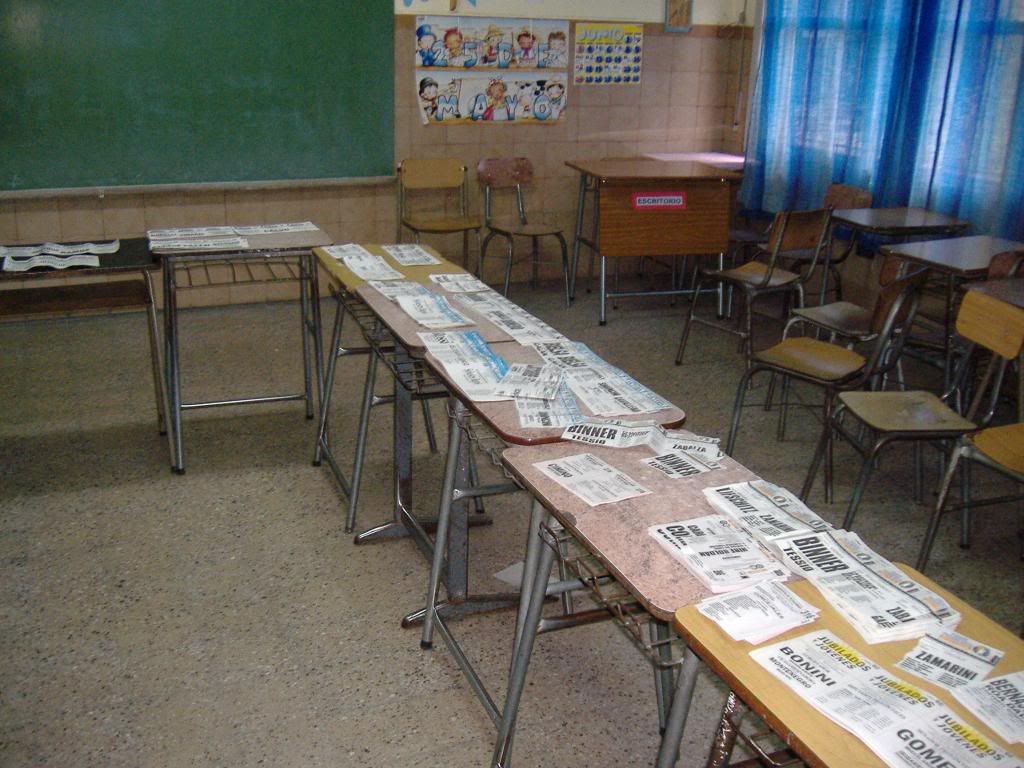
Yesterday's election brought some unexpected things. A lot of people went to vote, more than 70%. You'd think a compulsory election (under the threat of jail for those who don't attend) should not be skipped by 30% of the voters, but given the complete lack of enforcement of the electoral law and the fact that many people didn't actually know who or what they were voting for (the system is new, a bit confusing, and a lot of people are indifferent to politics when not simply dumb), it was a success — the rate of attendance was about the same as in most main elections in the recent past. On the other hand, blank and voided votes were a lot as well, about 17%. The profusion of ballots of different lengths and the possibility of cutting them to combine candidates from different parties and factions probably contributed to the confusion.
The real surprise, however, was Binner's loss. The Socialist governor candidate believed (as we all did, based on surveys) he was going to get more votes than the two Peronists combined, which would make victory in September almost a certainty; but he gathered about 30,000 votes less than the total of Rafael Bielsa and Agustín Rossi. Worse, he went public before the official figures were out saying he'd won over both, and even the papers got it wrong. Rossi was crushed — Bielsa got double the votes. So it's going to be Binner vs. Bielsa, and the result will depend on whether people who voted for Rossi did so out of Peronist loyalty or focused on the personal qualities of the candidate. If the former is true, Binner could very well lose the main election by a few thousand votes.
Then there are also the smaller parties and the people who chose them. This is not a ballotage as in Buenos Aires, but it's likely that, now the real numbers are in place, the September elections will be much more polarized and people will resort to what's called voto útil, the useful vote — a vote for someone whom you may not like but who has at least some chance to win. There's a Peronist candidate running outside the Front for Victory, and there's a Radical candidate running outside the Progressive Front; the former got 28,000 votes, the latter got 41,000. Not much in a province with 2.3 million voters, but enough to tip a close-tied election.
In Rosario, the Socialist component of the Progressive Front practically mopped the floor with its competitors, both internal and external, but that was pretty much expected. The Peronists should take note that their best candidate for mayor, Héctor Cavallero, is a former Socialist mayor (who sold out to Carlos Menem), and he got more votes for mayor than the votes Bielsa got for governor in Rosario — i.e. a significant number of people wanted to vote Cavallero, who was a good mayor in his time, and a good mayor in the line of Binner and Lifschitz, but didn't want to vote for Bielsa, and took the time to manually cut the ballot.
In case you're getting lost, remember this was all for almost nothing except for the Justicialist Party to decide which candidate will run. The real election for mayor and governor is in September, and the final numbers may differ greatly.
Yours truly won't tell you who he voted for, though it shouldn't be difficult to guess if you check my many earlier posts about politics. I'm hoping for the end of the 24 years of Peronist mediocrity in power. Worse, Bielsa is basically a Rosario-born porteño sent to Santa Fe by the President to win an election, and he takes pride in saying he's nothing but a representative of the President's national project. I believe a province with 3 million inhabitants who generate a large part of the total wealth of the country deserves a strong local government and independent ideas.
Some of the people who didn't vote yesterday will go to vote in September. And I'm now hearing people on the radio some people who say they voted for Rossi but won't vote for Bielsa, for the same reasons as me, but for Binner. There's hope.
19 March 2007
Elections afoot
 Provincial elections are already on the run. Since every province is an autonomous state regarding authorities, each has its own rules and schedule. Most often the provincial elections are held on the same day as the national ones (presidential and legislative), but this depends mainly on two factors: whether the province was intervened or had its government otherwise removed prior to the end of the usual term, and whether its government chooses to manipulate the schedule (within a limited timeframe dictated by its own electoral laws). When people vote for a party's candidate (say, for president), a significant part tend to vote also for the other candidates (e.g. for governor and legislators).
This "dragging effect" can be advantageous or disadvantageous for the people in charge to call for elections. A governor is typically obligated to name a day for the election of his successor based on the day of the end of his term — e.g. between 90 and 120 days before. That leaves him some room to play.
President Kirchner is nowadays extremely popular, so he's viewed as a touchstone for electoral success by many a politician. The Radical Civic Union, the long-time rival of the Justicialist/Peronist Party, has de facto broken into many local factions; the rest of the opposition is also mostly localized (for example, the Socialist Party is strong in Rosario, less so in Santa Fe as a whole, and definitely not anywhere else; Mauricio Macri's right-wing PRO is strong in Buenos Aires City and to a much lesser extent in the metropolitan area; fronts made up of provincial parties dominate in several jurisdictions but have no national projection at all). Local political groups with even the slightest ideological affinity with the Kirchner administration seek approval and support from the president, and the president happily gives it if it looks like it might be a net gain.
With most of the provinces burdened by poverty, lack of infrastructure and growing budget deficits, the national government has the tools to co-opt provincial governments. This leaves provinces in the hands of fleeting minions (fleeting, because they're always ready to change masters) and makes Argentina's federalism a joke. Unfortunately, it's in the politicians' best interest to keep the people poor and continue plundering their budgets, as long as the national government comes to the rescue with political and economic support before the elections.
The electoral calendar has already begun. In Catamarca a Peronist governor won the election against another Peronist — the word "Peronist" is really not used anymore, being replaced by "Kirchnerist" or "non-Kirchnerist". Granted the loser is a veritable mob leader... Luis Beder Herrera, the new governor of La Rioja after ousting his own fellow Peronist companion (who was formerly a fanatic supporter of the right-wing neoliberal Carlos Menem, then swiftly turned into a fanatic supporter of left-wing populist Néstor Kirchner) is calling for elections 180 days from now, or so he says. Of course he will run for governor; that was his goal all the time. How low can you go? Yesterday two Kirchnerist candidates came in first and second in the governor's race in Entre Ríos; the winner is a minister of the current administration. Governor Jorge Busti, in a rather vulgar (and uncalled-for) confrontational style, saluted the victory of his faction as a victory of his own and of President Kirchner, by calling his opponents "losers", and by telling politicians of other parties to go home to their own territories.
In Santa Fe we'll have primaries in July, provincial and municipal elections in September, and the national presidential election in October. Santa Fe, unlike most of the provinces, is awash with money, and the likely winner, Hermes Binner, is a Socialist who carefully doesn't... officially... dislike... a priori... with Kirchner... all the time... in general. Kirchner looks the other way and has left the campaign in the hands of the local Peronism, whose leaders are understandably worried, if not a little pissed off by the lack of presidential support. So unlike the situation in other provinces, the outcome (besides the sheer numbers) is a mystery.
10 February 2007
The Socialist, the independent and the two little Radicals
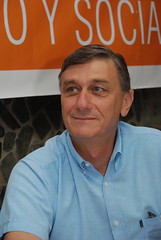
Topping it off, he got Griselda Tessio, a respectable federal prosecutor (she's just resigned) and a daughter of the last Radical Party governor of Santa Fe, to be his running mate, and he launched the campaign, with her on one side and Fascendini on the other, in a meeting in Esperanza, the prosperous city in central Santa Fe where both Fascendini and Tessio were born.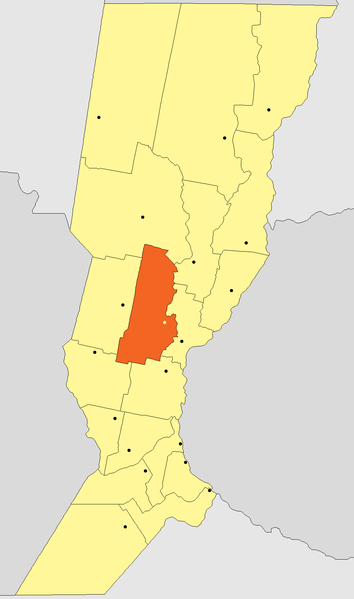
A faction of the Radicals, led by a couple of political parasites who've never been elected to anything or had any political power outside the party bureaucracy, are against Binner and Tessio. They need Binner but they wanted their own candidate — first they appointed Fascendini, now they want another one elected in primaries. They may take the issue to court so that Binner and Tessio are forbidden to use the name "Progressive Front" in their ballots. Strictly speaking, Binner did violate an agreement with the Radicals; it turned out OK, the campaign is going ahead and all, but the formal Radical Party structures did not accept the fait accompli.
Santa Fe's Radicals have a tendency to split over small matters, basically following individual leaderships. Will these guys, with legal but not consensual authority, end up proclaiming a governor candidate of their own? The poor guy would be doomed to wither in solitude and lose, but he would divert some votes from the Socialist-Radical alliance. The Peronist candidates are more than a few votes behind, but not impossibly far behind.
The Peronist provincial government has started throwing money around — millions and millions to repair schools, to upgrade hospitals and healthcare centers, to pave roads, to beautify small towns — things that should've been done during the three years since this administration took office, in a consistent, regular way, not as a extraordinary pre-electoral show. It's disgusting, this spectacle of a governor and officials appearing in a virtual partisan rally to deliver a large check to a hospital so it can buy a few shiny expensive items while HIV+ patients can't get their drug cocktails in that very same hospital because the provincial bureaucrat in charge is on vacation, and while the healthcare centers that send patients to the hospital don't have computers, full-time nurses, or a regular supply of toilet paper.
I can't say for sure this is going to change if the politicians change; I can't believe it might be worse than this.
02 February 2007
The 2007 campaign
The campaign for the governor election in Santa Fe is getting hotter... or should I say the pre-campaign, since there are formally no candidates yet, no parties or alliances already in the register that must be compiled months before the election.
Before you go away, I may as well explain why this is important. As anybody who's been living under a democracy for a while knows, elections almost never change anything — 99% of the times it's the same people or their clones trying to get you to vote for them with all sorts of empty promises, oblique threats, lies, lies, more lies, mud-slinging, sentimental pleas, appeals to your pocket or your ethics, etc., and once they're elected they resume their daily routine, some jobs and titles exchanged for others. Well, this might be one of the 1%.
The reasons:
- This is the first governor election since 1991 without the Ley de Lemas. I'll spare you the details here. The Lemas electoral system allowed Peronism to steal the election twice.
- The established Socialist candidate, Hermes Binner (twice mayor of Rosario), is leading the surveys. If he wins, he'll be the first Socialist governor in the history of Argentina.
- The established Peronist candidates are both linked to Rosario as well; one was born here (though he was exiled in Europe and then moved to Buenos Aires) and the other has lived and made its political career in Rosario since his youth.
- Given the two points above, the next governor of Santa Fe is practically sure to be a man of Rosario, ending (we hope) a long string of rulers that have consistently economically and politically discriminated against the largest and most important city in the province. This might lead to a better share of funds for Rosario, and to the attainment of a long sought after dream: municipal autonomy, à la Buenos Aires City.
 In 1995 came Jorge Obeid, who stole the election from the Radical Party candidate Raúl Usandizaga by adding up the votes of the sold-out ex-Socialist Héctor Cavallero to his own using the Ley de Lemas. In 1999 Reutemann was re-elected. He oversaw a horrible crisis with a straight face, survived a couple of scandals, and in 2003 again he left the post to Obeid, who has since devoted his time to visiting Cuba, inaugurating unfinished public works, and appearing in pictures with President Kirchner.
All this time the province has been stumbling through history, guided by an automatic pilot. Its much-touted record fiscal surplus is more a product of automatic taxation on its immense wealth than a sign of good administration, and its progress in later years can be directly attributable to the overall recovery of Argentina, even moreso as it's powered by the export of agricultural commodities. The public sector is bloated and inefficient, the judicial branch is full of dark, corrupt judges protected by the political establishment, the ministries and secretaries are occupied by political operators without skills, policies and their application are irregular, episodical, never fixed, and oriented to the spectacular and to the populist.
Is that different from any other provincial administration in Argentina, or from other local and national governments in the Third World? Probably not. Can it be easily improved? Undoubtedly yes. Will it improve if the party in power changes? Probably, judging by the results that the Socialist administrations have produced in Rosario since 1989, and especially since the degradation brought about by almost a quarter of a century of Peronist rule is due mostly to stagnation and to the naturalization of bad habits.
The two main Peronist candidates are now at each other's throats, as usual; it's not that they have ideological disagreements or fight over policies (what?), but they want power and they can't both have it. Binner watches from afar and has but completely forced the hardliners of the Radical Civic Union, his allies, to choose the vice-governor candidate that he likes, the extra-party Santa Fe federal prosecutor Griselda Tessio. Isn't that nice?