(I'll stop the politics after this. Promise.)
The election was Sunday, today's only Wednesday, and everything already seems to be upside down. Some people who were overconfident to the point of hubris are desolate. The parachuted former candidate Rafael Bielsa is going to resign from his deputy chair because "it wouldn't be ethical to represent the city of BA after I was candidate for governor of SF" (what, you mean now?). Governor elect Hermes Binner met with governor Obeid in the government house and the employees left their posts to go and greet him. The factions of Peronism in Santa Fe are at each other's throats, as they see their power structure crumbling like a house of cards. The President hasn't uttered the words "Santa Fe" (or "Córdoba") since Sunday.
And Binner is already laying out his plans, which include giving more money and more power to the municipalities, avoiding the discretional management of funds by the central provincial state, fighting tax evasion without raising taxes, ensuring that school classes start on schedule next year, and cancelling the construction of a new provincial hospital only 10 blocks away from a municipal hospital (a project that vice-governor, councilmember elect and well-connected architect María Eugenia Bielsa made up and is now defending with such foamy rage that it seems rather obvious she was going to make dirty money for herself out of it).
The situation in Córdoba after the election is a mess. Only 17,000 votes (out of more than 1.5 million valid votes) separate the two main candidates. The vote count was abnormally slow, the handling of the information was horrible, and the fraud is obvious; the only issue is whether it was a general effort, planned from the top down, or just minor tricks on the local scale (the latter are a certainty).
And, thanks to the Ley de Lemas, the elections in Misiones next Sunday will most likely be even messier: besides the board-kicking effect caused by the rejection of the constitutional reform allowing the governor's re-election, the Ley de Lemas, which allows parties to combine the votes of any number of minuscule factions and candidates, means 18,000 candidates will be running for something — one every 36 voters.
Anyway, we're done over here for now. There have been many interviews and articles about Binner's achievement, and in most of them one can realize that the media have caught the general vibe of the people and, besides the natural journalistic interest for "the first Socialist governor in history", there's a serene awareness that change for the better is coming. Nobody expects a lot, but then everybody expects something — even those who voted for Bielsa, who (for the most part, if you ask me) aren't so sure that they should be sad about the loss.

05 September 2007
Santa Fe, Córdoba, Misiones

 Stumble it!
03 September 2007
Election Sunday

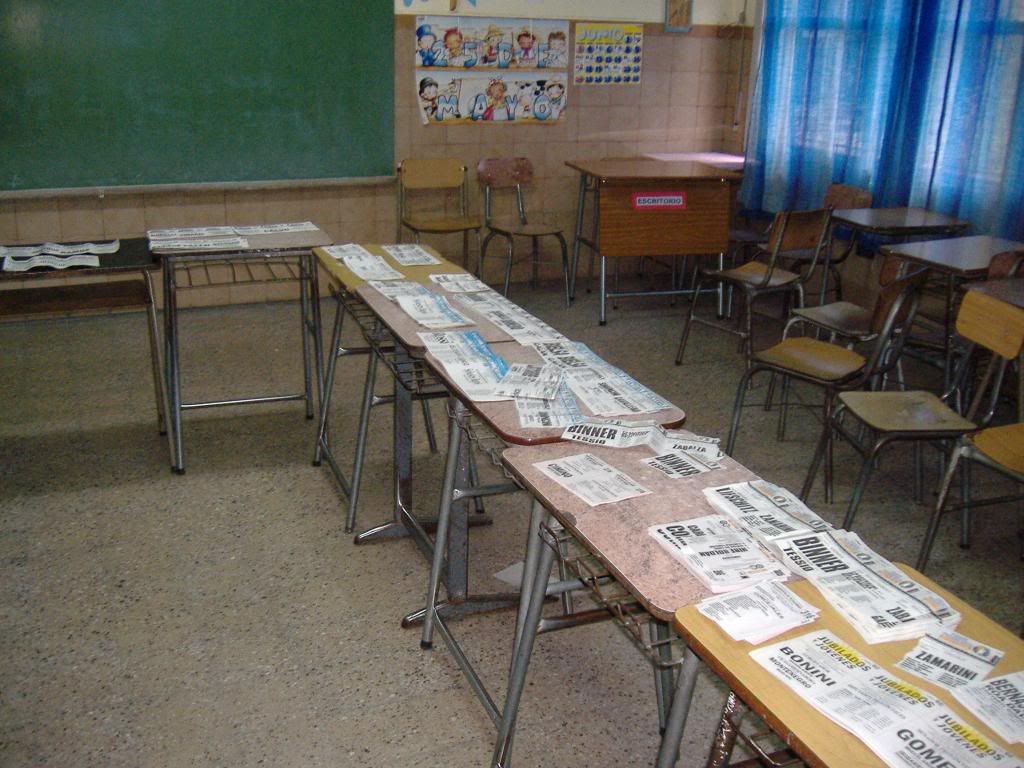
Well, the short version is: Hermes Binner won the election against the Rosario-born, porteño deputy Rafael Bielsa with a 10% overall difference. In Rosario, mayor Miguel Lifschitz was reelected, beating the repeatedly sold-out former Socialist mayor Héctor Cavallero by such a wide margin Cavallero didn't even bother to appear in public to protest.
The Front for Victory (Kirchner's version of the Justicialist Party) lost the governor election in great part thanks to Rosario's votes. It also took several surprising hits, losing its grip on several important cities that had been ruled by Peronists for years or decades, such as Santo Tomé (near the capital, pop. 60,000), San Lorenzo (30 km north of Rosario, pop. 45,000) and Villa Gobernador Gálvez (right south of Rosario, pop. 75,000). The biggest and quite possibly painful surprise was the provincial capital itself, where the Socialist Mario Barletta beat both the Front for Victory candidate Martín Balbarrey (seeking reelection) and the "dissident Peronist" Oscar Martínez. Starting in December, five of the seven largest cities in Santa Fe and more than half of the population will be ruled by Socialists.
Those were the objective numbers. Now the impressions... What I got from most people was simply relief, the comforting realization that a dynasty of mediocre opportunists was ending, the sudden awareness of this turn of events. Binner is the first Socialist governor in the history of Argentina, but it's obvious to everyone that he was voted by many people who wouldn't call themselves Socialist. Others don't like him very much, and many outside Rosario surely don't really know him at all, but voted against something: the crude inability of the Peronists to do anything but clinging to power (even as they fight among themselves for it), the aggressive language and derisive manners of a candidate that tried to pass for one of us when he hadn't set foot in the province for two decades, the plain realization that anything but a radical change would mean four more years of flat, uneventful decadence or, at most, vegetative growth. Four more years, after 24 years of corruption, of judges on the payroll of the party, of a police force stained with a string of unpunished crimes, of friends turned government officials who have no idea to do what they're supposed to do, of fundamental laws delayed and then passed and ignored, of callous indifference to the suffering of millions, of the State turned into a section of the Party. That was too much.
Another impression I got was that Rosario was the lever that moved the election. With almost one-third of the population of the province, the landslide victory in Rosario was important for the overall result, but I'm speaking of comparisons and imitations. People are not stupid. Rosario serves as proof that, while unable to work magic, a good administration can improve the citizens' quality of life a lot, even without help from the provincial state, and beyond the mere recovery of employment and consumption that follows automatically from a high economic cycle. Thus it shouldn't be surprising that the two largest cities in the Greater Rosario area changed hands last Sunday. San Lorenzo, an industrial port city, has an enormous untapped potential and a government that wasn't up to the challenge. Villa Gobernador Gálvez, next to Rosario, could not but watch with envy as the neighbouring metropolis flourished while a mafia government led directly or by proxy by a violent, uneducated thug continued to win elections.
And then that was it. The numbers continued arriving, and as more data from the bigger cities were input in the system, the difference between Binner and Bielsa widened. It didn't matter anymore.
We now have three months to wait. Binner is meeting with Obeid today to talk about the transition. Obeid, I think, will listen, and won't do anything stupid. He's an old politician, and he's on his way out.
What can we expect? Well, first of all, autonomy for Rosario!
Media coverage in Spanish: La Capital, Página/12, Rosario/12, Rosario3, La Nación, Clarín; in English: CNN, Buenos Aires Herald
31 August 2007
The end is near
My Japanese calligraphy teacher's view of the candidates for the governor election: "There's the guy with all that beard... and the other guy who looks like Hitler." I had to laugh. It's very difficult to discuss politics in a language you're just starting to understand beyond the basics, and explaining Argentine and local politics to a foreigner from a vastly different culture is absolutely impossible. We left it at that. (Watanabe-sensei also inquired about Cristina Kirchner. I just said no.)
OK, that was just comic relief. We're right on top of the election, and that's a good thing, because I was getting tired of the incessant TV and radio ads, the childish taunts among grown men, the unsubtle campaign moves. If I hear the President is coming again to unveil yet another one of those hypothetical or half-finished public works that abound these days, I will lose it.
In case you didn't notice, I'm starting a news blog. I'm going to take news from local media and classify them with graphical labels according to their type... morbid, boring, useless filling, paid-for ads disguised as news, etc. It's en español and it's called Etiquetame todo ("Label Me All Over"). If you read Spanish, check out it.

02 July 2007
Out of dark rooms
Yesterday's election brought some unexpected things. A lot of people went to vote, more than 70%. You'd think a compulsory election (under the threat of jail for those who don't attend) should not be skipped by 30% of the voters, but given the complete lack of enforcement of the electoral law and the fact that many people didn't actually know who or what they were voting for (the system is new, a bit confusing, and a lot of people are indifferent to politics when not simply dumb), it was a success — the rate of attendance was about the same as in most main elections in the recent past. On the other hand, blank and voided votes were a lot as well, about 17%. The profusion of ballots of different lengths and the possibility of cutting them to combine candidates from different parties and factions probably contributed to the confusion.
The real surprise, however, was Binner's loss. The Socialist governor candidate believed (as we all did, based on surveys) he was going to get more votes than the two Peronists combined, which would make victory in September almost a certainty; but he gathered about 30,000 votes less than the total of Rafael Bielsa and Agustín Rossi. Worse, he went public before the official figures were out saying he'd won over both, and even the papers got it wrong. Rossi was crushed — Bielsa got double the votes. So it's going to be Binner vs. Bielsa, and the result will depend on whether people who voted for Rossi did so out of Peronist loyalty or focused on the personal qualities of the candidate. If the former is true, Binner could very well lose the main election by a few thousand votes.
Then there are also the smaller parties and the people who chose them. This is not a ballotage as in Buenos Aires, but it's likely that, now the real numbers are in place, the September elections will be much more polarized and people will resort to what's called voto útil, the useful vote — a vote for someone whom you may not like but who has at least some chance to win. There's a Peronist candidate running outside the Front for Victory, and there's a Radical candidate running outside the Progressive Front; the former got 28,000 votes, the latter got 41,000. Not much in a province with 2.3 million voters, but enough to tip a close-tied election.
In Rosario, the Socialist component of the Progressive Front practically mopped the floor with its competitors, both internal and external, but that was pretty much expected. The Peronists should take note that their best candidate for mayor, Héctor Cavallero, is a former Socialist mayor (who sold out to Carlos Menem), and he got more votes for mayor than the votes Bielsa got for governor in Rosario — i.e. a significant number of people wanted to vote Cavallero, who was a good mayor in his time, and a good mayor in the line of Binner and Lifschitz, but didn't want to vote for Bielsa, and took the time to manually cut the ballot.
In case you're getting lost, remember this was all for almost nothing except for the Justicialist Party to decide which candidate will run. The real election for mayor and governor is in September, and the final numbers may differ greatly.
Yours truly won't tell you who he voted for, though it shouldn't be difficult to guess if you check my many earlier posts about politics. I'm hoping for the end of the 24 years of Peronist mediocrity in power. Worse, Bielsa is basically a Rosario-born porteño sent to Santa Fe by the President to win an election, and he takes pride in saying he's nothing but a representative of the President's national project. I believe a province with 3 million inhabitants who generate a large part of the total wealth of the country deserves a strong local government and independent ideas.
Some of the people who didn't vote yesterday will go to vote in September. And I'm now hearing people on the radio some people who say they voted for Rossi but won't vote for Bielsa, for the same reasons as me, but for Binner. There's hope.