The weather has become unstable as of late, maybe a sign that the tranquil workings of summer's furnace are finally being disturbed by the proximity of the equinox (still more than three weeks away). In simpler terms, it's hot, but it's not sunny and hot all the time — sometimes it's just clammy.
It's softly raining as I write this. Right now I should've been at the Flag Memorial, preparing to watch the reenactment of the first hoisting of the Argentine flag, which took place on the banks of the Paraná River exactly 196 years ago. But it rained cats and dogs right after noon, and then it started again a couple of hours ago, so they called it off, together with other outdoors activities planned for tonight. Of course, the rain did not bring any relief to the heat — it's the same steam-bath as yesterday. With a little more steam.
Like most people I know, I'm a bit sick of this summer. I'm overwhelmed by the heat, the low pressure, the humidity. I don't have the strength to go out and walk and take pictures, or to try resuming outdoors exercise. I spend way too much time sitting before the computer, but I can't think. So I don't have much to tell, and I don't feel like sitting down to write it down, plus I'm having real heavy work at the office. All of this is why I'm blogging intermitently, instead of every day.
The office — that's a real mess. For obvious reasons I can't reveal too much about that here, but let's say conflict is bubbling just below the surface of the provincial administration — the bitter underground conflict between those who want to get to work and finally see there's someone paying attention to their work, and those who have never worked or wanted anything but to suck the state's tit and devote office days to gossip over coffee, and now feel threatened but can't express it openly for fear of being discovered, even though everybody knows what they are. Yes, folks, such are the deep human dramas you find in our public offices.
I intend to wait for more cheerful topics, or at least interesting ones, before I write one more blog post. Let us hope together...

27 February 2008
Rain all over

 Stumble it!
14 August 2007
Campaign daze
There are so many ways to go about a political campaign! If you're the government, that's made easy by the fact that you can unveil public works and you can do it at the exact moment you want. If they actually serve a useful purpose, better yet.
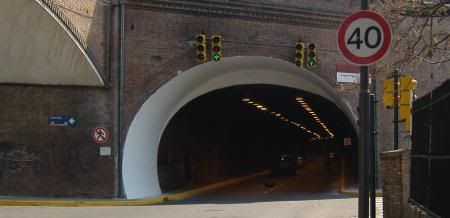
This the Arturo Illia Tunnel on Monday, August 13:
This is the same tunnel on Tuesday, August 14 (the time of the day is about the same, but the lighting and the exposure are different):
The municipality changed the lighting system of the tunnel: they took out the fluorescent lights on both sides, and installed a double row of zenital cut-off sodium lamps, "for power efficiency and safety". So far, so good. Only the mayor Miguel Lifschitz, went there to inaugurate the lights. It was a lot of work, I get it, but I don't get a will-never-be-the-same feeling from the change. Lifschitz is campaigning for his reelection, though — which explains why he not only mounted a show to unveil the lights at a scheduled event on Tuesday although they were basically ready on Monday, but also why he's also unveiling a level crossing on a very minor street in a forgotten spot of the city tomorrow, and advertising it with pamphlets carrying the internationally recognizable symbol of the rose in the fist.
In his defense, I may say these things are actually useful, and they're working already. Other government authorities have a tendency to unveil things that are not complete, or worse, to gather thousands of people just to announce future works, which may or may not be impossible to do. Think the Rosario-Buenos Aires "bullet train", which I still refuse to dismiss as pure fantasy, but also remember how Carlos Menem infamously promised we'd have an airport for "stratospheric planes", and how he "unveiled" the Rosario–Victoria Bridge four years before it was completed.

21 February 2007
Gimme, gimme!
This is what happens when the economy goes well in a country with people accustomed to ask for more all the time without regard for common sense.
It's not that Argentina is swimming in fresh money. There's just more currency in the streets. The money-making machines are rolling at full speed, as the Central Bank desperately attempts to buy more and more dollars to keep the exchange rate high and encourage exports. Argentinians don't like to save, and they love spending. The national state is collecting a lot in taxes and this is an electoral year — remember, also, that this is a truly, old-fashioned populist Peronist government, so it's throwing money around in projects, subsidies and plain advertising throughout the country.
As a result, we the people have money in our pockets, usually, and we don't restrain ourselves as much as we did in former times, when we had to think twice before choosing the comfort and speed of a taxi over the crowded inside of a public bus. Back then we preferred receiving guests at home, with food and drink bought at the supermarket; now we don't feel guilty going out to dinner in a fancy restaurant every now and then. And so on. We're now spending money, big time, and those who want our money have noticed it.
First it was the taxi drivers, then the bus drivers. Our urban bus fee was AR$0.75 cents, now it's AR$1.20, all because the bus drivers wanted to earn a minimum of AR$2,300 a month. Most semi-qualified full-time workers in Rosario get around AR$1,000, maybe a bit more, and there are many, many people working eight or nine solid hours per day, Monday thru Saturday, for less than that. In general, a person earning more than AR$2,000 per month in Rosario, unless they're a established professional (a doctor, a lawyer, an architect), is doing very well. The bus drivers in Rosario drive badly, and their manners are terrible; the service is erratic, unsafe, and almost inexistent at night; and it hasn't improved. But wait! Just after the last fee raise, which was entirely their fault, the drivers are now asking for a salary raise again. I guess soon medicine and law students will start leaving the universities to become bus drivers; they'll earn more without having to gain experience or look for clients.
But wait (again)! Since the bus is getting a bit expensive, people are choosing to get taxis (three people pay AR$3.60 for a bus trip; for AR$6 they can get a 15-minute taxi trip, give or take). Taxi drivers are enraged by the fact that they're having so much work, and complain that their service should be expensive not only in absolute terms (which it is) but also in comparison to the bus, so they want the taxi fees to raise, too. The fee is made up of two parts: the basic starting fee, called bajada de bandera (i.e. what they charge you just for stopping and turning off their "FREE" red light sign), and the ficha, or time/distance-based fee (i.e. what they charge for every block, plus the waiting times before traffic lights, etc.). The bajada de bandera is now AR$1.80, while the ficha is AR$0.90. The taxi owners want those figures to raise to AR$2.60 and AR$1.30 respectively. That would make the taxi what they want, a more exclusive service, in the literal sense: a service whose cost excludes most of the public from using it.
Not to be left behind, the public employee union of Santa Fe is also asking for a raise. The provincial government has been making a big deal of the fact that we (they) have a fiscal surplus, so why don't they pay us more? The leader of UPCN, the main union, is also a deputy (member of the Lower House). Incompatibility, anyone? He's also a well-known embezzler (nobody has been able to prove anything, but that's not difficult when the judges are all friends of the party). UPCN wants a minimum wage of AR$1,800. For most employees that would mean a 90% salary raise. Naturally, the provincial government is not happy about this ridiculously high request, but can't refuse it outright because it's an electoral year and UPCN is always quick to resort to strikes in sensitive places, such as public hospitals.
The teachers employed by the provincial state are asking for a raise too. They want a minimum of AR$2,200. Bear in mind these are people who work 5 hours a day, 9 months a year. For sure they've studied to get there and they work in a hostile environment (public schools, overcrowded with mostly poor children, often in bad neighbourhoods). But I can have no sympathy for them. They've always used schoolchildren as symbolic human shields in their fight for a higher pay. They always, always go on strike, causing the children to lose class days they'll never recover, and they never try to negotiate and set things straight with the government during the summer vacations. Since I was a child myself, teachers have never, ever, gone to class every day in the year. As March approaches, teachers threaten they won't start classes, thus delaying the educational schedule from the very beginning.
Most labour unions are asking for raises as well. They argue that both private companies and the state are doing financially well and that inflation was 10% last year (most believe it was actually much more). What can we say to that?
Orthodox economics says that higher salaries for everyone will increase costs and will fuel consumer spending, and in turn this will trigger more inflation. Orthodox economists, though, are notorious for favouring companies over consumers. Looking at companies' production costs, it's apparent that the private sector is in fact taking advantage of the public sensation of economic exhuberance to raise prices and reap more profits, since the workers' pay is only a small percentage of the total cost of the product in most cases. This may vary a lot, of course; harvesting corn is not the same as manufacturing cars and definitely not the same as selling vacations in a spa. The service sector in particular is collecting truckloads of money; long-distance bus fares have increased out of all reason, restaurants charge ridiculous prices for drinks (8 pesos for a beer you can get for 2 pesos in the supermarket!), and the cheesiest gyms in town fake a Pilates class and charge old ladies 80 pesos for it.
The argument that salaries cause inflation is the favourite of private companies. If modern economy were based in real life, it would be easy to dismiss it, but since the whole world economy is based in arbitrary factors (such as Ben Bernanke's mood when he wakes up, or the amount of people blown up in Iraq during a given week), it's often enough that the market or the public "feel" something to make it real. Well done!