The legislative elections are over, and if you're following the news, you'll be surely aware of the big picture: Néstor Kirchner has lost, the government's power in Congress has been cut down, and several presidenciables (that is, likely presidential candidates) are already lining up (or have been lined up by the media) for the 2011 election.
So I'll just concentrate on the small things and the analysis. First, let's get Kirchner out of the way... Néstor Kirchner lost to Francisco de Narváez by a handful of votes, a lot of votes actually, but only about two-and-a-half percent of the Buenos Aires Province vote. Of course, what happened is that the list of candidates headed by NK got a few votes less than that led by FDN; in formal terms it was a tie, but Kirchner's insistence on the paramount importance of this election worked like a self-fulfilled prophecy: almost everyone assumed positions as if it were the one and final battle of a war, and the election turned into an opportunity to bash the government. And bashed it was: Kirchner, who had achieved record levels of popularity during his term, lost to a group of the strangest bedfellows politics has inflicted on us as of late, led by a right-wing Colombian-born multimillionaire with an image constructed hastily by the media in a matter of months. Many of the so-called "barons" of Greater Buenos Aires, who rule the poorest and most densely populated parts of Argentina as virtual feudal lords and are keen observers of reality, betrayed their alliance with Kirchner, unnanounced.
In any case, after what must have been a very long night and a terrible day, Kirchner dutifully resigned from the presidency of the Justicialist Party. He released a short video accepting the defeat and I swear he looked mildly drugged.
Yesterday in the afternoon, Cristina Fernández de Kirchner gave a press conference. First she started out by reciting highly optimistic figures for the composition of the new Congress, and feigned not to have the exact numbers of her husband's defeat on hand (while, as everyone knows, she probably had the figures down to the least significant digit painfully etched in her short-term memory). Then she tried to turn the whole thing on its head, pointing out how an awful lot of people had still voted for the government's party. When a journalist pointed out that she'd gotten 45% of the vote when she was elected and now her husband got only 31%, she was upset and accused the media of having a double standard because they hadn't gone and asked that to Mauricio Macri and his candidate Gabriela Michetti (in the City of Buenos Aires, Michetti got 30% of the vote, only half of what Macri and her had gotten two years ago). She also resented the petitio principii of a journalist who asked about the manipulation of INDEC's figures of inflation — which did beg the question, of course, because the government has never admitted to that manipulation, although everyone, including some of the president's favorite economists, is certain of it.
At that point, approximately, I stopped watching the press conference. It was pointless. Either Cristina has learned nothing or she needs a few days to let it sink in, but based on previous experience, the latter is unlikely. We're left with the hope that she won't attempt something funny before December, when the new Congressmen will take their seats.

30 June 2009
After the elections

 Stumble it!
25 June 2009
Before the elections
It's only a few days to the legislative election, so this is a brief "state of the campaign" post. I'll refrain from emphasizing the appallingly low level of today's politics, if only because the post would turn into in a long, bitter rant if I tried to convey that.
First, my home district, Santa Fe. Here the senatorial race is the major one, because we have two great contenders: former two-time governor Carlos Reutemann, and Rubén Giustiniani, backed by current governor and former two-time mayor of Rosario Hermes Binner. Both candidates are already senators and both are sure to be reelected; the real issue is, first, who will win (even by one vote), and in a distant second place, which party will get the third senator.
Reutemann is a well-known, wealthy, conservative Peronist who for some reason (certainly not his charisma or his performance when in office) has consistently captured over a third of the vote in every election. Giustiniani is your typically neat low-profile militant of the very moderate (almost European-like) Socialist Party who ran (big mistake!) as candidate for the vice-presidency next to Elisa Carrió in 2007. Reutemann is playing the anti-Kirchnerist card, an attribute he earned by positioning himself against the ruling couple on the issue of Resolution 125, even though he barely did anything but raise his hand on command on all other issues. Since half the population of the province barely knows Giustiniani, until a few months ago Reutemann took his triumph for granted, but since governor Binner stepped into the campaign, Giustiniani has come close to his opponent, to the point that the predicted result is very close to a tie.
The leading candidates for the Chamber of Deputies are almost completely unknown; they're only getting votes because they'll be on the same paper ballot as their respective senators. Ironically, the only candidate everyone knows is the one heading for the distant third place: Agustín Rossi, by now politically disgraced in his own home turf due to his complete, unwavering submission to Néstor Kirchner.
In the Province of Buenos Aires, well... you have a contest of unscrupulous millionaires, a huge, impoverished clientele, well-oiled political machines with their filthy cogs obscenely in view and no-one doing anything about it, the government doing campaign for its party with state funds, the opposition wipping up the visceral hate for the Kirchners of the mostly right-wing citizenry, and no government proposals whatsoever except for "it's us or chaos". It's sleazy. So you'll forgive me if I refuse to take one more step into that crap.
Several problems with this election and with the system in general: first, the ballots printed by each party with their own candidates (instead of a universal ballot where you have to select what you want), which leaves ample space for fraud and many borderline illegal practices; second, the use of (linear) proportional representation in a country like Argentina, with a ridiculously skewered population distribution, which makes it possible for a party to win an election just by concentrating their efforts on a few hundred square kilometers crammed full with very poor, very influentiable people; third, the lack of political awareness of most of the citizens, understandably tired of anything to do with politics, which makes it easy for opportunists to flourish and for the unscrupulous to "disappear in the crowd".
I feel fortunate that I inhabit a district where, at least, the choices are clear-cut and the fight has not turned dirty beyond words. I won't vote for Reutemann, the love child of Carlos Menem and completely deprived of ideas besides his own plans to maintain influence; I won't vote for Rossi, a mouthpiece of the Executive Branch who would bring its own province to its knees to further the Kirchnerist agenda of centralized control; I'll vote for Giustiniani, who has some ideas I like and belongs to a structured political project that's going in the (general) right direction.
08 August 2008
Rosario sues over the smoke

Not only is the environmental damage considerable, but the smoke raising from the burning islands decreases the visibility on major road corridors (the Buenos Aires–Rosario Highway and the Rosario–Victoria Bridge), and the falling ashes create health problems.
The islands opposite Rosario are under the jurisdiction of the municipality of Victoria, Entre Ríos. Further south, the delta comes under the jurisdiction of Buenos Aires Province.
After years of putting up with the smoke and seeing how nobody does anything to stop it (except the feverish but insufficient joint operation mounted by the national government through the Environment Secretariat a few months ago when the smoke reached the Center of the Universe, i. e. the City of Buenos Aires), mayor Miguel Lifschitz decided to sue the provinces of Entre Ríos and Buenos Aires, not asking for monetary reparation but to get the authorities to stop the burning, monitor the area, and control its development.
I think this is good idea, seeing how all the friendly talks and meetings have failed.
31 July 2008
Power fees going up in Buenos Aires
The national government is giving the power companies a raise, through an increase in the power fees, that will fall on those who consume more than 650 kWh every two months. The increase will range from 10% to about 30% and, while Minister Julio De Vido says it'll only affect 24% of the population, others claim the middle class will be hit hard. And it seems a further raise is due next February.
The above is the news as reported everywhere in Argentina, and many people are genuinely concerned or outraged for the wrong reasons. Why? Well, despite the big headlines and the alarming newsflashes broadcast by the media, the raise is only for Buenos Aires, its metropolitan area and the city of La Plata only. Granted, that's 40% of the consumer base and Buenos Aires is the center of the universe for the porteño and for the "national" media, but you'd think they should at least qualify their statements.
I didn't say we hinterlanders* shouldn't be concerned or outraged. We have reason to be concerned since the same inflation and the companies' lack of investments that prompted the national government to grant the raise for the Buenos Aires area utility companies is having serious effects on those that supply the provinces; many had adjusted their fees up or were considering raises before this, and now it's only a matter of time before they align themselves with the capital's companies. Our own EPE (the Santa Fe Provincial Power Company) is checking its numbers right now.
* "El interior del país" ("the interior of the country") is what they call everything but Buenos Aires. That's how Argentina was structured to begin with: a colony with a big port to interface with the world, plus a broad expanse of land ripe for primary exploitation. It's customary and it doesn't sound alright. In fact, it reminds me of the ridiculous conception of Bender's robot apartment in Futurama — Bender sleeps standing up in a 1×1-metre room with no furniture, and the place where he lets Fry live is a huge room in itself... which Bender calls "the closet".
The reason for the outrage is, partly, the outrage of the porteños at this raise, because they've been enjoying ridiculously low prices for power, natural gas and public transportation at our expense since... well, ever. Time and time again I've written about the subsidized fuel for buses. As Rosario's city council is about to take the bus ticket to AR$1.60, a bus or subway ticket in Buenos Aires still costs about AR$1.
Well, as it turns out, the average residential power fee in Buenos Aires is vastly lower than the average in the rest of the country. No wonder the system has problems — you can't expect that the power grid won't collapse when you charge the lowest fee in the place with the largest and densest population, the highest per-capita income, and the highest concentration of installed top-notch air conditioners and refrigerators. According to the article in Crítica Digital, in the capital area a home that consumes 1,700 kWh will get a bill for about 88 pesos. Checking EPE's website and doing a quick calculation, we learn that the same amount of power, in Santa Fe, will punish the wasteful ways of the unfortunate consumer with a bill for 194 pesos. (The guy who writes the Crítica article obviously has math issues. He reports that fees in Buenos Aires are "194% cheaper" than in Santa Fe. Things can't be more than 100% less anything, unless you allow for negative values. Back in 2002 journalists noted that the dollar-peso parity had gone from 1 to a rate of almost 4 pesos per dollar, and reported that the peso had therefore "devalued by 400%". I recall only one news source giving the correct figure of 75%.)
Why did the porteños get this lucky all this time? Well, first of all, no-one likes being charged more, and when you have a metropolitan area with 12 million people surrounding the government seat, you don't want to make them angry. Especially when outside the capital proper you have several huge concentric rings of increasingly impoverished areas. If you control the money, you can use it to favour those near you, while the rest of the country gets indebted. Second, if you measure inflation only in the metropolitan area, it's in your best interest (image-wise and in the short term, i.e. the Argentine way) to concentrate your anti-inflation tactics there and leave "the interior" to its own devices. When the system starts to buckle under pressure (because you subsidize the demand but do not force the companies to invest and increase the offer), you deny it for as long as you can. And then you do something. You can imagine how close to the brink we've come if you consider the government is taking this step now, after the president's image has plunged and with a cooling economy on the horizon.
So, porteños and platenses, welcome to the rest of the country. Don't complain; you're still getting lucky.
15 July 2008
Rallies in Buenos Aires
Today the Senate is going to start discussing the export tax bill, which, as you will remember, were approved by the Chamber of Deputies by a difference of only seven votes. Although the Peronist majority in the Senate is even greater than in the lower house, senators are much more committed to their local constituencies. A significant number of Peronist senators are voting no to the government-sponsored bill. Only one or two votes decided at the last minute might make all the difference, and it's entirely possible that there's a tie — in which case the president of the Senate, Vice-president Julio Cobos, will have to break it.
Both Kirchners (the formal president, Cristina, and the de facto one, Néstor) and their high-profile ministers have been wooing the senators, pressuring them, threatening them, to get votes. The end result we'll only see later today, or tomorrow.
The farmers' organizations and the national government are organizing parallel rallies for today in Buenos Aires. The farmers want to (but probably won't) repeat the numeric performance of the May 25 meeting in Rosario, and the government wants to do better than the farmers. Néstor Kirchner has the mob-like truck drivers' union on his side, plus the Peronist Youth and a few other useful idiot clubs, to provide him with a lot of screaming fans, and the farmers have received the support of a true Prince of Sleaze, the leader of the Gastronómicos (the bar and restaurant workers' union).
It's all pretty stupid if you ask me. And divisive, and dangerous. The rallies are basically a bragging competition and won't serve any purpose. Néstor Kirchner is simply unable to stay quiet and hope for the best, and his hateful insolence is contagious. And the farmers must know that this is it, that they're not going to change anybody's mind now, because this has long ago ceased to be about taxes. It's all about ideology and people's conceptions of what government must handle power.
I believe that Kirchnerism is fascism, just as old-time Peronism was — corporatist, demagogical, perversely fusing patriotism with partisan loyalty, corrupt to its very dark core by its own nature. It must be brought down, by legitimate means, because it's wrecking the economy and destroying our dignity.
I don't believe for one second that this is the worst government we might have had at this time. Neither do I believe that the wealthy farmers would choose a better government (better for us) if they had the opportunity.
But the thing I believe the least is that we must somehow choose either populism or oligarchy, and violently reject the possibility of alternatives, the possibility of dialogue and compromise. I'd rather have no rival rallies hurling abuse at each other, no passionate masses in the public squares, no more demonstrations. Not for a while, at least. We'll have to do a lot of cleaning up, as a people, after this.
22 April 2008
Smoked: It's blame time!
The authorities are saying that 60–80% of the fires on the islands of the Paraná river delta are under control, and given the expected wind patterns Buenos Aires is unlikely to be covered by smoke again (though some say Buenos Aires is likely to be covered by smoke again!).
Here in Rosario we've seen no more of it after the ash-filled smelly cloud that appeared last Friday evening and stayed until Saturday afternoon, though there was some smoke blowing in again on Monday evening.

The eastern and southern horizons continue to be covered with an almost uniform smoky blanket, gray during the day and turning a sick shadow of purple before sunset. It goes south, mostly, but as soon as the wind shifts it will surely come back. As I write this, National Route 9 is closed to traffic because of the smoke and an accident involving three trucks, and the Rosario–Victoria Bridge is, once again, closed as well. People keep complaining of eye and throat irritation. The fires near Victoria, across the delta, are still far from contained.
The smoke is not merely smelly, dirty or irritating, since it's not just burning plant matter — there are about 220 thousand head of cattle on the islands, each producing 21 times as much waste as a human being. All that dung is burning and raining on an area shaped like an elongated trapezoid, its shorter base, between Rosario and Victoria, being 60 km wide, and the longer one, located 300 km south-southwest at the mouth of the Río de la Plata, about double or triple that width.
Now the Uruguayans are also mad at us — first we block their international bridges in protest for a paper mill that was supposed to pollute our air and water, and, while said paper mill cleanly and flawlessly works as it should, we sit idly as the whole delta of the Paraná turns into smoke and sends that smoke their way, and then we realize the situation is grave (i.e. the smoke has reached the upper-class neighbourhoods of Buenos Aires) and desperately start trying to put the fire out with more courage than equipment.
The fires, as an official conservative estimate, have devastated 70,000 hectares (700 km² or 173,000 acres) of the delta's islands. The government of Santa Fe wants to turn the Paraná's islands and wetlands into a protected area, like a national park. Governor Hermes Binner has demanded that Sergio Urribarri, governor of Entre Ríos, do something about the whole issue, because that's their jurisdiction, and they're the ones who allowed ranchers to overpopulate the islands and burn them to clear the scrub. Binner ironically repeated what Rosario's mayor had said about the smoke — "We've lived with these problems every year. Fortunately this time the smoke reached Buenos Aires, so it's everybody's concern now."
The fires aren't just a source of smoke, but they've also killed off the whole ecosystem. Of course grass will grow again; that's the purpose of the fires. But the islands are (were) much more than simply grassy plains for cows to graze on. The destruction originally began when the numbers of cattle multiplied by 15 in a matter of years. Those cows' excrement and urine are full of nutrients that the environment cannot absorb properly. When algae get hold of them, they choke the streams where they grow, then die and rot, and this causes a proliferation of bacteria that consume all the oxygen dissolved in the water, killing the fish and the rest of the aquatic fauna (the process is called eutrophication).
A lawyer is accusing Romina Picolotti, Secretary of the Environment, for her handling (or lack thereof) of the problem. Picolotti is an environmentalist who used to counsel the Gualeguaychú Assembly regarding the Uruguayan pulp mills (remember?), and I thought she would be at least alarmed, but she acts like a bureaucrat and seems to have blended extremely well into the state of general indifference to real problems that characterizes the Argentine government. Like somebody said (I overheard on TV) she realized there was a problem when the smoke started coming in through her windows.
Among the impending failure of the negotiations with the agricultural producers, the governments has resorted to finger pointing, accusing farmers of burning fields with no regard for human life only to reap more money from crops. This is strictly true, but then the majority of the farmers who've done nothing wrong were justly enraged. The government was unsubtly trying to shift all the blame on their chosen enemies of the day.
Yesterday, grassroots agro-leader Alfredo De Angeli remarked that, back when the roads were blocked, the people were armed so as to defend themselves in case the truck drivers sent by Hugo Moyano (head of the truckers' union, allied to the government) tried to force them out. Within hours, prosecutor Guillermo Marijuán filed an accusation against De Angeli for "inciting violence". Marijuán being usually independent, one must wonder whether he sold out, or was pressured by the government, or was simply stupid. De Angeli is an aggressive activist, to be sure, but his comment was a description of the tense environment of the road block, not a call to arms.
The last ridiculous development on this sad story is the indictment of a rural worker who was found setting fields on fire. This person couldn't possibly do much on his own, and certainly not without orders from an employer or permission from the owner of the field. In our slang this is called a perejil — a kind of scapegoat, but one specifically chosen due to his complete lack of power to influence the big picture (like a street drug dealer that gets jail time because of an ounce of marijuana, while the one that brings the dope in by tons stays free).
My own impression is that the national administration is lost and, faced by problems on several fronts, behaves like a caged tiger, almost blind with fury. Ten days from now the farmers' "truce" will end, and it's quite possible that the fires, or the problems caused by them, won't have been extinguished by then. In the meantime, Secretary of Commerce Guillermo Moreno wants to seize cattle from their owners to sell on the market and keep the price down. Inflation continues to rise, and the government stays on denial. They're going to indebt the country heavily to build a bullet train that only rich people will be able to afford. Our capacity to produce electricity and natural gas is strained. The power fees are going to rise soon. Paraguay's new president wants to renegotiate the price of the energy from Yacyretá they sell to Argentina.
19 April 2008
Smoked!
Wake up and smell the smoke, if you haven't! I've noticed this blog has many occasional (or one-time) readers. So, for the ones just tuning in, this is about the fires covering the Argentine littoral (and its capital) with smoke. Here's a few pictures, all taken from the coast of Rosario, Santa Fe, Argentina, today around noon. We're 300 km north from Buenos Aires (whose name has never seemed so much of a joke as nowadays, he he...). A seamless cloud of gray smoke covers the eastern horizon. The islands of the Paraná delta are on fire, because the owners of the fields have once again employed the ancient method of clearing scrubland with fire.
The Rosario–Victoria Bridge has been re-opened to traffic after a couple of days of being partially or totally shut down. You can barely see it, though, from this point located only 7 km away. Remember this is noon, and the picture has been enhanced for contrast.

You can't go from the south of Santa Fe to Entre Ríos if you can't use the bridge — you have to take a huge detour up to Santa Fe City and cross the river though the Subfluvial Tunnel.
In Rosario we've been enduring the smoke and the ashes for years, but it was only this time that the fires got completely out control and the smoke reached Buenos Aires, thus instantly turning this issue into a national emergency. The presidential minions quickly blamed the farmers (who seem to be guilty of everything that's wrong in the world today, from child hunger to environmental destruction) and Queen Cristina herself ruined her hair by flying over the affected area on a helicopter.

Not a word was heard from the unanswered complaints of Rosario's municipal government over the years, or the complete lack of suitable responses by the Kirchnerist governors of Entre Ríos (both past and present) regarding the fires being intentionally started by farmers in their jurisdiction. They knew who they were, and although there was a judicial ruling protecting their irresponsible actions, those things can and should be fought in court. Anyone with a minimum of foresight could see this coming.
Firefighters are now trying to contain (not extinguish) the many fires throughout the delta's islands. It's impossible to do anything else. Planes cannot go there with all that smoke. The place is a tangled maze of wetlands and streams. I hear we're getting help from the federal government; up until recently there were only volunteer firefighters from Santa Fe and Entre Ríos, the former heavily outnumbering the latter, although (as I said and will keep on saying) the islands are in the jurisdiction of Entre Ríos and whatever happens there falls entirely under the responsibility of the government of Entre Ríos.
Here you have another picture, this time facing due north, so you can see the visual effect of the smoke. The sky is naturally colourless at this time of the day, but the horizon's gray is not natural. The old piers and the silos on the left are closest; the silos and the buildings around are former port facilities. They're not far away, and you can see they're already veiled by the smoke.

A little more to the right you can see the silhouettes of four towers; they're the illumination towers of Rosario Central's Gigante de Arroyito stadium. On the center-right you have the Sorrento thermal power plant, and then a cargo boat anchored nearby. At that point the coast describes a curve, so what you see right of the boat is much farther away. On a clear day you can see that shore clearly, though, but these days the smoke is noticeable all the time, subtly when you look at buildings a block or two away, and as a thick gray cloud when your line of sight is clear, as in this case.
So far I don't know of people suffering any grave consequences from the smoke. Fortunately most of it is being blown southwest towards Buenos Aires, leaving us with a subtle cloud that runs all along the coastal area of the city, including downtown. It's not pretty, and sometimes it smells, but we can breathe.
In case you didn't like my pictures, here's one from a better perspective, by NASA. The tiny red circles are fires. Rosario is the grayish splotch to the right of the leftmost one (above the ra in Parana), beside the green mass of the delta.

17 April 2008
Wake up and smell the smoke

"Smoke paralyzes the country", warns Perfil, "Retiro station is closed and trucks cannot leave Buenos Aires". "Smoke also affects Entre Ríos and Santa Fe", almost parenthetically notes Crítica. "Behind a shroud of fog", ironizes Página/12, echoing the lyrics of the March of the Malvinas, while the accompanying picture shows a grayed-out Puerto Madero. "The smoke in the city will not go away", says La Nación, essentially titling a glorified weather forecast.
All I can say is... wow. To the otherwise uninformed reader, it would seem like this is a unique phenomenon, rather than something we backward hinterlanders have been suffering for years. Cattle farmers of the Paraná river delta in the provinces of Entre Ríos and Buenos Aires have been using fire to clear fields on the islands all along the littoral for ages; the smoke is blown westward towards us (Rosario and the cities south of it), and the government of Entre Ríos has never answered to Santa Fe's requests that they police their territory, or to more desperate requests made before national authorities and environmental agencies. But one day porteños wake up smelling the smoke and the whole country is suddenly in grave danger, paralyzed and terrified.
"It seems the smoke has to reach Capital Federal for someone to try and solve this problem", as Rosario's mayor Miguel Lifschitz tiredly put it. There's a whole chain of islands opposite Rosario, at some points no more than 600 meters from the coast, often employed for recreation, but they don't belong to our municipality; they fall under the jurisdiction of Victoria, located on dry land on the other side of the delta, almost 60 km away, which has never cared for them (except to collect taxes). For years Rosario has demanded that they control the fires and punish the farmers who use them to clear the islands, damaging the ecosystem (an important wetland) and smoking our city. They've mocked us with their silence.

But the governor of Entre Ríos knows better than to bother Buenos Aires. I mean, the president lives there, and she would get absolutely mad if her European furs caught that smoke! So right after Environment Secretary Romina Picolotti called the governors of the three affected provinces, the governor of Entre Ríos Sergio Urribarri promised to work on it, and Victoria's mayor also noted he has a list of the islands' landowners who've been setting their fields on fire, so they can be sued.
Later, though, we learned that this was already done in 2004 — a judge in Entre Ríos took the case and the process ran smoothly, until the accusation was appealed and dismissed. The reason: clearing fields by fire is an "ancestral practice" so it can't be abolished just like that. Even though some of the perpetrators clearly knew that the fire could spread out of control.
In the meantime, traffic accidents have been allowed to happen, half a dozen people have died in the road just last week, and now the Rosario-Victoria bridge is closed to traffic, as are several major routes. The core of Argentina's industrial, agricultural and overseas trade area is half-paralyzed, its ports closed, its roads blocked, for completely avoidable causes due to intentional fires initiated by people who've been identified for a long time — but the real news is that porteños cannot leave their precious city. I repeat, in case you didn't get it before — this is old news to everyone in Rosario and around, but only became a national concern because Buenos Aires was affected.
There's a saying here, "God is everywhere, but His office is in Buenos Aires." It could very well date back to the federalist struggle of early and mid-19th century. That's how long we've been fighting this fight.
02 November 2007
Bloggers outside Buenos Aires
I've talked about the disproportionate representation of Buenos Aires in the media and its projection in the international image of Argentina. Prompted by a comment by Pieter, I'll revisit that topic and I'll add to it. Pieter says that from the point of view of the outside world, Argentina seems to consist of BA and nothing else, and specifically noted that Argentine English-language blogs are all porteños, with the exception of moi, and there seems to be not a single blog based in Córdoba.
Now Rosario has an active Spanish-language blogosphere, and I although I'm the only blogger here that writes his own blog in English, I know that others can and do contribute in English in other forums. On the other hand, I haven't really searched for Córdoba-based blogs, but I haven't run into any yet. Now Córdoba was a center of culture before Rosario even existed as a handful of mud houses, and is still a vibrant university town, a major touristic area, and an industrial power, with a population around 1.5 million, even larger than Rosario's. (We rosarinos consider ours to be Argentina's "second city" for other reasons besides mere population, but we have no quarrel with the cordobeses.) I don't see how there could be no bloggers there.
Not only that, but for the most part nothing from the "interior" of the country appears in the Argentine blogosphere (for an international audience, that is), again, with the exception of this blog (see e.g. the Argentine blogger section of Bloggers in Argentina). References to Rosario, Córdoba and other large cities are almost nonexistent, save for Mendoza — which in turn is pictured as merely a huge winery with some pretty snowy mountains in the background. No mendocino, that I know of, is blogging in English from/about Mendoza.
I have no idea if people in Córdoba and Mendoza have the sort of local pride that we have here in Rosario. I don't see why they wouldn't. If they don't make themselves known, if they don't advertise themselves, talk about themselves, and refuse to yield to the unfortunate circumstance that all major media are based in Buenos Aires and believe it to be the Axis Mundi, then they'll continue to be under- (or mis-) represented.
For ages we were told (we're still told) that we were pathetic countryfolk trying to mimic Buenos Aires' sophistication, but I don't think that's true anymore, if it ever was. The large cities of the so-called "interior" are sophisticated (enough, at least), prosperous, quieter, safer, and cheaper to live in than Buenos Aires. We need to make those things known, not just to attract expats and tourists, but to establish the principle that Argentina can be truly federal, and multicentric.
As an aside, all the people I know who've recently gone to BA for tourism, family or business tell me the capital is quickly becoming an unlivable place: prices are a rip-off, traffic's crazy, people seem always in a hurry, crimes are commonplace, and horrific poverty is always visible next to the consumerist fever of these days, in the midst of a thousand new luxury towers and the shiny shopping malls. I know what poverty looks like from up close, but on my last trip to BA, I couldn't believe my eyes when I saw the shanty town just beside Retiro, which is turning into something bigger than a mere villa miseria and more like a favela. My brother recently went to a town just outside BA, in the conurbano, and said that, for all the wealth of the capital, its suburbs reminded him of Africa: poor, rotten, rusty and crumbling. It's not that Rosario doesn't have that — it was the sheer scale of it that made such an impression on him. For all the faults of our local governments, they've never let things turn into such a nightmare.
I realize this is a very short explanation that veers off the main issue and I need to write a bit more about the causes and effects of Buenos Aires' dominion over the rest of the country, and its current problems. I don't know if I'm capable, but I'll try... when I have the time.
29 August 2007
Return of the train

There's currently a weekly train service between Rosario Norte Station and Retiro, operated by Trenes de Buenos Aires (TBA). I've never seen it (not strange, given its frequency) but I've been told it's not only slow (7 hours to do 300 km) but also not in good condition, and rather dirty. However, a ticket is only AR$17 in "first class" (do note the quotes!) and thus extremely cheap, compared to the luxurious, fast, comfortable, but pricey bus services given by a number of companies, notably the AR$39 service of El Rosarino.
The national government has just bought a convoy from Spain, as part of the National Railway Recovery Plan (sounds like a good plan, but this is the first time I've ever heard of it, so it mustn't be doing lots of things around here — how odd is that!). Starting in mid-September, it'll be doing the Rosario–Buenos Aires route daily. It's a three-coach train with a diesel locomotive, with a capacity of 228 passengers. It has air conditioning and reclining seats. Since the railways are not well-maintained outside Buenos Aires, after Zárate (they're prepared for cargo traffic only), the train can only reach its maximum speed of 120 km/h within a small segment of the route, and the trip will take about 6 hours (depart from Rosario at 6 AM, reach Retiro at noon, depart from there at 6:30 PM and return to Rosario Norte around midnight).
Six hours in a luxury train seems fine to me. Quite logically the ticket "will be raised somewhat", according to the diplomatic language of TBA's authorities. Considering, however, that the bus ticket will go up soon as well (to AR$44 pesos as announced), and that the train is much safer and more comfortable (and romantic, if you're into that), the price would have to triple in order not to be attractive and competitive.
I'm looking forward to travelling on this train, as I last did when I was a child, in better times.
24 July 2007
Be careful what you ask for

Some of the items that are not, repeat, not becoming more and more expensive every day.
In the meantime, inflation in Kirchnerland was 0.7% in June. It was only 0.4% in No-Thinking-Men's-Land (Filmus dixit), double that in Santa Fe, and 6 times as much in Mendoza. I have to check the rest of the data, but I believe there's a definite correlation between the inflation rate of a given place and its distance to Economy Minister Miguel Peirano, quite possibly with fluctuations here and there due to the presence of Evil Neoliberals, unexpected polar airmasses, and political transvestites.
Now seriously, La Nación complains that the national government is trying to make things complicated for Macri. You know Buenos Aires has always lived off the national state. Telerman, since before his lame duck stage, and now Macri as well, have repeatedly demanded that the national state transfer the control of the part of the Federal Police that patrols Buenos Aires City to the City, something that was included in the conversion of Buenos Aires from a Federal District to an Autonomous City. Macri, in particular, wants the police to follow his orders, something quite understandable when you based your campaign on the issue of security (or rather, how to protect the middle and upper class from the lower class). The national government ignored the demand, until now. Now they want to talk about it, but it seems they only intend to give the police to Macri — not the money needed to pay for it. That's 900 million pesos, almost US$300 million, 10% of the city's budget. As Petinato would say, chan!
And that's not all. K's folks are also perfectly willing to let Macri control the subte (i.e. the underground, tube, métro), which is the preferred method of transportation for millions of porteños every day — safe, fast, environmentally clean, and extremely cheap. But don't hang on to that last adjective. The subte companies receive 250 million pesos a year in subsidies. National subsidies for a system supervised by the national government. Guess what will happen when the system is transferred to the city. Chan!
 You're probably thinking I strayed off my usual territory, since this doesn't have anything to do with Rosario. Wrong! Do you know how much a passenger pays for a trip on the Buenos Aires subte? 70 cents! That's less than one-fourth the price of a cup of black coffee in any café in BA. Do you know how much a passenger pays for a (much slower, much dirtier, and usually shorter) trip on a bus in Rosario? 1.20 pesos. That's half the price of a cup of a coffee in most cafés here. And that's because the subsidies granted by the state to make gas oil cheaper for public transportation throughout the country, which were already very biased in favour of the capital and its metropolitan area, were decreased even more some months ago.
Now I don't have the tiniest bit of hope that the Kirchner administration will take funds from BA just to give them to us. But the funds should never have been granted to BA in the first place. The unsubsidized subte ticket will probably cost about AR$1.60, more than twice what it does now, but certainly not unpayable. I don't see the problem — that should be nice to Macri's associates and ideological supporters, who surely don't like such populist, leftist devices as subsidies, especially if they make it easier for the poor to move about cheaply in the city. And it should also be nice to the national government — with higher fees, the subte will be used less, thus saving energy (not that's there's in any way an energy crisis!) that the country needs to produce the value-added industrial goods that are fueling our economy, such as soybeans and sunflower seeds.
Alas, what Macri asked for, he will get. Is there not a lesson to learn from this?
PS: I've just added a link to an article in today's La Capital. The Santa Fe Province and the national Ombudsman offices are considering an accusation of discrimination against the national government due to the unequal distribution of the subsidies to public transport. The metropolitan area of Buenos Aires gets 86% of the country's total subsidies; Santa Fe gets 2.42%. Each bus that runs in BA gets between 9,000 and 12,000 pesos/month, while in Santa Fe they get about 3,000.
26 June 2007
Strange days in politics
Strange days! I blogged on Saturday and Sunday, and that must be a first. And didn't blog yesterday and I almost didn't blog today, but I thought, everybody's talking about politics... well, at least everybody on TV, and a lot of people in the capital of our proudly macrocephalic country, plus a few thousands near the End of the World.
What to make of Macri? Well, for one he has a terrific image counselor — at times he can almost pretend he's a kind human being. Then, of course, he speaks outside his extremely limited script and we can all see his shadow turn into an old man with a mischievous smile joining the tips of his hands and muttering "Excellent!".
Macri has been praised by the right and derided by the left, and yet he's new to politics and to public life, so there's no way to know what he'll do once he's in power. He might be just what the average, fascist middle-class porteño wanted, or he might not have what it takes. Because "getting Buenos Aires in order" is not a task that you can accomplish without turning the streets into a battlefield, killing (by accident or design) a few protesters, and causing a fair amount of distress to those citizens who naïvely believe "order" can be achieved with a simple recipe (à la "Zero Tolerance"). Página/12 speculates a lot about this today (What kind of ruler will he want to be?).
If I were a porteño, I'd be more concerned about vice-Chief Gabriela Michetti. Mark my words: Macri might have the money and a lot of simplistic and dangerous upper-class ideas stemming from his upbringing as a spoiled brat, but Michetti is educated, conservative, devout, firm as a rock, relentless — the kind of person who can have tea with you and then send you to the firing squad with an unchanging smile on her face. (OK, maybe that was too much.) Just my impression.
Then there's Tierra del Fuego. In case you didn't hear (almost impossible, since it was repeated ad nauseam last Sunday on TV), Fabiana Ríos, a 43-year-old pharmacist born in Rosario who lives in Río Grande since she's 23, won the runoff election by a small but significant margin over the Kirchnerist governor Hugo Cóccaro, and is the first female governor to be elected to rule a
province. She looks younger than her age and seems a nice little lady, until you hear she intends to meet the president and tell him, basically, that she doesn't want the national government to mess with her province now that it's changed hands. Bear in mind this is a province that lives mostly on tourism and has a smaller population than some barrios of Buenos Aires... in fact, only half of Kirchner's Santa Cruz.
Ríos is also the first governor belonging to ARI, the continuously mutating party that Elisa Carrió founded and still leads on the national level... sort of. Carrió wants to be St. George to Kirchner's dragon — or, in less poetical terms, they hate each other's guts. Ríos cautiously (and truthfully) noted that this is a victory for her and her constituency and against an entrenched corrupt political class, not a triumph of Carrió against the president. But to Mr. K, this and Macri on the same day must have hurt really bad. Well, pain teaches you to keep away from some things, so let's hope K is beginning to learn that lesson.
19 June 2007
Flag Day is tomorrow!
These have been atypical days. First of all, it was a long weekend; and then also, in Rosario it's a very short working week. You see, most public holidays are moveable in Argentina. In order to produce long weekends, which are good for tourism, holidays that fall are moved back to the prior or next Monday. The exceptions are the fixed religious festivities (such as Christmas), the New Year, and the two main patriotic holidays: May 25 and July 9. No matter where in the week they fall, they're never moved. One would expect public displays of outrage if the government decided to play around with those two sacrosanct dates just to please tourists and raise the profits of the tourism industry. Yet, one would also expect Flag Day to be a very patriotic date, but Flag Day (June 20, the anniversary of the death of Manuel Belgrano, creator of the Argentine Flag) is moveable. May it be because it's a celebration linked specifically to Rosario and not to Buenos Aires? Belgrano, after all, crafted his flag and hoisted it for the first time in two artillery batteries located on both sides of the Paraná River, one in Rosario and one in an island directly opposite the village. And he did it in violation of direct orders of the central government of Buenos Aires (the same government which, a few years later, ordered General José de San Martín to attack the province of Santa Fe, that was beginning to oppose the centralism of the capital — an order which San Martín, too, disobeyed).
But that mustn't be it. After all, the Declaration of Independence was written and proclaimed in Tucumán, and Independence Day (July 9) is not moveable, and the President usually celebrates it there.
Must be that national governments, one after another, have never found Flag Day very important. We rosarinos, supported by the provincial government, have asked the federal government to fix Flag Day at June 20, but to no avail, for years. June 20 continues to be a public holiday for the public administration and for all the schools in Rosario, but for no-one else and nowhere else, so many people in the city and from other places cannot attend the celebrations.
This makes it, in principle, easier for the President to bring a parade of applauders for hire, as especially Peronists like to do, but historically that hasn't been a good idea. When Carlos Menem did that, he was left with his minions and a minuscule group of followers in what amounted to a badly organized party meeting. It was so pathetic and sleazy that he didn't want to come to Rosario anymore. He always had excuses: his plane was broken, it was too foggy, it was too windy... Besides, Rosario was hit very hard by anti-industrial Cavallonomics, so Menem stayed away. President De la Rúa never came in his two years. He wasn't a Peronist but I bet he was a Menemist... Duhalde didn't come either. Kirchner came in 2003, and then in 2005; he had appropriate excuses.
Kirchner is not going to come for the main celebration this year; he announced he'll be here "late" (that's 3 hours after the beginning) and just do a speech. Now I understand a president's agenda is always full, but didn't anyone notice June 20 was in there? If a president skipped the celebration of any other major patriotic date, he would be burned at the stake by the media, the opposition, and many common folks. I don't like the guy; I was even guessing he was going to turn his speech into a campaign rant like he always does; but leaving the person aside, there's the symbol, the authority. This is the commemoration of the death of one of the very few true patriots this country has seen in its history, and the celebration of its flag.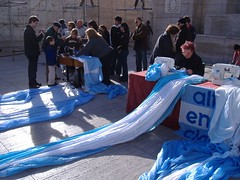
It's the 50th anniversary of the Flag Memorial, and the Municipality is, as we say over here, throwing the house out the window (or "throwing butter to the ceiling"). There have been concerts, a professional reenactment of General Belgrano's entrance into Rosario in 1812, rodeo-like traditional events, and a national artisans' fair; the Memorial has a new and revolutionary lighting system installed (which will be inaugurated tonight), and in general, the city is bustling with flaggy activity. Before the mast of the Memorial, a group of volunteers is sewing up the parts of Alta en el Cielo, the longest flag in the world (and longer each year!), so as to march with it tomorrow. I saw them yesterday when I passed by with the Rosarigasinos to take pictures. There were still people at the Memorial, listening to a guide narrating the life of Manuel Belgrano, at 8 PM, just as I returned there after a tour of Rosario's historical cupolas. I was tired and freezing, but the old ladies in scarves listening to the guide were just warming up.
07 June 2007
Politics against the people
It's been a couple of days... I'm doing some programming-for-hire during the afternoon, so I don't have the amount of spare time I'd like to have to craft long detailed posts. And the office has been busy too. So that's why. I promise (more to myself than to anyone else, because I know I'm a procrastinator) that I'll try to stick to one post a day during weekdays.
I was thinking of commenting on the ridiculous, half-childish, half-brutish behaviour of president Kirchner and his minions regarding Mauricio Macri's triumph last weekend, but there's no need — you can watch K's tirades in all their inarticulate muck-racking glory anytime you want, as he's on it all day. As much as I dislike Macri from the bottom of my guts (and the deceptively nice Iron Lady on a wheelchair that accompanies him), I'm beginning to think he's not that a terrible thing to happen. Buenos Aires can surely bear four years of plutocracy, and after that eventually porteños will either learn or repeat history, or maybe (just maybe) Macri in power will turn out not to be a horrible mistake. In the context of a local election in a district that is not really troubled, Filmus's apocalyptic warnings about a clash of ideologies is exaggerated to say the least.
But that's not what I was going to comment on. Although I did. As I said, I've been busy at the office. Yesterday, for a change, I did some fieldwork; office's Number Two and I went to Granadero Baigorria to check on a healthcare center. Now the usual idea of what a public healthcare center is like is a shabby building with workers either willing and desperately trying to do their work without basic resources, or (more commonly) undermotivated, accustomed to doing nothing, and exempt from control and punishment by their powerful union. (This description works for most of the public administration, of course.)
What we found was a group, a team, of people doing their work earnestly and diligently with modest resources, in a decent, clean building, and willing to get help to make it all better. They had everything in order, though most in dead-tree form; the computer was old but OK. The director was a nurse. The administrative staff (two women) were volunteers — members of the community who work there for free, or as we say, ad honorem, though they didn't receive any formal honours. One of them, a lady in her sixties, kept about 4,700 patient records on an Excel file; she didn't know how to do counts and filters, so I taught her. Prior to that, when the authorities needed a count of (for example) how many female patients under 15 are served by the health center, she needed to manually count them.
The authorities don't know or don't want to know that these women work hard, for free, or that they need a computer course the state should pay for, or that they would glady do a much better job if they had the tools, or that most of the structure of the state that feeds their incompetent asses is supported by hard-working people who don't get what they deserve.
Right at the entrance of the health center, a bit dusty because the street is not paved, a large painted banner read "Welcome, Rafael Bielsa". The Peronist party, which paid for this banner promoting Buenos Aires Province deputy Bielsa's campaign for governor of Santa Fe (!), is also the one in power, the one that should have paid for those two women's salaries, the one that campaigns to stay in power by noting the province has a surplus and hasn't raised taxes, the one that doesn't spend that surplus on, let's say, public works to keep the province from flooding whenever it rains more than usual. Politics is not nice, we all know that, right?
13 April 2007
Media is the plural of mediocre
I've often spoken, in passage, about the appalling quality of the media in Argentina, especially TV news coverage. The floods in Santa Fe were only one glaring example; ironically, you didn't get much from me regarding the media coverage because dealing with it would've been as frivolous as the way the topic itself was dealt with on TV.
All the big media are based in Buenos Aires, which can be considered a self-sufficient city-state for all practical purposes except for the generation of primary products, which anyway is usually invisible to the residents of large urban centers (porteño kids probably think eggs are manufactured right there in the back of the supermarket). As such, the media are myopic and extremely parochial. A multiple suicide bombing in Baghdad, an earthquake in Chile, a devastating flood in Córdoba, a minor traffic accident in Palermo and a stray cat in Villa Lugano are treated more or less equally (and the cat will most likely get more air time).
Not that our local Rosario media are better. Worse, they practically don't have a local content production; one of the channels is basically a branch of Telefé (Gran Hermano, cheesy and barely differentiable Colombian/Venezuelan/Mexican telenovelas). They both have news shows, which draw heavily from Buenos Aires channels (Canal 3 gets content from TN's Telenoche; Canal 5 gets Telefé's news). We also get TN, Crónica TV, Canal 9 and América TV by cable.
I usually have breakfast around 6 AM, watching the only moderately ridiculous early morning news on TN. There's just an anchor speaking at that time, who varies from day to day, though none of them seems to have received proper training regarding modulation and pronunciation. They repeat what they're told and do not editorialize. It gets worse after that, as a round table of wannabe journalists gathers to greet those just waking up for their 9-to-5 jobs with all sorts of supposedly funny skits, jokes and puns, before going on to the actual news.
I don't watch Telefé, ever, for my health. I mean, this is the source of such horrors as Susana Giménez, Marcelo Tinelli, Gran Hermano, and some of the worst soap operas ever to defile the small screen. I don't usually watch Canal 9 (too fascist for my taste) and I tend to skip América TV (makes you dumb just by watching). Crónica TV I do sometimes, as it's not only sensationalistically yellow but does also, surprisingly, have a much better coverage of national and international news than multi-awarded TN.
The news today (carried over from the weekend) is that the icebreaker ARA Almirante Irízar (the only icebreaker we, proud, if contested, rulers of a huge chunk of Antarctica, have in stock) is still on fire, its captain still on board waiting for his ship to be towed back to port, some 120 nautical miles south of Puerto Madryn; and that Diego Maradona was again hospitalized due to severe abdominal pains — he had hepatitis some time ago, was released, and now they suspect a pancreatitis. The smoke rising from the Irízar, the rescue of its crew and their safe arrival to port, with the ensuing family reunions, were played and replayed again and again until the whole episode turned into a foul, mushy mass of sentimentaloid infodramatic crap. Maradona, of whom one doctor said he's in trouble because "he thinks he's God", is being worshipped non-stop by followers and media alike, as if it wasn't his fault at all that he's an overweight drug-addicted alcoholic with an ego the size of La Bombonera and the Maracanã put together.
Some of us are tired of this... but hey, whatcha gonna do? Tomorrow another cat will climb a tree it can't get down from, or a cute baby elephant will be born somewhere, or an abandoned storehouse will burn in a suburbs of a suburb of Buenos Aires, and they'll grab the full attention of the cameras again. Let's hope.
07 March 2007
¿Por qué in English?
¿Por qué escribo este blog en inglés?
La pregunta no me sorprende. Mi idioma nativo es el castellano, y vivo en un país y una ciudad donde no son mayoría los que pueden entenderme si escribo en otro idioma. Me juego en contra, se diría además, al escribir en inglés desde y sobre una ciudad que no es internacionalmente conocida, que no es un destino turístico, que no tiene fama excepto la muy difusa de ser la cuna del Che Guevara.
Fueron precisamente esas cosas las que me decidieron a escribir en inglés. La comparación con Buenos Aires es inevitable. La capital de nuestro país tiene muchos bloggers, y más que unos cuantos son extranjeros angloparlantes. Se hace y le hacen también mucha publicidad a Buenos Aires para un público internacional. Rosario tiene comparativamente pocos bloggers, y ninguno, que yo sepa, en inglés, salvo yo. Creo que lo que pasa en el interior de Argentina es tan importante como lo que pasa en la capital, que ya tiene demasiados privilegios como para concederle, además, que sea la única visión de Argentina que llegue al exterior. Creo también firmemente que el futuro de Rosario como ciudad turística está en juego en estos años, y que hay que ayudarla; que también vale la pena difundir lo que pasa en esta provincia, tan rica en recursos y en emprendedores y a la vez tan pobre en instituciones y en representación ante el mundo.
En cuanto a lo personal, supongo que si puedo escribir de mis convicciones y opiniones, no está mal escribir sobre mis hobbies y distracciones. Si puedo hacerlo sin traicionar mis raíces como argentino hispanoparlante, llegar a un público amplio y de paso practicar mi segunda lengua, ¿por qué no?.
Why do I write this blog in English?
The question does not surprise me. My native language is Spanish, and I live in a country and a city where the ones who can understand me if I write in another language are not a majority. I'm going against my interests, you could say, by writing in English from and about a city that is not internationally known, that is not a tourist destination, that has no fame except the vague claim of being the craddle of Che Guevara.
It was precisely those things that prompted me to write in English. The comparison with Buenos Aires is inescapable. Our country's capital has a lot of bloggers, and more than a few are English-speaking expatriates. Buenos Aires also gets lot of advertising targeted to an international public. Rosario has relatively few bloggers, and none in English, that I know, except myself. I think that what happens in the interior of Argentina is as important as what happens in the capital, which already has too many privileges and shouldn't be additionally granted the one of being the only view of Argentina that reaches the world abroad. I also firmly believe that the future of Rosario as a touristic city is at stake these years, and that it has to be helped; and that it's worth making things known that happen in this province, so rich in resources and enterprising people and at the same time so poor in institutions and in representation before the world.
As for the personal stuff, I suppose if I can write about my convictions and opinions, it can't be wrong to write about my hobbies and pastimes. If I can do that without betraying my roots as a Spanish-speaking Argentinian, reaching a wider audience and in passing practise my second tongue, why not?
05 March 2007
Rosario in the news
I peruse several local and national newspapers almost every day to get my news..., which of course would be useless to look for on TV (too much time lost waiting for pseudo-news to finish). The main local news source is La Capital, a venerable paper founded in 1867 that is Argentina's oldest of those still published. La Capital is objective enough not to pass op-ed for news, and its online version is fairly good. There's also El Ciudadano, but it's a "popular" paper so its quality is atrocious, and its website looks like something you could've designed using HTML 1.0. Then there's Rosario3.com, an online newspaper property of the same media group that owns Canal 3, Radio 2 (the main AM station in Rosario) and several major FM stations. Rosario3 is a recent addition and, though amateurish at times, it does cover certain items that the other neglect. Finally, there's Rosario/12, a short supplement to the Buenos Aires-based Página/12 written by a local staff.
I also read the "national" papers La Nación and Página/12 to get an ideologically broad coverage. I use scare quotes because Buenos Aires-based papers are invariably biased towards Buenos Aires coverage. They're distributed throughout the country but, quite logically, most of their public is concentrated in one hypertrophic metropolitan area that thinks of the country as one Important Place plus a vast, undiferentiated hinterland that provides the capital with food and football players. Página/12 does often take a look at important issues of "the interior", especially those related to social and political conflicts, which it attacks with undisguised ideological zeal; La Nación deals with national and local issues using the same pseudo-objective uptight treatment it employs with Buenos Aires news. I generally don't read Clarín, mainly because it's usually 75% sports non-news, though its supplements and journalist blogs are sometimes very interesting.
Rosario appears in Buenos Aires news almost only when something horrible or bizarre happens. Since we don't usually have floods or strange animal attacks or resonant small-town displays of misery, it's not often (there was these guys eating a cat in a villa miseria once in the 1990s... hence the epithet comegatos applied to rosarinos). However, reading Página/12's tourism supplement last Sunday, I was positively surprised by an article about Rosario.
The article speaks of Rosario as a passing weekend destination, which may be OK for people who only want to follow pre-set paths, but doesn't do justice to the city. Granted, most visitors wouldn't be caught dead outside certain areas (I myself would rather not) but the visitor may leave with the impression that Rosario is a medium-sized block of old houses plus a strip of river beaches and a few parks. The article does mention the amazing changes Rosario has had since the disastrous riots of 1989, where people looted supermarkets and stores, and the crisis of 2001–2002. Rosario was at one time the country's "capital of unemployment", and became at parts as dirty, desolate and unsafe as the poor parts of Greater Buenos Aires. This same city, however, emerged from the last crisis with fewer permanent wounds and recovered fast. It earned a recognition for its advances in governance and development, leading to a better quality of life, by the UN Development Programme, and a recent study (which I covered) also placed it at the top of the quality of life ranking of Argentine metropolitan areas.
Página/12 humorously notes that Rosario views itself as "an independent city-state", so "if we take this seriously... a trip to Rosario is like going abroad". It and speaks of a "new Rosario" which has opened up public access to its river, something that Buenos Aires lost long ago, and notes that long-term urban planning has been at work. Despite two economic crises (with a full decade of neoliberal adjustment in the meantime), the local administrations have shared a common vision of Rosario and struggled to make it real. They've failed in many respects, or they've been forced to downsize certain promises, but an urban strategy exists. The municipality is drafting the plan for the period 2007–2017 (I read about this in Rosario/12, by the way). It includes a project to build a multi-modal public transport node at the Cruce Alberdi, the place where the northeast of the city meets the border of the peripheric downtown area, now occupied by the Patio Parada, a railway node administered by the Nuevo Central Argentino. The project would have a small bus terminus, a stop of the BA–Rosario–Córdoba "bullet train" (which, by the way, nobody's heard of again), and (oh such delight!) a tramway station. The area will form an axis of communication within the city, with access to the airport and links with the metropolitan area.
At the same time, the municipality is presenting its urbanistic plans for this year. This will outline a number of large-scale changes to key areas of the city, design certain areas for residential use, preserve historical corridors with architectural homogeneity, prevent the disruption caused by tall towers popping out in certain areas (as is happening in Buenos Aires), and other more complicated goals. Such foresight is often marred by the harsh realities of negligence, corruption, bureaucratic delays and sheer lack of personnel... but anything is better than nothing.
25 January 2007
Rosario bus fee raised

This is not exactly news, though it was unexpected. The municipality just raised the urban bus fee from 0.95 to 1.20 pesos; the 6-trip prepaid card rose from 5.40 (each trip for AR$0.90) to 6.90 (AR$1.15/trip); all in all it's over 25%, quite a brutal hack to one's pockets. The political cost is going to be high. The executive branch (mayor Miguel Lifschitz) asked the Socialist-dominated legislature of Rosario to grant it the power to raise the fee. The Deliberative Council complied at once, eager to shift the political cost to the mayor, who has kept a low profile and a high approval rate. Lifschitz conditioned the fee increase to the results of a study of the costs of public transportation, but it was obvious that the fee was going to go up regardless. The opposition was quick to point out that the delegation of legislative powers was done too fast, during the holiday season (everybody knows nobody pays attention to the news during the summer holidays!), and denounced a previous secret agreement between the mayor and the companies that own the bus line concessions (and that will participate in the re-designed public transportation scheme to be implemented a few months from now). Basic knowledge of realpolitik tells me this is probably true; the companies will not invest in a system that doesn't give them enough profit.
The root of the problem, however, is the combination of last year's huge salary raise for bus drivers (that was presented to the media as the resolution of a conflict between the drivers' union and the companies, but was rather clearly, except for the most naïve, a mis-en-scene to appease the drivers and to get the companies an argument to push for a fee increase) and the national parliament's preference for Buenos Aires City in the issue of subsidies to fuel for public transport — which is why bus tickets in Buenos Aires remain at around 80 cents while the big cities in the rest of the country (Córdoba, Mendoza, and now Rosario) have had to raise them to over AR$1.10, from previous values around 90 cents.
Buses in BA carry a lot of passengers from the impoverished metropolitan area, to be sure, but the cost of living in that area is considerably higher than that of the rest of the country (I'm told a cup of coffee can be around 4 pesos in BA — you can get a medium cup of coffee with milk plus two medialunas for less than 3 pesos in Rosario). Why is the bus fee kept artificially low in BA? BA has trains and a subway, and of course people there have many more cars and many more taxis available in proportion (BA has a taxi per 80 people — Rosario has about 1 per 350 people). Moreover, with a national government that constantly pressures private companies and interferes with the market to keep the prices of basic products depressed, what sense does it make to let public transportation become so expensive? An average worker in Rosario may now spend between 6 and 8% of his or her monthly salary just to get to and back from work.
I use the bus a lot (maybe 90 bus trips a month when I'm going to Japanese class); despite my willingness to exercise, I just can't go to work on foot or by bicycle; it's too far away and I can't possibly wake up even earlier than I do now. I can pay for the difference, but I shouldn't. My bike got out of repairs just yesterday and I think I'm going to start putting it to use...
Meanwhile, the transport officials of the municipality say the bus system is working fine and will be even better, the everyday bus users are complaining about the quality and frequency of the service, the taxi drivers want their own fee to be increased even more to compensate, and at least one person is attempting to block the fee increase by a judicial interdiction. The taxi owners are also complaining that they will have lots of work because the bus won't be advantageously cheap enough (what do you call a businessman who complains because his product has a large demand?).
02 January 2007
Happy New Year

I hope my loyal readers had a great New Year. Over here it was so hot that we went relatively light on food and focused on cold beer... which didn't stay cold for long. We ate outdoors (a round of sandwiches around 10 PM, main course starting 11 PM) but the air was absolutely still. The first day of 2007 was even worse. Amidst the constant feed of non-news that fills TV from mid-December until March, great headlines warned us that the temperature was above 35 °C and the sensación térmica (lit. "thermic sensation", a kind of heat index, only it takes the wind into account as well) was almost 42 °C. With the sun hanging high and unmitigated by clouds, the streets were deserted. The media from Buenos Aires reported a catastrophic scenario of empty avenues and the usual massive exodus of porteños towards the Atlantic coast of Buenos Aires Province..., a nightmarish migration of millions of middle-aged men with beer bellies and fat suntanned women carrying along screaming little children and bored teenagers pouring into the very same places they visit and get ripped off at every year since the 1980s. (Who endures a 4-hour traffic jam on a hot road to stay in a hotel room and go to a casino?)
Not that rosarinos don't do the same, of course. The less favoured, however, turn to the public pools, the beach of La Florida, or the islands. I read the other day that Rosario has the largest amount of public pools in the country, where you just get a physical, pay a small fee (AR$5 tops), and stay as much as you want; plus there are more than a few clubs with such facilities. La Florida is a barrio that stretches along the river in the north of Rosario, east of Barrio Alberdi proper, and La Florida is also the name of the beach — which has two parts: a beach resort where you pay, and a free area. La Florida is lined with pubs and bars; at night they tend to get full, since boliches (discos, disco-bars) move to the coast. Finally there's the islands in front of Rosario, which have always been popular but have been greatly developed in the last few years. Boats leave at regular intervals from a few piers taking eager passengers equipped with summer gear.
I'm not a fan of going elsewhere for the day just to keep cool; you have to have equipment and you have to spend a significant time going to and back from the place, all the time sweating while you carry your backpack or whatever. I'm just patiently waiting to get away from Rosario for two weeks. Mendoza is not necessarily cooler (in fact it's hotter at times) but it's much less humid; you can get by just drinking lots of water and staying in the shadow.
I'm wondering whether I should stick to a less-than-daily posting rhythm in this blog. I've been having less visitors lately, probably because they're on vacation. I'll be away for two weeks anyway, and I don't think I'll be posting much (if anything) from Mendoza. I have interesting plans for after the summer, though. Just wait!
17 December 2006
The perfect storm
 If you're really into this blog, which I doubt, you may have noticed that your intrepid host has not posted anything in the last three days. In part that was due to Real Life™ concerns and, thankfully, fun things to do elsewhere, but the terrible heat was a major factor. The lack of air conditioning in my computer room (which won't be remedied during this summer, unless Santa brings me something I didn't ask for, or the reader helps with a donation) made it impossible to survive in there, and my PC wasn't happy either. Yesterday the temperature in Rosario reached 36 degrees Celsius and the heat index was 43 °C.
Our very own Ayami sensei, which gave me classes during half of 2005, leaves for Japan after two years of serving as a volunteer in Argentina, so she was having her 送別会 (soubetsukai, farewell party). I took a much-needed shower with room temperature (i.e. warm) water, put on as little clothing as decently possible, and headed off for the Japanese Association party room, which has no A/C but does stay cooler than the rest of the building. Food was eaten, drinks were drunk, speeches were given, and just when I was leaving, Valeria sensei, my first teacher, who was trying (fruitlessly) to take in some fresh air just outside the room, noted that a storm was gathering; a few rain drops had already fallen.
By the time I got to the bus stop, just across an intersection from the Bus Terminal, the wind was rather strong. Dirt and leaves were flying; you could feel tiny things hitting your legs and arms. I patiently waited for a bus or a taxi, a bit jealous of the hordes of teenagers who filled the area as they prepared to go to bars and discos (it was about 1:30 AM). A group of people was sitting with a couple of beers in an outdoor table in the bar at the corner of Cafferata & Santa Fe St. Suddenly, a gust of wind blew off the large parasol on their table. The thing took the plastic table, the bottles, the glasses and one chair with it, and ended up in front of a car, which had fortunately stopped at the traffic lights. At this point I started seriously fearing that I could be hit by things more dangerous than dirt and leaves, so I retreated to a safer spot.