Just a few quick notes on politics.
Every time you see the Presidenta meeting with industrial moguls and businessmen to reassure them that the next administration will support them, I get this uneasy feeling that this cannot be good for us, the ones who actually work.
Conversely, every time you hear the leaders of industry and finance praising the economic continuity promised by Cristina, I cannot help but think that the power cards have been dealt, the players are already on their places, and, once again, we the people will just be watching from the outside. And serving the drinks.
I also think that, after being a lefty for most of my adult life, the scandalous displays of mob-like behaviour on the part of unions and government will end up turning me into a supporter of typical right-wing police repression. Did you see what happened yesterday before the Legislature of the City of Buenos Aires? I mean, except the part where the policeman beat a defenseless demonstrator with a stick, most of the violence came from the union guys, and then they did an incredible show of victimization, as if they'd been Gandhi vs. the British Empire.
When a union leader can decree a strike that will cripple nationwide public transport for a day, without consulting with the workers at all, it's not a good sign. And when a president can call (has to call?) the top union leader to get him to cancel the strike, and everything's "back to normal" in a couple of hours, that's a terrible sign. Realpolitik is messy, but this is just plain wrong.
When a president tolerates a radicalized ecologist group blocking international roads and making ominous threats, and speaks for his country saying "you've backstabbed our people" to the president of a neighbouring friendly country because said country won't put up with our bullying anymore, that's a horrible thing to happen, especially if citizens stay silent.
When the president of your country makes friends with a president that is well on his way to become a dictator for life, and who gladly consorts with a guy who denies the Holocaust, believes Israel should be erased from the map and is producing nuclear weapons, that's not a good thing. One should pick one's friends carefully, because from outside one's always associated with their faults.
Something's very wrong and it seems like no-one here is reacting.

13 November 2007
Something smells rotten in Argentina

 Stumble it!
02 December 2006
Overreactions: Argentina vs. Uruguay
Everybody seems to be on edge these days, haven't you noticed? And moderation seems to have gone out the window together with restraint and sense of proportion. Some examples:
- Months ago, a double-decker interurban bus had an accident. Many passengers, mostly children, died. They said it may be due to bad balance and wind (driving a tall narrow bus with strong side winds may be dangerous, understandably). Almost instantly there were people demanding that double-decker buses be forbidden. What?
- The hail caused property damage and losses. Some said it was the government's fault for not releasing a proper alert. The government agency in charge of weather prediction should have had something like alarm sirens set up in all the cities and towns and should have been able to broadcast an alert within minutes of discovering that hail was likely, the kind of alert that no-one can ignore (the TV, the radio and the Internet are not enough). It didn't, so it should pay for the repairs to my car. What?
But wait, it gets worse. The possibility of withdrawing Uruguay's ambassador was mentioned. It was rejected, but unfortunately the explanation given by Uruguay was "if we were to solve everything by withdrawing the ambassador, we wouldn't have had [the ambassador in Argentina] since one year and a half". This was the Uruguayan Chancellor, i.e. the head of the foreign relations office. Diplomacy, anyone?
As one of the readers of this rather low-level thread in Yahoo! Answers says, seeing Argentina and Uruguay against each other is like watching a fight of two chihuahuas. The issue is not only international but intranational; the mayor of Colón, north of Gualeguaychú, called their actions "exacerbated extremism", and the Gualeguaychú folks got mad at that. As of now, the international roads passing near both cities are being blocked again. These guys are actually mounting permanent tents by the road, setting up chemical baths, and a "kitchen bus". "If they come to repress us with the police", they said, "we might be forced to move, but in two hours they'll have 30,000 of us protesting in another spot".
The time has come to drop this ridiculous pretense that we're defending ecology as a national cause, and to accept the obvious facts:
- The Botnia plant will be built, on time, and in the designated spot, and it will work.
- Uruguay cannot make its way out of this. It has a special treaty with Finland that forbids messing up with certain agreed-on investments.
- The president of Uruguay cannot and will not lose the rest of its already diminishing popular support. His balls are in the hands of a corporation that's bringing the largest investment in the history of Uruguay. He simply has no room to move.
- The Assembly of Gualeguaychú is formed, like most of these movements, by 95% of people who don't have clear justifications for the protest, and 5% of misguided leaders. The withdrawal of official support has only radicalized them.
- When-and-if the Assembly commits an actual crime, the Argentine government will have to react but it will be too late.
- When-and-if the Argentine government reacts, there will be (as predicted by the Assembly) a horrible mess. This is entirely the government's fault. The clock is ticking.
22 November 2006
Mindless road rage
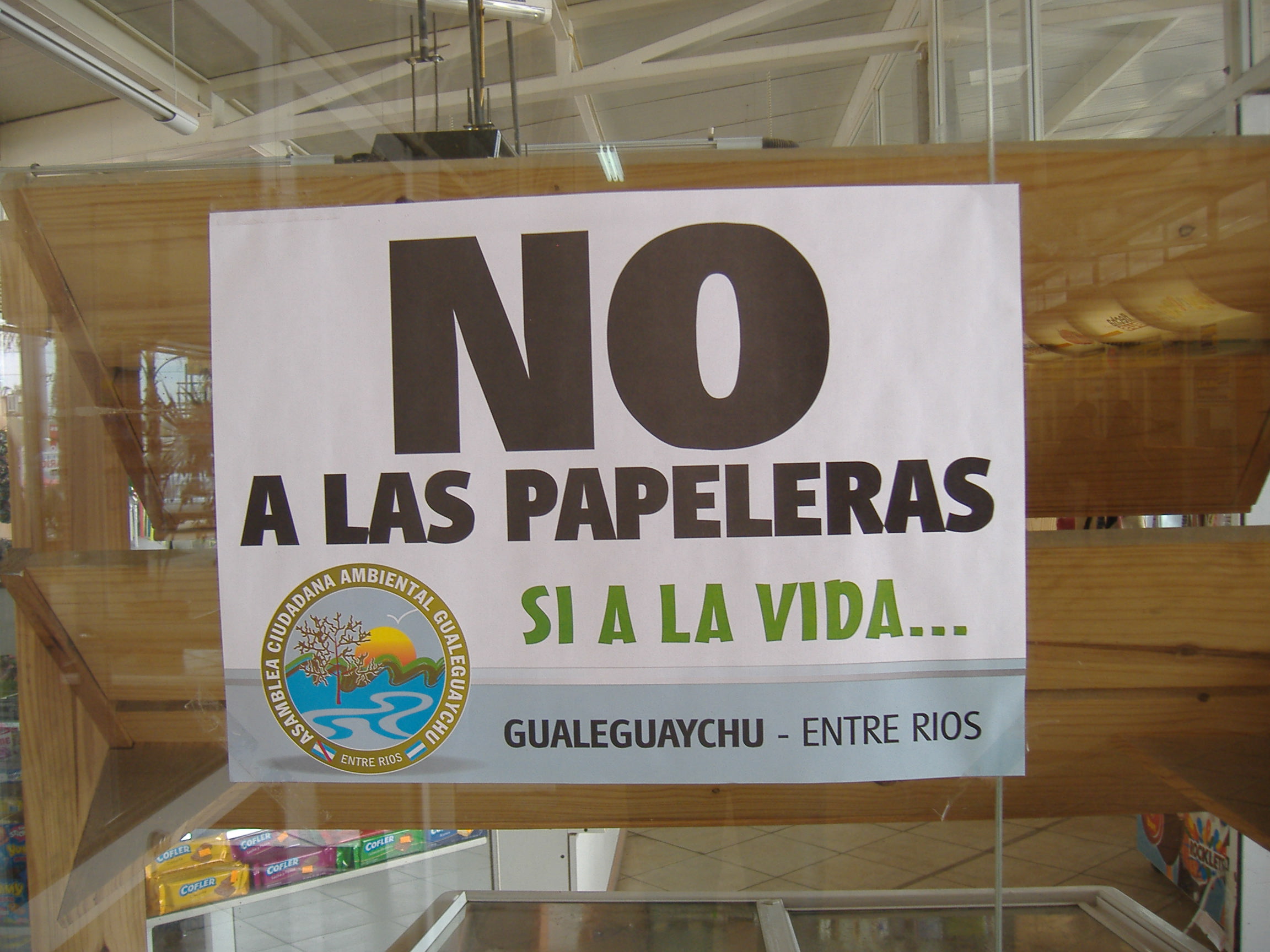 The folks in Gualeguaychú are blocking the international route to Uruguay again, after the World Bank announced it would grant a $170 million loan to the Finnish company Metsä-Botnia to continue building its cellulose and woodpulp mill on the Uruguay River. If this is already looking like useless repetition leading to a dead end to you, it must be because it is. The mill will be built, and it will pollute the Uruguay River as little or as much as it was supposed to, and we'll have to live with it. We'll survive and Gualeguaychú probably will too, but I'm not sure the traditional friendship between Argentina and Uruguay, as of late rather strained, will survive as well.
 I couldn't possibly be more sympathetic to the inhabitants of this beautiful city that lives in part thanks to tourism and in turn thanks to its wide, brown-colored river. But after months of intermitent blockades, diplomatic negotiations, a good amount of political dance, media attention, and a model in a bikini parading a "NO TO THE PULP MILLS" sign in front of a dozen of presidents, the blockade tactic is not only stale and useless, but pathetic and counter-productive.
On TV I saw an Argentine motorist stopped by the blockade, arguing with the protestors to let him pass through, telling one of them that he was not fooling around as a tourist but he was a working Argentinian; and the protestor told him "I don't think you're an Argentinian". When it's come to this irrational us-vs.-them feeling, can we doubt that these people are horribly wrong, even as we know that their cause is just?
The pulp mills will pollute, as they do everywhere. They will emit a foul stench of rotten eggs and they'll taint the waters. They'll do just the same as each and every paper and pulp mill in Argentina, only producing much less pollution, because they have modern First World technology. The battle is already lost; the protestors in Gualeguaychú just haven't heard the retreat order -- and it is the Argentine government's fault that they haven't, because near election time nobody wants to give up on a national cause which was embraced in a hurry only months ago, and least of all sending the police or the Gendarmerie to clear the international pass.
The protestors clearly know this. One of them, in the latest assembly, demanded action from the authorities: "[They should] either come and beat us up, or come and lead our fight!". They're ready to ask the people of Colón and Concordia to block the international bridges located north of Gualeguaychú, thus completely cutting off Uruguay's land access from Argentina. This will reach a critical point soon..., and then what?