I often say that the politician's mind is beyond my comprehension, beyond any understanding on the part of we the people. Politicians (especially when they're only politicians, and even more so when they've been for a long time) are not people, they move on different rules, and they see the world with different senses, moral values, and filters.
That's why I can't understand, for example, the resistance of the national government to acknowledge the obvious problem of creeping inflation, with the pathetic stream of doublespeak that results from the public expression of this denial, and why I could never understand the failure of the Santa Fe provincial government to do the very simple things it should've done to ensure victory for its candidate. There were many, many dark spots in the Peronist administration, but the largest obstacles to their removal (as I see it) were the maddening entanglement of personal loyalties and personal feuds, ridiculous bureaucratic delays, and sheer tradition — the tradition of just going on as before even as the people more and more loudly demand for things to change.
On his first day as governor of Santa Fe, Hermes Binner had the police fences around the Grey House removed (they'd been set up to deter demonstrators from trashing the government house), used the front door to get into his office (where the previous governor entered through the back door), and went around the other offices introducing himself to the employees, who were both terrified and very pleased. None of these marks Binner as an outstanding human being or even a good politician; all can be interpreted as plain inexpensive PR and nothing else.
Binner then signed his first decree, cutting his own powers to appoint judges at whim; in this he followed Néstor Kirchner's example, and he took good care of noting this explicitly. And then he announced he'll set aside 30 million pesos, effective immediately, to repair public schools during the summer, so that they're fit for use when the school season begins next March.
Both of these things are minor expenses (political in the former case, economic in the latter), and they were never beyond the powers of former governor Obeid. Why did he let schools turn into dirty, decrepit traps, while public opinion grew indignant by the day after each news report showing their pitiful state? Why did he not impose limits on his own powers to appoint judges, seeing how society distrusts the judiciary for its undue political ties? Why did he spend millions in advertising things no-one actually saw or cared about?
You've already read here about tons of other awful things the previous government did or did not, apparently not noticing or willfully ignoring the political consequences. I can only guess that politicians' minds are alien to our shared reality. If this the case, let's hope Hermes Binner doesn't get caught up in that, after this start off on the right foot.

14 December 2007
The politician's mind

 Stumble it!
30 November 2007
"We were so good I don't get why we lost"

(Post-election advertising poster for the outgoing government,
almost identical to posters used in the campaign to boost
the government party candidate, who lost anyway.)
Reporter: "[Governor] Jorge Obeid said he'll leave you [enough] money to pay salaries and bonuses to the public employees in December, 200 million pesos from the anti-cyclical fund, 80 million from the public works fund, and 300 million for ongoing works, adding up to 1,400 million. What do you think?"
Governor-elect Hermes Binner: "That we're going to have to pay for a lot of advertising."
31 August 2007
The end is near
My Japanese calligraphy teacher's view of the candidates for the governor election: "There's the guy with all that beard... and the other guy who looks like Hitler." I had to laugh. It's very difficult to discuss politics in a language you're just starting to understand beyond the basics, and explaining Argentine and local politics to a foreigner from a vastly different culture is absolutely impossible. We left it at that. (Watanabe-sensei also inquired about Cristina Kirchner. I just said no.)
OK, that was just comic relief. We're right on top of the election, and that's a good thing, because I was getting tired of the incessant TV and radio ads, the childish taunts among grown men, the unsubtle campaign moves. If I hear the President is coming again to unveil yet another one of those hypothetical or half-finished public works that abound these days, I will lose it.
In case you didn't notice, I'm starting a news blog. I'm going to take news from local media and classify them with graphical labels according to their type... morbid, boring, useless filling, paid-for ads disguised as news, etc. It's en español and it's called Etiquetame todo ("Label Me All Over"). If you read Spanish, check out it.

10 February 2007
The Socialist, the independent and the two little Radicals
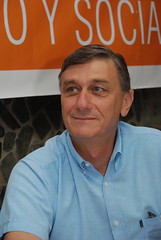
Topping it off, he got Griselda Tessio, a respectable federal prosecutor (she's just resigned) and a daughter of the last Radical Party governor of Santa Fe, to be his running mate, and he launched the campaign, with her on one side and Fascendini on the other, in a meeting in Esperanza, the prosperous city in central Santa Fe where both Fascendini and Tessio were born.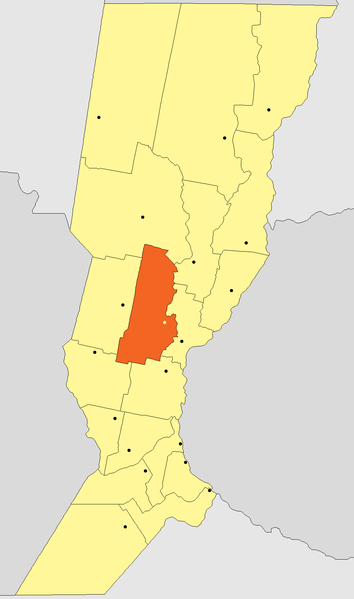
A faction of the Radicals, led by a couple of political parasites who've never been elected to anything or had any political power outside the party bureaucracy, are against Binner and Tessio. They need Binner but they wanted their own candidate — first they appointed Fascendini, now they want another one elected in primaries. They may take the issue to court so that Binner and Tessio are forbidden to use the name "Progressive Front" in their ballots. Strictly speaking, Binner did violate an agreement with the Radicals; it turned out OK, the campaign is going ahead and all, but the formal Radical Party structures did not accept the fait accompli.
Santa Fe's Radicals have a tendency to split over small matters, basically following individual leaderships. Will these guys, with legal but not consensual authority, end up proclaiming a governor candidate of their own? The poor guy would be doomed to wither in solitude and lose, but he would divert some votes from the Socialist-Radical alliance. The Peronist candidates are more than a few votes behind, but not impossibly far behind.
The Peronist provincial government has started throwing money around — millions and millions to repair schools, to upgrade hospitals and healthcare centers, to pave roads, to beautify small towns — things that should've been done during the three years since this administration took office, in a consistent, regular way, not as a extraordinary pre-electoral show. It's disgusting, this spectacle of a governor and officials appearing in a virtual partisan rally to deliver a large check to a hospital so it can buy a few shiny expensive items while HIV+ patients can't get their drug cocktails in that very same hospital because the provincial bureaucrat in charge is on vacation, and while the healthcare centers that send patients to the hospital don't have computers, full-time nurses, or a regular supply of toilet paper.
I can't say for sure this is going to change if the politicians change; I can't believe it might be worse than this.
02 February 2007
The 2007 campaign
The campaign for the governor election in Santa Fe is getting hotter... or should I say the pre-campaign, since there are formally no candidates yet, no parties or alliances already in the register that must be compiled months before the election.
Before you go away, I may as well explain why this is important. As anybody who's been living under a democracy for a while knows, elections almost never change anything — 99% of the times it's the same people or their clones trying to get you to vote for them with all sorts of empty promises, oblique threats, lies, lies, more lies, mud-slinging, sentimental pleas, appeals to your pocket or your ethics, etc., and once they're elected they resume their daily routine, some jobs and titles exchanged for others. Well, this might be one of the 1%.
The reasons:
- This is the first governor election since 1991 without the Ley de Lemas. I'll spare you the details here. The Lemas electoral system allowed Peronism to steal the election twice.
- The established Socialist candidate, Hermes Binner (twice mayor of Rosario), is leading the surveys. If he wins, he'll be the first Socialist governor in the history of Argentina.
- The established Peronist candidates are both linked to Rosario as well; one was born here (though he was exiled in Europe and then moved to Buenos Aires) and the other has lived and made its political career in Rosario since his youth.
- Given the two points above, the next governor of Santa Fe is practically sure to be a man of Rosario, ending (we hope) a long string of rulers that have consistently economically and politically discriminated against the largest and most important city in the province. This might lead to a better share of funds for Rosario, and to the attainment of a long sought after dream: municipal autonomy, à la Buenos Aires City.
 In 1995 came Jorge Obeid, who stole the election from the Radical Party candidate Raúl Usandizaga by adding up the votes of the sold-out ex-Socialist Héctor Cavallero to his own using the Ley de Lemas. In 1999 Reutemann was re-elected. He oversaw a horrible crisis with a straight face, survived a couple of scandals, and in 2003 again he left the post to Obeid, who has since devoted his time to visiting Cuba, inaugurating unfinished public works, and appearing in pictures with President Kirchner.
All this time the province has been stumbling through history, guided by an automatic pilot. Its much-touted record fiscal surplus is more a product of automatic taxation on its immense wealth than a sign of good administration, and its progress in later years can be directly attributable to the overall recovery of Argentina, even moreso as it's powered by the export of agricultural commodities. The public sector is bloated and inefficient, the judicial branch is full of dark, corrupt judges protected by the political establishment, the ministries and secretaries are occupied by political operators without skills, policies and their application are irregular, episodical, never fixed, and oriented to the spectacular and to the populist.
Is that different from any other provincial administration in Argentina, or from other local and national governments in the Third World? Probably not. Can it be easily improved? Undoubtedly yes. Will it improve if the party in power changes? Probably, judging by the results that the Socialist administrations have produced in Rosario since 1989, and especially since the degradation brought about by almost a quarter of a century of Peronist rule is due mostly to stagnation and to the naturalization of bad habits.
The two main Peronist candidates are now at each other's throats, as usual; it's not that they have ideological disagreements or fight over policies (what?), but they want power and they can't both have it. Binner watches from afar and has but completely forced the hardliners of the Radical Civic Union, his allies, to choose the vice-governor candidate that he likes, the extra-party Santa Fe federal prosecutor Griselda Tessio. Isn't that nice?