We're suffering a drought, as is most of the country, especially the agricultural productive areas. It rained last night, and might rain again today a bit, but it was an isolated phenomenon. Right here in Rosario it's still not as bad as it was last year, when grass everywhere was reduced to brittle, desiccated brown fragments and finely-powdered dirt was blowing from exposed patches everywhere, but there are serious problems in the north.
 The Paraná's water level is so low you can see the pipes that drain the rain into the river, lying on the sand in the beaches of the northern city. People still go and bathe there, but the usable area has shrunk; five or six meters from the current shoreline, the river starts to get deep and dangerous.
Upstream, in the dry north of Santa Fe, the situation is dramatic. Neither people nor cattle have enough water for themselves, and the crops are dying. Ironically, northern Santa Fe used to be an area of wetlands and forests, but already in the late 19th century logging companies felled a lot of trees (quebracho, mostly) and then the wetlands were drained by canals to avoid floods. After 2002, when soybean became the star crop, agriculture expanded to the area, and cattle were also moved there from the south. But when you remove a forest, you leave the terrain subject to erosion, and without major watercourses you're tied to rainfall.
The drought will reduce the production of most crops. Maize and soybean were planted late because of this, and coupled with a lower yield, that means Argentina will produce a lot less of both (making things worse, the government continues to place administrative obstacles on crop exports, and the international price of agricultural commodities has decreased dramatically). Wheat production has plummeted to about half of the 2007–2008 harvest. Cattle farming is also suffering; the animals languish and die of starvation or thirst, and often farmers prefer to slaughter cows and sell them for what they might be worth. This year there will be one million less calves.
Hmm... still no rain over here.

13 January 2009
Hot and dry

 Stumble it!
07 November 2008
No more trams for Rosario
I was going to write about Obama's victory (and I will eventually), but I just spotted a bit of bad news over here on Rosario3.com. On February 2007 I was happy to report that the mayor's trip to San Francisco had resulted in a conversation with that city's Rosario-born Secretary of Transport and an agreement to mediate in the donation of a fleet of old trolleybuses from Vancouver, Canada (negotiations for which had started before).
Unfortunately, although the trams were almost free (a symbolic amount, as I understand), we had to pay for the shipping. Bringing 80 buses from the opposite end of the planet costs a lot. The national government promised to help us with 2.5 million pesos, but the money never arrived, and the municipality of Rosario is really strapped for cash. So the trams are going to the city of Mendoza, which could afford them (being a provincial capital has its advantages, I guess). They left Vancouver by boat on November 4 and are now headed for the port of Valparaíso, Chile.
I'm beginning to sound like a broken record, but I must say this: it's a shame how local governments are always poor, how provincial administrations have lost control of their own financial resources, and how the national government takes more and more money from us without our representatives doing anything about it. I'm not advocating for the kind of independence from the federal administration seen in the United States; that would be impossible because some provinces, left alone, would simply be inviable. And some things (such as large public works) might be better left to the federal state. But for a city of 1 million to be unable to disburse some US$7 million to take advantage of such a fantastic opportunity is terrible.
I suppose I must be happy for Mendoza, a beautiful city and one I love... but I'm just very frustrated.
22 September 2008
Vacation report: La Rioja City

Joaquín V. González's house
La Rioja is a relatively small provincial capital, and I don't have much to say about it, although I do want to be fair and emphasize that we visited it in a hurry and because we had to, since the return bus to Rosario departed from there rather than from Chilecito. La Rioja is cute, but it has no major remarkable touristic spots, with the exception of a huge palaentology museum and some historical churches. The cathedral is also beautiful, but at this stage of our vacations we were no longer terribly impressed about this sort of things.
There's a house resembling a castle where the famous Joaquín V. González lived (the one who built Samay Huasi in Chilecito as a house of rest), and a fair amount of ample, well cared-for public squares, but no big parks within the urban downtown area.
 Parque Yacampis, the public park where the zoo is located, lies almost outside of town, and either because of the drought or sheer carelessness it looks rather decrepit. The zoo itself is surprisingly large and comprehensive for such a small city, and we spent a couple of hours going from one cage and enclosure to another. Among the primates there are caí monkeys (capuchins), a spider monkey, and baboons; also many birds, including a miserable condor which seemed to have too little space to exercise its vast wingspan; llamas and guanacos, too, and less curious animals such as goats and pigs.
The "problem" (note the scare quotes) with La Rioja is that, touristic or not, it's a "deep country" city with a small town mentality, and siesta time is sacred, so even the finest restaurant on the best parts of downtown shoo off customers during the afternoon. The traveller that arrives from Chilecito, for instance, checks in at the hotel and goes looking for late lunch, is in for a bad surprise and will be forced to a hungry pilgrimage around the city before he or she can find a table and a waiter.
We stayed in La Rioja all Friday afternoon and Saturday until sunset, when our bus departed. Again we had the unforgettable experience of an interrupted return trip. In March, you'll remember, we were stopped en route by a picket of farmers near Villa María, Córdoba; now it was a bit earlier, when the engine failed and started losing diesel. Marisa, doubtless because of the fuel vapours, felt sick all night; she couldn't force herself to eat so much as a mouthful of dinner, and the nausea lasted even a couple of days after our return. Fortunately we weren't delayed a lot: we stopped in La Falda, north of Córdoba, and we waited an hour or so until a replacement bus was sent from nearby Capilla del Monte. So in the end we got to Rosario two hours after schedule.
And that's the end of my vacation report.
22 July 2008
March of the penguins
It seems the first casualty of the Kirchners' defeat in the Senate won't be a senator but one of the most revolting elements in the government, Secretary of Domestic Commerce Guillermo Moreno. So say some people. But the news channels disagree: was it just a rumour, or will Moreno leave after all?
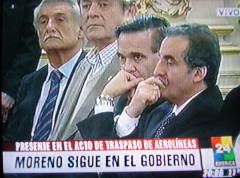
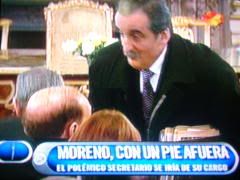
Does he stay or does he go? Same place, almost the same time.
Moreno is a thug. Just as Néstor Kirchner is the de facto president despite Cristina's formal title, Moreno de facto handles microeconomic policies (or what passes for that) as if the Minister of Economy, Carlos Fernández, did not exist. (I've only seen or heard this Fernández guy speak twice or three times on TV.) He deals with "price fixing agreements" (Kirchnerspeak for price controls) and, through his mafioso acquaintances, manages INDEC, the census bureau that protects us from the harsh reality of inflation by fudging the rates every month.
Moreno was one of the leaders of the mob that drove a cacerolazo away from the presidential residence last month. On Monday afternoon, a couple of hours before the press conference where Cristina Kirchner announced the nationalization of Aerolíneas Argentinas (and its massive debt), his mob at INDEC attacked the office of the opposition union ATE, whose members (also INDEC employees) have been protesting the Kirchnerist tampering of the inflation rate since it began. They threatened the employees and, after they escaped, trashed the office. The authorities did nothing. The police arrived late.
Moreno is just an extreme example of the characters that populate Kirchner's camarilla, and of his way of doing things. Most of his (and Cristina's) top officials are criminals in some way or another — they simply don't make it so clear.
18 June 2008
One step forward, two steps back
After almost 100 days of doing nothing but fueling the rage of the farmers and a good part of the general public (including many of her voters), President Cristina Fernández de Kirchner took note of the cacerolazo and reluctantly sent her mobile tax exports bill to Congress.
Never one to aspire to perfection, though, she let her husband go on with today's rally at Plaza de Mayo, which was transmitted on Cadena Nacional (i.e. forcefully overriding the regular schedule of all air TV channels to broadcast her speech). The rally was formally an occasion for all Argentinians to hear the President speak live on the current issues of prime importance for the country, but as expected, and as usual, it was merely a distasteful partisan meeting — thousands of public employees and unionized workers forced to attend, plus thousands of "social movements" who herded their militants to applaud Cristina.
Once before the crowd, la Presidenta took again on her Evita voice (which failed her a couple of times) and proceeded to insult the leaders of the agricultural organizations and to accuse those who protested against her government of being undemocratic and disrespectful of the popular majority. Her thesis (we've heard several times recently) is that democracy consists of voting every four years and then either quietly tolerating the decision of the majority, or form a new political party and compete when time is due. That is, all channels of feedback and criticism between the people and their government (except the ballot box) are to be suppressed: public opinion shouldn't be allowed to express itself through the media or through demonstrations and protests. Criticism on TV or the papers means big media corporations trying to destabilize the government. Banging pots and pans in the streets means inciting a coup. The spectacle of thousands of people who despair at the lack of action of their supposed representatives, taking to the streets on a freezing night with their kids to make some noise, to try to reach the consciousness of the ruler, doesn't mean anything but a threat to democracy.
That's the Kirchners' message, the subtext of most of their speeches. Every time Néstor and Cristina have taken one discursive step forward to speak of free speech or freedom of the press, they've proceeded to immediately take two steps back, treating their critics as enemies. So far it's been the media groups and some specific individuals and organizations. Today, it was the people as a whole.
Yesterday, when I heard Cristina's vow to let Congress discuss the tax bill that caused this whole mess in the first place, I was briefly glad about it. But again she'd taken those two steps back. The bill, they explained, deals with a matter of export tariffs and is under the jurisdiction of the Executive, i.e. it's not really a tax. As such, what Cristina sent to Congress was a closed package that can't be opened. It can only be approved or rejected as a whole. If approved, the conflict will be renewed. If rejected, we must assume, Cristina can ignore it, and given her record, it's quite possible that she would. The political costs might be extremely high for her and for everyone in her party. But the Kirchners have already shown us that they care for nothing. They're like blind bulls racing through a china store.
24 May 2008
Rosario after the general strike
After Thursday's general strike, Rosario's taxi drivers met with the authorities and then decided to work normally during the weekend (the city will be full of visitors, so they can't lose that money) and suspend the night service starting on Monday. Political characters of various stripes latched onto the horrible murder that triggered this and took advantage of it to speak ill of the provincial and municipal governments.
While the initial response of the taxi union was understandable, the rest immediately seemed to me to be staged for political purposes. Yesterday evening, after the tense meeting with the authorities, the head of CGT Rosario, Néstor Ferrazza, was seen at Agustín Rossi's campaign launch meeting for the presidency of the Santa Fe Justicialist Party. It was Ferrazza who decreed the general strike with less than two hours notice, and it's Rossi who's been more active criticizing the new Socialist administration since his party lost the election here.
This kind of strike had been unheard of for years. Later Ferrazza called it "a Rosariazo against insecurity", which for people with some knowledge of history seems not only a exaggeration, but really dangerous speech. The Rosariazo was a series of protests against unpopular measures of the dictatorial government of Juan Carlos Onganía, during 1969, at a time when the whole country was in unrest. There were many wounded and dead, and the city turned into hell, because the government used as much violence as it could. Comparing it with last Thursday's strike is an insult. We the common citizens suffered great inconvenience, but the government tried to solve the situation with words. Everybody, except the ones blocking the streets, behaved democratically and as calmly as the awful situation allowed.
What's it about "insecurity"? After five years of economic growth at unprecedented rates conducted by a government that claims income redistribution as its main goal, poverty is still about 30% and income inequality is about the same as in the peak of the last crisis, while nothing has been done to improve education or to bring back the dream of upward social mobility. And then these filthy low-grade politicians disguised as speakers for the working class demand that insecurity be solved by a local government with no power to affect national policies, dictated by a president who's more concerned about how many people applaud her awful, divisive speeches than anything else.
Tomorrow's 198th anniversary of the creation of the first national government. The four agricultural organizations are going to have a mass gathering here in Rosario, at the Flag Memorial, while Cristina Kirchner will be speaking in Salta, far north, in a place where she doesn't have to fear opposition and where her paid supporters will be carried in large numbers. If all goes well, I'll be here taking pictures and contributing with my presence.
22 May 2008
Transport strike!
Rough day today, and it's only 2 PM... Last night a taxi driver was murdered by two men in the north of Rosario. They boarded the taxi as passengers and, a few blocks later, they apparently tried to rob Sergio Oberto, the driver. He was stabbed several times, once in the throat. The attackers fled, leaving him there to die. The news spread quickly, and the taxi drivers' union took to the streets, blocking some and burning tires, to protest against insecurity. By early morning, the two streets that border the downtown area (Oroño Blvd. and Pellegrini Ave.) were almost completely blocked by taxis, forcing buses and private cars to take long detours. I got to work 15 minutes late. I thought that was going to be the biggest inconvenience.
At mid-morning I took one hour off work to go to a doctor's appointment. He was remarkably punctual, so I got back to my office quickly, but as soon as I'd returned, my father called me to warn me that a general transport strike had been declared — starting at noon. It was just past 11 AM. The people at the office were preparing to leave. I took care of my stuff and went to the bus stop. Five minutes later, a group of people coming from the south (where the nearest street blockade was) told me buses weren't entering downtown anymore. I started walking, since I'd seen some buses. I couldn't possibly walk home (well, I could — but it was going to be tough) and I couldn't ask anybody I knew for a car ride. After 10 minutes I decided I'd better try Marisa's house, 20-something blocks from where I was. My bus finally came, packed with people. I and twenty others somehow squeezed into it, and we began our slow progress back home.
When I left the office, the downtown streets were weirdly silent, only a few cars circulating, people with concerned faces speaking on their mobile phones. The cellphone grid collapsed almost immediately, leading me to think what would happen if this were a true catastrophe — everybody's only means of communication would fail at the most critical time! Soon afterward, however, the pupils from all the schools downtown were released by the teachers, everybody was alert, and the streets became chaotic, full of screaming kids wandering and running after buses, disoriented old ladies asking around for news, and cars trying to avoid collisions with the above.
Oberto's wife said the strike made no sense and would solve nothing, that it was disrespectful, and that nobody from the unions or the government had come to comfort her in this time of sorrow. The strike was launched by CGT (Confederación General del Trabajo), the "union of unions" of Peronist roots, allied with the national government. I think it has a clear political intention; the Justicialist Party has been trying to undermine the Socialist government of Rosario for ages, and even more after Peronism lost the provincial elections, and fake "grassroots" demonstrations against the local government on the issue of security have been orchestrated.
The obvious truth is that insecurity is solved by increasing the general standard of living and giving the poor more access to education, not by burning tires and paralyzing a city. I got home safely today. I imagine thousands didn't. Thousands of children missed a school lesson, thousands of people lost a day of work, thousands missed a doctor's appointment or a job interview. Countless innocent people, including mothers with small children, disabled people, old people who can't walk tens of block to get back to their homes, were left to their own devices by leaders who used the understandable rage of their followers to their advantage.
14 May 2008
Crazy Argentina, take 1
Just a news scoop from today's online newspapers, since time doesn't permit anything else...
From Clarín, the new enemy of the people according to Kirchnerist doctrine: the government reports poverty in Argentina is down to 20.7%, while private estimates (where the price of the food basket used to calculate the poverty line is not grossly fudged) place it at close to 30%, and in the meantime, the census bureau INDEC suddenly announces that it won't take into account the measurements of inflation outside the Greater Buenos Aires area, where the fudging is effected. In fact, the Kirchnerist mayors of Greater Buenos Aires have been ordered to send inspectors to check prices in the field and report to Commerce Secretary Guillermo Moreno, in case these "deviations from the ideal" have to be, let's say, corrected. And while the anti-inflation brigades keep prices down in the cities, piquetero leader Luis D'Elía says he's taking his guys to the countryside to defend the government against the evil machinations of coup-inciting farmers on strike.
From Crítica Digital we also learn that members of three different gangs groups of piqueteros K attacked Luciano Miguens, head of the Sociedad Rural Argentina (i.e. the Argentine Rural Society, aka "the Oligarchy"), the police being suspiciously absent at the time, and the Jóvenes K (that is, the Kirchnerist Youth) protested at Clarín's kiosk at the Buenos Aires Book Fair.
From Página/12, recently remade as the government's official press organ, we hear nothing of all this. How many fingers am I holding up, Winston?
19 April 2008
Smoked!
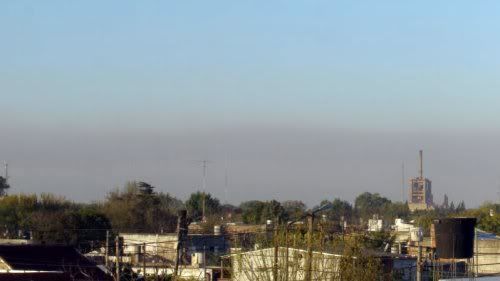
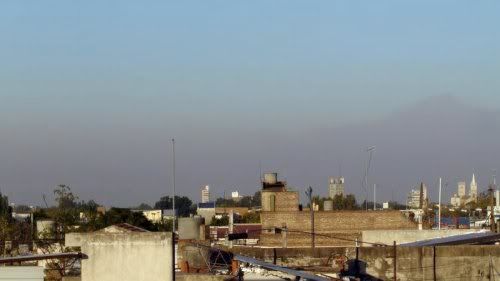
Wake up and smell the smoke, if you haven't! I've noticed this blog has many occasional (or one-time) readers. So, for the ones just tuning in, this is about the fires covering the Argentine littoral (and its capital) with smoke. Here's a few pictures, all taken from the coast of Rosario, Santa Fe, Argentina, today around noon. We're 300 km north from Buenos Aires (whose name has never seemed so much of a joke as nowadays, he he...). A seamless cloud of gray smoke covers the eastern horizon. The islands of the Paraná delta are on fire, because the owners of the fields have once again employed the ancient method of clearing scrubland with fire.
The Rosario–Victoria Bridge has been re-opened to traffic after a couple of days of being partially or totally shut down. You can barely see it, though, from this point located only 7 km away. Remember this is noon, and the picture has been enhanced for contrast.

You can't go from the south of Santa Fe to Entre Ríos if you can't use the bridge — you have to take a huge detour up to Santa Fe City and cross the river though the Subfluvial Tunnel.
In Rosario we've been enduring the smoke and the ashes for years, but it was only this time that the fires got completely out control and the smoke reached Buenos Aires, thus instantly turning this issue into a national emergency. The presidential minions quickly blamed the farmers (who seem to be guilty of everything that's wrong in the world today, from child hunger to environmental destruction) and Queen Cristina herself ruined her hair by flying over the affected area on a helicopter.

Not a word was heard from the unanswered complaints of Rosario's municipal government over the years, or the complete lack of suitable responses by the Kirchnerist governors of Entre Ríos (both past and present) regarding the fires being intentionally started by farmers in their jurisdiction. They knew who they were, and although there was a judicial ruling protecting their irresponsible actions, those things can and should be fought in court. Anyone with a minimum of foresight could see this coming.
Firefighters are now trying to contain (not extinguish) the many fires throughout the delta's islands. It's impossible to do anything else. Planes cannot go there with all that smoke. The place is a tangled maze of wetlands and streams. I hear we're getting help from the federal government; up until recently there were only volunteer firefighters from Santa Fe and Entre Ríos, the former heavily outnumbering the latter, although (as I said and will keep on saying) the islands are in the jurisdiction of Entre Ríos and whatever happens there falls entirely under the responsibility of the government of Entre Ríos.
Here you have another picture, this time facing due north, so you can see the visual effect of the smoke. The sky is naturally colourless at this time of the day, but the horizon's gray is not natural. The old piers and the silos on the left are closest; the silos and the buildings around are former port facilities. They're not far away, and you can see they're already veiled by the smoke.
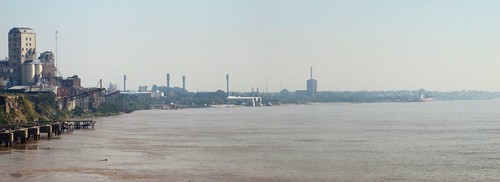
A little more to the right you can see the silhouettes of four towers; they're the illumination towers of Rosario Central's Gigante de Arroyito stadium. On the center-right you have the Sorrento thermal power plant, and then a cargo boat anchored nearby. At that point the coast describes a curve, so what you see right of the boat is much farther away. On a clear day you can see that shore clearly, though, but these days the smoke is noticeable all the time, subtly when you look at buildings a block or two away, and as a thick gray cloud when your line of sight is clear, as in this case.
So far I don't know of people suffering any grave consequences from the smoke. Fortunately most of it is being blown southwest towards Buenos Aires, leaving us with a subtle cloud that runs all along the coastal area of the city, including downtown. It's not pretty, and sometimes it smells, but we can breathe.
In case you didn't like my pictures, here's one from a better perspective, by NASA. The tiny red circles are fires. Rosario is the grayish splotch to the right of the leftmost one (above the ra in Parana), beside the green mass of the delta.

17 April 2008
Wake up and smell the smoke
"Smoke paralyzes the country", warns Perfil, "Retiro station is closed and trucks cannot leave Buenos Aires". "Smoke also affects Entre Ríos and Santa Fe", almost parenthetically notes Crítica. "Behind a shroud of fog", ironizes Página/12, echoing the lyrics of the March of the Malvinas, while the accompanying picture shows a grayed-out Puerto Madero. "The smoke in the city will not go away", says La Nación, essentially titling a glorified weather forecast.
All I can say is... wow. To the otherwise uninformed reader, it would seem like this is a unique phenomenon, rather than something we backward hinterlanders have been suffering for years. Cattle farmers of the Paraná river delta in the provinces of Entre Ríos and Buenos Aires have been using fire to clear fields on the islands all along the littoral for ages; the smoke is blown westward towards us (Rosario and the cities south of it), and the government of Entre Ríos has never answered to Santa Fe's requests that they police their territory, or to more desperate requests made before national authorities and environmental agencies. But one day porteños wake up smelling the smoke and the whole country is suddenly in grave danger, paralyzed and terrified.
"It seems the smoke has to reach Capital Federal for someone to try and solve this problem", as Rosario's mayor Miguel Lifschitz tiredly put it. There's a whole chain of islands opposite Rosario, at some points no more than 600 meters from the coast, often employed for recreation, but they don't belong to our municipality; they fall under the jurisdiction of Victoria, located on dry land on the other side of the delta, almost 60 km away, which has never cared for them (except to collect taxes). For years Rosario has demanded that they control the fires and punish the farmers who use them to clear the islands, damaging the ecosystem (an important wetland) and smoking our city. They've mocked us with their silence.
But the governor of Entre Ríos knows better than to bother Buenos Aires. I mean, the president lives there, and she would get absolutely mad if her European furs caught that smoke! So right after Environment Secretary Romina Picolotti called the governors of the three affected provinces, the governor of Entre Ríos Sergio Urribarri promised to work on it, and Victoria's mayor also noted he has a list of the islands' landowners who've been setting their fields on fire, so they can be sued.
Later, though, we learned that this was already done in 2004 — a judge in Entre Ríos took the case and the process ran smoothly, until the accusation was appealed and dismissed. The reason: clearing fields by fire is an "ancestral practice" so it can't be abolished just like that. Even though some of the perpetrators clearly knew that the fire could spread out of control.
In the meantime, traffic accidents have been allowed to happen, half a dozen people have died in the road just last week, and now the Rosario-Victoria bridge is closed to traffic, as are several major routes. The core of Argentina's industrial, agricultural and overseas trade area is half-paralyzed, its ports closed, its roads blocked, for completely avoidable causes due to intentional fires initiated by people who've been identified for a long time — but the real news is that porteños cannot leave their precious city. I repeat, in case you didn't get it before — this is old news to everyone in Rosario and around, but only became a national concern because Buenos Aires was affected.
There's a saying here, "God is everywhere, but His office is in Buenos Aires." It could very well date back to the federalist struggle of early and mid-19th century. That's how long we've been fighting this fight.
16 April 2008
Middle East, Argentina
Suppose you hear the following statements:
- "The first thing Jews do with their children is put guns in their hands. Then they send them to Israel to learn how to use them."
- "Arabs are not terrorists. There are no terrorists among the Arabs. They're peace-loving people. They don't even have guns."
- "It was a shame how they treated Saddam Hussein — they killed a man who was ill and defenseless."
And then, imagine you eventually come around to tell this person what you thought and how disgusted you felt about those words, and among a flurry of incoherent but vehement justifications you get this:
- "Why do you get so upset about this? You're not a Jew."
- "You know, you might be a Jew. You could pass for one. Are you sure you're not a Jew?"
Well, the first part is what happened to me during my third, and last, Arabic language class. The rest took place three days afterward. The person who said those words was my teacher, the founder and current head of the Arabic School of Rosario, who I won't name (though you can find out her name quite easily if you try). It was a week ago. Fortunately I've had better things to do and say, since then, than reporting on this nasty episode.
While I was sitting there listening to this old woman's disgusting antisemitic rant, I felt my stomach turn. Several voices concurred with my teacher, several heads nodded in agreement, someone said something about the Jews controlling the media. The class went on. I thought, alright, this is an 81-year-old woman after all. She's the daughter of Syrian parents. She's seen her ancient land crushed, and Arabs being humiliated, turned to despair and hatred; she's watched young men turning into suicide bombers. It's natural, I thought, that she has a one-sided view, that she's resentful, intensely angry, even blindly mad at the attackers. I left in a daze.
Then I realized I'd been a coward. I should've stood up and said something. I would've made a scandal. It wouldn't have served any purpose, but I knew I wasn't going back to that classroom, ever, so that wasn't a problem, and I could possibly get my classmates to think.
And, I thought, I made a mistake being kind to that old lady. It didn't matter that she was 81 years old, or that she was partly right about the suffering of the Arabs under Israel's attacks and the worldwide wave of racist anti-Arab sentiment. Her romantic view of the Arabs as peaceful, family-loving, law-abiding people who don't keep a single gun in their homes was a dream that insulted the thousands of people murdered by Islamic terrorists around the world. She wasn't an incoherent old woman; she spoke clearly and precisely. She wasn't just criticizing the murderous policies of the state of Israel or its treatment of Israeli Muslims as second-class citizens; she spoke of "the Jew" and how he teaches his children to kill, and the evil alliance between the U.S. empire and the Zionists. In her head she thought she knew what she was talking about. She had (she has) no excuse.
And no excuse is what I got when I finally confronted her, just before the next class. I think she didn't even understand what troubled me. I didn't expect to change her mind, but at least hoped she would get angry. I needed that. I didn't get it. She said I was "a good boy", if only a bit too sensitive ("since you're not a Jew, why does it bother you so much?"), and that I had tried "to be just". She said she wasn't anti-Jew — "I have lots of Jewish friends". I asked her, well, have you said those things in front of any of your Jewish friends?
That was last Thursday. Besides several hours of my time and the sign-up fee, I felt I'd lost an opportunity. Fortunately I had a terrific weekend, and I can write this now, free of those somber feelings of failure.
03 April 2008
Vacations in Córdoba: Carlos Paz and back
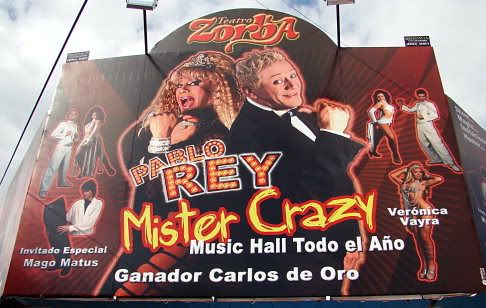
Our last trip was to Carlos Paz, a city about an hour from Córdoba. Carlos Paz is a busy town traversed by the small San Antonio River, with opens into Lake San Roque, formed by the dam of the same name. It's an all-time tourist trap, not unlike Mar del Plata, and like Mardel, it's full of over-colourful marquees advertising plays starred by wrinkled middle-age "actors" and busty "vedettes", shops selling all kinds of souvenirs, and endless crowds of fat tourists with loads of kids that push you and trip over you and block your way in the sidewalk.
Carlos Paz (like Mar del Plata) is the paragon of overvalued touristic spots — people come here and happily, obliviously, fill it to the brim, paying whatever they're told to pay, going through the motions, and thus the town inexplicably survives until the next season. Nothing changes. There's no incentive. People will continue to come, so why spend money on beautifying the city?
It's not that Carlos Paz is ugly. It's not. It's just ordinary. Supremely ordinary. Run-of-the-mill, featureless, flat. There's nothing of note here. Not a singular piece of architecture, not one place of breathtaking natural beauty. Nothing. Sure, you've got the river and the lake, and the sierras beyond — no big deal: there are a million places in Córdoba and elsewhere with the same natural features and less irritating surroundings.
So why did we go? Well, although I didn't particularly liked the idea, Marisa wanted a place with a quiet spot by a body of water, not far from Córdoba City, and I agreed with that. And neither of us had been to Carlos Paz in a long time (I think I went there as a child). We weren't prepared for it.
I was determined not to leave a single peso in this awful town, but tradition demands that you bring back alfajores when you go to Córdoba, and we were leaving the next day so we might not have the time to go shopping then. So we went into a shop and bought several dozens. Those alfajores were the only good thing to come out of our visit to Carlos Paz.
We went back to Córdoba and, though very tired (I was actually ill all this time — I'll tell you about that later), decided to take advantage of our last night, so we went out to see an artisans' fair. I don't particularly care for those, but the night was pleasantly cool and the fair had an upbeat vibe. We bought home-made liquors there, and Marisa got a purse to give as a present for her niece. Then we had dinner nearby, and went to bed early.
The next day was our last, so we finished packing our stuff and then studied the map — had we missed anything? I saw we hadn't seen the Museum of the Marquis of Sobremonte. Rafael de Sobremonte was Governor-Intendant of Córdoba for 14 years. Outside the province it's known as the guy who was in charge of the Viceroyalty of the Río de la Plata and ran away from Buenos Aires with the royal treasure when the British attacked the capital city in 1806. It seems, however, that Sobremonte was doing what he must. As for Córdoba, he's said to have been an excellent administrator there.
 The museum, as in other cases, turned out to be the house where Sobremonte lived, an old colonial-style building, simple, with thick walls. I wish I had good pictures of it, but all we were allowed to photograph were the patios. Some rooms preserved furniture and personal effects, others were just used to display objects of the time — military uniforms, weapons of various kinds. On one of the big inner yards were several large bronze cannons.
I noticed the rooms were very well-kept, but the outdoor areas weren't — the cannons were simply thrown there, exposed to the elements. Policemen (museum security) were sipping mate next to one of the rooms. There were plastic buckets and other cleaning tools next to one of the venerable walls. It looked as if, leaving aside the rooms allocated for the museum, the rest was free to use by anyone in charge.
The above notwithstanding, the museum was a nice place to see. It was larger than it seemed at first, so it kept us busy almost exactly until the time we had to leave.
We did a small detour back to the hostel to take pictures of the Cathedral, which was now almost empty (it was Tuesday, and the rage of Easter weekend had passed). They're restoring it, so we had to stay out of certain areas.
After that, we headed for the hostel, got our luggage, took it to the bus station (only two blocks away, thankfully) and sat down to wait for our bus, which came almost in perfect time, for which I felt stupidly happy at the time. You know what happened next...
12 March 2008
Traffic incidents
One always assumes that, barring the very few intentionally planned homicides and "crimes of passion", people who run over other people with their vehicles are not doing it on purpose in any sense, and traffic accidents are exactly that — bad things which just happen. All too human mistakes. Bad luck. Randomness. Things going bad at the wrong time.
In Argentina, things seem to "go bad" all the time, so our traffic accident record is appalling. Each Monday, on TV, we get the tally of the weekend's road casualties alongside the football match scores. The tally is never zero, or even close to it; often it's in the double digits. Sometimes it's so bad it makes the international news.
In our law there are these two main alternative views of death (I guess this must be the case in other places as well, though the names and details are sure to vary) that apply to traffic accidents. If you killed the other person on purpose — e.g. you drove as carelessly as to make certain that you'd eventually hit someone, or else (as in most cases) you killed the other person truly by accident. You're still guilty in the latter case (unless the victim jumped in front of the car or something like that), but the legal consequences aren't as great as in the other scenario.
Most drivers don't want to run over people and kill them in the streets; yet most drivers in Argentina often drive as if they didn't mind killing themselves and as many other human beings in the process. At the very least they bypass traffic laws that they deem unimportant, put too much trust in their driving skills, and justify themselves with the lamest excuse in the book: "everyone else does it". Think about it, and you'll find it very difficult to continue referring to those dead and maimed human beings as victims of "traffic accidents".
At last the law is doing something about this. A prosecutor is asking the court to change the accusation against a driver who hit a motorbiker and killed him, last November, in Casilda (45 km west of Rosario). The driver was being investigated under the charge of homicidio culposo (that's more-or-less involuntary manslaughter), but the prosecutor wants him to be charged with homicidio doloso (which implies a degree of willfulness, and stops short of plain murder). This is a new one — and it might establish a precedent. Jurisprudence is not as important in our system (which is one of civil law, rather than the common law system of Britain and former British colonies), but a precedent like this cannot be dismissed.
And just what did the driver do? He drove his pickup truck, at about 9 AM on Sunday, down an avenue, at over 70 km/h. He hit a motorbike he couldn't not have seen, and dragged it (and its driver) more than 20 meters. He didn't try to dodge, and he didn't brake. He was in a hurry because he had a punctured tire and wanted to get it fixed before it was completely flat. And he was reported to have been under the influence of alcohol at around 7 AM. We don't know if the report was accurate, because he didn't allow the police to test him — which made his troubles worse.
We simply can't allow ourselves to keep this "shit happens" stance regarding traffic. Motor vehicles are potentially lethal weapons; and as with weapons, it holds true that "cars don't kill people; people do". Maybe this guy gets the sentence he deserves. What I really hope, though, is that this serves a purpose. Let careless drivers think twice about what they do, and the rest of us should stop thinking of traffic accidents as something akin to the weather. They're not random, and neither (as many seem to believe) is a tendency to recklessness embedded in our genes. "We Argentinians are like that, plain and simple", "there's nothing to do about it", "this country will never change" is bullshit.
27 February 2008
Rain all over
The weather has become unstable as of late, maybe a sign that the tranquil workings of summer's furnace are finally being disturbed by the proximity of the equinox (still more than three weeks away). In simpler terms, it's hot, but it's not sunny and hot all the time — sometimes it's just clammy.
It's softly raining as I write this. Right now I should've been at the Flag Memorial, preparing to watch the reenactment of the first hoisting of the Argentine flag, which took place on the banks of the Paraná River exactly 196 years ago. But it rained cats and dogs right after noon, and then it started again a couple of hours ago, so they called it off, together with other outdoors activities planned for tonight. Of course, the rain did not bring any relief to the heat — it's the same steam-bath as yesterday. With a little more steam.
Like most people I know, I'm a bit sick of this summer. I'm overwhelmed by the heat, the low pressure, the humidity. I don't have the strength to go out and walk and take pictures, or to try resuming outdoors exercise. I spend way too much time sitting before the computer, but I can't think. So I don't have much to tell, and I don't feel like sitting down to write it down, plus I'm having real heavy work at the office. All of this is why I'm blogging intermitently, instead of every day.
The office — that's a real mess. For obvious reasons I can't reveal too much about that here, but let's say conflict is bubbling just below the surface of the provincial administration — the bitter underground conflict between those who want to get to work and finally see there's someone paying attention to their work, and those who have never worked or wanted anything but to suck the state's tit and devote office days to gossip over coffee, and now feel threatened but can't express it openly for fear of being discovered, even though everybody knows what they are. Yes, folks, such are the deep human dramas you find in our public offices.
I intend to wait for more cheerful topics, or at least interesting ones, before I write one more blog post. Let us hope together...
31 January 2008
Vacations: Malargüe revisited: Last day
On our last day in Malargüe we repeated last year's trek to the dam on the nearby Malargüe River, 8 km from the hostel, only we set off in the morning, as early as we could manage to get up, after a delicious breakfast of home-made bread and jam. We took a more direct route, so we arrived earlier, but then we spent a lot of time leisurely lying on the grass and sipping mate.
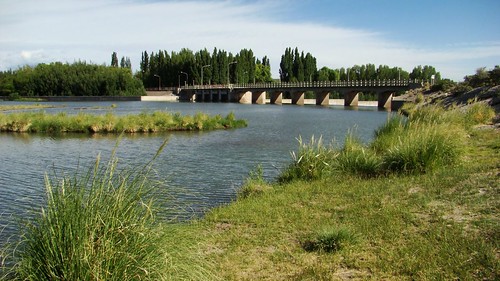
On our way back to the hostel (in fact, right before the entrance gate), we found an overflowing irrigation ditch and had to walk on the little wall that formed the edge of the bridge crossing the ditch. By lack of attention or sheer bad luck, I stepped on the wrong spot and found my right leg sinking into the cold water of the ditch along with half of my body. The other leg must have slipped somehow, though not before my left knee hit the concrete edge. I cried out for help, and my two friends promptly lifted me up. Though I was soaked from the waist down, the water was clear and my backpack got only slightly wet in the bottom. My wallet was miraculously spared, as was the bag with my camera in it. But my knee hurt so much I couldn't stand or walk.
After the initial pain subsided, I managed to stand on my feet, supported on both sides by my pals, and step by step get into the hostel. Once in my room, I changed my clothes and surveyed the damage. I got a few bleeding scrapes and bruises, nothing serious. But the knee was hurting badly, and I was devastated — I thought I'd broken something and this was the end of my vacations.
In the end, I took a Diclofenac pill from one my friends, and plopped into bed for a nap. I felt much relieved (and less desperate) when I woke up.
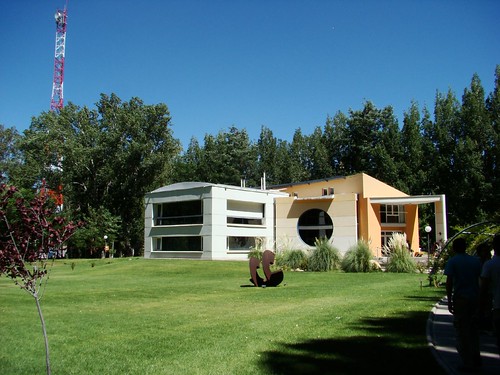
In the late afternoon we took a cab to the city in order to visit the seat of the Pierre Auger Observatory, which is the largest cosmic ray observatory in the world (about 1,500 high-energy particle detectors spread over 3,000 km² in the southern Mendoza desert). We heard a lecture explaining their work and their latest findings.
(We tried to get into that lecture when we went to Malargüe in 2007, but the facilities had been overwhelmed by a troop of about 20 nuns.) After the observatory, we walked around town looking for places to restock our cooking supplies. We got noodles, rice, oil, some non-perishable vegetables, and a few other things we needed. My knee bothered me all this time, but I could follow, if only at a slow pace.
We had bus tickets for San Rafael, and from there to Neuquén, booked in advance. The next day we left Malargüe.
28 January 2008
Vacations: Getting there is half the fun
 The title is ironic, of course. The weather was oppressive the day when we departed from Rosario. We took the Chevallier bus to San Rafael, Mendoza, at 8 PM (in full afternoon glory, thanks to our crazy DST scheme). There's no direct bus from Rosario to tiny Malargüe so we had to make a combination.
Off we went, west and south. Some time afterwards it began raining lightly, and then a T-storm broke out. Nothing serious. Around 1 AM, near Venado Tuerto (I'm guessing), the bus stopped. A tree or a branch or something had fallen over the road, so all traffic was stuck.
At first nobody told the passengers what had happened, so we speculated it was a car crash. Then we learned about the tree and started waiting for whoever was in charge of removing it.
We stayed there for over an hour, possibly an hour and a half. I slept in short stretches, while the rain continued. Finally we resumed the trip, but instead of arriving at 9:15 as scheduled, we got to San Rafael around 11 AM. We missed the bus we could've boarded at 10:15, and the rest were all full. The next available bus departed at 6 PM. We were faced with the choice of taking that bus (spending 7 hours in San Rafael) or looking for emergency cheap accomodation in San Rafael for the night. Now San Rafael is a nice city, but not particularly attractive, and we were after all carrying our huge travel bags, so we couldn't possibly just take a walk around and do sightseeing. And San Rafael's bus terminus is truly creepy, a cramped half-block with dirty platforms and unpleasant-looking little shops, with some people looking as if they either want to rob you or sell you a fake Rolex, to the point it reminded me of Paraguay.
The alternative, however, wasn't really for us. We didn't want to spend a night in San Rafael, but anyway finding accomodation was hopeless, and it entailed losing the day completely, as well as a night's expenditure. So we dragged our bags from the terminus to a nearby public square, and I set off looking for two things: a phone to call the hostel's folks in Malargüe to ask them not to cancel our booking, and something to eat for lunch. I got an OK from Malargüe, and got us the ingredients for sandwiches. After those, we sat there sipping mate, getting suntanned, and generally looking like out-of-luck bums. The bus finally came in time, and after almost three hours of travelling south with several stops seemingly in the middle of nowhere, we reached our destination at about 9 PM (under a Patagonian sun at full blast). I was back in Malargüe at last, after a year of waiting for the peace and quiet of that little corner of Argentina, and 25 hours in the road.
23 November 2007
Blackout count: 3
The Power Supply Fluctuation Watch recorded a new event yesterday. Blackout #3 of the 2007/2008 season has been assigned the name Carlos. It began with minor drops of voltage just after sunset, followed by recovery, and ending with a large loss of voltage that lasted until the morning.
In other news, the outgoing government of Santa Fe led by Governor Jorge Obeid continues to appoint scores of its own officials, political allies, and friends and relatives of the governor, his cabinet, and influential former governor Carlos Reutemann, to high-ranking vacant posts in the public administration, the judiciary and the Provincial Power Company (Empresa Provincial de la Energía, EPE).

Sorrento power plant
EPE is said to have serious shortages of personnel in certain areas, while others are overpopulated by (or were just created especially to harbour) unqualified people appointed there in violation of regulations just because they have family or political contacts in the management. Wages paid by EPE are legendarily high. The company will close 2007 with an estimated AR$90 million deficit, double the figure of 2006, and will have to be asisted with government (i.e. taxpayers') money.
Since the Front for Victory lost the election in September, the provincial government has been cutting supplies to its public offices, and the quality of its services has gone downhill. This hasn't prevented the government party to advertise itself using the same posters that appeared during the campaign — huge colour prints boasting "4 years of hard work, without raising taxes". The Peronists seem to be determined not to leave a single coin, a single spare printer ink cartridge or a single made-up vacant post on their way out, and are turning the judiciary and the (formally) independent control offices into a minefield for the next administration.
Boy, this will take years to fix...
15 November 2007
Anniversaries and natural rhythms
Today's the anniversary of the Hail Hell. On November 15, 2006, a storm with hailstones big as golf balls brought Rosario to its knees. The effects are felt even today. You can still see its marks in some cars, whose owners could not or would not repair, and the hysteria that ensues every time hail is mentioned in a weather forecast as a slight possibility shows that people haven't forgotten.
I've always said that having a car is like having a child. A very dumb child who never grows up and demands constant attention and lots of expensive food and gear. Some actually treat their cars as they would treat their children (or better). A car will never learn to avoid hail, and so people who can't be bothered to walk ten blocks every morning and choose to clog the streets with their cars are doomed to be always on the alert, so they can run to their little babies and put them under a roof if the need arises.
(If you think the above rant is a personal digression of mine aimed at specific people, you're right. But it may apply to you, so think about it. For the most part a car is not needed for everyday activities here in the big city. You know that.)
As befitting the anniversary of a weird weather event, today's weather is also messed up. There's not a cloud in sight and no hail is possible, but the morning looks and feels like it was June instead of November. I've never seen a mid-spring season like this, with temperatures falling below 10 degrees Celsius as soon as the sun goes down. Yesterday, though the sun was blasting, it was cold and windy even at noon. Half the people I know (including myself) caught a cold or something worse last week.
Up until a few years ago, there used to be a certain day in the year (it could be September, it could be October) when your mother said "Well, kids, let's take all the warm winter clothes out of the drawers and off the hangers, fold them and put them away neatly in the closet's top drawers which you have to use a chair to reach. We'll take them down next year when the cold season comes. We won't need any of it until March." Such a thing is impossible today. We live by cold fronts and heat waves today — no seasons.
05 November 2007
The cogs of the political machine
An Al-Jazeera video showing how politicians buy votes from the poor through punteros (middlemen), how they manage to confirm that those votes were actually cast, how much they pay, and how politicians hire people to fill their meetings and cheer for them... No less sickening because we've always known this is so.
31 October 2007
Blackout count: 2
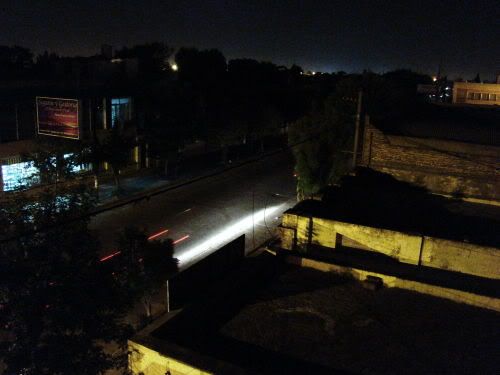
This is blackout #2 of the 2007 blackout season. The Power Supply Fluctuation Watch has assigned it the name Betty. Betty was a Type IIaS blackout (partial, small area, duration between 2 and 4 hours), and it was recorded in the northwest of Rosario, Argentina, beginning at about 21:30 hrs on 30 October 2007.