The legislative elections are over, and if you're following the news, you'll be surely aware of the big picture: Néstor Kirchner has lost, the government's power in Congress has been cut down, and several presidenciables (that is, likely presidential candidates) are already lining up (or have been lined up by the media) for the 2011 election.
So I'll just concentrate on the small things and the analysis. First, let's get Kirchner out of the way... Néstor Kirchner lost to Francisco de Narváez by a handful of votes, a lot of votes actually, but only about two-and-a-half percent of the Buenos Aires Province vote. Of course, what happened is that the list of candidates headed by NK got a few votes less than that led by FDN; in formal terms it was a tie, but Kirchner's insistence on the paramount importance of this election worked like a self-fulfilled prophecy: almost everyone assumed positions as if it were the one and final battle of a war, and the election turned into an opportunity to bash the government. And bashed it was: Kirchner, who had achieved record levels of popularity during his term, lost to a group of the strangest bedfellows politics has inflicted on us as of late, led by a right-wing Colombian-born multimillionaire with an image constructed hastily by the media in a matter of months. Many of the so-called "barons" of Greater Buenos Aires, who rule the poorest and most densely populated parts of Argentina as virtual feudal lords and are keen observers of reality, betrayed their alliance with Kirchner, unnanounced.
In any case, after what must have been a very long night and a terrible day, Kirchner dutifully resigned from the presidency of the Justicialist Party. He released a short video accepting the defeat and I swear he looked mildly drugged.
Yesterday in the afternoon, Cristina Fernández de Kirchner gave a press conference. First she started out by reciting highly optimistic figures for the composition of the new Congress, and feigned not to have the exact numbers of her husband's defeat on hand (while, as everyone knows, she probably had the figures down to the least significant digit painfully etched in her short-term memory). Then she tried to turn the whole thing on its head, pointing out how an awful lot of people had still voted for the government's party. When a journalist pointed out that she'd gotten 45% of the vote when she was elected and now her husband got only 31%, she was upset and accused the media of having a double standard because they hadn't gone and asked that to Mauricio Macri and his candidate Gabriela Michetti (in the City of Buenos Aires, Michetti got 30% of the vote, only half of what Macri and her had gotten two years ago). She also resented the petitio principii of a journalist who asked about the manipulation of INDEC's figures of inflation — which did beg the question, of course, because the government has never admitted to that manipulation, although everyone, including some of the president's favorite economists, is certain of it.
At that point, approximately, I stopped watching the press conference. It was pointless. Either Cristina has learned nothing or she needs a few days to let it sink in, but based on previous experience, the latter is unlikely. We're left with the hope that she won't attempt something funny before December, when the new Congressmen will take their seats.

30 June 2009
After the elections

 Stumble it!
29 April 2009
Testimonial candidates, or, lying for Kirchner
 In the past, people voted for parties. But the candidates were important. They were expected to support the party platform, but also to do things independently, since a party's legislative bloc is not a committee. Otherwise it would be simpler to choose one representative per party and give each a certain number of beans to represent their voting power.
When Resolution 125 was killed in the Senate, the Kirchners realized that legislators were not beans they could count and hold in their hands. But Cristina and Néstor still need their beans. Now they're dangerously close to losing the majority, they'll do anything to retain it, including the latest fad: "testimonial" candidates.
Testimonial candidates are the quintessential beans. They're not even expected to get elected and then vote as the party leader tells them: their only function is to bring in votes. They're expected to resign without even taking office and leave their place to their stand-ins and to the next ones in the list. This is so because testimonial candidates must perforce be highly visible characters with political influence, and these are already taken up, mostly at executive positions, so they're not to be "wasted" as mere beans.
A few weeks ago, Néstor Kirchner told a number of loyal governors and mayors of the Buenos Aires metropolitan area to run for legislative posts, with the understanding that they'd have to campaign and let their valuable names be placed in big bold letters at the top of ballots, but nothing else. They are to (unofficially) take a couple of months off from their government obligations and just get elected. Most of the mayors accepted to run for the post of city council member. Some said they wouldn't, but offered to put their spouses or children on the lists instead (that's advertising by association for you); after all it's not as if beans must know what to do once elected, except raise their hands at the appropriate moments. The governors weren't so obedient, but Daniel Scioli, the governor of Buenos Aires, the largest and wealthiest province of Argentina, complied. He's now the best known of testimonial candidates.
Why "testimonial"? Well, the Kirchners believe (or want us to believe — it's not clear) that they're leading a movement based on a certain "model". El modelo is said to stand for a lot of very nice things, like wealth redistribution and social justice. It's like Christian salvation. Like religious believers, the governors and mayors are being told to testify. Their contribution to "the model" is to be where the leader tells them to, defending the bean count (i.e. the legislative majority). There's no need for them to take office; once the beans are in place, it doesn't matter who they are; in fact, it's better if they're not well-known, politically experienced people, as these tend to become ambitious on their own. The testimonial candidates just stand there saying "I support this model".
Whether this insulting farce will work or not, we'll see after June 28.
15 January 2009
Seven point two
One strongly feels that this is about it — it's just not possible to lie any more than this and still pretend to be in contact with reality. The government first denied there was inflation, then accused a vaguely defined ensemble of foes of fueling price increases, all the while letting the thuggish Secretary of Trade, Guillermo Moreno, mangle the figures produced by INDEC. Last year the mangling became unnecessary: you don't have to tweak the figures when you've intimidated all the figure-checking personnel into silence or replaced them by your own employees.
Although the real inflation rate, as measured by several independent sources, is about three times the one reported by INDEC, it doesn't really matter to anyone (except the holders of inflation-pegged bonds, for whom this represents a fraud for $5.5 billion). People in the streets have turned from anger to indifference. As in many other respects, this once promising-looking government has abandoned us. We know they're lying, they know we know, and we know they know we know. How they plan to stay on top for three more years like this is a mystery to me. We can only hope they will die with a whimper and not with a bang.
03 December 2008
Expensive, those principles (by Martín Caparrós)
What follows is a translation of an article by Martín Caparrós on today's Crítica Digital (Caros, los principios) about the sweeping tax and capital smuggling amnesty proposed by Kirchner's government and currently being discussed in Congress. In dire need of fresh funds, Cristina is basically offering criminals a free pass to launder their money in Argentina, and inviting all those Argentinians who illegally sent their undeclared foreign currency abroad to take them back without paying taxes, dropping any legal investigations under way. [For some more background, see the American Task Force coverage.] Caparrós, once a leftist militant, again voices his disappointment with this supposedly progressive government, whose true leader (Néstor Kirchner) famously said he would never agree to check his principles at the door of the Casa Rosada.
The good thing is that we now at least know how much they're worth. Or rather how much they believe they're worth. (It may be, if anything, as in the classical sudaca joke about the best business deal: buy an Argentinian for what he's worth, sell him for what he thinks he's worth.) We now know, I was saying, the price. They're not cheap: they must believe their principles are better than they look — and they're charging a lot for them. The savings repatriation and tax moratorium proposal, which Congress began discussing yesterday, is that: a price label. They were supposed to have some principles: equality before the law, opposition to financial capitalism, a "new tax culture", a push towards some [wealth] redistribution by the State, an insistence on justice being made despite [purposeful] oversights. All of which crumbles when the government tells those who took away the money, those who evaded taxes, that there's no problem, that everything's forgotten. For a handful of dollars: various economists reckon that, on the best scenario, five percent of the Argentine capital that escaped might come back — that is, some six billion. That, if anyone believes them and brings in the bucks, which isn't a safe bet at all. With luck, the State could recover 10% of that 5%, some 600 million, and at the same time, of course, take advantage of the modicum of reactivation that money could bring to our economy.The translation is free; the links are mine. Caparrós employs a few local references that may not be obvious unless you live in Argentina: the use of sudaca as a self-effacing slur; the soundbite por una nueva cultura tributaria ("for a new tax culture") which the Federal Tax Administration uses to advertise its fight for citizens' fiscal responsibility (which this moratorium turns into a mockery); the diego or "10% commission" — an euphemism for bribery; the expression punto final, which compares this obscene pardon for the wealthy to the law that halted investigations of the dictatorship's crimes. It just came out and I felt I had to share.
That's what their principles are worth. Or rather the price of shitting on them: if you laundered money, if you evaded taxes, if you forged your bills to take home your "10% commission", don't worry, we'll fix it; and if you were in jail, you can now go home. If you stole 10 kilos of beef from the butcher's on the corner, or 80 pesos from some boy on a dark street, then no, this deal doesn't include you. Evading taxes is not stealing from one person — it's stealing from all of them, from the State which should spend that money on schools and hospitals for everyone, or at least for those who don't have them. Tax evasion is robbery worse than any other robbery: it's robbing those who have the least. These are the crooks this law wants to spare: the big crooks, the shirt-and-tie ones, the friends.
That's why this law is a full stop: a point of no return. If they pass it as it is, they won't ever again be able to speak of their principles: they will have sold them, under the excuse of a crisis that didn't exist days ago. A bit expensive, it's true: as in that bad joke.
03 November 2008
Nationalizing pension funds: more money for the Kirchners?
It's time again for a depressing anti-government post! This time, about the nationalization of AFJPs (private retirement funds). I strongly feel it's a good idea, and as strongly as that I also feel we must keep it from happening as intended by president Néstor Kirchner. (If you think Cristina's the one in charge, you must be living inside a jar, as we say over here. For months she's been devoting her time exclusively to cutting ribbons to [unfinished] public works and, lately, to writing newspaper articles in praise of her husband's ideas. Néstor is de facto big guy.)
Now you mustn't believe I do this because I like destructive criticism. I'm absolutely for "big government" as Americans call it, and I believe important stuff should never be left fully in the hands of private corporate interests whose creed is "make money fast whatever way you can". Kirchner's government has taken us far in this sense, and that's OK.
The problem with the Kirchner administration is that they always, somehow, manage to turn good theory into bad practice, and for a long while now (and not because the media or the far right are trying to make it look so, as C&K passionately believe) everything they've proposed has been born tainted by association. Or, as in this case, destined to fail before (a good part of) public opinion because common sense and the typical Argentine paranoia will kick in, and all alarms will go off, as soon as the state gets close to our pockets.
About 15 years ago, the law that allowed the creation of the AFJP system was drafted and passed, accompanied with a heartfelt defense of private capital accumulation (the so-called "capitalization scheme") by many who now profess to be old-time fans of the old-fashioned state-regulated collective saving scheme, including many faithful Kirchnerists (flip-flopping is another word for pragmatism — the only thing that can be truly called "Peronist doctrine"). Gobs of money were transferred to private capitalization accounts from the state's coffers, and the AFJPs (Administradoras de Fondos de Jubilaciones y Pensiones) started recruiting associates. The law said if you didn't choose where your retirement funds should go, then it would be automatically assigned to an AFJP; thus millions of distracted workers were signed up for a massive speculative operation. The AFJPs invested money in assets of various kinds and for a while they actually increased their clients' funds, although they charged huge commissions.
Pensions were frozen for ten years, as the economy entered into a low-growth phase, unemployment rose steadily, and finally recession entered the picture. After president Carlos Menem (cursed be his name) got away with murder, president Fernando de la Rúa found the dying economy and, instead of trying to resuscitate it, he finished it off with such nice measures as cutting 13% of pension payments. We all know what happened then... so fast forward to 2003.
Néstor Kirchner passed a series of decrees increasing both salaries and pensions, which were well-received, even as employers complained. The economy took off and pensions did as well. There was a small problem, though: the private pension funds couldn't keep up. They started losing money. The law said that the state must guarantee pension payments, if necessary by compensating (subsidizing) the private funds. So the state poured money into the AFJPs, whose risky investments had proven disastrous (does that sound familiar?), and when the companies began accumulating too much debt, the government forced them to buy national debt bonds. Yes, that's right: the government forced the guarantors of retirement funds for millions of Argentinians to accept what amounted to wet paper in order to rid itself of them (the only other feasible destination for those bonds was Hugo Chávez).
In January 2008, after the scarce enthusiasm that followed Cristina's election had faded, someone near her came up with the idea of "letting people choose" where to place their retirement savings. The Kirchnerists hastily passed a law opening up the choice for everyone: 180 days to take your money away from the private box to the state's bag (or the other way round). And the law also established that, if newcomers to the labor market didn't explicitly choose which way, their funds would go to the state system, not some AFJP. The AFJPs understandably lost a lot of clients, but in all fairness they deserved to, and the law didn't force anyone to accept anything against their interest. It had some other very good points as well, so good in fact that, "better late than never" aside, some of us wondered why it hadn't been passed before. Like four years before.
The answer came easily. Why indeed? Because it was only now that the economy had begun slowing down, while debt payments were looming closer and the whole economic structure was showing the strain. High inflation, high interest rates, no way to get fresh funding for things like the bullet train, and the need to pump more and more money into subsidies for electric power, drinking water, fuel, natural gas and everything else. Néstor Kirchner had always ruled with a big wallet of state money freely available to him, but Cristina's future was uncertain. The fresh funds from the AFJPs, of course, should have never been used to fund the state in any respect other than pension payments, but the new law didn't say anything about that. Already in 2007, his last year, Kirchner had signed a decree allowing the government to divert funds from ANSeS (the social security agency) to expenses such as public works.
After the fiasco of Resolution 125 (another, more desperate attempt to get money for the state) came the worldwide financial crisis. After being deprived of juicy taxes on exports of soybean, both exporters and the government have seen the prices of soybean plummet to half the levels of the first quarter: less and less money! Subsidies on buses, natural gas and power were reduced, but that's not enough; with a world recession looming, and the economy visibly decelerating, it would be economic suicide to raise the prices of basic services. On top of that, 2009 is an electoral year, and that means a lot of wills and votes must be bought. Back then, Néstor and Cristina could campaign all year round, visiting one town after another in provinces with "loyal" governors, handing out multimillion checks without any real oversight, and making sure crowds of bussed-in "supporters" would be ready to applaud their presence; but all that costs money.
The national state keeps about 70% of what the provinces contribute, and what it shares, it does so rather unfairly. Most provincial governments are strapped for cash right now, and more than a few are absolutely dependent, on a short-term basis, on presidential whims when it comes to distribution.
Kirchner's desperation is now becoming noticeable. Initially he ordered the bill that nationalizes AFJPs to be approved and turned into law at once, without any changes. His parliamentary bulldog, deputy Agustín Rossi, first attempted this, then saw it was impossible, and timidly conceded that the government's bloc would accept discussion of the finer points.
Now, the bill seeks to overturn a 15-year-old system with millions of associates, in a context of financial turbulence, and to do so in a matter of weeks, so that all the money from the private pensions can be transferred to the state's social security before the end of the year. Not only does this negate the choice of millions of people who decided to stay in the private companies earlier this year, but it also looks rather suspicious.
Why the hurry? True, the assets of the AFJPs are taking heavy hits from the world's financial meltdown. But those things come and go. It's also true that the AFJPs haven't given their associates what they promised, and that they've engaged in some dubious practices. That's something to be settled with general audits. If you have a critical system that doesn't seem to work as intended, you don't decide to break it. You fix it and keep it going while you prepare the transition. The president can count on ample powers, a Congress controlled by overwhelming margins, and a social consensus that private pension funds aren't a good idea for most of us. I repeat, why the hurry? Cristina still has three years to go.
This administration has frustrated me time after time. I'm really tired of seeing great ideas given such bad names by the Kirchnerist gang. I'm fed up with having to agree with certain people... being forced to be on the same side as some who hold principles completely opposite from mine.
Yet I have no alternative. It's just plain common sense that the Kirchners want the private pensions' money to continue their incessant campaigning for their own permanence. They have no new ideas, no plan, no policies, nothing but a hunger for power that sometimes translates into seemingly brilliant developments, soon marred by corruption and negligence. Are we as a nation doomed to go from one rotten set of politicians to another?
08 October 2008
Argentina's economy: what now?
Everybody's talking about the financial crisis, so I thought I could chip in with my two cents..., especially seeing how our own Argentine government continues to deny we'll face serious trouble. In fact, President Cristina Kirchner has devoted a lot of time to deride, with barely concealed glee, the proponents of globalized laissez-faire capitalism (we must acknowledge that "kicking them while they're down" never felt better) and to defend the Kirchnerist achievement of decoupling Argentina from international market shocks, which would be terrific — if it were true.
First of all, not to despair: we are, as Cristina says, better prepared than ever in recent history for the shock. The problem started outside our borders (we have different problems) and we'll just have to slow down and wait, hoping that they don't spill into our own economy. For example: we need money to pay our foreign debt next year (and it's a lot of money — more than we owed before Néstor Kirchner renegotiated it, because we actually exchanged debt for more debt), and it'll be difficult to get money from abroad or to refinance the debt once again, with interest rates being so high and everybody clutching desperately to their remaining assets; but we still have a fiscal surplus and a trade surplus.
The peso-dollar rate jumped a bit, too, and that will help the trade surplus. There's just one problem — we're dependent on imports of all kinds, so a higher exchange rate means inflation. And one more problem: the Brazilian real has devalued as well, only much more brutally, so Brazil will be able to sell cheaper stuff to us, they won't be able to buy as much from us, and they'll be much more competitive with respect to third parties. Brazil has a long-standing state policy of industrialization; we don't. Brazil can cope with lower or higher exchange rates; we can't.
Yet more problems: our trade surplus feeds our fiscal surplus, via retenciones (export taxes), especially on soybean products. The price of soybeans (as with other commodities) has taken a deep dive, so that means less revenue from exports. China buys most of our soybeans, but China, like all countries around the globe, will start buying less of everything. Less revenue from exports means less available money to (for example) cover the costs of subsidizing inefficient public services and utilities, and funding public works. The national government has already left the inner country to its own devices, delaying or altogether abandoning plans to build homes, schools and such (Minister De Vido lies, as usual); now it's Buenos Aires's turn. Natural gas, drinking water, domestic power, buses, trains, the subway — they'll go up and up, while construction (the engine of Argentina's economic recovery since 2002) will come to a halt. Tourism and foreign investment will suffer as well; people in the US and Europe simply won't have money to spend on Third World countries like Argentina.
There's a political problem as well, because 2009 is a legislative election year, and the Kirchners doubtless had plans to pour money into cheap, quickly-unveiled public works all over the country, as Peronists are fond of doing; that just won't be possible in this scenario. Least of all if the opposition gets to revise the budget, which contains certain provisions deserving a "best fiction" award, plus the infamous "superpowers" that let the Chief of Cabinet move around huge chapters of the budget under the excuse of an economic emergency that supposedly ended years ago.
All in all, it looks like the next months will bring a "plateau" in Argentina's so far swift growth, and the Kirchnerist government will have to deal, for the first time ever, with a tight budget. It's easy to play when you have cards, as we say over here. The feeling of opportunities for true growth, for industrialization, for true redistribution of wealth, wasted and lost and now unlikely to return for a few years, is almost unbearable.
03 September 2008
Musketeers of redistribution: Guillermo Moreno
This is the third and last installment of my translation of the Crítica Digital article titled Los mosqueteros de la redistribución ("The Musketeers of Redistribution"), which shows how the Kirchner administration has failed to redistribute income, which they claim as their main economic goal. This time it's about the worst offender in many respects, Secretary of Commerce Guillermo Moreno. This is what the article says about him:
In theory, his mission was to keep inflation from diluting the purchasing power of fixed-wage workers and retired citizens. The price agreements that he signed with companies at the beginning ceased being complied with long ago, except for [the statistics bureau] INDEC, where Moreno draws the lines of his private world.Of course I've already written about INDEC and its ridiculous, obscenely faked figures of inflation, which the government continues to defend as true. Moreno is de facto leader of INDEC, which used to be a purely technical organization, fairly independent from the national government and thus trustable, until Néstor Kirchner decided he didn't like reality and let Moreno appoint his minions in places of power there. And that's not all.
[The manipulation of INDEC's figures] is a well-known story. Less known are [Moreno's] practices to favour concentrated companies, consolidating monopolic or oligopolic markets. For Moreno, competition is [a subject] for textbooks. He has always chosen commanding phone calls and verbal agreements with the major actors in each economic sector (cereal producers, mills, supermarkets, dairy companies, food companies, etc.) over transparent regulations that might discourage [the formation of] concentrated structures and encourage competition.Guillermo Moreno is the kind of official that any sane administration would get rid of as quickly as possible, preferrably offering him (as compensation) a trip to some faraway land. Cristina Kirchner's unspoken excuse for keeping him is that everybody in the opposition and the major media is asking for Moreno's head, so firing the guy would be interpreted as a sign of weakness. I can understand that, but it also shows quite plainly that Cristina cares more for an appearance of overwhelming power and firm determination than for doing her job well despite her personal pride.
The removal of José Sbatella from the leadership of the National Commission for the Defense of Competition, key to the enforcement of anti-monopoly laws, is the culmination of that process. Sbatella, a professional with a long career, ruled against the Cablevisión-Multicanal merge, which two of Moreno's deputies in the Commission approved on the last day of Néstor Kirchner's term; Sbatella also set conditions for other multi-million [company] purchases in the food sector, which were not taken into account.
Moreno is a wrench in the most sensitive part of the economic machinery; the more he stays, the more difficult it will be to restore the credibility of the government regarding inflation and their goal of reducing poverty. Right now we don't know how many poor people there are in Argentina, but we know for sure they're many, many more than Cristina Kirchner and Guillermo Moreno would admit.
31 August 2008
Musketeers of redistribution: Ricardo Jaime
Continuing with the translation of the Crítica Digital article titled Los mosqueteros de la redistribución ("The Musketeers of Redistribution"), about the subsidies granted by the Kirchner administration.
The second musketeer of redistribution is the Secretary of Transport, Ricardo Jaime. During the first semester of the year, subsidies to transportation (urban buses, trains and subways) reached AR$2.66bn, up by 71% compared to the same period last year.Néstor and Cristina Kirchner (for all practical purposes, it's all one open-ended presidential term) have channeled billions into subsidies for public and private companies, with almost complete freedom to alter the budget and without oversight, so these figures are important. They usually say they need freedom to redistribute the income collected by the state so that it reaches the poor, but in fact all that money and all that freedom gives a few people a huge amount of power. Unsurprisingly, they've been using it to benefit the companies.
Subsidizing public passenger transportation is not an Argentine invention. And there's a consensus that such subsidious mostly benefit the lower-income rung of society. However, here we have doubtful criteria for assignment of subsidies, [which are granted,] in the case of bus companies, on the basis of sworn statements without control over cost structures, and in the case of trains and subways, over cost structures that are inflated by companies linked [to the main ones] as suppliers.If you've travelled by train in Buenos Aires, it should be obvious to you that the companies that provide the service aren't pouring money into it. I mean, people have set fire to train stations out of anger, due to how bad the services are. By giving money to private companies and not overseeing their investments or forcing them to give a reasonably good service, the government is an accomplice of fraud. If the Secretary of Transportation can't make sure that people aren't treated like cattle in buses and trains that he (using our money) is paying for, then he should resign.
Aerolíneas Argentinas is a completely different matter. The poor do not generally travel by plane. The decission of re-nationalizing is debatable, but valid if weight is conceded to arguments such as regional integration or economic development. What is not trivial from the point of view of redistribution is who will take on the cost. Jaime said that, if it were up to him, he would pay nothing to the Spaniards of [the Marsans group]. And he says they gutted the company, while he looked the other way for five years…This is especially relevant now that Aerolíneas is being really nationalized. It certainly looks as if we'll be buying back a company laden with debt and with a dismal record of service, and we'll be taking care of fixing it.
There is not a successful precedent of redistribution, either, in the case of LAFSA, the state company that in 2003 took care of the employees of former companies LAPA and DINAR. LAFSA never flied and today it is in the process of dissolving itself. But in the budget there are still funds set aside to pay the salaries of 99 employees, about 10 of them with wages above AR$10,000 per month.Empty shells masquerading as actual companies for accounting purposes are so common in Argentine history that this surprises no-one. "Enterprise ethics" is an oxymoron in Argentina. This case is also interesting because the state invokes the welfare of the workers to justify the intervention in the finances of failed companies. We're hearing this kind of thing in the debate about Aerolíneas Argentinas as well. At the risk of being accused of insensitivity, I think the state should decide whether it wants a serious company that works and can sustain itself as a flagship airline, or a mockery of an airline whose main purpose is to produce money for its workers, some of who have never done any actual work besides showing up at union meetings.
I'll be posting the last installment of this series in a few days.
24 August 2008
Musketeers of redistribution: Julio De Vido
Long time no write, sorry. I resume the translation of the Crítica Digital article titled Los mosqueteros de la redistribución ("The Musketeers of Redistribution"), which shows how the Kirchner administration isn't Robin Hood taking from the rich to give to the poor, as they arrogantly assert all the time.
… [T]he residential natural gas fee in Buenos Aires amounts to 30 cents per cubic metre. However, four million low-income households which have no access to the natural gas supply network are forced to buy [pressurized natural gas] containers at a cost of AR$1.70/m³, that is, almost six times more. Since the devaluation [of the peso, in early 2002] the residential gas fees have been frozen; but the price of the 10-kg gas container has climbed 275%, to an average of AR$30…. [Minister of Federal Planning Julio] De Vido authorized the deregulation of the gas container market, in which [the private company] Repsol YPF is dominant, and in exchange offered the so-called "social container", which is impossible to find at the price of AR$18 suggested by the State. Even if you could get that, the price (AR$1.20/m³) would be four times that of the network gas….That is, the government forces the natural gas companies to sell their product at ridiculously low prices to a mostly middle-class public (and gives those companies a good excuse not to invest on surveying and expanding their network to less privileged areas) and allows Repsol YPF to charge six times more to the poor who aren't reached by the network, or who can't pay for a connection to it. (Until a few years ago my neighbourhood itself wasn't connected to the NG network — when it was our turn, we had to pay something in the order of AR$700 to get the pipes into our home; the equivalent price today must be three or four times as much.)
With more concern for fiscal health… in the last weeks Cristina's government started giving signs that it will unfreeze the utility fees. The astronomical growth of subsidies would threaten the fiscal balance if tax revenue were to falter in the future. … During the first semester [of 2008] the energy subsidies alone amounted to AR$8.2 billion, 295% than the same period [in 2007]. The announcement of hikes in the power fees will be followed by the slow thawing of residential natural gas fees.More about this coming soon...
The interesting thing is that the increases follow a segmented criterion: more [percent] increase for those who consume more. According to data provided by the power distribution companies, 7% of the high-income households account for 25% of the consumption. In the case of natural gas the concentration is similar.
If progressive [as in gradual?] adjustments had been applied two or three years ago, the State would have avoided a huge transference of wealth to the pockets of the less needy. Why wasn't it done before? De Vido used to explain it was not easy to identify the bills of the higher-income households, something acknowledged as possible only now.
11 August 2008
Income redistribution?
An example of why I don't consider Cristina Kirchner's to be a progressive government, and why the Kirchnerist mantra about their income redistribution goal is a big lie, and why I think it's OK if the middle- and upper-class heavier consumers are charged more for utilities: an article on Crítica Digital, titled Los mosqueteros de la redistribución ("The Musketeers of Redistribution" — Minister of Federal Planning and Infrastucture Julio De Vido, Secretary of Transportation Ricardo Jaime, and Secretary of Domestic Commerce Guillermo Moreno). I translate freely:
"This year, one million families with incomes in excess of AR$6,000 per month will receive a state subsidy of AR$750/month in the form of cheap power, domestic natural gas and fuel. This is the equivalent of five social plans [welfare payments] of AR$150/month, which are still received by little less than one million household heads under the extreme poverty line."The minimum wage has been recently raised to AR$1,200, from an earlier figure of AR$980 established in July 2007.
"We have already written about the sales boom of natural gas-powered heaters for swimming pools, of the rage in 1,000-watt searchlights for the gardens of the most exclusive closed neighbourhoods, or the growth of the market of high-end diesel cars. Since nothing is free in economics, these subsidized prices are paid by the state, which this year will give away nearly AR$20 billion to compensate energy companies."For comparison, the federal state collected taxes for about 17 billion in March and 24 billion in July, so this is like giving away a whole month of taxpayers' money. You could argue the subsidies go to the taxpayers, only they're not the same taxpayers. Most of those billions come from the IVA (our VAT), which is 21% over most goods and services (including food), so the poor pay a disproportionate amount of it, because everybody needs food, and most of what the poor buy is food. A smaller amount comes from a profit tax that leaves ample room for evasion, and that the government doesn't even try to collect. In fact, the government is about to exempt individuals with monthly wages over AR$3,300 (single) or AR$4,500 (married with children) from the profit tax, detracting from the total collection.
The government actually benefits from the "inflation tax". Every month it proudly exhibits huge and increasing tax collection figures, which is easy when your main source of revenue is tied to the prices of consumer goods. Coupled with INDEC's low inflation rates pulled from Guillermo Moreno's ass, it lets them believe or pretend that the country is growing fast, although that plainly happens only in nominal terms.
"From the total subsidies to the energy sector, the generous Argentine State will provide this year AR$9bn to subsidize the consumption of that higher-income social group. Incredibly, there are still well-off middle-class people who complain that the State "gives away" Jefes de Hogar welfare plans, which today are received by extremely poor households mostly headed by women. The 2008 budget for the Unemployed Heads of Household programme is only AR$1.8 billion."Yes, many in the middle class are really angry that the poor "don't work, don't pay taxes and get money from the government", while "decent hard-working citizens" have to struggle to go on vacations or change the car every few years. I've heard borderline middle-class citizens demand that the government "sends those lazy bums to work", disregarding the fact that most of them are single women with small children, or young men who have no qualifications at all. This is the state's fault, but taking away their welfare payments is not a viable remedy.
"So as to dispell all doubt regarding the magnitude of the redistribution exercised by [Julio De Vido's] Ministry of Federal Planning: the nine billion pesos devoted to subsidize the consumption of well-off citizens are well above this year's budget for the Ministry of Social Development (AR$7.6bn); they're on par with the annual budget of the Ministry of Education (AR$9.3bn); and they represent 2.5 times the budget of the Ministry of Health (AR$3.5bn)."This was just the first part of the article devoted to the "Musketeers of Redistribution", who (as you see) wield huge power over the lives and fortunes of Argentinians, and who are accountable only to the office of the President. If and when I have the time, I'll translate another part.
23 July 2008
March of the penguins, part 2: Two down and counting
 Things are moving in the government of Cristina Fernández de Kirchner. Although the Scourge of Statisticians Guillermo Moreno hasn't been removed (yet?), Secretary of Agriculture Javier de Urquiza had to go, and today the unthinkable happened: Chief of Cabinet Alberto Fernández has resigned. De Urquiza was replaced by Carlos Cheppi, formerly head of INTA (the National Agricultural Technology Institute). Fernández's place will be filled by Sergio Massa, up to now mayor of Tigre, Buenos Aires, who led ANSES (the National Social Security Administration) back in 2002. On inquiry, Massa said he'll be there to serve as "the President's spare tire". What personality.
Alberto Fernández, the man I once called "quite possibly the most aggressively ignorant and intolerant minister Argentina has ever had" and "that filthy rat", has been with us for a long time; when Cristina Kirchner was elected he was one of the many things left over from Néstor's government she should've thrown away as quickly as possible, and didn't. As both presidents' mouthpiece (the official spokesman for the Presidency was merely decorative), Alberto was in charge of implementing the policy of constant derision of the opposition and the media that made Néstor Kirchner well-known as a "strong and confrontational leader" — which he was, until he became simply a bully. But Fernández started to fade together with the Kirchners' popularity ratings, and he just wasn't himself since the long farm tax crisis began, during which he conducted unsuccessful meetings with the farming leaders. Rumours of his resignation had popped up every now and then since April or May.
This government defends its own members more than it cares for its own sustainability, its image, or its results. Fernández should've been expelled when he was the most aggressive and the most unpleasant in the eyes of public opinion; most people would've liked his shrill voice to be silenced, and the government would've scored points; now his resignation won't serve any real purpose. But hey, one less Fernández can't be a bad thing altogether.
Some recent pearls of wisdom from Alberto Fernández:
- In May 2007, as inflation grew beyond the obfuscation powers of Guillermo Moreno's INDEC: "The opposition candidates are dealing irresponsibly with the issue of inflation… They're trying to create inflationary expectations in order to ruin Argentinians' lives."
- In August: "[After Néstor Kirchner's four year term] we are standing at the gates of paradise."
- In September: "There's no inflation in Argentina."
- After the 2007 presidential election, which Cristina won in the countryside (!) and lost in the big cities (Buenos Aires, Córdoba, Rosario): "I ask porteños to stop voting and thinking as if they were an island."
22 July 2008
March of the penguins
It seems the first casualty of the Kirchners' defeat in the Senate won't be a senator but one of the most revolting elements in the government, Secretary of Domestic Commerce Guillermo Moreno. So say some people. But the news channels disagree: was it just a rumour, or will Moreno leave after all?
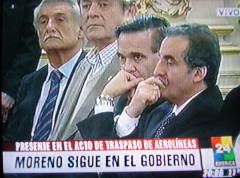
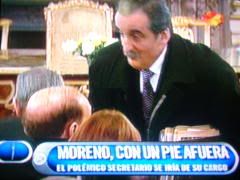
Does he stay or does he go? Same place, almost the same time.
Moreno is a thug. Just as Néstor Kirchner is the de facto president despite Cristina's formal title, Moreno de facto handles microeconomic policies (or what passes for that) as if the Minister of Economy, Carlos Fernández, did not exist. (I've only seen or heard this Fernández guy speak twice or three times on TV.) He deals with "price fixing agreements" (Kirchnerspeak for price controls) and, through his mafioso acquaintances, manages INDEC, the census bureau that protects us from the harsh reality of inflation by fudging the rates every month.
Moreno was one of the leaders of the mob that drove a cacerolazo away from the presidential residence last month. On Monday afternoon, a couple of hours before the press conference where Cristina Kirchner announced the nationalization of Aerolíneas Argentinas (and its massive debt), his mob at INDEC attacked the office of the opposition union ATE, whose members (also INDEC employees) have been protesting the Kirchnerist tampering of the inflation rate since it began. They threatened the employees and, after they escaped, trashed the office. The authorities did nothing. The police arrived late.
Moreno is just an extreme example of the characters that populate Kirchner's camarilla, and of his way of doing things. Most of his (and Cristina's) top officials are criminals in some way or another — they simply don't make it so clear.
18 July 2008
Julio Cobos hits Kirchner with a piece of sanity
Yesterday at about 4:15 AM I got out of bed, went to the bathroom, and went to the kitchen grab a glass of water. I'd gone to bed early, as usual, the latest news reporting that the government's export tax bill had accumulated 37 votes as announced by the senators themselves, with 35 votes for the opposition. So it was with masochistic intent that I turned on the TV, expecting to see hordes of Kirchnerists beating drums and waving banners in celebration of the victory of their leader's will.
What I saw instead was Vice President Julio Cobos, presiding the Senate, slowly taking the microphone, and at the bottom of the TV screen there was a huge announcement: "URGENT - THERE IS A TIE AT THE SENATE - COBOS HAS TO BREAK IT". The vote tally (as announced) was 36–36. A senator had done a major flip-flop at the last minute. Cobos wanted to put off the vote and continue the debate later to reach a consensus, but the leader of the majority had rejected it outright with a biblical quote: "What you must do, do quickly" — Jesus' admonition to Judas. Cobos took a while. First he ordered the vote. It was a tie. In this case and only in this case, the president of the Senate gets a vote to add to the 72 senators.
Cobos then took the mike (and here I was, half naked and suddenly very awake before the screen in the dark kitchen) and with a croaky voice and many pauses, he explained that he had to follow his inner convictions, that he thought the bill as it was was less than useless, that he hoped he would be forgiven if he made a mistake, and finally (by the time the leader of the majority looked like he was about to explode) that he could not vote yes.
The session ended in a mess. Canal 7, the state channel, immediately cut the transmission and went back to some old documentary. The rest of the news channels switched to hurried analyses of the vote and to the triumphal speech by Eduardo Buzzi, president of the Argentine Agrarian Federation, in the farmers' encampment in Palermo. I went back to bed, but I couldn't sleep. I got up again at 5:30 to go to work.
The papers closed late to catch the news. The papers from Buenos Aires must have arrived in Rosario at about 10 AM, and then they disappeared from the stands. Everybody was speaking about Cobos and the Kirchners. The vibe I caught (I don't presume to speak for the whole of public opinion) was cheerful and hopeful. Like when you're watching a movie and the bad guy is beaten for the first time and the happy ending is not there yet, but you can see it coming. The only concern was for the Kirchners' ability to process the opposition, accept it, and work to fix what's wrong — an ability to accept they might not be absolutely and automatically right every time — an ability they have so far shown not to possess in the slightest.
Yesterday afternoon Cristina went to one of those stupid inaugurations she likes so much, and gave a calm speech where she spoke of "defection" and of "those who haven't yet understood what our project is, but eventually will", avoiding names. Two hours ago she'd had to call a few people to notify them she wouldn't resign, a rumour that had been floated by her own close ones, and which was apparently was what Néstor Kirchner wanted.
I wrote about this in a slightly different mood on Sin calma. If you read Spanish, check out Es para Kirchner que lo mira por tevé. I still have lots of things to say in both places.
06 July 2008
More complicated than seven votes
Last Saturday evening the mobile tax exports bill was approved by the Chamber of Deputies. Now it will go to the Senate, and if approved there it will become law.
Each politician and political pundit in Argentina has a slightly different view of the legislative debate and its result. The Kirchnerists are publicly exhilarated, though of course we don't know what they actually believe. For the hardcore K-people, it was a show of power and a triumph of loyalty. For the less sophisticated (the usefully idiotic palaeo-leftists, the Peronist Youth, and all the scum between those extremes), it was victory against the "oligarchy". For more than a few legislators, however, it was simply well-deserved relief from the strain of being pulled in several different directions — by the de facto President Néstor Kirchner, by the farmers, by the governors of agricultural provinces, by the urban middle class threatening with more cacelorazos, by our vulture-like media.
For the ones who lost, it was either the first step towards the unification of the opposition or merely one battle in a war that won't end soon. And they got a precious victory of principles: Cristina Kirchner had to subject to the will of Congress.
Mathematically, the result was simple enough: 129 to 122. The Front for Victory had to call on all of its allies for help, and some of their own defected. If three of the Río Negro deputies hadn't been offered a tax exemption that benefits the apple and pear producers of their province, the difference would've been reduced to one vote. If a certain deputy hadn't chosen to abstain at the last moment, instead of voting for the first minority, it would've been a tie. A year ago, even six months ago, Kirchnerism could've passed any law; yesterday it could've lost by a few votes, if only certain deputies hadn't been bought beforehand. That didn't happen, so the Kirchnerists won.
Néstor Kirchner won — the deputies explicitly ratified the authority of the President to set and modify export tariffs. This is so unconstitutional even a ten-year-old could take this matter as far as the Supreme Court, as it will most surely happen, but Kirchner has never been bothered by the law. The rest of the bill was changed almost beyond recognition — first it establishes a new tax and then it returns the money to 85% of the taxed. But the core of the problem, the one thing that matters to Néstor Kirchner, and which we citizens should never stop protesting — the short line that says that the President is entitled to do as she pleases with tariffs, is still there. So Kirchner can count this as a victory.
However, in a sense, it may be said he lost, too, and he's taking her wife and her party down with himself. Cristina Kirchner's approval rate has plummeted, most people don't believe she exercises power in more than symbolic fashion, the party is divided even at its core, and its alliances are coming apart. Right after Felipe Solá announced his vote against the export taxes, fellow Peronist deputy Carlos Kunkel called him "you traitor son of a bitch" so that everybody could hear. Vice-president Julio Cobos was told to "shut up" by an anonymous phone caller, echoing a previous, slightly more polite suggestion by minister Alberto Fernández. Cobos, who will be presiding the Senate next week, calmly replied he won't resign ("How could I resign, when so many people voted for me?"). Many of Kirchner's former allies, who are aligned with Cobos, will vote no to the taxes.
It's been almost four months since this all began, and everything has turned to the worse — consumer spending is down, credit rates are up to ridiculous levels, capital flight has accelerated, the high dollar-peso rate that made industrial exports competitive has had to be decreased to avoid a run on the dollar, and estimates of GDP growth have been taken down a couple of notches already. The export taxes that should've brought billions into the government's coffers are nowhere to be found, since the farmers refuse to sell, and the government is paying tens of billions per year to subsidize utilities and public services, and somehow has to honour a few additional billions of debt payments. Kirchner hates the idea of "cooling the economy", so public spending continues to rise. How will this end? One ugly word — stagflation.
English coverage:
- Al Jazeera: Argentina parliament backs tax hike
- Yahoo!News: Argentina grain tax bill clears lower house
- BBC News: Argentine MPs approve farm taxes
20 June 2008
Flag Day 2008 (no pictures this year)
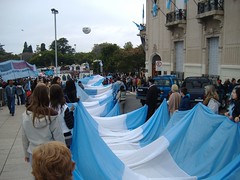 Flag Day 2007
For reasons unknown to me, Argentina commemorates great men and their deeds at the date of their deaths rather than their births or the actual events that made those men great. So this death anniversary is Flag Day. I wrote about it last year (Flag Day 2007), which was a big deal because it was also the 50th anniversary of the construction of the Monumento a la Bandera (Flag Memorial).
This time, however, I refrained from attending the ceremony and the parade. Besides the awful weather (cold, windy, cloudy, and threatening to rain) plus my own concern for my health (I'm still recovering from the cold I caught last weekend), there was too much going on for it to be just a festive meeting of the citizenry.
Until a few days ago, nobody knew whether Cristina Kirchner would preside over the official celebrations in Rosario, as protocol dictates. The "man in the street" view was that she would either (a) employ any excuse to avoid coming to Rosario, where she'd meet harsh popular opposition, or (b) come here bringing along a couple tens of thousands of "supporters". The latter hypothesis was likely, given that the shock troop leader in the service of the Kirchners, Luis D'Elía, had vowed to come to Rosario today to cheer for the President, "defend democracy" and "vindicate the flag", defiled by the May 25 meeting. However, D'Elía went overboard with his call to "take up arms" against those who wanted to "destabilize the government", and the Kirchners backed away from him.
Then the President went and presided over a partisan rally, two days ago. It was organized and paid for by the Presidency, i.e. our taxes, but it was undoubtedly a Peronist rally. The CGT union even decreed a national strike (it was effective only in Buenos Aires) to allow workers to go see Cristina. This rally was seen as both a provocation and a confirmation that Cristina would only address her selected supporters from now on. The idea that she might have thousands mobilized again, to Rosario, 300 km away from her only real center of political power, and along a national road that is blocked in a hundred places by people hostile to her policies, was beginning to sound ridiculous.
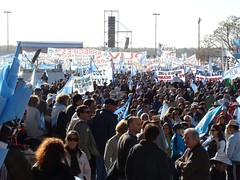 May 25 meeting
The middle class, in fact, hates Cristina with a passion. Even the local leftist movements are against her in her fight with the agricultural sector. The governor of Santa Fe, Hermes Binner, is a Socialist who supports the legislative debate of the export taxes that Cristina would've chosen to impose. The mayor of Rosario, Miguel Lifschitz, is also a Socialist. Cristina, like her husband, is used to have local authorities on her side wherever she goes — authorities that can be counted on to fill the spaces at rallies with cheering people.
 So she chose not to come. The excuse was "bad weather" — plausible, but nevertheless just an excuse. Two days ago, when "bad weather" couldn't be assured, the national officials in charge of protocol and presidential security were already conspicuously absent, when usually they should be planning and coordinating with local police and municipal officials here in Rosario. Then it was announced that Cristina would be instead in Quilmes, near Buenos Aires, in the afternoon. And finally, she moved once again and decided she would do some other minor stuff in Hurlingham, because it's going to rain and there's a roofed stadium in Hurlingham. (La Nación says the Flag Day celebration was moved to Hurlingham. That, as someone pointed out, is incorrect. What moved was Cristina and the presidential political machine, not the official seat of this patriotic celebration, which is duly held in Rosario, as has always been the case.)
It's a pity that the President misses the true celebration. I for one would've considered going if she came, though mainly to boo her. Some of my fellow citizens would, I think, as well. Others were understandably afraid that the Kirchnerist mob would hijack the celebration and disallow the expression of dissent. And yet others were planning to boycott the President's coming to Rosario by hanging black flags on the balconies, instead of sky-blue-and-white Argentine flags, or by simply leaving when she began her speech. She's spared us from choosing among those sad alternatives.
Yesterday I was thinking that Rosario has traditionally been a progressive city, with critical citizens, who never receives attention except on Flag Day, when protocol compels the chief of state to be here for a couple of hours. In ten years Carlos Menem came three times, and the last one he was basically ignored (the weather was awful, like today). Fernando de la Rúa never came, since he couldn't have gotten out alive. Néstor Kirchner came twice, and only the first time he was greeted with enthusiasm; the second time he had to bring his occupation troops with him. Cristina backed away already.
I was writing to someone who lives abroad about this, and I said I felt this feeling of refreshing insolence against the government. Not the bitter anger of people who don't know what the government will do to them, but a healthy mixture of disrespect and rebelliousness. Indeed, if one isn't free to insult one's own authorities for fear of being accused of subversion, what's left? Cristina is afraid of coming here to Rosario, where she'd receive the public punishment she deserves. And I'm proud of that.
18 June 2008
One step forward, two steps back
After almost 100 days of doing nothing but fueling the rage of the farmers and a good part of the general public (including many of her voters), President Cristina Fernández de Kirchner took note of the cacerolazo and reluctantly sent her mobile tax exports bill to Congress.
Never one to aspire to perfection, though, she let her husband go on with today's rally at Plaza de Mayo, which was transmitted on Cadena Nacional (i.e. forcefully overriding the regular schedule of all air TV channels to broadcast her speech). The rally was formally an occasion for all Argentinians to hear the President speak live on the current issues of prime importance for the country, but as expected, and as usual, it was merely a distasteful partisan meeting — thousands of public employees and unionized workers forced to attend, plus thousands of "social movements" who herded their militants to applaud Cristina.
Once before the crowd, la Presidenta took again on her Evita voice (which failed her a couple of times) and proceeded to insult the leaders of the agricultural organizations and to accuse those who protested against her government of being undemocratic and disrespectful of the popular majority. Her thesis (we've heard several times recently) is that democracy consists of voting every four years and then either quietly tolerating the decision of the majority, or form a new political party and compete when time is due. That is, all channels of feedback and criticism between the people and their government (except the ballot box) are to be suppressed: public opinion shouldn't be allowed to express itself through the media or through demonstrations and protests. Criticism on TV or the papers means big media corporations trying to destabilize the government. Banging pots and pans in the streets means inciting a coup. The spectacle of thousands of people who despair at the lack of action of their supposed representatives, taking to the streets on a freezing night with their kids to make some noise, to try to reach the consciousness of the ruler, doesn't mean anything but a threat to democracy.
That's the Kirchners' message, the subtext of most of their speeches. Every time Néstor and Cristina have taken one discursive step forward to speak of free speech or freedom of the press, they've proceeded to immediately take two steps back, treating their critics as enemies. So far it's been the media groups and some specific individuals and organizations. Today, it was the people as a whole.
Yesterday, when I heard Cristina's vow to let Congress discuss the tax bill that caused this whole mess in the first place, I was briefly glad about it. But again she'd taken those two steps back. The bill, they explained, deals with a matter of export tariffs and is under the jurisdiction of the Executive, i.e. it's not really a tax. As such, what Cristina sent to Congress was a closed package that can't be opened. It can only be approved or rejected as a whole. If approved, the conflict will be renewed. If rejected, we must assume, Cristina can ignore it, and given her record, it's quite possible that she would. The political costs might be extremely high for her and for everyone in her party. But the Kirchners have already shown us that they care for nothing. They're like blind bulls racing through a china store.
17 June 2008
Cacerolazo, and then?


I was still there when, at 5:30 PM, I received a mass SMS calling people to turn off the lights for 15 minutes at 8 PM and then start a cacerolazo against the government. I didn't pay attention to it. I was too tired to think of protesting anything, I was stuffed full and it was cold. Besides, I didn't think anybody would attend. I got back home at around 7 PM, and one hour later I was proven terribly wrong.
I was exhilarated. On edge. Finally! I only wished I could've been there. People were banging pots and pans or honking their horns or simply out on the streets singing or waving flags, disorganized but not incoherent. Thousands (some say 10,000, some say 40,000 or more) in Rosario around the Flag Memorial, many thousands also in several parts of Córdoba City, thousands in Buenos Aires near the Obelisk and also in Olivos, in front of the presidential residence, where the previous night a small group of demonstrators had been forced to leave by a group of government-paid thugs. And in La Plata, Posadas, Catamarca, Santa Cruz, San Rafael and Mendoza City, Chaco, in the larger cities and the towns of the deep countryside and even the places dominated by Kirchnerist administrations. Some were asking for the President to leave; most demanded that she act — do what must be done to put the country back on track, and send the First Gentleman back to where he belongs.
The hardcore Kirchnerists are in the latest stages of paranoia and denial, seeing coups and destabilization and conspiracies everywhere. Luis D'Elía even called people to take up arms in defence of the government. But the rest of the K people are cautiously stepping back from the mad leader.
Yesterday, vice-president Julio Cobos asked for Congress to intervene and discuss, exactly what should've been done to begin with, and just the kind of consensus-based, non-coercive process Néstor K abhors. Several loyal governors suddenly announced they wouldn't attend the government rally planned for Wednesday at Plaza de Mayo in Buenos Aires. Many long-time Peronists showed their disgust for D'Elía's manners. The K Radicals supported their leader, the vice-president. Here in Santa Fe, governor Hermes Binner put it succintly: "This way of governing is coming to an end."
Today the President broadcast one more of her venom-filled speeches, comparing the downfall of Perón in 1955 to what is supposedly being done to her..., and then, she said that, just to please the ungrateful and the ever-discontent and show her respect for the law, she would submit the export taxes to the approval of Congress. It took her 45 minutes of badly doctored speech to acknowledge that she'd been forced to take a step back.
Now Kirchnerism has an automatic majority in Congress. But it's not the monolithic front it used to be. Even if the retenciones pass the legislative filter, it will cost (we hope) several politicians their post in the near future. You'll have to think for yourself and decide, ladies and gentlemen — and then face the consequences when you go back home to your constituencies asking for their vote.
12 June 2008
Claudio Lozano on Cristina's "political naiveté"
This is a translation of an op-ed by Claudio Lozano on Crítica Digital about Cristina Fernández de Kirchner's speech. Lozano is a left-wing economist associated with the CTA labour union, former Kirchner supporter, and now a national deputy for Proyecto Sur. He speaks of Cristina's acknowledgment that the government's only mistake when implementing the mobile tax exports was the "political naiveté" of thinking that people who earn a lot of money would tolerate the state's demanding of some of that money to give to the poor. The emphasis is mine.
I wish it were the first speech. I wish the argument of political naiveté were believable. I wish we were discussing a serious income redistribution programme while taking responsibility for the fact that in Argentina, since 2007, the economy and hunger are growing in parallel. I wish the debate of a more egalitarian relation between the Nation and the provinces were seriously undertaken. I wish we were in the presence of a government whose goal were capturing extraordinary profits to realize the proclaimed goal of "paying off the Argentinians' deficitary social account". It's a pity that it's not the case. Can it be true that they want to solve the social situation, when INDEC is under intervention and millions of poor people are deliberately hidden from view? What's the reason why the Government speaks of transferring income, and yet its social programme includes no concrete mechanism of transference of resources to families? Does the Government not know that, by just implementing a universal assignment of 100 pesos for every child, extreme poverty (hunger) would be practically eliminated among underage citizens? Does the Government know that simply by setting aside 1% of the annual GDP the issue of hunger would be solved, and with 5% of the GDP poverty would be eliminated altogether? Isn't the Fund created today a bit scarce, when we know that foreign trade taxes will bring in, this year, more than 50 billion pesos? Considering that in the last five years there's been no advance on tax reform, no advance on seizing the profits of oil, mining and fishing, and that in the case of agricultural profits this was done in a small proportion, and granting benefits that favoured the concentration of this economic sector, is today's presidential speech believable? I wish it were true. I wish it weren't just one more speech. But why do we explain what we're going to do with the tax collection above 35%? Weren't export taxes intended to redistribute income?During five years we've heard the Kirchners and their supporters incessantly congratulate themselves on their progressivism. But nothing has been done to make this country more egalitarian. Kirchnerism has an automatic majority on both Chambers of Congress, a Congress that never refuses a command, and yet all they seem capable of doing is extracting money from one sector of the economy using the bluntest tools at their disposal. Even one of Página/12's commentators, one month after the beginning of the farmers' strike, had to acknowledge that the Kirchners' government is not reformist or progressive at all. Poverty and social inequality are much worse than they were 25 years ago, right after 6 years of a corrupt military dictatorship and a disastrous war. A huge gap still lies between the poor and rich in Argentina: the wealthiest 10% earns 30 times more than the poorest 10%, worse than during the neoliberal rule of the Menem administration. The tax system is horribly regressive: 47% of the total tax revenue corresponds to the IVA (our VAT), a tax on consumption, while you pay no taxes of any kind if you win a million through speculation or when you sell your company's stocks.
And on top of this, the president explains that the leftovers from an exceptionally high tax, imposed by the Executive branch without congressional approval, will be used to redistribute income. I mean, wasn't redistribution the main reason why they needed so much money? And if so, where's the rest of it? Because we sure can't see it anywhere.
11 June 2008
I want to believe but...
 Just an example of why it's so difficult to believe in Cristina Kirchner's "redistribution programme": the chairman of the Rosario branch of the Argentine Construction Chamber notes that, of 4,000 popular homes the national government had vowed to pay for in Rosario during 2007, not a single one has been built so far. First they were cut down to 1,400, then the funds never arrived, and as of now "we haven't yet obtained a clear answer from the national government regarding the reasons for the delay… all we have is a promise, without details, that the construction of those homes will begin in the second half of this year." And of course, the budgeted prices of supplies and labour are completely outdated; updating them is a bureaucratically slow process and uses INDEC's fudged (and therefore useless) inflation figures. Considering the expediency shown by the Kirchners to deal with other matters bypassing Congress, the Constitution, and basic attempts at dialogue or consensus, it's hard to see why Cristina can't speed this up.
This report comes after Cristina granted an audience to Santa Fe governor Hermes Binner, who had criticized the handling of the farmers' crisis and asked for a better redistribution of federal funds. Yesterday, after the audience, Cristina gave a speech next to Binner noting that Santa Fe has received a lot of funds for public works, and how that shows in Rosario's growth and prosperity. Well, while it's true that we've received funds, we're still waiting for the national government to pay for the repair of a section of our coastal park that Néstor Kirchner promised to deal with in 2005 (!) and that will be finished no sooner than 2009 (hopefully). And most of Rosario's recent prosperity, as everyone over here above kindergarten age knows, is due to the money coming in from the nearby countryside, the construction boom being just one example. Put simply, when people have money to spend, they come to the big city and splash.
Yesterday, the President rubbed her figures on Binner's face noting that federal money transfers to Santa Fe had increased 30% in a year — which is true of all provinces, because that's how much tax collection increased in nominal terms, mostly due to inflation. She also claimed Santa Fe had received over AR$42 billion since 2003. However, according to our Finance Minister Ángel Sciara, the books only show AR$15 billion on all accounts. And the federal government is behind schedule by about AR$1 billion.
The national government has legal obligations — by law Santa Fe must receive 8.84% of the federal taxes, and that's not a grant, a gift, or in any sense something we must thank for to our most gracious Cristina Kirchner.
10 June 2008
I want to believe
 Cristina, you are a genius! You just sent those coup-inciting filthy rich farmers packing, and you unveiled a master plan that will show Argentinians the extent of your generosity, vowing to put those billions of dollars of tax exports to use on the things the poor and the struggling working class need — roads, public hospitals, unexpensive housing. If only I could believe you!
As I write this, I've just finished hearing President Cristina Fernández de Kirchner's speech on the national broadcasting signal (Cadena Nacional) which she had used only once before. I'm posting it now, on the day after the speech, because I just posted something else, something personal about my weekend, something of no importance.
I must say this — Cristina showed that she's not beyond reflection and change, and everybody took note of that. That that simple fact is a huge relief shows clearly how low our political culture has gone. The President, in the most contorted fashion, acknowledged that the government made a mistake, and asked for forgiveness to anyone she might have offended. I bet several million of my compatriots had never dreamed they'd hear such words coming from a Kirchner.
Now for the real content of the speech, things aren't so bright. Before Cristina began, the official spokesman read aloud a decree that will be published tomorrow, creating a "Social Redistribution Programme", which will be funded by the mobile tax exports on soybean whenever they climb above the 35% mark, and will be in charge of building public healthcare centers, roads and "popular homes". The Programme will be "decentralized", said the Prez; the national government will leave it to the provinces and municipalities to implement what they need. So far, so good.
Now, the Kirchners have been doing this kind of "federal decentralization" for years — it works by giving money to politically obedient governors and denying it to provinces ruled by the opposition (opposition doesn't mean just a different party — anyone who disobeys is opposition). There's no sign that this time it will be different. The Programme's funds will be administered mainly by Federal Planning Minister Julio De Vido, who has the power to do whatever he wants with great chunks of the budget.
At no time during her 30-minute speech did the President explain why this plan is presented to the public now and not before, or why the extra couple of billions that might be collected from farmers couldn't be replaced by the US$4 billion they're spending on a bullet train for the rich. It's obvious the Programme was made up in the last few days, and we Argentinians know perfectly well that such great plans never come to fruition, mainly because middlemen divert (steal) the funds.
Cristina said we're not in a crisis anymore, which is right, I believe. If so, however, our useless, yes-people-filled Congress should reclaim its duty to manage the national budget, which they gave away (in violation of the Constitution) years ago because we were in an emergency. The emergency is over, right?
Moreover, the need for a paternalist, strong-handed government is over as well. We don't need an Evita lookalike implementing her version of a Great Leap Forward. We need a federal state that lets the provinces have their own money and manage it, not granting them leftovers from an unconstitutional tax. Only allied governors and government-addicted mayors were invited to Cristina's speech, to nod and smile and applaud. No room was allowed for dissent. The Kirchners firmly believe they're the only ones who know how to run the country, and they refuse to hear, let alone follow, other people's opinions.
Cristina did one thing right: she noted that it all began because a certain specific group of people, who on average are doing quite well compared to the average, refused to accept that the state took away part of their profits (again). Of course, we all knew that, and it's a testimony of the profound ignorance of the Kirchners that they turned a focalized reaction against tax collection into a divisive countrywide revolt that brought down their image and caused huge losses of money and time for everyone.
Here are links to the coverage of the speech, in Spanish:
- El Gobierno anunció que las retenciones móviles financiarán un plan social (La Nación)
- Cristina anunció un plan social con fondos de las retenciones (Clarín)
- La presidenta anunció un plan social solventado con las retenciones móviles (La Capital)
- Cristina "descentralizó" la distribución de las retenciones y pidió perdón (Rosario3)
- "El error fue la ingenuidad de tocar la renta extraordinaria de un sector" (Crítica Digital)
- and this article published this morning, which follows Cristina's speech so closely that it's obvious it was leaked to the most government-friendly newspaper: ¿Podría pasar? (Página/12)