Showing posts with label malargüe. Show all posts

31 January 2008

Vacations: Malargüe revisited: Last day

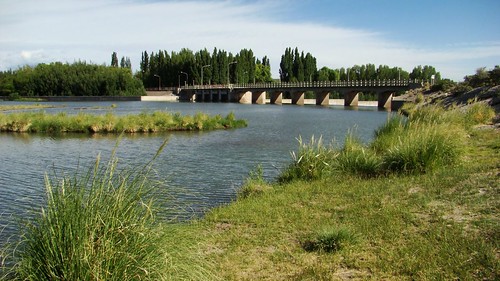
On our last day in Malargüe we repeated last year's trek to the dam on the nearby Malargüe River, 8 km from the hostel, only we set off in the morning, as early as we could manage to get up, after a delicious breakfast of home-made bread and jam. We took a more direct route, so we arrived earlier, but then we spent a lot of time leisurely lying on the grass and sipping mate.

Paz junto al dique

On our way back to the hostel (in fact, right before the entrance gate), we found an overflowing irrigation ditch and had to walk on the little wall that formed the edge of the bridge crossing the ditch. By lack of attention or sheer bad luck, I stepped on the wrong spot and found my right leg sinking into the cold water of the ditch along with half of my body. The other leg must have slipped somehow, though not before my left knee hit the concrete edge. I cried out for help, and my two friends promptly lifted me up. Though I was soaked from the waist down, the water was clear and my backpack got only slightly wet in the bottom. My wallet was miraculously spared, as was the bag with my camera in it. But my knee hurt so much I couldn't stand or walk.

After the initial pain subsided, I managed to stand on my feet, supported on both sides by my pals, and step by step get into the hostel. Once in my room, I changed my clothes and surveyed the damage. I got a few bleeding scrapes and bruises, nothing serious. But the knee was hurting badly, and I was devastated — I thought I'd broken something and this was the end of my vacations.

In the end, I took a Diclofenac pill from one my friends, and plopped into bed for a nap. I felt much relieved (and less desperate) when I woke up.

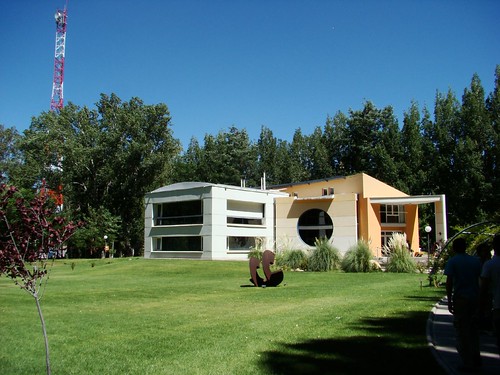
In the late afternoon we took a cab to the city in order to visit the seat of the Pierre Auger Observatory, which is the largest cosmic ray observatory in the world (about 1,500 high-energy particle detectors spread over 3,000 km² in the southern Mendoza desert). We heard a lecture explaining their work and their latest findings.

Malargüe - Observatorio Pierre Auger

(We tried to get into that lecture when we went to Malargüe in 2007, but the facilities had been overwhelmed by a troop of about 20 nuns.) After the observatory, we walked around town looking for places to restock our cooking supplies. We got noodles, rice, oil, some non-perishable vegetables, and a few other things we needed. My knee bothered me all this time, but I could follow, if only at a slow pace.

We had bus tickets for San Rafael, and from there to Neuquén, booked in advance. The next day we left Malargüe.

30 January 2008

Vacations: Malargüe revisited: Valle Hermoso

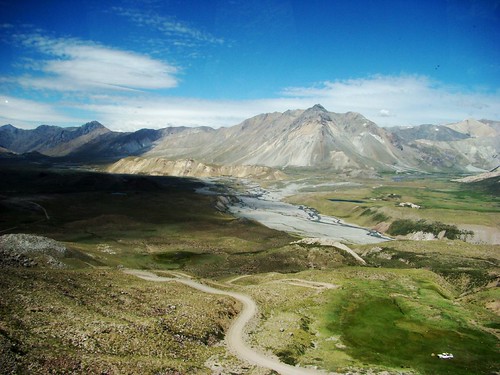
On our second day in Malargüe, we went to Valle Hermoso. This is really a package tour of several locations, with superb-looking landscapes and plenty of opportunities for photography, but not much else. First the van starts climbing and climbing up a dangerously winding dirt road, and (a couple of hours later) you get to see colourful mountains...

Malargüe - Bajando a Laguna Escondida

... and you get to the top of the tour, at about 3,100 m above sea level. You get off to stretch your legs and take pictures, and then you go down for a while and you're taken to the posh ski resort of Las Leñas, where celebrities are said to walk among normal folk without causing so much as a sideways glance.

Las Leñas, though superficially just a bunch of ugly expensive hotels and gift shops parasiting on one of the best places for skiing on Earth, actually owns half of the beautiful landscape around you, including places that no country but a true banana republic like Argentina would ever privatize. Las Leñas is in turn owned by a multinational group rumoured to be led by the president of Malaysia, whoever that is. I wouldn't be surprised to know it's the property of the Reverend Moon or of some other shady religious figure, like G. W. Bush.

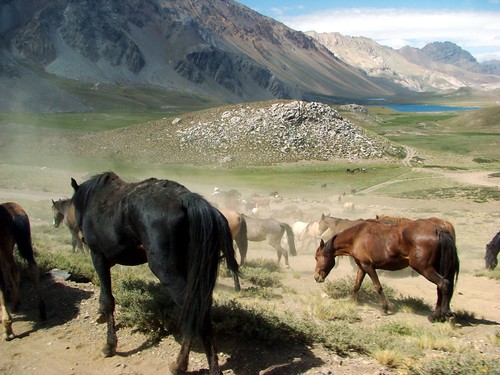
After succesfully making use of Las Leñas for what it was worth (toilets), we took off, climbed again out of the valley, and after a while we started going down again, this time toward our main destination, Laguna Escondida (Hidden Lagoon), a small lake surrounded by a truly dreamy sight (owned by Las Leñas). There were horses being herded, cows grazing on the bottom of the valley, and birds quietly gliding in the wind. It was a bit cold, in fact my first encounter with real cold during the trip, for which I wasn't prepared.

Malargüe - Arreo de caballos

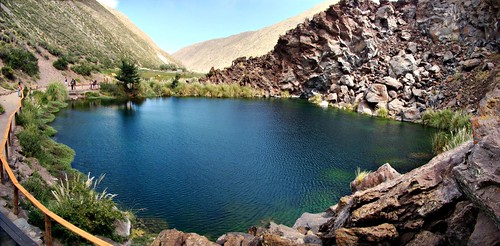
We spent a while beside the lake, watching the campers on the other side (owned by Las Leñas), and then we took off again, now towards Laguna de la Niña Encantada (Haunted Girl's Lagoon), which is more like a big pond of emerald waters. It's protected, so you have to pay a small fee to see it, and you can't even touch the water, but the trip is worth it.

Malargüe - Laguna de la Niña Encantada - Panorama

After a lot of clouds and wind coming and going all day, the weather got really wrong, and it started raining soft, heavy cold drops. It was the end of the tour anyway, so we packed our stuff and left for the hostel.

29 January 2008

Vacations: Malargüe revisited: La Payunia

Since I visited Malargüe last year, I won't describe it all over again. I can't help recommending the place, again, to anybody who wants to sit back and rest and enjoy a very fair climate in the summer, or simply likes the dry Patagonian landscape and doesn't mind long walks. That's your basic Malargüe package if you don't want to spend lots of money.

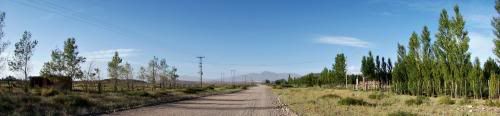
Dirt road in Malargüe

As I explained in my previous post, we lost most of the first day we'd planned to spend in Malargüe because of a delay. We arrived in time to check in to the Hostel Internacional (the same as last year, in the countryside a mile from town), unpack our bags into a room, and cook some rice with vegetables we'd bought in San Rafael for dinner.

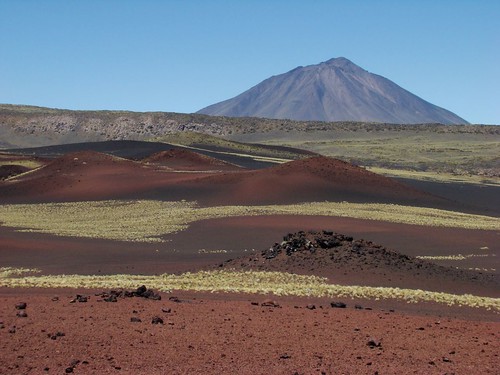
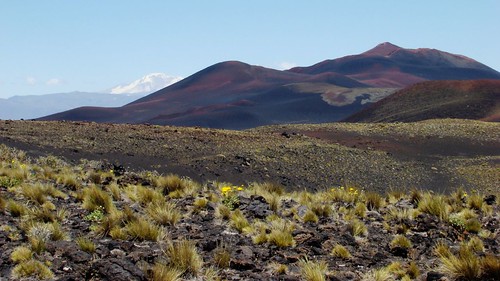
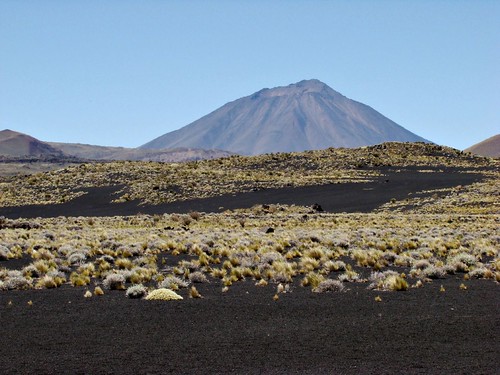
For the following day (Tuesday, January 8) we booked a trip to La Payunia, a nature reserve that consists of a huge volcanic plain in the middle of the desert, dotted with volcanoes of all the types known on Earth, placed together for our enjoyment by the mysterious forces of geology.

Malargüe - La Payunia - Colores

Malargüe - La Payunia - Vista general

Malargüe - La Payunia - Volcán Payún Liso


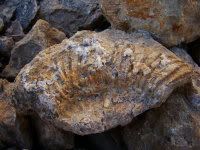
Fossil ammoniteThis area was formerly under the sea. The waters covered all of what today is northern Patagonia, which is why you can found ammonite fossils and others in abundance just by looking around your feet in certain places beside the road. When the Andes rose they lifted up the whole area. At present this is over 1,200 meters above sea level (I think La Payunia is even higher). The volcanoes came later. The Payún Liso (the one with the prototypical conical shape in the pictures) is about 3,600 m high.

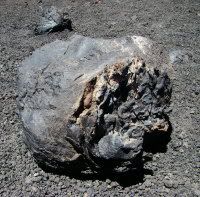
Volcanic bombThe soil, as you can see, has several different colours. They correspond to different compositions of lava and ejecta from the volcanoes. None of them is truly inactive, but I gathered the last eruptions took place millennia ago. Today the visitor walks on a mixture of small porous stones and lava ground to dust, plus volcanic bombs (the one in the picture is about the size of a human head).

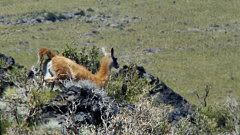
Payunia is a nature reserve, so visitors cannot alter it in any way. You can't leave or take anything from there (I did take a couple of small rocks). The only way to get there is by a suitable vehicle on a very, very bumpy dirt road, which takes three to four hours, and once within the reserve's limits the vehicle must follow the paths already marked by previous visitors; there are no actual roads of any kind. I don't think it rains often. GuanacoThe wind blows all the time with great force — the typical strong Patagonian wind at ground level, and a extremely potent wind when you climb the volcanic hills (our guide took us to a fairly low hill and told us to crawl, not stand up, once we reached the top, since a gust of wind over 100 km/h might easily send a person flying and falling down the volcanic cone). Almost nothing lives here besides a few hardy species of plants, and guanacos, which are protected and, as expected of wild animals, generally don't like people around.

Now my advice for photographers is — take good care of your camera. Mine came back full of dust and is still behaving a bit funny; I'd say a reflex with interchangeable lenses is absolutely out of the question, unless you have some magic way to deflect dust, or restrict yourself to one lens for all shots and have it ready in place before you step out the vehicle.

The Payunia package was one of the two things I couldn't do when I went to Malargüe in 2007 (the other was the Valle Hermoso trip, which I'll come to next). It isn't cheap, and it will take you no less than 10 to 12 hours, which is basically your whole day, but if you go to Malargüe, you absolutely must go. You won't get this for less, and you won't get it anywhere else like this. The place is immense, awe-inspiring, and otherwordly — change the colours of the sky, forget the spiny bushes here and there, and you could very well be in Mars. And yet this is truly Earth — in fact it's among the purest manifestations of the forces that made Earth.

Malargüe - La Payunia - Peregrinos

28 January 2008

Vacations: Getting there is half the fun

On the Chevallier bus, near San RafaelThe title is ironic, of course. The weather was oppressive the day when we departed from Rosario. We took the Chevallier bus to San Rafael, Mendoza, at 8 PM (in full afternoon glory, thanks to our crazy DST scheme). There's no direct bus from Rosario to tiny Malargüe so we had to make a combination.

Off we went, west and south. Some time afterwards it began raining lightly, and then a T-storm broke out. Nothing serious. Around 1 AM, near Venado Tuerto (I'm guessing), the bus stopped. A tree or a branch or something had fallen over the road, so all traffic was stuck.

At first nobody told the passengers what had happened, so we speculated it was a car crash. Then we learned about the tree and started waiting for whoever was in charge of removing it.

We stayed there for over an hour, possibly an hour and a half. I slept in short stretches, while the rain continued. Finally we resumed the trip, but instead of arriving at 9:15 as scheduled, we got to San Rafael around 11 AM. We missed the bus we could've boarded at 10:15, and the rest were all full. The next available bus departed at 6 PM. We were faced with the choice of taking that bus (spending 7 hours in San Rafael) or looking for emergency cheap accomodation in San Rafael for the night.

Now San Rafael is a nice city, but not particularly attractive, and we were after all carrying our huge travel bags, so we couldn't possibly just take a walk around and do sightseeing. And San Rafael's bus terminus is truly creepy, a cramped half-block with dirty platforms and unpleasant-looking little shops, with some people looking as if they either want to rob you or sell you a fake Rolex, to the point it reminded me of Paraguay.

The alternative, however, wasn't really for us. We didn't want to spend a night in San Rafael, but anyway finding accomodation was hopeless, and it entailed losing the day completely, as well as a night's expenditure. So we dragged our bags from the terminus to a nearby public square, and I set off looking for two things: a phone to call the hostel's folks in Malargüe to ask them not to cancel our booking, and something to eat for lunch. I got an OK from Malargüe, and got us the ingredients for sandwiches. After those, we sat there sipping mate, getting suntanned, and generally looking like out-of-luck bums.

The bus finally came in time, and after almost three hours of travelling south with several stops seemingly in the middle of nowhere, we reached our destination at about 9 PM (under a Patagonian sun at full blast). I was back in Malargüe at last, after a year of waiting for the peace and quiet of that little corner of Argentina, and 25 hours in the road.

23 January 2007

Malargüe

We arrived in Malargüe on Tuesday, at noon. We'd been instructed to call the number of the tourist agency from the bus station, so they could pick us up. Soon enough, a truck sent by the agency came by and took us outside town, into the countryside, to our hostel.

In truth I knew this hostel was in the middle of nowhere, and had tried to book a room in the other one (which is near the city center), but they didn't return my mails, so we left Rosario without a place to stay in Malargüe. The recepcionist in San Rafael could not reach the hostel either, so she turned to the other one. We thought it would be a huge problem. If God existed I would thank Her for that "problem".


The Hostel Internacional Malargüe is located about 6 km from the city center, in a patch of farmland with a few horses, a few dogs, lots of alfalfa, and the usual irrigation ditches. When we got there it was made up of two cabins made of cane, mud and wood, which is always cool even under the harsh sun of southern Mendoza, and stays warm in the night. A third cabin was the home of the owners, Johnny and Gaby, who were often in the city. Their younger offspring, a 2-year-old blond imp called Lucas, runs around the place (often with no clothes on) and, surprisingly, doesn't bother anyone, politely thanks you when appropriate, and is obviously not spoiled (this is easily achieved by letting the child watch little TV, giving him lots of natural space to play, and feeding him good homemade meals; or at least that's a start). There are a few solid tables and chairs, a TV and a DVD player (we used it only occasionally to listen to music and to watch an episode of The Simpsons). Roxy and Mabel work in the kitchen. I watched Roxy prepare kilos of bread for the mud oven, and couldn't get Mabel to give me her vegetable-and-chicken soup recipe.

At the head of the hostel, receiving the passengers and arranging everything, are our three informal goddesses, an Austrian named Kim and two Swedish named Lisa and Frida. The picture doesn't do them justice at all. You don't need to be a heterosexual male to appreciate these girls; they're much more than pretty blondes, to be sure, starting by the fact that they came from Europe to a backward and desertic part of a Third World country to work. They speak excellent Spanish, they sit down after dinner and drink beer along with you, they know who to ask when you have a question, and in general they're not your typical ho(s)tel staff.


There was also this sturdy Dutch guy called Jup (Joop?), who was working at the expansion of the hostel (they're making a platform for a kind of outdoors bar, among other things); Santiago, a friend of the hostel, frequent guest, problem-solver, and self-appointed legal representative of Kim, standing between her and her numerous fleeting suitors (a half-drunk porteño actually proposed to her one night — Santiago said "You must arrange that with me first"); and Ramón, who could be seen working all day at his own slow but steady pace along Jup.

On our first day we had no food with us, no time to cook anything (we'd hastily booked a trip to Llancanelo Lagoon at 2 PM), and so we had to rely on the hostel's meals. It seemed a bit expensive to pay 15 pesos for chicken, but anyway it wasn't ready yet; however, Mabel's marvelous vegetable soup was our salvation. Off we went to the lagoon. We climbed a small hill so we could see the 60-km-long shallow salty lake, and then we went down to watch the flamingos fly before sunset.


The following day we found ourselves with nothing to eat again, so we hired a taxi to go to town and buy some food (and water). The taxi was a shabby pickup truck driven by a middle-aged woman with a nice smile, and it charged us only 8 pesos to take us to the city center. We walked around the important places (not many — Malargüe City is small), rested a bit in the shade at the main square, beside a fountain, and purchased noodles, rice, tomato sauce, cooking oil, salt, paprika, an onion, oranges, carrots, and a 5-liter bottle of water.

Malargüe is the seat of the southern section of the Pierre Auger Observatory project, which is being jointly conducted by 19 countries to study high-energy cosmic rays. I don't know why Malargüe was chosen; maybe it's because it's high in the atmosphere, in an area with little human technological interference. Anyway, a guided visit was scheduled for 5 PM, so we waited as the town dozed off (the siesta is sacred) and, when we went back to the observatory, it turned out that the guided visit was in fact a lecture, and that the seats were all taken, mainly because a group of 20 or 30 nuns were touring Malargüe all together. We cursed those nuns so bad we should've been hit by lightning. We were very tired to wait, so we left.

We'd forgotten to book anything for the next day, so we had it free, and the prospect was extremely boring. I mean, the countryside is beautiful, but you can't admire the mountains and the bushes and the wilderness passively all day. So we inquired about the renowned dam on the Malargüe River, with its trout farm. It was expensive and not fun to hire a taxi to go there. We thought it over and said, what the heck, we have lots of water, good sunscreen, and legs, so off we went, after some quality breakfast, at 9:30 PM. We walked 3 or 4 km down the dirt road and along National Route 40, got to the river, refreshed our sore feet in it, and then turned away from the road and followed a dirt path for 4 km until the Blas Brisoli Dam.


This dam, unlike those we'd seen in San Rafael, doesn't have a large reservoir; it's mainly a derivation dam. The waters are distributed to the whole Malargüe Department through irrigation canals. Part of it goes to a camping site a few hundred meters away, with a number of pools where trouts are raised. The camping site in itself is a trap — nobody sells anything to eat except trout, and it's 28 pesos per serving; you can buy 3 kg of beef or have three super-sized milanesas for that figure. We were not that hungry, and we had oranges. After that refreshment, we went back. We stopped by the river again, and with the laziest pace we finally got back to the hostel at around 3 PM.

The fourth day was our last. We went to visit the Witches' Cave (Caverna de las Brujas) and the Manqui-Malal Cascade. I can't begin to explain what the cave is like. Its entrance is in an isolated spot, custodied by provincial nature reserve rangers, at 1,800 m a.m.s.l. Our experience inside it was short both in time (2 hours) and in length (200 m?), mainly because most of the cave is now closed to tourists. The part we saw, according to our guide, is the part that is already damaged; stupid visitors have taken "souvenirs" from it, breaking the precious stalactites, only to find that the shiny and brightly-colored calcium carbonate becomes opaque and crumbles to dust when exposed to sunlight. The rest of the cave, which is not completely explored, holds marvels we'll never see (unless we become certified speleologists).


At the entrance, the guide told us to turn off our helmet lights and started telling us about the legends of the cave, its geological origin, etc. This was so we could wait for our eyes to get accustomed to darkness. Before that, the lights were useless; I could only see my hand, nothing else. After those minutes, I could discern the silhouettes of all my companions and see part of the cave, lit by the faintest sunlight entering through small natural openings. When we reached the last part of our tour, the guide told us to turn off the lights and stay silent for one minute. I heard a loud buzz (my blood rushing through my veins!), the calm breath of my companions, the gurgling sound of running water hundreds of meters away, in the depths of the cave. It was magical.

We left Malargüe for Mendoza City in a minibus at 1:30 PM on Friday; we waited at Mendoza's bus station for an hour or so, got on our bus to Rosario, and after a delay we were back by 9 AM on Saturday. That was the end of the journey, but only physically. I'll tell you my conclusions tomorrow...

21 January 2007

Mendoza's water craze

Mendoza, like most of the places just east of the Andes, is extremely dry. The humidity that blows in from the Pacific Ocean mostly causes precipitation in Chile and doesn't make it across the nearly 7,000-meter-high Andean ranges. However, there are a number of important glacial rivers that grow when the ice melts up there. The people of Mendoza have taken advantage of these rivers: they've dammed them in several points, forming reservoirs (artificial lakes), deriving water for irrigation, and generating hydroelectricity. I visited several of these reservoirs during my vacations.

The first one is the largest dam, called El Nihuil. It is the first dam on the Atuel River, near the city of San Rafael. The dam is located at about 1,250 m above mean sea level, just at the point when the river enters a canyon.

Embalse El Nihuil

El Nihuil traps the waters and derives the flow through a series of tunnels excavated in the mountains (they took 25 years to complete!), to a series of four hydroelectrical power stations downstream. The original course of the Atuel along the canyon is barely visible; the river vanishes completely in many places.

Then you have the Valle Grande reservoir:

Embalse Valle Grande

The rock formations in the center of the lake receive the name of El Submarino ("The Submarine") and, according to our tour guide, they're in every touristic pamphlet about San Rafael.

Once the Atuel has fulfilled its duties as a hydropower generator, it can be used for other activities, such as rafting. We did some of that, though it was only level II in the scale of river difficulty (with a maximum of VI for rivers that cannot be navigated at all).

Besides these huge engineering works, the importance of water can be seen throughout Mendoza. All the cities have ditches running along each side of the street that serve as irrigation channels; every now and then you find a system to manually stop the flow. The ditches (acequias) turn into channels and more ditches in the countryside. Of course, there aren't many thing that can grow there easily — mostly grapes and olives. I assume there must be some control as to how each farmer gets his or her water from the collective ditches.

In Mendoza City people are already complaining that the recently-built Potrerillos dam, with its 14-km-long reservoir, is making the town more humid. There are actually mosquitoes in Mendoza now; I spent two nights there with a humid heat that reminded me of Rosario. Further south the problem is not that big, and in Malargüe the aridness of the landscape was impressive. The Malargüe River, which is the most important in an area of more than 30,000 km², would be called a little stream here in the Argentine littoral, but it manages to serve a small city... provided you don't take long showers. In the places I stayed, the toilets didn't flush a large discharge automatically — you needed to keep pressing the thingy in order to keep the water flowing.

20 January 2007

12 days, 11 nights

I'm back! Wow! It seemed like ages and I didn't want to return, but here I am, back from Mendoza.

I won't attempt to condense the whole experience in one blog post, or any number for that matter; it's impossible. There were highlights and a few dark spots — I promise I'll try to mark the highlights and underscore the dark spots. The latter were few, among them (1) the late night amateur recital in the hostel's bar that kept me awake in my room in Mendoza City, (2) the formerly unheard-of humid heat in said city, and (3) the time and money wasted in that horrible outdoors disco outside San Rafael where our hyperactive host lured us (most probably for a commission). Not bad for a 12-day trip amidst a maze of tourist traps!

As for the highlights... Again walking the wide, tree-lined avenues of Mendoza City, hearing the murmur of the irrigation channels in the shade... Eating the best asado on Earth at Bar Loa, a.k.a. La Casa de Papito (on San Martín Ave. north of the city, just entering Las Heras)... The scorching sun in Potrerillos as you climb the tiniest hill, feeling you're a bit closer to climbing the mighty mountains. The initiate's thrill upon encountering the novice-level rafting course on the Atuel River... The peaceful lake of Valle Grande and the four hydroelectrical power plants on the Atuel Canyon... The cold emerald-colored waters and the wind under the sun on Los Reyunos... The lonely desert, only sand and spiny bushes and basalt rock running past as the Andes get closer and climb higher... An oasis of wood and canes and mud in the arid countryside of Malargüe, tended by no less than three beautiful young women (blonde, blue-eyed, two Swedish and one Austrian) and by a Dutch guy who would make the tiny hostel's cabin grow every day... Baby goat cooked in a mud oven and served with assorted roasted vegetables, with as much wine as you wanted... The walks after dinner under the clearest Milky Way, no moon, no street lights, only the faint snowy peaks in the West... The mystery inside the Witches' Cave, the suddenly deafening rush of your blood in your ears when you turn off your lights and stay silent... The pink flamingos gathering at sunset over Llancanelo Lagoon, along the horizon... The tastiest vegetable soup, the best homemade bread, the long conversations about nothing in the night, as the wind becomes strong and chilly...

Well, I set off on the exact kind of summary that I promised I wouldn't do! I'm still in disbelief, sitting before a computer after (seemingly) a very long time, my hair and beard a complete mess, and my luggage still half unpacked. What am I going to do on Monday, when I have to go to work?