Last Saturday, September 27, there was a "ship parade" to protest the fires on the islands of the Paraná river's delta, opposite Rosario. The municipality organized it, and called all the people without a boat to participate by staying beside the river and waving.
Since I've written about the island fires before, I won't explain it all over again in detail. In short: farmer needs place for cattle; government of Entre Ríos Province lets farmer buy island; farmer cheaply clears island scrub by setting fire to it; drought makes fire worse; smoke blows away, blocks traffic, irritates people's eyes and noses; ash rains on Rosario; wetland ecosystem is destroyed; Entre Ríos government does nothing; neighbouring Santa Fe government gets angry; Rosario sues.
The ship parade was the last move of Rosario's municipal government, one week after a gathering and a declaration against the unchecked burning on the islands and for the creation of a natural reserve.
You wouldn't believe the kind of bullshit we've been getting from the government of Entre Ríos and the municipality of Victoria, under whose jurisdiction the nearby islands are. This has worked against them, as more and more facts are uncovered. Entre Ríos, we learned, gets some good money from leasing fiscal land plots on the islands to cattle farmers. And the mayor of Victoria, Entre Ríos, approved the establishment of a meat processing plant there as well, even after the town council rejected it because of the highly suspect credentials of its owner.
It's clear these guys have some business going on on the islands. The governor of Entre Ríos was livid when he learned that Santa Fe's senators were requesting the creation of a protected area. Right now, Entre Ríos and Victoria can say they are unable to stop the fires, with what the drought and their lack of economic resources, and that anyway it's private land; but a protected area under federal jurisdiction would force the national government to preserve the ecosystem from such destruction.
The fact that Cristina Kirchner's government has done almost nothing to stop the fires, except when the smoke reached Buenos Aires, and that Environment Secretary Romina Picolotti might as well be a wooden lamppost for all the effort she's put into this issue, is also a cause for more anger here in Rosario. We've always taken this sort of local pride on being a "self-made city", so if Entre Ríos can't or won't solve it and Cristina doesn't feel like it, let them hand the islands over to us, and we'll surely do a better job keeping one of South America's largest wetlands and most fragile ecosystems from being burned to the ground for short-term profit.
If you read Spanish, keep up with the news and activism reading my blog Sin calma: No a la quema.

29 September 2008
Ship parade against the fires

 Stumble it!
08 August 2008
Rosario sues over the smoke
 The municipality of Rosario is taking the case of the smoke coming from the islands to the Supreme Court. As I've reported on several occasions, people who own fields on the islands on the Paraná river's floodplain have been setting the scrub on fire, a traditional and cheap way to clear the land that has gotten out of control. The reason why the fires are so widespread is that farmers are moving all their cattle to the islands and keeping their good fields elsewhere for much more profittable soybean, wheat and sunflower.
Not only is the environmental damage considerable, but the smoke raising from the burning islands decreases the visibility on major road corridors (the Buenos Aires–Rosario Highway and the Rosario–Victoria Bridge), and the falling ashes create health problems.
The islands opposite Rosario are under the jurisdiction of the municipality of Victoria, Entre Ríos. Further south, the delta comes under the jurisdiction of Buenos Aires Province.
After years of putting up with the smoke and seeing how nobody does anything to stop it (except the feverish but insufficient joint operation mounted by the national government through the Environment Secretariat a few months ago when the smoke reached the Center of the Universe, i. e. the City of Buenos Aires), mayor Miguel Lifschitz decided to sue the provinces of Entre Ríos and Buenos Aires, not asking for monetary reparation but to get the authorities to stop the burning, monitor the area, and control its development.
I think this is good idea, seeing how all the friendly talks and meetings have failed.
29 June 2008
We have smog
Smog isn't a common word in Spanish. We're familiar with it but nobody really uses it. Our large cities naturally have some, always, but it tends not to be that visible. Buenos Aires and Rosario are on a plain beside large bodies of water and with no natural obstacles to keep airborne pollution in its place. I don't know how Córdoba manages that, but I've never heard of it having smog despite being inside a big hole.
When the owners of vast tracts of land in the Paraná Delta's islands started burning the scrubland to prepare those lands for cultivation or pasture, we got to know smog. This is etymologically correct smog I'm talking about — it's smoke plus fog, the latter being caused by cool weather and high humidity.

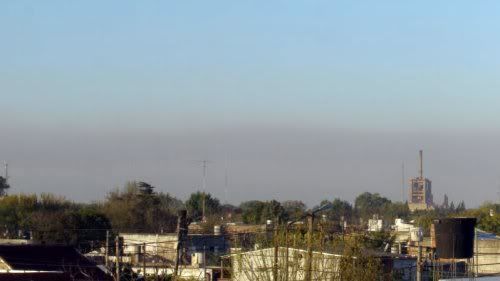
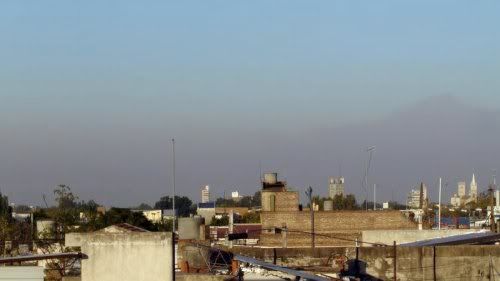
Now some early morning fog makes for great pictures, but smoke and ashes aren't that healthy, especially at the beginning of winter, when people's respiratory systems are already oversensitive. I didn't feel anything funny myself while taking the photo above, but then most of the blurry stuff was true fog. The lamppost you see near the center of the picture (above the guy's head) was only one block away. When you turned round, the view was much clearer, but a faint greenish-gray screen was readily apparent.
Besides that, I swear I'd never heard of so many plane delays due to smog. These are bad times for road trips too — the road blockages set up by farmers and truck drivers have stopped for the moment, but in this region (say from Rosario to Buenos Aires and around) there's so much fog and smoke that roads are totally or partially closed to traffic every day, until the sun dissolves some of the stuff. And traffic accidents are so common that the radio broadcasts the body count next to the weather forecast.
(I object to calling these "accidents", since in most cases they're caused simply by disrespect for the law, overconfidence and disregard of basic safety measures, for which Argentinians are infamously known. If you find yourself inside an airborne gray soup, the right thing to do is flash your lights appropriately and stop beside the road, no matter if you're late for work or the start of your vacations. And if you see someone stopping beside the road ahead of you, you should consider doing the same. The Argentinian's typical reaction, however, is to trust his good stars, disregard a few near misses, curse the weather, and finally crash into someone and blame the state for not forcing him to stop.)
The fires on the islands are obviously not being monitored by anyone. On any given day it's easy to spot two or more columns of smoke rising from different places along the floodplain of the Paraná, opposite the coast of Rosario.
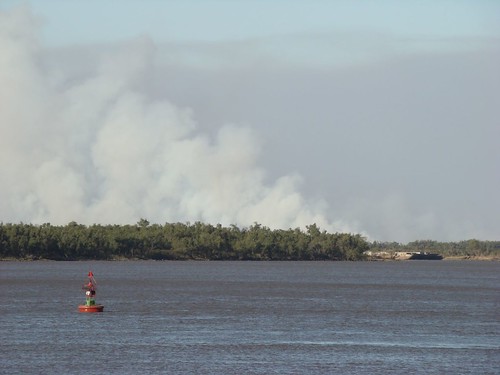

The fires are intentional or derived from intentional ones. Though the weather might be humid, it hasn't rained a respectable amount for months (in fact the north of Santa Fe has been declared an emergency area because of the drought), so all that withered grass and plants and trees are prone to ignite at the very lightest touch of flame. The wind usually carries the smoke away toward the south (to Buenos Aires), but part of it always remains here and affects the coastal areas of the city. If I can see where it comes from, then the authorities (governors, mayors, police, judges, prosecutors, ecological management offices) can see it as well. Why does nothing happen?
22 April 2008
Smoked: It's blame time!
The authorities are saying that 60–80% of the fires on the islands of the Paraná river delta are under control, and given the expected wind patterns Buenos Aires is unlikely to be covered by smoke again (though some say Buenos Aires is likely to be covered by smoke again!).
Here in Rosario we've seen no more of it after the ash-filled smelly cloud that appeared last Friday evening and stayed until Saturday afternoon, though there was some smoke blowing in again on Monday evening.

The eastern and southern horizons continue to be covered with an almost uniform smoky blanket, gray during the day and turning a sick shadow of purple before sunset. It goes south, mostly, but as soon as the wind shifts it will surely come back. As I write this, National Route 9 is closed to traffic because of the smoke and an accident involving three trucks, and the Rosario–Victoria Bridge is, once again, closed as well. People keep complaining of eye and throat irritation. The fires near Victoria, across the delta, are still far from contained.
The smoke is not merely smelly, dirty or irritating, since it's not just burning plant matter — there are about 220 thousand head of cattle on the islands, each producing 21 times as much waste as a human being. All that dung is burning and raining on an area shaped like an elongated trapezoid, its shorter base, between Rosario and Victoria, being 60 km wide, and the longer one, located 300 km south-southwest at the mouth of the Río de la Plata, about double or triple that width.
Now the Uruguayans are also mad at us — first we block their international bridges in protest for a paper mill that was supposed to pollute our air and water, and, while said paper mill cleanly and flawlessly works as it should, we sit idly as the whole delta of the Paraná turns into smoke and sends that smoke their way, and then we realize the situation is grave (i.e. the smoke has reached the upper-class neighbourhoods of Buenos Aires) and desperately start trying to put the fire out with more courage than equipment.
The fires, as an official conservative estimate, have devastated 70,000 hectares (700 km² or 173,000 acres) of the delta's islands. The government of Santa Fe wants to turn the Paraná's islands and wetlands into a protected area, like a national park. Governor Hermes Binner has demanded that Sergio Urribarri, governor of Entre Ríos, do something about the whole issue, because that's their jurisdiction, and they're the ones who allowed ranchers to overpopulate the islands and burn them to clear the scrub. Binner ironically repeated what Rosario's mayor had said about the smoke — "We've lived with these problems every year. Fortunately this time the smoke reached Buenos Aires, so it's everybody's concern now."
The fires aren't just a source of smoke, but they've also killed off the whole ecosystem. Of course grass will grow again; that's the purpose of the fires. But the islands are (were) much more than simply grassy plains for cows to graze on. The destruction originally began when the numbers of cattle multiplied by 15 in a matter of years. Those cows' excrement and urine are full of nutrients that the environment cannot absorb properly. When algae get hold of them, they choke the streams where they grow, then die and rot, and this causes a proliferation of bacteria that consume all the oxygen dissolved in the water, killing the fish and the rest of the aquatic fauna (the process is called eutrophication).
A lawyer is accusing Romina Picolotti, Secretary of the Environment, for her handling (or lack thereof) of the problem. Picolotti is an environmentalist who used to counsel the Gualeguaychú Assembly regarding the Uruguayan pulp mills (remember?), and I thought she would be at least alarmed, but she acts like a bureaucrat and seems to have blended extremely well into the state of general indifference to real problems that characterizes the Argentine government. Like somebody said (I overheard on TV) she realized there was a problem when the smoke started coming in through her windows.
Among the impending failure of the negotiations with the agricultural producers, the governments has resorted to finger pointing, accusing farmers of burning fields with no regard for human life only to reap more money from crops. This is strictly true, but then the majority of the farmers who've done nothing wrong were justly enraged. The government was unsubtly trying to shift all the blame on their chosen enemies of the day.
Yesterday, grassroots agro-leader Alfredo De Angeli remarked that, back when the roads were blocked, the people were armed so as to defend themselves in case the truck drivers sent by Hugo Moyano (head of the truckers' union, allied to the government) tried to force them out. Within hours, prosecutor Guillermo Marijuán filed an accusation against De Angeli for "inciting violence". Marijuán being usually independent, one must wonder whether he sold out, or was pressured by the government, or was simply stupid. De Angeli is an aggressive activist, to be sure, but his comment was a description of the tense environment of the road block, not a call to arms.
The last ridiculous development on this sad story is the indictment of a rural worker who was found setting fields on fire. This person couldn't possibly do much on his own, and certainly not without orders from an employer or permission from the owner of the field. In our slang this is called a perejil — a kind of scapegoat, but one specifically chosen due to his complete lack of power to influence the big picture (like a street drug dealer that gets jail time because of an ounce of marijuana, while the one that brings the dope in by tons stays free).
My own impression is that the national administration is lost and, faced by problems on several fronts, behaves like a caged tiger, almost blind with fury. Ten days from now the farmers' "truce" will end, and it's quite possible that the fires, or the problems caused by them, won't have been extinguished by then. In the meantime, Secretary of Commerce Guillermo Moreno wants to seize cattle from their owners to sell on the market and keep the price down. Inflation continues to rise, and the government stays on denial. They're going to indebt the country heavily to build a bullet train that only rich people will be able to afford. Our capacity to produce electricity and natural gas is strained. The power fees are going to rise soon. Paraguay's new president wants to renegotiate the price of the energy from Yacyretá they sell to Argentina.
19 April 2008
Smoked!
Wake up and smell the smoke, if you haven't! I've noticed this blog has many occasional (or one-time) readers. So, for the ones just tuning in, this is about the fires covering the Argentine littoral (and its capital) with smoke. Here's a few pictures, all taken from the coast of Rosario, Santa Fe, Argentina, today around noon. We're 300 km north from Buenos Aires (whose name has never seemed so much of a joke as nowadays, he he...). A seamless cloud of gray smoke covers the eastern horizon. The islands of the Paraná delta are on fire, because the owners of the fields have once again employed the ancient method of clearing scrubland with fire.
The Rosario–Victoria Bridge has been re-opened to traffic after a couple of days of being partially or totally shut down. You can barely see it, though, from this point located only 7 km away. Remember this is noon, and the picture has been enhanced for contrast.

You can't go from the south of Santa Fe to Entre Ríos if you can't use the bridge — you have to take a huge detour up to Santa Fe City and cross the river though the Subfluvial Tunnel.
In Rosario we've been enduring the smoke and the ashes for years, but it was only this time that the fires got completely out control and the smoke reached Buenos Aires, thus instantly turning this issue into a national emergency. The presidential minions quickly blamed the farmers (who seem to be guilty of everything that's wrong in the world today, from child hunger to environmental destruction) and Queen Cristina herself ruined her hair by flying over the affected area on a helicopter.

Not a word was heard from the unanswered complaints of Rosario's municipal government over the years, or the complete lack of suitable responses by the Kirchnerist governors of Entre Ríos (both past and present) regarding the fires being intentionally started by farmers in their jurisdiction. They knew who they were, and although there was a judicial ruling protecting their irresponsible actions, those things can and should be fought in court. Anyone with a minimum of foresight could see this coming.
Firefighters are now trying to contain (not extinguish) the many fires throughout the delta's islands. It's impossible to do anything else. Planes cannot go there with all that smoke. The place is a tangled maze of wetlands and streams. I hear we're getting help from the federal government; up until recently there were only volunteer firefighters from Santa Fe and Entre Ríos, the former heavily outnumbering the latter, although (as I said and will keep on saying) the islands are in the jurisdiction of Entre Ríos and whatever happens there falls entirely under the responsibility of the government of Entre Ríos.
Here you have another picture, this time facing due north, so you can see the visual effect of the smoke. The sky is naturally colourless at this time of the day, but the horizon's gray is not natural. The old piers and the silos on the left are closest; the silos and the buildings around are former port facilities. They're not far away, and you can see they're already veiled by the smoke.
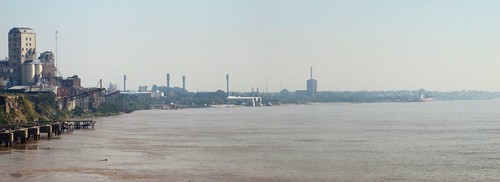
A little more to the right you can see the silhouettes of four towers; they're the illumination towers of Rosario Central's Gigante de Arroyito stadium. On the center-right you have the Sorrento thermal power plant, and then a cargo boat anchored nearby. At that point the coast describes a curve, so what you see right of the boat is much farther away. On a clear day you can see that shore clearly, though, but these days the smoke is noticeable all the time, subtly when you look at buildings a block or two away, and as a thick gray cloud when your line of sight is clear, as in this case.
So far I don't know of people suffering any grave consequences from the smoke. Fortunately most of it is being blown southwest towards Buenos Aires, leaving us with a subtle cloud that runs all along the coastal area of the city, including downtown. It's not pretty, and sometimes it smells, but we can breathe.
In case you didn't like my pictures, here's one from a better perspective, by NASA. The tiny red circles are fires. Rosario is the grayish splotch to the right of the leftmost one (above the ra in Parana), beside the green mass of the delta.

17 April 2008
Wake up and smell the smoke
"Smoke paralyzes the country", warns Perfil, "Retiro station is closed and trucks cannot leave Buenos Aires". "Smoke also affects Entre Ríos and Santa Fe", almost parenthetically notes Crítica. "Behind a shroud of fog", ironizes Página/12, echoing the lyrics of the March of the Malvinas, while the accompanying picture shows a grayed-out Puerto Madero. "The smoke in the city will not go away", says La Nación, essentially titling a glorified weather forecast.
All I can say is... wow. To the otherwise uninformed reader, it would seem like this is a unique phenomenon, rather than something we backward hinterlanders have been suffering for years. Cattle farmers of the Paraná river delta in the provinces of Entre Ríos and Buenos Aires have been using fire to clear fields on the islands all along the littoral for ages; the smoke is blown westward towards us (Rosario and the cities south of it), and the government of Entre Ríos has never answered to Santa Fe's requests that they police their territory, or to more desperate requests made before national authorities and environmental agencies. But one day porteños wake up smelling the smoke and the whole country is suddenly in grave danger, paralyzed and terrified.
"It seems the smoke has to reach Capital Federal for someone to try and solve this problem", as Rosario's mayor Miguel Lifschitz tiredly put it. There's a whole chain of islands opposite Rosario, at some points no more than 600 meters from the coast, often employed for recreation, but they don't belong to our municipality; they fall under the jurisdiction of Victoria, located on dry land on the other side of the delta, almost 60 km away, which has never cared for them (except to collect taxes). For years Rosario has demanded that they control the fires and punish the farmers who use them to clear the islands, damaging the ecosystem (an important wetland) and smoking our city. They've mocked us with their silence.
But the governor of Entre Ríos knows better than to bother Buenos Aires. I mean, the president lives there, and she would get absolutely mad if her European furs caught that smoke! So right after Environment Secretary Romina Picolotti called the governors of the three affected provinces, the governor of Entre Ríos Sergio Urribarri promised to work on it, and Victoria's mayor also noted he has a list of the islands' landowners who've been setting their fields on fire, so they can be sued.
Later, though, we learned that this was already done in 2004 — a judge in Entre Ríos took the case and the process ran smoothly, until the accusation was appealed and dismissed. The reason: clearing fields by fire is an "ancestral practice" so it can't be abolished just like that. Even though some of the perpetrators clearly knew that the fire could spread out of control.
In the meantime, traffic accidents have been allowed to happen, half a dozen people have died in the road just last week, and now the Rosario-Victoria bridge is closed to traffic, as are several major routes. The core of Argentina's industrial, agricultural and overseas trade area is half-paralyzed, its ports closed, its roads blocked, for completely avoidable causes due to intentional fires initiated by people who've been identified for a long time — but the real news is that porteños cannot leave their precious city. I repeat, in case you didn't get it before — this is old news to everyone in Rosario and around, but only became a national concern because Buenos Aires was affected.
There's a saying here, "God is everywhere, but His office is in Buenos Aires." It could very well date back to the federalist struggle of early and mid-19th century. That's how long we've been fighting this fight.