Showing posts with label córdoba. Show all posts

03 April 2008

Vacations in Córdoba: Carlos Paz and back

Our last trip was to Carlos Paz, a city about an hour from Córdoba. Carlos Paz is a busy town traversed by the small San Antonio River, with opens into Lake San Roque, formed by the dam of the same name. It's an all-time tourist trap, not unlike Mar del Plata, and like Mardel, it's full of over-colourful marquees advertising plays starred by wrinkled middle-age "actors" and busty "vedettes", shops selling all kinds of souvenirs, and endless crowds of fat tourists with loads of kids that push you and trip over you and block your way in the sidewalk.
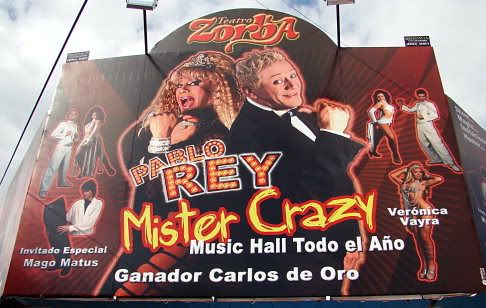
Cultural activities in Carlos Paz

Carlos Paz (like Mar del Plata) is the paragon of overvalued touristic spots — people come here and happily, obliviously, fill it to the brim, paying whatever they're told to pay, going through the motions, and thus the town inexplicably survives until the next season. Nothing changes. There's no incentive. People will continue to come, so why spend money on beautifying the city?

It's not that Carlos Paz is ugly. It's not. It's just ordinary. Supremely ordinary. Run-of-the-mill, featureless, flat. There's nothing of note here. Not a singular piece of architecture, not one place of breathtaking natural beauty. Nothing. Sure, you've got the river and the lake, and the sierras beyond — no big deal: there are a million places in Córdoba and elsewhere with the same natural features and less irritating surroundings.

So why did we go? Well, although I didn't particularly liked the idea, Marisa wanted a place with a quiet spot by a body of water, not far from Córdoba City, and I agreed with that. And neither of us had been to Carlos Paz in a long time (I think I went there as a child). We weren't prepared for it.

I was determined not to leave a single peso in this awful town, but tradition demands that you bring back alfajores when you go to Córdoba, and we were leaving the next day so we might not have the time to go shopping then. So we went into a shop and bought several dozens. Those alfajores were the only good thing to come out of our visit to Carlos Paz.

We went back to Córdoba and, though very tired (I was actually ill all this time — I'll tell you about that later), decided to take advantage of our last night, so we went out to see an artisans' fair. I don't particularly care for those, but the night was pleasantly cool and the fair had an upbeat vibe. We bought home-made liquors there, and Marisa got a purse to give as a present for her niece. Then we had dinner nearby, and went to bed early.

The next day was our last, so we finished packing our stuff and then studied the map — had we missed anything? I saw we hadn't seen the Museum of the Marquis of Sobremonte. Rafael de Sobremonte was Governor-Intendant of Córdoba for 14 years. Outside the province it's known as the guy who was in charge of the Viceroyalty of the Río de la Plata and ran away from Buenos Aires with the royal treasure when the British attacked the capital city in 1806. It seems, however, that Sobremonte was doing what he must. As for Córdoba, he's said to have been an excellent administrator there.

Cañonazo (by pablodf) The museum, as in other cases, turned out to be the house where Sobremonte lived, an old colonial-style building, simple, with thick walls. I wish I had good pictures of it, but all we were allowed to photograph were the patios. Some rooms preserved furniture and personal effects, others were just used to display objects of the time — military uniforms, weapons of various kinds. On one of the big inner yards were several large bronze cannons.

I noticed the rooms were very well-kept, but the outdoor areas weren't — the cannons were simply thrown there, exposed to the elements. Policemen (museum security) were sipping mate next to one of the rooms. There were plastic buckets and other cleaning tools next to one of the venerable walls. It looked as if, leaving aside the rooms allocated for the museum, the rest was free to use by anyone in charge.

The above notwithstanding, the museum was a nice place to see. It was larger than it seemed at first, so it kept us busy almost exactly until the time we had to leave.

We did a small detour back to the hostel to take pictures of the Cathedral, which was now almost empty (it was Tuesday, and the rage of Easter weekend had passed). They're restoring it, so we had to stay out of certain areas.

After that, we headed for the hostel, got our luggage, took it to the bus station (only two blocks away, thankfully) and sat down to wait for our bus, which came almost in perfect time, for which I felt stupidly happy at the time. You know what happened next...

02 April 2008

Vacations in Córdoba: Alta Gracia

On our fourth day in Córdoba, we took a short trip to Alta Gracia, a town less than 40 km from the provincial capital.

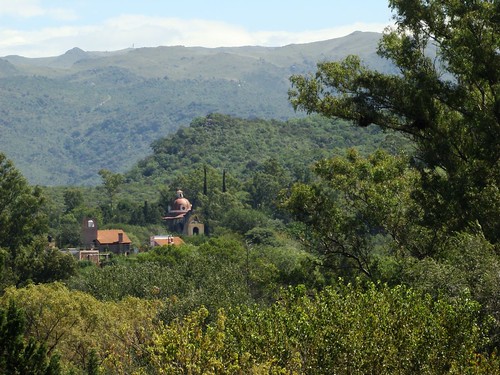
Vista serrana (by pablodf)

Alta Gracia is most famous for being the home of Ernesto Che Guevara during his childhood and youth (after his family moved in from Rosario, looking for a climate better suited to Ernesto's asthma). It was originally a Jesuit town, so there's also a Jesuit church and mission, and other signs of the presence of these enterprising religious order. And it's the place where the Spanish composer Manuel de Falla came to rest during the last four years of his life.

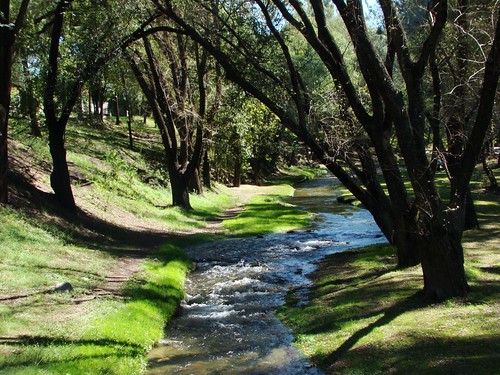
It's a quiet town, with an abundance of simple, sturdy white houses along meandering streets; parts of it climb into the surrounding hills, full of green. A stream runs through the western, older part of town.

Verdes y sombras (by pablodf)

We arrived before noon after a one-hour trip from Córdoba City and discovered that the bus terminal lacked an information booth. We had passed the busy touristic part, and now we had no maps, no-one to point us to where we should go. I found a large map glued to the inside of an empty office, and took pictures of it. After a long while, following the zoomed image in my camera's screen, we got to the closest marked spot, the Manuel de Falla Museum.

This was a good way to start the day, because the museum was wonderful. De Falla moved to Argentina in 1939, after the Spanish Civil War, and to Alta Gracia in 1942, looking for peace and quiet — and I'm sure he got plenty. The house he rented was designed specifically for the needs of the sick, with plenty of natural lighting in all the rooms, and a gallery to spend the day in the sun.

Museo Casa de Manuel de Falla (by pablodf)

De Falla had a chronic condition and this was exactly what he needed. After his sister became a widow, she took care of him, while he worked on the cantata Atlántida, which he never finished. He died in 1946. His remains were taken back to Spain by request of the dictator Francisco Franco. De Falla was a very devout Catholic and a lover of things traditional and Spanish, so Franco viewed him as ideologically OK. We don't know how De Falla he felt about Franco, but he sure didn't like his intellectual friends being murdered or forced into exile for political reasons, and his country torn apart by war; that and the ensuing solitude and desperation, according to the museum's guide, was the reason why he moved to Argentina, where he had played concerts before. He was buried in the cathedral of Cádiz, his city of birth, and his personal effects were taken to Spain, but decades later many of them were brought back to Alta Gracia.

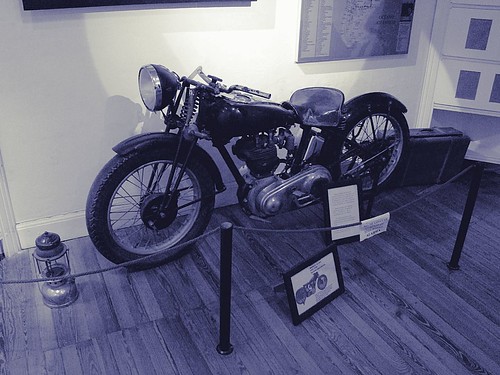
After this nice tour, we followed the map to the home of Che Guevara. The contrast couldn't have been greater. Where the De Falla museum was peacefully empty, quiet and unassuming, Guevara's childhood home was full of noisy, rude tourists, stuffed with souvenirs and trinkets, all of it recognizable from a block away. I hated every moment I stayed in there. Besides the many photographs, there was nothing of interest except a replica of the famed motorcycle (the one in The Motorcycle Diaries).

La Poderosa II (by pablodf)

At the porch there was a very badly done bronze statue of little Ernesto for the tourists to take pictures beside it, and an equally horrible bust of Guevara in a corner. Granted, this was the peak hour of the busiest weekend in the whole tourist season, so you might find fewer people at other times, and if you really appreciate Guevara you may be inspired by his lingering presence in this place while there's no-one stepping on your toes. But Guevara didn't actually do anything here.

Next we looked for a place to eat lunch. It was the hottest time of day. Once the sun went down a bit, we went back to the stream and spent some more time there, just relaxing. Then we dragged ourselves to the Jesuit historical core.

The Jesuits weren't people to just come and build a church. They built whole towns around their churches. It's all a World Heritage Site now. The church is surprisingly well preserved, as are the courtyards and galleries around it.

Aljibe, etc. (by pablodf)

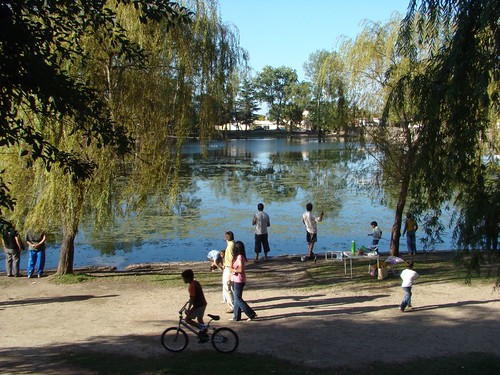
In front of it there's the Tajamar, a wall that the Jesuits used to dam the stream and create a reservoir for their water needs. Nowadays the water level at the Tajamar is usually low, the water is green and stagnant and covered with plants, although it surprisingly doesn't stink. Birds live around it, and people fish in it too. It's a nice sight when the sun goes down and the ancient buildings and the trees are reflected in the surface.

Tajamar (by pablodf)

And that was the end of our visit to Alta Gracia, and probably the best day in our vacations. We took the bus right there beside the Tajamar and arrived back in Córdoba as night settled in.

01 April 2008

Vacations in Córdoba: Quebrada del Condorito

On our third day in Córdoba, we intended to reach the Quebrada del Condorito (which translates as Little Condor's Gorge), a gorge on whose walls condors can be seen from up close. The gorge and the high plateau that surrounds it at no less than 1,900 m above sea level, called Pampa de Achala, are all part of Quebrada del Condorito National Park, created in 1996. There's a project to raise condors there and repopulate the area with them.

Buen viento (by pablodf)

If we'd had our way, we could've chosen the day and enjoy it to the max. But it turned out that you have to buy bus tickets in advance, or you may not get a place. So we got our tickets for Saturday morning on Thursday afternoon. It's the bus that goes along the winding road known as Camino de las Altas Cumbres (High Summits Road), crossing the Sierras Grandes range from Villa Carlos Paz (west of Córdoba City) to Mina Clavero, and we had to get off the bus midway, in a place called La Pampilla.

Well, Friday night was unbearably hot and humid, so we went to bed reviewing the precautions stated in the national park's brochures for sunny days: lots of water to drink, a light windbreaker since the wind blows strong all the time at those heights, some good sunblock, etc. An hour later, however, we heard the familiar faraway rumble of thunder, followed by a steady downpour of rain.

Come morning, there was still raining lightly. We didn't want the bus ticket money to go to waste, but even disregarding that, we would probably have no choice after this — who knows when we could get other tickets. Off we went, with the vague hope that the rain could stop and maybe even the clouds could part. We had a two-hour trip before us into an area where the weather is known to change rapidly, so it wasn't completely ridiculous to think that.

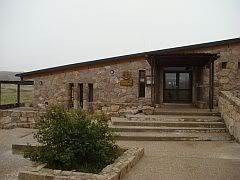
Quebrada del Condorito National Park - Visitors' CenterLa Pampilla was just a spot along the road. We'd somehow gotten the idea that there were huge signs pointing to where the adventurous tourist was supposed to go, but no. We almost climbed over a fence on the wrong side of the road, until we spotted a sign and a path on the opposite side. We took it. It was cold (10 degrees? 5 degrees?) and there was a drizzle, and wind blowing it into our faces (I had to take off my glasses). About a mile later, shivering and dripping wet, we came to the park rangers' house. We were informed of the various dangers (including pumas) and sent on our way, with the warning that there weren't any other human-built shelters of any kind beyond that point. Yipee.
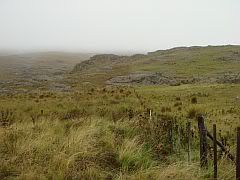
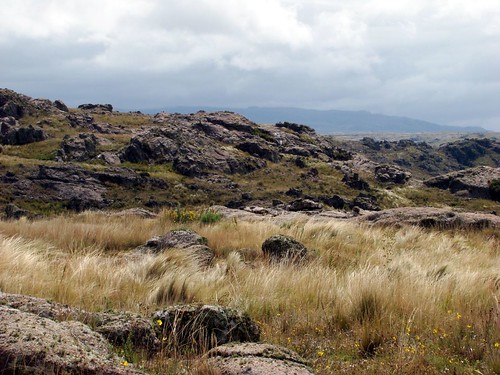
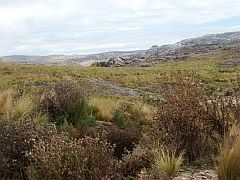
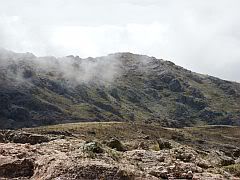
Quebrada del Condorito - Inside a cloudSoon we stopped feeling so cold. The landscape was soberly beautiful and the road wasn't steep. However, we were literally inside a rain cloud most of the time. By the time we reached the middle point, we were soaked all over, except where our windbreakers had (partially) protected us. We forged on. We got to the last marked spot (number 10), and there we found a sign indicating the way for the place where you could actually see the condors... 45 minutes away.
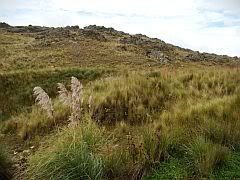
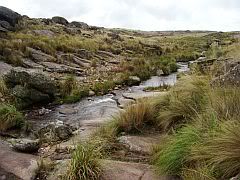
We turned back. I felt I was going to faint, and Marisa was shivering. We searched for shelter, and found a rock with a top projection that kept the wind and most of the rain from us. We took out the thermos to prepare hot mates... only to find the water had cooled off. By now it was lukewarm — we threw it over our hands to regain the sensation, and then ate our ham-and-cheese sandwiches. That was good.

We retraced our steps. Once we got disoriented and went in a circle for 15 minutes. Soon afterward, though, I sensed a change in light. The drizzle had all but stopped. I put on my glasses. The wind was blowing away the clouds, and a bit of sun was beginning to shine through. Minutes later, a patch of blue sky appeared and expanded.

We found another big boulder to cover from the wind, and took off a couple of layers of clothing, including our socks. They wouldn't dry completely, but they would get warm, as we would. We stayed there for a while, and then headed back, dead tired but uplifted. I saw many details of the landscape for the first time — I realized that before, with the wind and the rain, I'd kept my eyes fixed to the ground and all my efforts concentrated in merely walking on.


The trip was worth it. Even with the rain, the cold, and not seeing a single condor up there, we had a lot of fun.

31 March 2008

Vacations in Córdoba: Day 2

Our second day in Córdoba was spent fully in the city. We had a handy tourist map, with the must-see spots, so we started as early as we could to try to visit all of them. Córdoba's most famous touristic show is the Jesuit Block, an old section of town where all the major historical buildings are preserved (although they're not all strictly built during the period of Jesuit dominance). So we headed there.

While walking we spotted a couple of majestic church spires some blocks away, so we diverted our course and ended up before the stunning beauty of the Church of the Sacred Heart of the Capuchin Fathers.

Columnas, columnas (by pablodf) Confusión arquitectónica (by pablodf)

(I'm only showing a few pictures here because Córdoba-based photographers with more time and/or better equipment have had plenty of opportunities to collect photos of it that surpass my humble attempts. See La otra catedral de Córdoba: Iglesia de los Capuchinos at SkyscraperCity, which BTW has a large community of Argentine architecture, history and urbanism buffs.)

Being Holy Friday, there were no celebrations in progress (quick note for those without a Catholic education: God doesn't appreciate that you celebrate while His Son is nailed to a cross), so we could get inside and take pictures freely.

Before that, however, we got diverted from our diversion by the musical water fountain of the Paseo del Buen Pastor, which I'm told is a new venture: a preserved church, a former women's prison turned into a modern art gallery with semi-transparent façade, and a little shopping mall, all together in the same triangular half-block wedged between a street and a diagonal avenue, plus an animated "dancing waters" show [click on the link for video].

Paseo del Buen Pastor (by pablodf)

I'm rather convinced that this was an attempt on the part of Córdoba's municipality to copy the dancing waters of Parque Independencia in Rosario. Whatever the case, they got it OK.

It was noon, so good pictures were hard to get. We were hot and thirsty, so after visiting the Paseo and the Capuchins' church we walked around and found a shady spot to prepare mate and eat something. We were struck by the troublesomeness of this simple enterprise.

Córdoba City is big. It's an old city which has grown and turned into a metropolis over long centuries, growing into this size (while Rosario went from an insignificant village to a major city in less than 50 years). It's got wide multi-lane one-way avenues, two- and three- and four-way crossings with a complex traffic coordination, wide sidewalks. Parts of it are simply ill-suited for people on foot — rather designed for fast vehicles.

Avenidas de Córdoba

We missed the tree-lined narrow streets of Rosario and its many small green spaces. It took us forever to find a place where the sun didn't scorch our backs, and it was sitting on an old bench in a square with too little of anything in the way of vegetation, amid the roar of nearby traffic.

We wandered a bit more and found the Colegio Nacional de Monserrat, a school founded in 1687 that has had some notable characters among its pupils. Parts of the building are a museum (showcasing old documents and scientific instruments), but in fact the whole college is a historical building which you can visit outside of class hours. It was around two in the afternoon, and the streets were white hot; by contrast the interior of this ancient place was cool and peaceful. We took ages exploring all of its hidden corners.

El patio del Monserrat

We came back to the hostel and took a nap. At night we were supposed to meet Adolfo, our photographer contact, and some guys from the Córdoba-based Viernes Foto Club group. We agreed to meet at the Paseo del Buen Pastor, where a Via Crucis was being staged.

Sure enough, we met Adolfo and VFC's people, and after some pictures and a visit to a historical house cum museum, we went to a bar called Johnny-B-Good, where they usually gather for a beer or two. I'd been feeling a bit down and sleepy, and had had a headache since before getting to Córdoba, so I skipped the beer and restrained my hunger. By the time I was feeling a little more upbeat, we had to leave. It was getting very late and we had a trip to the Quebrada del Condorito scheduled for the next morning.

28 March 2008

Vacations in Córdoba: Day 1

(As of this time, I'm neither ready nor willing to write a definitive statement about the situation in the countryside. So I'll begin with the story of my vacations.)

We arrived in Córdoba City after a six-hour trip from Rosario. It was a very good thing that we'd booked a room in a hostel located only two blocks from the bus station, although it was partly uphill (Córdoba is like that). We settled there and went to Parque Sarmiento, a large stretch of urban park zone nearby.

It wasn't a pretty sight. Compared to the exuberant foliage one can find in Rosario's parks, this one was rather sparse. There were many stretches of dirt, rather than grass. We took a winding stone path and found it stank of urine and was blocked by garbage. There was no signage for the visitors. In general it seemed like a picture of lack of care. We finally came to a less depressing view, an artificial lake with nice white bridges and balconies. On the shore were a group of bullyish, hungry ducks, and some biguás (Neotropic Cormorants) on the stones in the middle of the lake.

Patitos del horror (by pablodf) Biguás al sol (by pablodf)

The birds were the only highlights of this visit to the park, which, I admit, is much larger than that and must have better views... somewhere else.

That was the morning. Later, and after a nap, we walked down (actually it was up) to the historical core of the city. Córdoba was founded in the 16th century and has some stunning colonial buildings left, mostly religious, mostly built by the Society of Jesus. The Jesuits were everywhere at the time (it isn't difficult to see why they were ultimately expelled by the Spanish Crown — they had too much power).

Iglesia de Santa Teresa de Jesús (by pablodf)

They built for eternity back then — one-meter-thick walls, no mortar.

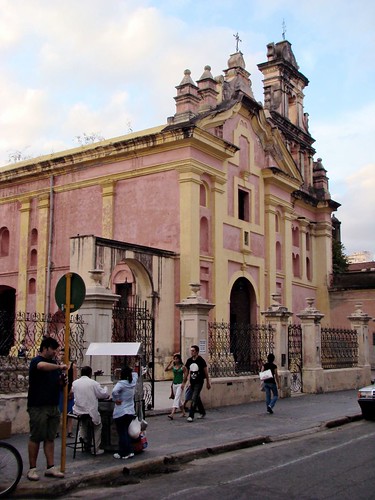
It was Maundy Thursday, so special masses were being held in some of the churches. We couldn't enter the Cathedral, but we stole into the ceremony at the pink-and-yellow church of St. Therese [pictured above] and stood there, a drop of godlessness in a pool of... well, mostly incense. Now seriously — it was truly mesmerizing, and I mean it in more than the anthropologically detached way, to watch the ceremony. Incense, candles, slow chanting, the subdued atmosphere inside the temple was effective; I could feel it, so I imagine for someone that considers this betrayal-death-resurrection stuff more than a myth it must have been powerful, overwhelming.

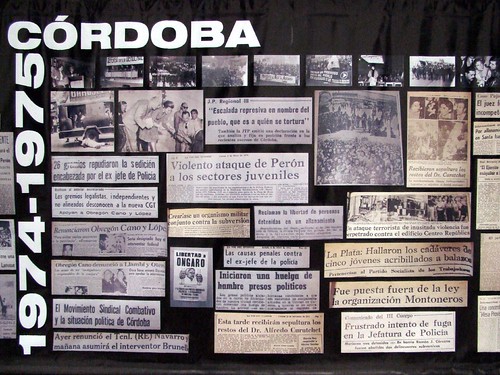
At the other side of the same block, along a narrow street/passage, people were beginning to prepare for the commemoration of a much less mythic, much more painful story: the 32nd anniversary of the last coup d'état, which brought to power the bloodiest dictatorship in our history, the perfidly self-styled National Reorganization Process. There was a large board with copies of newspaper clippings leading up to the coup — news bits that for the most part must have been considered mere incidents back then, rather than the ominous preparation for a dark era.

Recortes de historia (by pablodf)

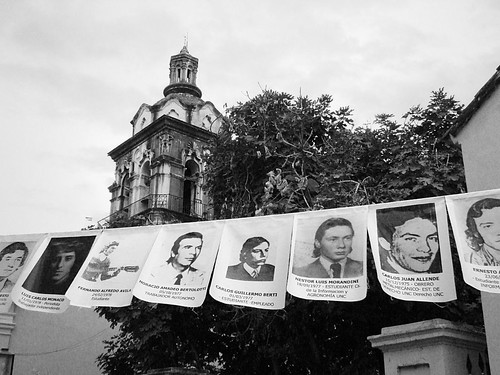
There were also tens of pictures hanging among the old-fashioned lamps in the passage, showing the faces and personal data of local desaparecidos. Against the background of the imposing towers of the Cathedral, I couldn't help feeling the contradiction. The Catholic Church for the most part either stayed silent, and often supported and even encouraged, the military's criminal plans; the archbishop of Córdoba, Raúl Primatesta, played an instrumental role in suppressing ecclesiastical criticism of the government. To this day, human rights organizations don't forget this, as attested by several graffiti.

Tiempo de hacer memoria (by pablodf)

And that was our first day in Córdoba.

19 March 2008

What, vacations again?

Folks, I'm going to Córdoba for the long weekend, so you won't be hearing from me until next Wednesday (at least). I leave this evening at 2 AM, and should be arriving in Córdoba at 8:30.

On principle, I oppose the commemoration of the Easter weekend, a religious holiday, as a public national holiday. But this is a minor issue, really, and I don't mind taking advantage of it for a short trip. What else am I going to do, stay home and medidate on my sins while I watch the two hours of torture of The Passion of the Christ? I'd rather relax somewhere else.

Monday, March 24, is the Day of Memory: the 32nd anniversary of the last coup d'état. This is a serious holiday. Right after Easter, no less!

Córdoba City was founded by Jesuits, and the shadow of the Church are everywhere. Two years ago I went to this same city on Easter weekend, and saw the swarms of priests, monks and nuns in old-style garb, and the flocks of the faithful, going about the imposing building of the Cathedral at the time of mass. This is the seat of the oldest diocese in the country, the same Cathedral where people heard the sermons of Cardinal Raúl Primatesta, Primate of Argentina at the time of the coup, who blessed the military, made a list of domiciles of Catholic teachers and workers available to military intelligence, and delivered "Marxist" priests (who worked with the poor) into the hands of the terrorist state. So it will be interesting to see what events are planned in Córdoba, and whether the two celebrations — the myth of death and resurrection, the true story of hopelessness and ruin of a whole country — interact and influence each other.

Besides Córdoba City, where Marisa and I are going to be greeted by a group of local photographers, I'll be visiting Alta Gracia, the childhood home of Ernesto Che Guevara, and Quebrada del Condorito National Park, where we're told you can have condors fly within reach of your hand.

I'm off now. See you next week!

02 November 2007

Bloggers outside Buenos Aires

I've talked about the disproportionate representation of Buenos Aires in the media and its projection in the international image of Argentina. Prompted by a comment by Pieter, I'll revisit that topic and I'll add to it. Pieter says that from the point of view of the outside world, Argentina seems to consist of BA and nothing else, and specifically noted that Argentine English-language blogs are all porteños, with the exception of moi, and there seems to be not a single blog based in Córdoba.

Now Rosario has an active Spanish-language blogosphere, and I although I'm the only blogger here that writes his own blog in English, I know that others can and do contribute in English in other forums. On the other hand, I haven't really searched for Córdoba-based blogs, but I haven't run into any yet. Now Córdoba was a center of culture before Rosario even existed as a handful of mud houses, and is still a vibrant university town, a major touristic area, and an industrial power, with a population around 1.5 million, even larger than Rosario's. (We rosarinos consider ours to be Argentina's "second city" for other reasons besides mere population, but we have no quarrel with the cordobeses.) I don't see how there could be no bloggers there.

Not only that, but for the most part nothing from the "interior" of the country appears in the Argentine blogosphere (for an international audience, that is), again, with the exception of this blog (see e.g. the Argentine blogger section of Bloggers in Argentina). References to Rosario, Córdoba and other large cities are almost nonexistent, save for Mendoza — which in turn is pictured as merely a huge winery with some pretty snowy mountains in the background. No mendocino, that I know of, is blogging in English from/about Mendoza.

I have no idea if people in Córdoba and Mendoza have the sort of local pride that we have here in Rosario. I don't see why they wouldn't. If they don't make themselves known, if they don't advertise themselves, talk about themselves, and refuse to yield to the unfortunate circumstance that all major media are based in Buenos Aires and believe it to be the Axis Mundi, then they'll continue to be under- (or mis-) represented.

For ages we were told (we're still told) that we were pathetic countryfolk trying to mimic Buenos Aires' sophistication, but I don't think that's true anymore, if it ever was. The large cities of the so-called "interior" are sophisticated (enough, at least), prosperous, quieter, safer, and cheaper to live in than Buenos Aires. We need to make those things known, not just to attract expats and tourists, but to establish the principle that Argentina can be truly federal, and multicentric.

As an aside, all the people I know who've recently gone to BA for tourism, family or business tell me the capital is quickly becoming an unlivable place: prices are a rip-off, traffic's crazy, people seem always in a hurry, crimes are commonplace, and horrific poverty is always visible next to the consumerist fever of these days, in the midst of a thousand new luxury towers and the shiny shopping malls. I know what poverty looks like from up close, but on my last trip to BA, I couldn't believe my eyes when I saw the shanty town just beside Retiro, which is turning into something bigger than a mere villa miseria and more like a favela. My brother recently went to a town just outside BA, in the conurbano, and said that, for all the wealth of the capital, its suburbs reminded him of Africa: poor, rotten, rusty and crumbling. It's not that Rosario doesn't have that — it was the sheer scale of it that made such an impression on him. For all the faults of our local governments, they've never let things turn into such a nightmare.

I realize this is a very short explanation that veers off the main issue and I need to write a bit more about the causes and effects of Buenos Aires' dominion over the rest of the country, and its current problems. I don't know if I'm capable, but I'll try... when I have the time.

05 September 2007

Santa Fe, Córdoba, Misiones

(I'll stop the politics after this. Promise.)

The election was Sunday
, today's only Wednesday, and everything already seems to be upside down. Some people who were overconfident to the point of hubris are desolate. The parachuted former candidate Rafael Bielsa is going to resign from his deputy chair because "it wouldn't be ethical to represent the city of BA after I was candidate for governor of SF" (what, you mean now?). Governor elect Hermes Binner met with governor Obeid in the government house and the employees left their posts to go and greet him. The factions of Peronism in Santa Fe are at each other's throats, as they see their power structure crumbling like a house of cards. The President hasn't uttered the words "Santa Fe" (or "Córdoba") since Sunday.

And Binner is already laying out his plans, which include giving more money and more power to the municipalities, avoiding the discretional management of funds by the central provincial state, fighting tax evasion without raising taxes, ensuring that school classes start on schedule next year, and cancelling the construction of a new provincial hospital only 10 blocks away from a municipal hospital (a project that vice-governor, councilmember elect and well-connected architect María Eugenia Bielsa made up and is now defending with such foamy rage that it seems rather obvious she was going to make dirty money for herself out of it).

The situation in Córdoba after the election is a mess. Only 17,000 votes (out of more than 1.5 million valid votes) separate the two main candidates. The vote count was abnormally slow, the handling of the information was horrible, and the fraud is obvious; the only issue is whether it was a general effort, planned from the top down, or just minor tricks on the local scale (the latter are a certainty).

And, thanks to the Ley de Lemas, the elections in Misiones next Sunday will most likely be even messier: besides the board-kicking effect caused by the rejection of the constitutional reform allowing the governor's re-election, the Ley de Lemas, which allows parties to combine the votes of any number of minuscule factions and candidates, means 18,000 candidates will be running for something — one every 36 voters.

Anyway, we're done over here for now. There have been many interviews and articles about Binner's achievement, and in most of them one can realize that the media have caught the general vibe of the people and, besides the natural journalistic interest for "the first Socialist governor in history", there's a serene awareness that change for the better is coming. Nobody expects a lot, but then everybody expects something — even those who voted for Bielsa, who (for the most part, if you ask me) aren't so sure that they should be sad about the loss.

19 December 2006

Livin' la buena vida

Avenida CorrientesI forgot to post this little thing the other day, but I thought I'd share. I love this city and I know it has many problems and shortcomings. However, a study conducted by a group of organizations based in Córdoba affirms that Rosario is the metropolitan area with the best quality of life in Argentina.

I found this coverage in La Capital and was surprised to find the same in Clarín. Even the Córdoba-based La Voz del Interior covered it. We really have no quarrel whatsoever with Córdoba (even though people love to compare), which is a very fine city, with a tradition and an overall style completely different from those of Rosario. Córdoba is larger, more populated (about 30% more so), and generally "wider". It has older historical buildings, it's a cultural capital and a provincial capital, and it's not a port city. In the 1990s, Córdoba was undoubtedly Argentina's second city, but even Córdoba's mayor has acknowledged that Rosario has retaken that position (I'll tell you about Rosario in the 1990s some other time -- read it during the day).

The study rated the quality of life of the largest metropolitan areas of Argentina in a scale of 1 to 7. The Greater Rosario area rated 5.96; Buenos Aires City, 4.32; Greater Córdoba, 3.26; Greater Mendoza, 3.16; and Greater Buenos Aires, 2.89. This number is based on several factors. One of them is healthcare centers: Rosario has 75 per 100,000 people, while Córdoba has 36. Rosario also fares better than Córdoba regarding income distribution, poverty and job creation. Finally, the study pointed out that Rosario produces 45% of the urban wealth in Santa Fe Province.

Nobody in the municipality made a big deal about this, except by smiling and (expectably) showing some pride in public, but a resentful pawn of governor Obeid was so angry that he actually claimed that Rosario's quality of life is supported ninety percent by the provincial government. It'd be mildly funny, if only this supposed representative of the people didn't earn a huge salary paid by moi and other 3 million santafesinos, apparently only to advertise his political patron and to raise his hand on command.