The municipality of Rosario is taking the case of the smoke coming from the islands to the Supreme Court. As I've reported on several occasions, people who own fields on the islands on the Paraná river's floodplain have been setting the scrub on fire, a traditional and cheap way to clear the land that has gotten out of control. The reason why the fires are so widespread is that farmers are moving all their cattle to the islands and keeping their good fields elsewhere for much more profittable soybean, wheat and sunflower.
Not only is the environmental damage considerable, but the smoke raising from the burning islands decreases the visibility on major road corridors (the Buenos Aires–Rosario Highway and the Rosario–Victoria Bridge), and the falling ashes create health problems.
The islands opposite Rosario are under the jurisdiction of the municipality of Victoria, Entre Ríos. Further south, the delta comes under the jurisdiction of Buenos Aires Province.
After years of putting up with the smoke and seeing how nobody does anything to stop it (except the feverish but insufficient joint operation mounted by the national government through the Environment Secretariat a few months ago when the smoke reached the Center of the Universe, i. e. the City of Buenos Aires), mayor Miguel Lifschitz decided to sue the provinces of Entre Ríos and Buenos Aires, not asking for monetary reparation but to get the authorities to stop the burning, monitor the area, and control its development.
I think this is good idea, seeing how all the friendly talks and meetings have failed.

08 August 2008
Rosario sues over the smoke

 Stumble it!
22 April 2008
Smoked: It's blame time!
The authorities are saying that 60–80% of the fires on the islands of the Paraná river delta are under control, and given the expected wind patterns Buenos Aires is unlikely to be covered by smoke again (though some say Buenos Aires is likely to be covered by smoke again!).
Here in Rosario we've seen no more of it after the ash-filled smelly cloud that appeared last Friday evening and stayed until Saturday afternoon, though there was some smoke blowing in again on Monday evening.

The eastern and southern horizons continue to be covered with an almost uniform smoky blanket, gray during the day and turning a sick shadow of purple before sunset. It goes south, mostly, but as soon as the wind shifts it will surely come back. As I write this, National Route 9 is closed to traffic because of the smoke and an accident involving three trucks, and the Rosario–Victoria Bridge is, once again, closed as well. People keep complaining of eye and throat irritation. The fires near Victoria, across the delta, are still far from contained.
The smoke is not merely smelly, dirty or irritating, since it's not just burning plant matter — there are about 220 thousand head of cattle on the islands, each producing 21 times as much waste as a human being. All that dung is burning and raining on an area shaped like an elongated trapezoid, its shorter base, between Rosario and Victoria, being 60 km wide, and the longer one, located 300 km south-southwest at the mouth of the Río de la Plata, about double or triple that width.
Now the Uruguayans are also mad at us — first we block their international bridges in protest for a paper mill that was supposed to pollute our air and water, and, while said paper mill cleanly and flawlessly works as it should, we sit idly as the whole delta of the Paraná turns into smoke and sends that smoke their way, and then we realize the situation is grave (i.e. the smoke has reached the upper-class neighbourhoods of Buenos Aires) and desperately start trying to put the fire out with more courage than equipment.
The fires, as an official conservative estimate, have devastated 70,000 hectares (700 km² or 173,000 acres) of the delta's islands. The government of Santa Fe wants to turn the Paraná's islands and wetlands into a protected area, like a national park. Governor Hermes Binner has demanded that Sergio Urribarri, governor of Entre Ríos, do something about the whole issue, because that's their jurisdiction, and they're the ones who allowed ranchers to overpopulate the islands and burn them to clear the scrub. Binner ironically repeated what Rosario's mayor had said about the smoke — "We've lived with these problems every year. Fortunately this time the smoke reached Buenos Aires, so it's everybody's concern now."
The fires aren't just a source of smoke, but they've also killed off the whole ecosystem. Of course grass will grow again; that's the purpose of the fires. But the islands are (were) much more than simply grassy plains for cows to graze on. The destruction originally began when the numbers of cattle multiplied by 15 in a matter of years. Those cows' excrement and urine are full of nutrients that the environment cannot absorb properly. When algae get hold of them, they choke the streams where they grow, then die and rot, and this causes a proliferation of bacteria that consume all the oxygen dissolved in the water, killing the fish and the rest of the aquatic fauna (the process is called eutrophication).
A lawyer is accusing Romina Picolotti, Secretary of the Environment, for her handling (or lack thereof) of the problem. Picolotti is an environmentalist who used to counsel the Gualeguaychú Assembly regarding the Uruguayan pulp mills (remember?), and I thought she would be at least alarmed, but she acts like a bureaucrat and seems to have blended extremely well into the state of general indifference to real problems that characterizes the Argentine government. Like somebody said (I overheard on TV) she realized there was a problem when the smoke started coming in through her windows.
Among the impending failure of the negotiations with the agricultural producers, the governments has resorted to finger pointing, accusing farmers of burning fields with no regard for human life only to reap more money from crops. This is strictly true, but then the majority of the farmers who've done nothing wrong were justly enraged. The government was unsubtly trying to shift all the blame on their chosen enemies of the day.
Yesterday, grassroots agro-leader Alfredo De Angeli remarked that, back when the roads were blocked, the people were armed so as to defend themselves in case the truck drivers sent by Hugo Moyano (head of the truckers' union, allied to the government) tried to force them out. Within hours, prosecutor Guillermo Marijuán filed an accusation against De Angeli for "inciting violence". Marijuán being usually independent, one must wonder whether he sold out, or was pressured by the government, or was simply stupid. De Angeli is an aggressive activist, to be sure, but his comment was a description of the tense environment of the road block, not a call to arms.
The last ridiculous development on this sad story is the indictment of a rural worker who was found setting fields on fire. This person couldn't possibly do much on his own, and certainly not without orders from an employer or permission from the owner of the field. In our slang this is called a perejil — a kind of scapegoat, but one specifically chosen due to his complete lack of power to influence the big picture (like a street drug dealer that gets jail time because of an ounce of marijuana, while the one that brings the dope in by tons stays free).
My own impression is that the national administration is lost and, faced by problems on several fronts, behaves like a caged tiger, almost blind with fury. Ten days from now the farmers' "truce" will end, and it's quite possible that the fires, or the problems caused by them, won't have been extinguished by then. In the meantime, Secretary of Commerce Guillermo Moreno wants to seize cattle from their owners to sell on the market and keep the price down. Inflation continues to rise, and the government stays on denial. They're going to indebt the country heavily to build a bullet train that only rich people will be able to afford. Our capacity to produce electricity and natural gas is strained. The power fees are going to rise soon. Paraguay's new president wants to renegotiate the price of the energy from Yacyretá they sell to Argentina.
17 April 2008
Wake up and smell the smoke
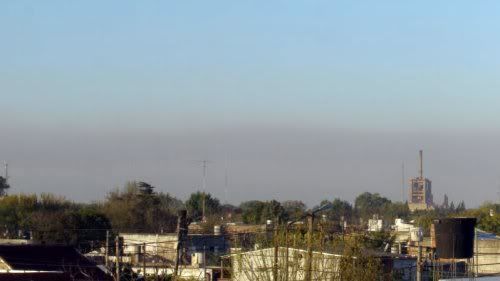
"Smoke paralyzes the country", warns Perfil, "Retiro station is closed and trucks cannot leave Buenos Aires". "Smoke also affects Entre Ríos and Santa Fe", almost parenthetically notes Crítica. "Behind a shroud of fog", ironizes Página/12, echoing the lyrics of the March of the Malvinas, while the accompanying picture shows a grayed-out Puerto Madero. "The smoke in the city will not go away", says La Nación, essentially titling a glorified weather forecast.
All I can say is... wow. To the otherwise uninformed reader, it would seem like this is a unique phenomenon, rather than something we backward hinterlanders have been suffering for years. Cattle farmers of the Paraná river delta in the provinces of Entre Ríos and Buenos Aires have been using fire to clear fields on the islands all along the littoral for ages; the smoke is blown westward towards us (Rosario and the cities south of it), and the government of Entre Ríos has never answered to Santa Fe's requests that they police their territory, or to more desperate requests made before national authorities and environmental agencies. But one day porteños wake up smelling the smoke and the whole country is suddenly in grave danger, paralyzed and terrified.
"It seems the smoke has to reach Capital Federal for someone to try and solve this problem", as Rosario's mayor Miguel Lifschitz tiredly put it. There's a whole chain of islands opposite Rosario, at some points no more than 600 meters from the coast, often employed for recreation, but they don't belong to our municipality; they fall under the jurisdiction of Victoria, located on dry land on the other side of the delta, almost 60 km away, which has never cared for them (except to collect taxes). For years Rosario has demanded that they control the fires and punish the farmers who use them to clear the islands, damaging the ecosystem (an important wetland) and smoking our city. They've mocked us with their silence.
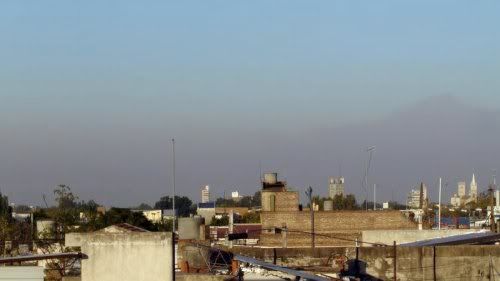
But the governor of Entre Ríos knows better than to bother Buenos Aires. I mean, the president lives there, and she would get absolutely mad if her European furs caught that smoke! So right after Environment Secretary Romina Picolotti called the governors of the three affected provinces, the governor of Entre Ríos Sergio Urribarri promised to work on it, and Victoria's mayor also noted he has a list of the islands' landowners who've been setting their fields on fire, so they can be sued.
Later, though, we learned that this was already done in 2004 — a judge in Entre Ríos took the case and the process ran smoothly, until the accusation was appealed and dismissed. The reason: clearing fields by fire is an "ancestral practice" so it can't be abolished just like that. Even though some of the perpetrators clearly knew that the fire could spread out of control.
In the meantime, traffic accidents have been allowed to happen, half a dozen people have died in the road just last week, and now the Rosario-Victoria bridge is closed to traffic, as are several major routes. The core of Argentina's industrial, agricultural and overseas trade area is half-paralyzed, its ports closed, its roads blocked, for completely avoidable causes due to intentional fires initiated by people who've been identified for a long time — but the real news is that porteños cannot leave their precious city. I repeat, in case you didn't get it before — this is old news to everyone in Rosario and around, but only became a national concern because Buenos Aires was affected.
There's a saying here, "God is everywhere, but His office is in Buenos Aires." It could very well date back to the federalist struggle of early and mid-19th century. That's how long we've been fighting this fight.
06 February 2007
Everybody hates oil?
 Biofuels are suddenly all the rage. Even the Dumbest Texan has acknowledged that the United States needs to research fuels produced from crops rather than extracted from ancient fossile reservoirs. Maybe he realized already that investing in the invasion of oil-rich countries does not yield the returns everybody thought they would. The U.S. is also engaged in talks with Brazil and other countries (not Argentina) to coordinate the production and trade of ethanol made from corn..., and stop paying astronomical fuel fees to the Venezuelan state oil company and from there to Hugo. In the meantime, some are already warning that the U.S. may begin importing corn from us to make ethanol.
Back down here, it just so happens that South America may be the place everyone will look to when thinking about fuel... just as Argentina is close to becoming a net importer of oil. We do have a lot of it buried somewhere, but the oil corporations haven't bothered to explore and/or extract it for years, since exportation is taxed and restricted, and the internal prices of oil derivatives have been frozen since the economic collapse of 2002. Of course, this can't last much, but big corporations are dominated by short-term interests. On the other hand, all that untapped oil may come in handy one or two decades from now...
Anyway, with oil being so expensive worldwide and local reserves unavailable, it was only a matter of time until people here had the idea that our veritable oceans of vegetable matter could serve to purposes other than feeding our cows, us, or the Chinese. Soybean is a good source of oil that can be used as fuel, but it may not be commercially sensible to burn it, and there are environmental costs along with it. There are alternatives, though.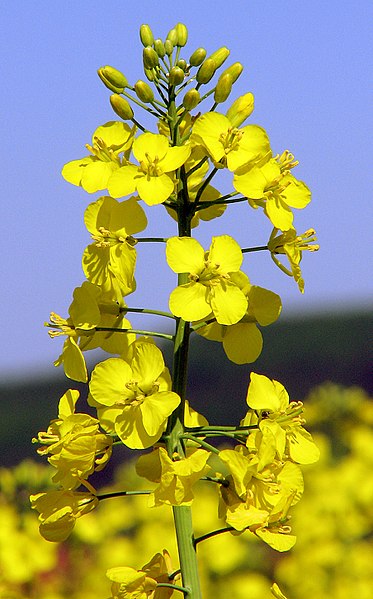 As a national biofuel law has been approved, Santa Fe is now about to follow the trend and exempt biofuel-related investments from taxes. The government is currently creating administrative structures to promote the development of biofuels based in rapeseed (Brassica napus), which is not strong here but is planted extensively in Buenos Aires Province, and a project of cooperation with Cuba to produce ethanol from sugarcane is in the works. The Cubans are experts in sugarcane, and the underdeveloped, underpopulated north of Santa Fe seems to be a good place to plant it, with appropriate irrigation techniques.
In Salto Grande, central Santa Fe, a rapeseed-based biofuel plant is about to open. The idea is mixing rapeseed oil with regular diesel (fuel oil) and save 30–40% in fuel costs. It has the added blessing that it will encourage the plantation of rapeseed, avoiding the monoculture of soybean.
Several companies in Santa Fe (petrochemicals, vegetable oil processors, even the former state-owned ensign oil company Repsol-YPF) are planning to build new facilities or even to open new production departments. Smaller companies are already producing biodiesel from various sources (such as sunflower oil) to supply the local markets.
You know how I like to speak badly of our disastrous provincial government (see? I just did). This commitment with biofuel production is auspicious and I hope it turns out right, because it's one of the very few good things this administration has done. Of course, it's rather late, the new biofuel-promoting bureaucracy will cost much and do next to nothing, and the actual effort will be that of the private sector, which is (fortunately) dynamic enough to catch and ride this wave, if only it receives a few tax breaks and soft loans.
You may say I sound too optimistic and overly pessimistic at the same time. That's perfectly logical. These are prospects nobody has presented in science-fiction movies and books about the near future. Instead of cold fusion, cooking oil? At least we already know it burns.