16 July 2007

Encarnación

The day I went to Encarnación was cold, rainy, dark, and windy. What a pleasure. I had four layers of clothing on. The little bus that takes you there runs through the center of Posadas, so I had to wake up early to catch it.

Going through customs is like a punishment. Once you get to the Argentine foot of the Roque González bridge, you have to get off the bus and form a queue before a cramped customs office where half a dozen clerks will get your National Identity Document (DNI), note it down, and return it to you. You exit on the other end of the room, and get on the bus again. The bus hops merrily along the bridge all across the Paraná River, and when you get to the Paraguayan side you have to disembark again, and make a run for the customs office. You hand them your DNI, they check it and give you a piece of paper with a stamp and the DNI number in it. Somebody'll ask for it when you return to Argentina, and if you don't have it they'll charge you 50 pesos, or dollars, according to the variant horror stories told by the passengers. If you don't get your stamped pass quickly, the bus will just move on without you and you'll have to wait for the next one.

I caught the bus just in time. I'd been instructed to stay in it as it progressed through the lower (physically and sociologically) neighbourhoods of Encarnación, up to the top. For better or worse, I got off at the bus terminal. I don't have pictures of that part of the city because I was a bit scared of taking out a shiny, if obsolete and cheap, digital camera, and parade around with it taking pictures like the stereotypical stupid tourist. The area around the terminal is full of people trying to get a few coins from you, to sell you watches or pirate DVDs, or to activate the chip on your cell phone for nothing.

Now, before somebody accuses me of being derisive to Paraguay, there are other parts of Encarnación where you won't do business either, and they're no worse than some parts of Rosario, of Buenos Aires, and of every other big Argentine city where I've been. It was the density that threw me off in Encarnación. I walked away a few blocks and I found a wholly different view. The city has a very nice Plaza de Armas, which is the main square, which I assume is called "Arms Plaza" because it was where the army was amassed in times of need, and that's what it was called in colonial times. Encarnación was founded at about the same time as Posadas on the opposite side of the river, in 1615 — it's a very, very old place.


There's a tree in the plaza that testifies to the very age of the settlement. It's called a curupay, which I'm told is Patagonian Rosewood, though I don't see how anything Patagonian can be found growing 1,500 km north of Patagonia. It's only about half the age of the city — just below 200 years.


Encarnación was initially a typical colonial Spanish city, but in the 19th and early 20th centuries it received a lot of immigration from several sources: like Misiones in Argentina, it welcomed a lot of people from central and eastern Europe; and it also encouraged the settlement of Japanese people, something Brazil up north also did (on a massive scale). The traces can be seen readily just by looking around; the last name of the mayor of the city is Schmalko, there are plaques and small monuments thanking the hard-working community of Germans that helped the town grow, and even a bust honouring Ukrainian poet Taras Shevchenko; and at least one employment agency offers jobs in Japan for people of Japanese descent up to the fourth generation.


The Catholic faith has been losing ground to evangelical denominations throughout South America for decades, but in Encarnación there are already well established, traditional non-Catholic Christian churches. From the central European immigrant component, I hoped to see a lot of Lutheran churches (something I saw later in Oberá, Misiones), but I'd neglected the eastern Europeans' faith. It was certainly strange to spot the rounded domes of Orthodox temples in Paraguay. The pictures below are St. George and St. Nicholas:


Another strange sight was the wealth. Not the healthy wealth of a vibrant progressive city (though Encarnación looked quite lively in that respect), but the kind of dubious wealth that shows in an over-abundance of big, shiny, squeakly clean new SUVs and an astonishing proportion of Mercedes rolling in the streets. I swear the bulky Mitsubishis and Toyotas plus the Mercedes made up at least 50% of the vehicles. The same kind of wealth showed even more insidiously in luxurious, mafia-boss-type houses that clashed terribly with their humbler surroundings.


Disregarding that, I liked Encarnación. There aren't many places that look good in such a bad weather. Encarnación has those same deliciously sloping and winding streets as Posadas, those same trees and plants and flowers everywhere, and it must be beautiful if you manage to see it under the sun, even in winter. I had no such opportunity.

One other thing, if you have the chance to visit Paraguay. They have no café culture. This was the most striking change. People in Misiones and in Paraguay talk with the same accent, share a cultural and ethnic background, and manage their affairs similarly, but as soon as you leave Argentina, forget about bars in every corner where you can order and get an espresso coffee just like that. I learned it the hard way — when, just before heading back to Posadas, I craved for a cup of coffee to keep away the cold and lighten myself up a bit, I walked around for half an hour and then I only found a not-so-good-looking bar where I asked for a coffee and after a long while I got... a cup of coffee, as in what you make for your guests at home. No espresso, no small sugar bags, no bubbly water to finish it. Worked alright for me, but only then it hit me I was no longer home.

Our next stop will be San Ignacio and Santa Ana, the missions.

Posadas

July 9, Independence Day. The bus guy woke everybody up at about 6:00, distributed plastic trays and gave us breakfast. By the time we were finished, we were reaching a place where many people got off the bus. I thought it might be Posadas, but it was Garupá, a town in the metropolitan area. Posadas Terminal Station is like 20 minutes after Garupá.

The first surprise of the trip came immediately afterwards, when I took a cab at the bus terminal. I gave the driver the address of the place I'd be staying, and he started driving along really dark neighbourhoods. On and on we went. It turns out that not only is the terminal quite far from the downtown, but also Complejo Aventura (my place) is far away from both. I paid 13 pesos for the taxi ride, which would've been enough to buy me a good lunch. I got to Complejo Aventura, which was a large place with trees and cabins joined by tiled paths, and in the dark, feeling incredibly, horribly, uncomfortably cold (remember this was the day when it snowed in Buenos Aires), I was directed to my cabin. No problem there — except there was no heating, of course.

Long story short, I had to take a bus to get to the center. I'm used to take buses everywhere, but this one took ages to come. The trip itself was short, merely 10 minutes, and left me on one edge of the city center. Posadas is a fairly large, sprawling city; the center is a 14x14 block area in the old Spanish tradition: everything neatly arranged in a regular square grid, with a plaza at the center, with the government house on one side and the church on the other. I walked aimlessly around with my umbrella. The city was not very active, maybe because it was a holiday. As I neared the main square, I heard sounds of roaring engines and singing. I came closer and saw there were many people on foot with their umbrellas, sipping mate or just braving the cold, and a row of tractors and other vehicles aligning in front of the government house. I'd run into a protest!


I read the signs and asked some guy about the demonstration. Misiones is famous for its yerba mate, and produces much (if not most) of the yerba we all put into our mates every day, but the ones who grow it and harvest it are getting mere cents for it. It seems the government and the big yerba companies came to an agreement with the farmers to pay them at least 48 centavos (about 15 cents of a dollar) per kilo of yerba mate leaves, but they're paying less than half of that. The demonstration was colourful, with labour union representatives, popular singers, and the usual assortment of kindergarten-level leftist demands. (PS: I got a video of a woman singing in Guaraní.)

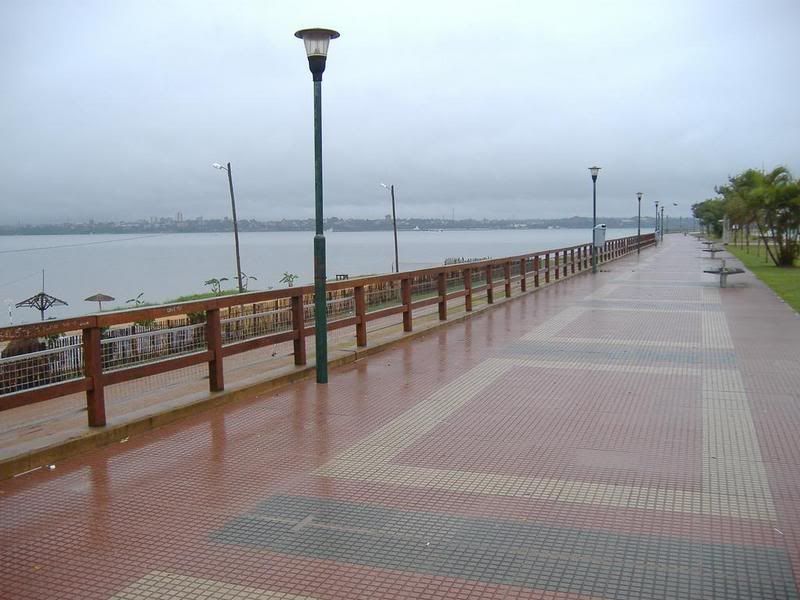
I left. I guess I had something to eat, then I headed for the Costanera. Posadas had a new coastal avenue built and paid for by the Binational Yacyretá Organization, i.e. the Argentine-Paraguayan company that manages the massive Yacyretá dam and hydroelectrical plant. (Yacyretá is the second largest dam in the world and by itself generates most of the energy needs of Paraguay, and a lot for Argentina as well. It's 83 km downstream from Posadas, but the effects of the rising waters extended past there.) Posadas has a lovely long costanera, which must be really a show in the summer... or just when the sun is up.


Some interesting facts about Posadas:
  • The city has a waste separation system! I don't know if it actually works, but at least the city is very clean.
  • There are exclusive bus lanes in several streets. This is something that was proposed in Rosario and implemented for a while, along Corrientes St., until businesses complained. One step back in the fight against traffic chaos...
  • The city, as expected in this land of past geological shifts, has slopes everywhere. You can get moderate exercise just by walking.
  • There are many trees, and wild things growing on trees or sprouting from walls. This is the main reminder that Posadas is on a wet subtropical area, even if it's winter and you're shivering.
Next installment: Encarnación.

15 July 2007

Back from the north


I came back to Rosario today at around 9 AM. I haven't been able to do much since then — I unpacked my mess, took a long hot shower (more on that soon), unloaded my photos, talked to a couple of friends to catch up, shared lunch with my family. I fear there won't be an end to the blogging once I start telling you about the many different things that I saw during my vacations in Misiones, but I have to start somewhere.

So I'll do more or less what I did in January regarding Mendoza. This post will be only for the general stuff. That would include the following factoids:

  • It rained or drizzled a lot most of the time, and it was unusually cold for a subtropical place. Then it also snowed in Buenos Aires. Nevertheless I had a terrific time, mostly, and came out of it without even a common cold.
  • I took a lot of pictures. Given the aforementioned bad weather, many didn't come out as I expected. There are many places that don't look as good as they are when not lit by unmitigated sunlight.
  • I was cold all the time... People in Misiones probably don't need hot showers often.
  • I think I'm in love with the city of Oberá.
  • I think I'm a luxury travel whore. I enjoyed being pampered by the bus company and would buy their overpriced tickets anytime without protest.
  • Misiones' famous red earth gives everything a nice warm touch, but red mud is not nice at all.
  • Paraguay doesn't have a café culture.
  • You can do a lot with very little money, but not without time. I need longer vacations.
Bear with me until I get myself in order, and I'll tell you about my adventures one place at a time... starting tomorrow.

06 July 2007

Going to Posadas

I'm getting my things in order because I'm going on winter vacations. It'll be only a few days, but not a long weekend escapade. I'm leaving this Sunday afternoon, to arrive Monday morning (Independence Day, incidentally) in Posadas, Misiones.

Posadas is a city of a quarter million people with no famous tourist attractions. The area, however, is full of ruins of 17th and 18th century Jesuit missions (think The Mission, though the movie's setting was actually elsewhere). It's about 1,000 km north of Rosario, upstream on the opposite shores of the Paraná, and logically much warmer at this time of the year. Now that a polar cold front (another one) is headed for us, I think my timing has been perfect... only the weather forecast for Posadas says either "cloudy" or "showers" for every day next week. I'd have some nice rain rather than just an overcast gray sky. It's better for pictures, too (except it's a bother to handle an umbrella without hands while you hold the camera still).

I'm told Posadas is very nice, even though it has no big monuments or the sophistication of bigger cities. I'm staying there at least three days, possibly more, but I also want to check out Encarnación, which is across the river, in Paraguay. Rumour has it you can smuggle anything at a very good price, from MP3 players to plasma TVs, from Paraguay. We'll see...

04 July 2007

Photo manipulation

I've been doing some experiments with pseudo-panoramic images and with filters. When I say "pseudo-panoramic" it's because they're not really taken with a wide-angle camera or any sort of special equipment, but assembled by software from a set of overlapping pictures. You just stand in the middle of the scenario you've chosen and take three, four, or a dozen pictures — take one, rotate a few degrees on your axis, take another, etc. Then you dump them on your PC, load them in AutoStitch, and wait for the pattern-matching software to do its thing.

If your camera doesn't have a manual setting, the software will probably have trouble matching the different (automatically adjusted) exposures. If left in automatic (or if there's no alternative), the camera will try to get a picture with a fixed total amount of light. If you have the sun in your picture, most of the light will be there... and the rest of the picture will be too dark. The software cannot match pictures where this light-dark balance is wildly different. There won't be any problem, though, if you just take a view of something far away, ideally with the sun behind you (or not more than 45 degrees to the right or left of the direction directly behind you).

For filters I use The Gimp, an open source program that was originally designed for Linux (the earlier version employed native GTK+ widgets, which looked —and behaved— quite odd in Windows). I've never tried Photoshop, for one reason or another, though mainly because I don't really like to fool around with filters that much, and The Gimp has plenty of them for me as it is.

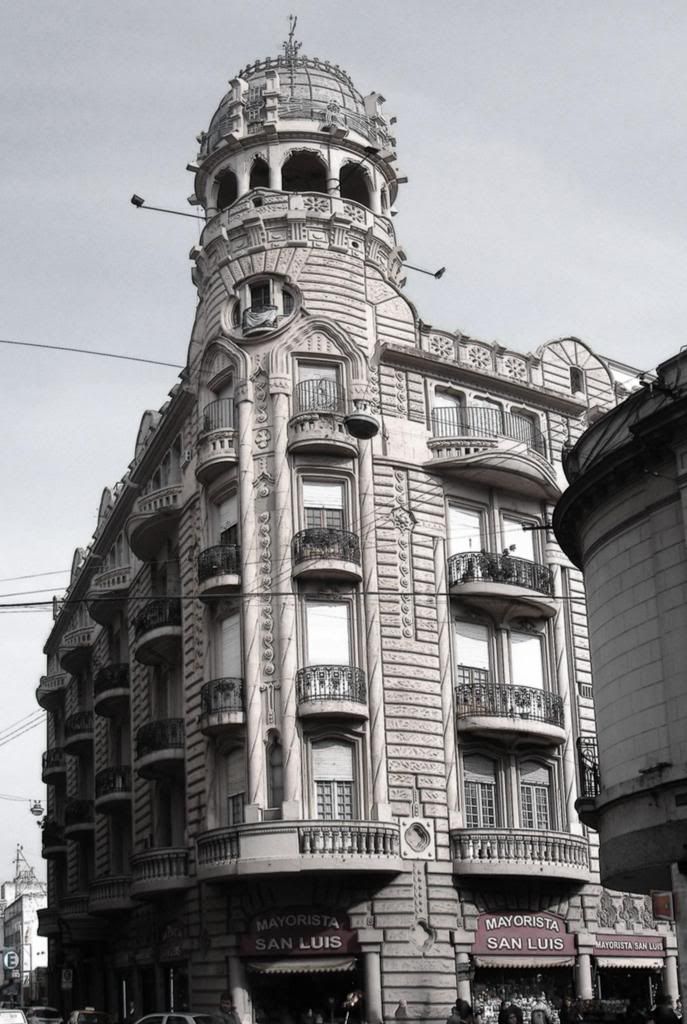
You've seen some of my panoramas here, in Flickr and in Vista Rosario. I haven't posted many retouched pictures anywhere, though, except for some basic clipping, fine-tuned rotation and quick contrast/brightness fixes. However, you can do interesting effects with filters — and I mean interesting, not just funny or "cool". For example, I passed by the Palacio Cabanellas yesterday, on my way to buying a bolso matero (a cross of backpack and purse to carry a mate gear — the gourd itself, a thermos for hot water, and a plastic container for yerba mate). I had some less-than-satisfactory pictures of it... bad lighting, bad time, not the right sunlight angle to bring out the details, ugly cloudy sky... The light looked perfect this time, though, so I defied the nightmare of rush hour in the place with the narrowest sidewalks of the world, and grabbed a set of pictures, including five destined to make up a panorama. Back home I assembled them. The spherical projection made the vault look like a hot air ballon on top of a golf tee, but The Gimp's Perspective tool took care of that. I added a "Detect borders" filters, played with the colour curves, threw in a bump map, and voilà. The result looks retouched but not too much — maybe like something out of an old newspaper, or a very detailed sketch — and the building sticks out from its (depressing) surroundings.


This is a picture you won't get with a common camera; there's simply no room in Rosario downtown to back away and take nice wide shots of tall buildings. And sadly, no amount of photo-tinkering or physical prowess will rid your pictures of aerial wires...

03 July 2007

Blacking out from happiness!


It's so good to live in these times of economic growth, with the shopping malls full of light, and people buying around tirelessly, and the factories bustling, producing goods for the anxious consumers and for the whole world! Now, every time the power goes out, you know it's a good sign — it's just growth pains!

Or would you like to live in a country that always has energy to spare? As they say, only the mediocre are always at their best. The fact that we're having problems (which we are not) is a sign that we're doing better each day!

Now if you think otherwise, you most surely must be a neoliberal right-wing nut bent on the destruction of everything that's good about Argentina, from Sunday asados to good ol' friends' capitalism, or a poor unthinking sod deceived by the diabolic cunning of the neoliberal right-wing nuts. You're still welcome to build the country that the sensible people truly want, with us, the good guys — in fact, you're welcome to become one of us, if you have some voters that we could use.

In any case, there's something you can do to help you through the dark hours..., which means a lot of time, since you'll be often living one of those painfully glorious growth spurts when the power goes out because the power plants cannot produce, or the grid cannot handle, the tremendous amount of electricity needed to run Argentina ever-increasing productive beatitude. Just use this mantra:

There's no energy crisis... There's no energy crisis... There's no energy crisis...


Repeat ad infinitum, and you'll see the light. Eventually.

(BEST IF USED BEFORE OCTOBER 2007)

02 July 2007

Out of dark rooms


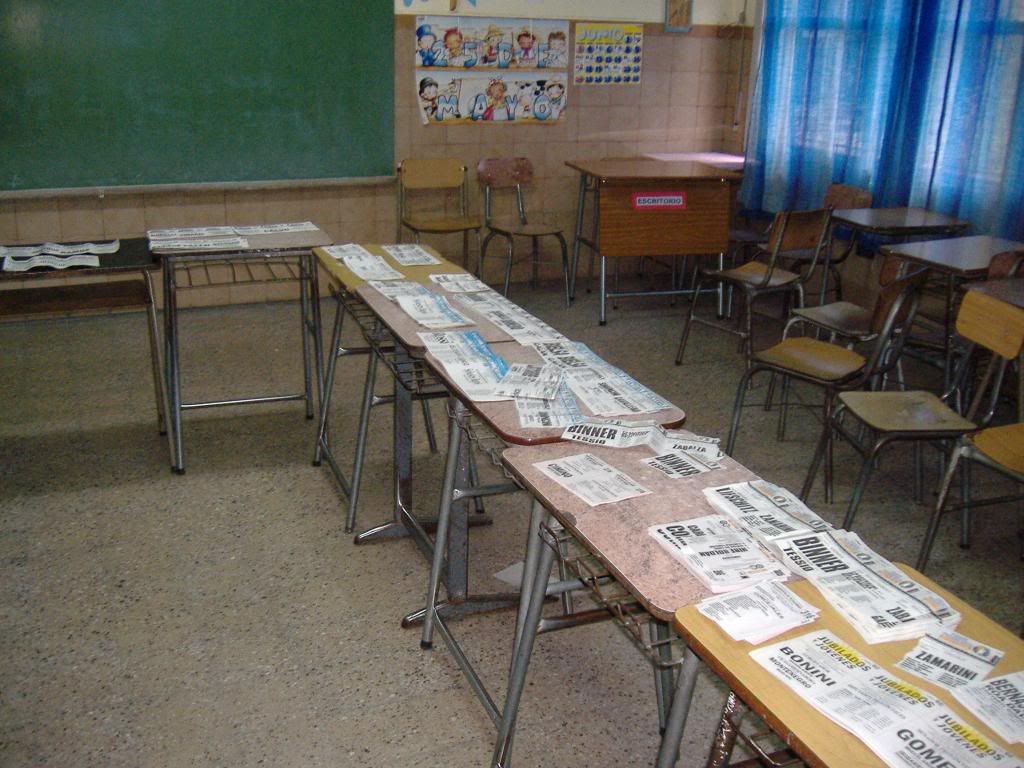
Yesterday's election brought some unexpected things. A lot of people went to vote, more than 70%. You'd think a compulsory election (under the threat of jail for those who don't attend) should not be skipped by 30% of the voters, but given the complete lack of enforcement of the electoral law and the fact that many people didn't actually know who or what they were voting for (the system is new, a bit confusing, and a lot of people are indifferent to politics when not simply dumb), it was a success — the rate of attendance was about the same as in most main elections in the recent past. On the other hand, blank and voided votes were a lot as well, about 17%. The profusion of ballots of different lengths and the possibility of cutting them to combine candidates from different parties and factions probably contributed to the confusion.

The real surprise, however, was Binner's loss. The Socialist governor candidate believed (as we all did, based on surveys) he was going to get more votes than the two Peronists combined, which would make victory in September almost a certainty; but he gathered about 30,000 votes less than the total of Rafael Bielsa and Agustín Rossi. Worse, he went public before the official figures were out saying he'd won over both, and even the papers got it wrong. Rossi was crushed — Bielsa got double the votes. So it's going to be Binner vs. Bielsa, and the result will depend on whether people who voted for Rossi did so out of Peronist loyalty or focused on the personal qualities of the candidate. If the former is true, Binner could very well lose the main election by a few thousand votes.

Then there are also the smaller parties and the people who chose them. This is not a ballotage as in Buenos Aires, but it's likely that, now the real numbers are in place, the September elections will be much more polarized and people will resort to what's called voto útil, the useful vote — a vote for someone whom you may not like but who has at least some chance to win. There's a Peronist candidate running outside the Front for Victory, and there's a Radical candidate running outside the Progressive Front; the former got 28,000 votes, the latter got 41,000. Not much in a province with 2.3 million voters, but enough to tip a close-tied election.

In Rosario, the Socialist component of the Progressive Front practically mopped the floor with its competitors, both internal and external, but that was pretty much expected. The Peronists should take note that their best candidate for mayor, Héctor Cavallero, is a former Socialist mayor (who sold out to Carlos Menem), and he got more votes for mayor than the votes Bielsa got for governor in Rosario — i.e. a significant number of people wanted to vote Cavallero, who was a good mayor in his time, and a good mayor in the line of Binner and Lifschitz, but didn't want to vote for Bielsa, and took the time to manually cut the ballot.

In case you're getting lost, remember this was all for almost nothing except for the Justicialist Party to decide which candidate will run. The real election for mayor and governor is in September, and the final numbers may differ greatly.

Yours truly won't tell you who he voted for, though it shouldn't be difficult to guess if you check my many earlier posts about politics. I'm hoping for the end of the 24 years of Peronist mediocrity in power. Worse, Bielsa is basically a Rosario-born porteño sent to Santa Fe by the President to win an election, and he takes pride in saying he's nothing but a representative of the President's national project. I believe a province with 3 million inhabitants who generate a large part of the total wealth of the country deserves a strong local government and independent ideas.

Some of the people who didn't vote yesterday will go to vote in September. And I'm now hearing people on the radio some people who say they voted for Rossi but won't vote for Bielsa, for the same reasons as me, but for Binner. There's hope.

29 June 2007

Wrapping up the campaign

We're in veda electoral, that is, the common pre-election ban on political advertising, since this morning. Though next Sunday's is just a primary election, it works like a main one and it's equally a bother: it's compulsory and you can't sell (therefore can't buy) booze the night before and during the whole day (you can buy booze beforehand and save it for Sunday, though).

In Rosario, almost exactly 700,000 people have the right and the obligation to vote; in Santa Fe as a whole, about 2.3 million. We're selecting the candidates who will run for their respective parties in the main election in September. Until 2005 we had Ley de Lemas, a perverse system by which a candidate could win with fewer votes than most of their opponents (follow the link). In fact, with Ley de Lemas you could win with 2 votes against someone who had gotten 1 million votes, provided you had 999,999 other candidates of your own party running beside you and they each got 1 vote (which would make a total of 1,000,001 votes for your party as a whole).

The system was repealed and replaced by simultaneous compulsory primary elections — compulsory for the parties, even if a party has internally decided to run with only one candidate. That's the case of the Socialist Hermes Binner, the favorite to win the governorship according to all surveys. The Justicialists (Peronists) have a more complicated task ahead, since they're presenting two candidates (Agustín Rossi and Rafael Bielsa) under the name Frente para la Victoria (Front for Victory), the faction of President Kirchner, plus one more, Roxana Latorre, who rebelliously decided to run by herself, and (naturally) claims to represent the true interests of Peronism. Latorre is (or was) a pawn of Carlos Reutemann, the Formula 1 race driver turned governor by the magic of Menemist popstar politics in the 1990s, and she doesn't like how the dominant faction has taken up her space.

Now common sense tells everybody that Latorre's proclamation of independence means less votes for the "official" Peronists; it doesn't matter now in the primaries, but it will matter in September, since Latorre will draw votes (very few, but some) from either Rossi or Bielsa. Binner, who runs solo and only appears as candidate in the primaries to keep the letter of the law, doesn't have this kind of problem. Socialism is allied with the Radical Civic Union, which managed to preserve a degree of local power (smaller towns scattered throughout the province) after they blew it once and again and descended into obscurity on the larger context thanks to President Alfonsín selling out to Menem (1994) and President de la Rúa selling out to Domingo Cavallo and fleeing the Casa Rosada on a helicopter (2001), not to mention other stupid blunders and many gestures of misplaced moral authority in the meantime and up to now who would've made Alem and Yrigoyen spin in their respective graves.

In Santa Fe, most of the Radicals saw the convenience of selling out once again, this time to Binner's Frente Progresista (Progressive Front), and are therefore telling their people to vote for Binner, who has placed a number of Radicals in his associated list of provincial legislators; a sensible move that will allow them to keep a foot on the parliamentary door and maybe, in a few years' time, run their own candidate for governor. Reelection is not allowed, so if Binner wins he'll be out again in merely four years.

In Rosario the mayoral candidates will be competing as well. We have two heavyweights on the side of Justicialism, Héctor Cavallero (former mayor, former Socialist and Binner's mentor, very good in his time, sold out to Menem — a pity) and Juan Héctor Sylvestre Begnis (former Radical, migrated to Peronism, son of Santa Fe's best governor of all time, served as a very fine Minister of Health of Santa Fe, also a pity since the one we have today is a living shame). There's the usual assortment of unknowns crawling around, too. On Binner's side, the current mayor Miguel Lifschitz looking for reelection — an almost sure bet, and Carlos Comi, a concejal (city council member) who belongs to the local branch of ARI. ARI, you'll remember, is the party founded by Elisa Carrió, the party that won its first governorship last Sunday in the person of Fabiana Ríos, the rosarina that moved to Tierra del Fuego. Funny!

Comi and ARI in general are not too happy with Binner, since the Socialist ballot we'll find in the voting room next Sunday carries Binner and Lifschitz on the same piece of paper, while ARI will not have such a big name attached to its candidate. If you want to vote for Binner and Comi, you'll have to cortar boleta — cut the ballot manually (or with a scissor), while if you want Binner and Lifschitz, you just need to tuck the ballot in the envelope as it is. Lifschitz thus benefits from Binner's preference..., you know, like placing the brand of potato chips you want to sell next to the beer aisle on the supermarket. So Fabiana Ríos and Elisa Carrió came to Rosario this week to support Comi's campaign, and they mounted a kiosk with a gigantic pair of scissors. Subtle.

The official Peronist candidates have been much kinder to one another, to the point of boring us all and the media. According to both of them, everything in the province is so darn well done already they only need to continue doing what the party has been doing since 1983...

26 June 2007

Strange days in politics

Strange days! I blogged on Saturday and Sunday, and that must be a first. And didn't blog yesterday and I almost didn't blog today, but I thought, everybody's talking about politics... well, at least everybody on TV, and a lot of people in the capital of our proudly macrocephalic country, plus a few thousands near the End of the World.

What to make of Macri? Well, for one he has a terrific image counselor — at times he can almost pretend he's a kind human being. Then, of course, he speaks outside his extremely limited script and we can all see his shadow turn into an old man with a mischievous smile joining the tips of his hands and muttering "Excellent!".

Macri has been praised by the right and derided by the left, and yet he's new to politics and to public life, so there's no way to know what he'll do once he's in power. He might be just what the average, fascist middle-class porteño wanted, or he might not have what it takes. Because "getting Buenos Aires in order" is not a task that you can accomplish without turning the streets into a battlefield, killing (by accident or design) a few protesters, and causing a fair amount of distress to those citizens who naïvely believe "order" can be achieved with a simple recipe (à la "Zero Tolerance"). Página/12 speculates a lot about this today (What kind of ruler will he want to be?).

If I were a porteño, I'd be more concerned about vice-Chief Gabriela Michetti. Mark my words: Macri might have the money and a lot of simplistic and dangerous upper-class ideas stemming from his upbringing as a spoiled brat, but Michetti is educated, conservative, devout, firm as a rock, relentless — the kind of person who can have tea with you and then send you to the firing squad with an unchanging smile on her face. (OK, maybe that was too much.) Just my impression.

Then there's Tierra del Fuego. In case you didn't hear (almost impossible, since it was repeated ad nauseam last Sunday on TV), Fabiana Ríos, a 43-year-old pharmacist born in Rosario who lives in Río Grande since she's 23, won the runoff election by a small but significant margin over the Kirchnerist governor Hugo Cóccaro, and is the first female governor to be elected to rule a
province. She looks younger than her age and seems a nice little lady, until you hear she intends to meet the president and tell him, basically, that she doesn't want the national government to mess with her province now that it's changed hands. Bear in mind this is a province that lives mostly on tourism and has a smaller population than some barrios of Buenos Aires... in fact, only half of Kirchner's Santa Cruz.

Ríos is also the first governor belonging to ARI, the continuously mutating party that Elisa Carrió founded and still leads on the national level... sort of. Carrió wants to be St. George to Kirchner's dragon — or, in less poetical terms, they hate each other's guts. Ríos cautiously (and truthfully) noted that this is a victory for her and her constituency and against an entrenched corrupt political class, not a triumph of Carrió against the president. But to Mr. K, this and Macri on the same day must have hurt really bad. Well, pain teaches you to keep away from some things, so let's hope K is beginning to learn that lesson.

24 June 2007

Tolerance and respect

Daniel, from San Luis, tells me he's not going to read this blog anymore because as a Catholic he feels I'm intolerant and disrespectful, based on my earlier post entitled "Monsignor my ass". I'm taking the opportunity to expand on that issue. (By the way, Daniel, I do publish comments like yours, which articulately disagree with what I think. What I don't allow is gratuitious insults and xenophobic rubbish, like she did.)

First, what is intolerance? Intolerance is saying, "I don't like what you think/say/do, so I'm going to discriminate you, or punish you, in some way." I can't do that with the archbishop. I believe he represents an evil organization, and I think many of the beliefs he holds are detrimental to human wellbeing. All I can do about it is criticize him, using the means at my disposal, one of which is ridicule. Any sensible member of any religion knows there are billions of people in the world who consider his or her religious beliefs false, ridiculous, absurd, or even supernaturally harmful. This doesn't mean those people are intolerant. I would have coffee or dinner with the archbishop any time and I'm sure we could get along fine, just as I get along with people of the most diverse beliefs in my daily life, as long as the archbishop refrains from telling me I'm going to hell because I'm a filthy unrepentant atheist.

Then, what is respect? More importantly, why do religious beliefs and to what extent do they deserve respect? (H. L. Mencken famously said, " We must respect the other fellow's religion, but only in the sense and to the extent that we respect his theory that his wife is beautiful and his children smart.") My idea of this is that respect is for people, not for ideas. You respect a person when you talk to them using the proper words and not insults, acknowledging their opinions, and accepting that they have different ideas even if you don't like them. Ideas are not people! They can't feel pain when attacked! If you bring to a table the idea that it's OK to burn people alive to punish them for heresy, or that Jews are an inferior race, or that women should be locked up in their homes and be content with being loyal sexual objects for their husbands, your idea will be called horrible things, torn to pieces and exposed as discriminatory, barbaric, medieval, and utterly damnable. But if you're dealing with tolerant subjects, they'll attack your idea, not you. You will be attacked or forcefully restrained or expelled only if you actually try to enforce your idea.

I respect archbishop José Luis Mollaghan. I don't respect his religion, and I shouldn't, because it's been the source of a lot of suffering and continues to be, in my opinion, a force against positive change and even for death in many parts of the world. Above that, it's a religion whose leaders treat me and many of my compatriots as second-class people, and if they were in power, they'd most surely also make me a second-class citizen. I don't like the fact that the Vatican has a spokesman telling me and my compatriots that being a good Argentinian and a patriot is somehow linked to being a faithful Catholic. I don't like how assumes he speaks for all of us and in behalf of all of us. I find the whole Christian theology thing a huge lump of incoherent nonsense.

So that's my personal opinion, and you can disagree or not, but you can't take away my right to say it in this public, but explicitly personal, account of my life. If archbishop Mollaghan has a blog, a personal webpage, a diary, or a self-edited paper, he's also free to voice his beliefs there — but I say he shouldn't be allowed to do it in a public patriotic holiday, as if he were an authority that represents us, the people. We didn't elect him, it was some old guy in the Vatican who did. He's not monsignor, "my lord", to me. He has enough influence to be quoted in independent media, and he has his own place as well — let him speak in church.

23 June 2007

Comedy night

Just a quick post, weekend style... Last night I went to see a troupe of comedy actors, The Jumping Frijoles. They do an improvisation show on the line of Whose Line Is It Anyway?, only they're not televised, of course... and they have no props, not even a chair, or any music whatsoever. According to their website, they've been doing this for five years. It really shows. They're very good most of the time. Some individual performances were not terribly good at times, but the whole was hilarious.

The setup for this is a stage at the bottom of a bar called Berlín, a place I knew from earlier nights as an underground den of vice and/or hellhole, which has turned into something much cleaner and professionally run lately. There live shows every Thursday, Friday and Saturday, and you can eat cold and hot snacks and sandwiches or drink good beer and fairly nice wine too; as the night progresses you can go downstairs (in this case literally underground) to the dance floor.

So we arrived, were brought to a table, and munched on a couple of hot sandwiches. Someone left pieces of paper and a pen on the table for us to suggest titles for the skits. We filled them in and returned them, and we received pompons on plastic sticks, two per person, one green and one red, for the vote — since the Frijoles assemble two teams for each skit. The show was, as I said, very good most of the time, especially considering a team only has 15 seconds to deliberate on what to do after they get the title.

I don't think the Frijoles do shows elsewhere (their site says "Rosario and some nearby towns" only). So if you're passing by the city and you want something funny to do before going to a disco, check if they're on schedule!

22 June 2007

Monsignor my ass

The guy you see on the picture is called José Luis Mollaghan. Now ask yourself (and reply to yourself, of course), what makes it different from you, me or anyone else on this planet? I mean, besides the fact that he's wearing a weird purple hat and speaking on a microphone very close to the top authorities of Argentina.

Well, this guy Mollaghan is called an archbishop, a word which etymology tells us means "chief overseer", or maybe "top-grade supervisor". He's in charge of checking on the local community of Catholics, an arduous job for which he was appointed by the Pope himself. The Pope is in charge of checking on us all, and I mean all the world, since he's the vicar of Christ, and he must not let us sin — since Christ was nailed to a cross 2000 years ago precisely to save us from sin, and apparently we didn't pay attention.

The Pope was found to be OK for this demanding job by an assembly of other notable Catholics called cardinals, in turn appointed by a previous Pope, under the inspiration of someone or something called the Holy Spirit, an invisible, inaudible, inodorous... thing which is one part of the three that make up the entity known as the Holy Trinity, aka the Roman Catholic God, or just "God". Who created the universe and loves us all, forever and ever, and will not let us be tortured in a lake of fire as long as we go to Mass every Sunday, et cetera.

Now it makes sense that the archbishop sits next to the president and tells us what to do, right?

If you, like me, think all of the above is farfetched, absurd and outrageously ridiculous, you'll answer "no". But then you'll be in the minority.

You're also supposed to address Mr. Mollaghan as "Monsignor", that is, "my lord" (or "milord"). Sorry, I thought all titles of nobility in Argentina had been abolished in 1813. This seems unfair to secular nobles.

Mollaghan gave a speech to the troops amassed on the celebration of Flag Day, before anyone else, even the governor or the Commander-in-Chief (that would be the President). The speech had little to do with the occasion; Flag Day was only an easy plug for a religious rant about how Argentina is a Catholic country, how the Virgin Mary wants us all to worship her 24/7, and how it should always be illegal to prefer a poor woman's life over a handful of barely differentiated cells. The authorities (a Socialist mayor, a left-leaning Peronist governor who professes to be a great friend of Fidel Castro, and other officials of a country supposedly governed by a secular Constitution) listened attently and (I guess) tried to ignore a group of women with a green banner set up before the stand who demanded free access to their reproductive rights. I was exposed to religious indoctrination and to this kind of oblivious, matter-of-factly intolerance for such a long time, this shouldn't bother me by now, but it did.

So Monsignor got to advertise his beliefs from a privileged spot during a public secular holiday, and nobody said a thing. But wait: the princes of the Church have other advantages over their secular counterparts: they get paid by the state (a bishop gets 70% of the salary of a federal judge) and their titles and other entitlements are not subject to the legal framework of Argentina — they're in fact representatives of another country, the Vatican, the only modern theocracy in the Western hemisphere, by virtue of a Concordat... signed between the Holy See and the dictatorial (i.e. illegal) government of Juan Carlos Onganía, in 1966.

20 June 2007

Flag Day

Phew! It's been mad since Sunday, when I started Flag Week by going to the former Rural Society (now a Municipal Fair Site) and then on Monday when I went with the Rosarigasinos photographers' group to check on what was happening prior to the celebrations. The whole city's been like crazy, and the photographers (press, private professionals, amateurs, me!) were buzzing around, grabbing picture after picture of the new Flag Memorial lighting, the crowds, the tenor José Cura (a Rosarino living abroad, who sang for everybody last night), the flags, Alta en el Cielo...

So today was Flag Day proper. I was truly wrecked yesterday when I came back from the wet cold night after listening to Cura and signing the Flag March along, but I woke up today at 8 AM, and together with my brother got a quick breakfast and headed for the Monumento. There weren't many people still.

There were, to be sure, many flag peddlers, and others; by noon the smell of chorizo and praliné mixed with the sight of white-and-blue flags and hats and the voice of people selling Coke and coffee in plastic glasses.

Contrary to my earlier post (my sources were wrong), President Kirchner did come. He came late, to be sure, though given his legendary tardiness at every meeting, it was almost OK. The civic-military parade started before he arrived, as scheduled. There were the usual speeches by the mayor and the governor, and then K came and spoke — again, it was a pleasant surprise not to hear him speak of magnificent macroeconomic numbers and denouncing dark conspiracies against the country we all want, etc. etc.

The only letdown, politically speaking, was the presence of professional bootlickers. It was these bootlickers, on behalf of governor candidate Agustín Rossi, who defiled a corner of Plaza 25 de Mayo by installing a crude campaign ad in the form of an inflatable penguin before the Cathedral. Others preferred to go with the traditional stuff and brought Argentine and Santa Fe flags superimposed with the faces of Juan and Eva Perón. These and others, with standards and banners proclaiming their loyalty to (whoever runs) Peronism, set themselves at the strategic spot right before the mast of the Memorial, in front of the authorities' stand, and brought uncalled-for drums (commonplace in Argentina's political demonstrations and protests) to "complement" the military bands.

I couldn't grab a good picture of the prez, since I couldn't get close to the stand, of course, and my puny camera only has 4 megapixels and a 3x optical zoom. Considering my shaking pulse and the fact I was lifting the camera in the air over rows and rows of other people, though, I got a nice result. You can see the Emperor Penguin clearly; to the picture's right (sitting) are vice president Daniel Scioli, and governor Jorge Obeid. The lady in pink/purple to the far right (!) is Senator and First Lady Cristina Fernández (quite possibly the first woman to be elected to the presidency in the history of Argentina), and if you know the guy, you'll recognize the dreaded Alberto Fernández by his moustache, to the left.

There were a lot of people, but not so many as last year. Maybe they were all exhausted, like me. Right at the end of the parade, when traditional associations were parading in horses and carriages, it started to rain, and many left. Yours truly took shelter under a tree, and then I noticed a crowd had climbed on the stand, that the powers that be had deserted. So I got to be right where K had given his speech.

There's a lot more to say. I'm going to post pictures during the following days, here and in Vista Rosario. Check my Flickr pictures and the Rosarigasinos group pool as well. I've taken over 700 pictures since Sunday and I'm sure I'm not the only one. Just one more, taken a bit later than the first:

19 June 2007

Flag Day is tomorrow!

These have been atypical days. First of all, it was a long weekend; and then also, in Rosario it's a very short working week. You see, most public holidays are moveable in Argentina. In order to produce long weekends, which are good for tourism, holidays that fall are moved back to the prior or next Monday. The exceptions are the fixed religious festivities (such as Christmas), the New Year, and the two main patriotic holidays: May 25 and July 9. No matter where in the week they fall, they're never moved. One would expect public displays of outrage if the government decided to play around with those two sacrosanct dates just to please tourists and raise the profits of the tourism industry.

Banderas argentinas desplegadasYet, one would also expect Flag Day to be a very patriotic date, but Flag Day (June 20, the anniversary of the death of Manuel Belgrano, creator of the Argentine Flag) is moveable. May it be because it's a celebration linked specifically to Rosario and not to Buenos Aires? Belgrano, after all, crafted his flag and hoisted it for the first time in two artillery batteries located on both sides of the Paraná River, one in Rosario and one in an island directly opposite the village. And he did it in violation of direct orders of the central government of Buenos Aires (the same government which, a few years later, ordered General José de San Martín to attack the province of Santa Fe, that was beginning to oppose the centralism of the capital — an order which San Martín, too, disobeyed).

But that mustn't be it. After all, the Declaration of Independence was written and proclaimed in Tucumán, and Independence Day (July 9) is not moveable, and the President usually celebrates it there.

Must be that national governments, one after another, have never found Flag Day very important. We rosarinos, supported by the provincial government, have asked the federal government to fix Flag Day at June 20, but to no avail, for years. June 20 continues to be a public holiday for the public administration and for all the schools in Rosario, but for no-one else and nowhere else, so many people in the city and from other places cannot attend the celebrations.

This makes it, in principle, easier for the President to bring a parade of applauders for hire, as especially Peronists like to do, but historically that hasn't been a good idea. When Carlos Menem did that, he was left with his minions and a minuscule group of followers in what amounted to a badly organized party meeting. It was so pathetic and sleazy that he didn't want to come to Rosario anymore. He always had excuses: his plane was broken, it was too foggy, it was too windy... Besides, Rosario was hit very hard by anti-industrial Cavallonomics, so Menem stayed away. President De la Rúa never came in his two years. He wasn't a Peronist but I bet he was a Menemist... Duhalde didn't come either. Kirchner came in 2003, and then in 2005; he had appropriate excuses.

Kirchner is not going to come for the main celebration this year; he announced he'll be here "late" (that's 3 hours after the beginning) and just do a speech. Now I understand a president's agenda is always full, but didn't anyone notice June 20 was in there? If a president skipped the celebration of any other major patriotic date, he would be burned at the stake by the media, the opposition, and many common folks. I don't like the guy; I was even guessing he was going to turn his speech into a campaign rant like he always does; but leaving the person aside, there's the symbol, the authority. This is the commemoration of the death of one of the very few true patriots this country has seen in its history, and the celebration of its flag.

Well, I'll tell you tomorrow (or Thursday) how it was like, with or without K. Vice governor Bielsa is not happy the president isn't coming (maybe because her brother, the candidate, won't be able to grab a campaign picture next to K? — though she says it's because people were looking forward to parade in front of the president, which is true). Governor Obeid excused Kirchner, though... I'm sure there won't be much of a difference.

It's the 50th anniversary of the Flag Memorial, and the Municipality is, as we say over here, throwing the house out the window (or "throwing butter to the ceiling"). There have been concerts, a professional reenactment of General Belgrano's entrance into Rosario in 1812, rodeo-like traditional events, and a national artisans' fair; the Memorial has a new and revolutionary lighting system installed (which will be inaugurated tonight), and in general, the city is bustling with flaggy activity. Before the mast of the Memorial, a group of volunteers is sewing up the parts of Alta en el Cielo, the longest flag in the world (and longer each year!), so as to march with it tomorrow. I saw them yesterday when I passed by with the Rosarigasinos to take pictures. There were still people at the Memorial, listening to a guide narrating the life of Manuel Belgrano, at 8 PM, just as I returned there after a tour of Rosario's historical cupolas. I was tired and freezing, but the old ladies in scarves listening to the guide were just warming up.

17 June 2007

Out of gas

One of the days we hoped would never come has arrived. This country may be full of problems, but it's always been prodigal, and we've always been accustomed to waste. Oh, not waste of money, necessarily, especially when half the population is still officially poor or very close to it, but our abundant natural resources have always been enough to throw around. We've never had (that I remember) a long drought or a widespread animal plague threatening our supply of food; we haven't been involved in any war that demanded us to carefully mind what we consume; we've always had plenty of fuel to heat ourselves, power our cars, and propel our industries.

Well, if this isn't the first toll of the bell signaling the Day of Reckoning for Argentina's Age of Waste, I don't know what it is.


Industries have been suffering scheduled cuts of their natural gas supply for several years in the months of peak consumption. These are industries working "interruptible contracts", which means they're supplied gas but have agreed with the supplier that the flow can be stopped at certain times. A few weeks ago, natural gas was cut to some other industries as well. Days ago, fuel stations in Buenos Aires received the order to stop selling Compressed Natural Gas. Almost the same order came to Rosario's fuel stations this weekend: do not sell CNG except in cases of emergency, or sell only through one pipe.

This is not so dramatic, you might say. It's been very cold, we don't have reserves, we don't have appropriate infrastructure, we're accustomed not to care about fuel. But it's not been so cold — just over or just below zero degrees in the main urban centers; we have some reserves, and we could build the infrastructure in no time; we only need to be more aware of what we spend. Yet, the cold cannot be remedied, our reserves are not high, and nobody seems to be building infrastructure for gas extraction and delivery. Some say we have natural gas reserves to last until 2012 or 2016, but it's a well-known fact that the last remains of reserves are not as easy or cheap to extract. With an industrial energy matrix designed to use more natural gas than anything else, with more than 1.4 million vehicles running on cheap CNG (more than any other country in the world both in relative and in absolute numbers), and a culture of irresponsible waste that cannot be changed by merely pointing at alarming figures, what are we going to do?

I was going to go out yesterday night. I didn't, in part because it was very cold and I was tired and the gang had no firm plans ("Let's go somewhere and get some booze"), but then also I knew I would have trouble getting back home. Catching a bus after 1 AM is like hitting the jackpot, and taxis, which never abound, were fewer than usual. Why? Because most taxis run on CNG, and at night they can't just park in a busy stop and wait for passengers to come by; they need to get out and drive around the city and load CNG every now and then, and if possible, keep the heat running. Most would rather stay at home. I've endured the experience of fruitlessly waiting for either a taxi or a bus to come, at night, in less-than-safe corners, with sub-zero temperatures, for an hour or more. I'm too old for that; these days it's either a quick and comfortable ride home, or nothing.

Fortunately nobody's speaking of rationing gas supply to homes, except in the negative. We all know what rationing would mean, mere months before the elections. That's reason to be truly frightened — if this is now, what will they do after our vote is safely again in the far future?

15 June 2007

National pride

Is it an inferiority complex? Is it a need to justify ourselves? Why do we Argentinians need to look for approval from abroad? Do we secretly consider ourselves less than the rest of the world? Good questions, I'd say, even if they're mine. They're not all mine — I've spoken to many people who wonder like this. The latest cause, for me at least: the fuss about the San Antonio Spurs winning its fourth NBA title.

I've never understood why people get passionate about sports. I must lack a gene or something. I can get passionate about a lot of things, I can even get some thrill from a good sports match, but drooling over teams' and individual athletes' performance is for me akin to the adoration of dogs for their masters. (You can tell I'm a cat person from that, too.) So back to San Antonio, why the fuss? Why, because it's an Argentine team!

The San Antonio Spurs have two Argentinians playing for them, Emanuel Ginóbili and Fabricio Oberto. Nice people, no doubt, and very good at what they do. They deserve praise for their athletic prowess. But they don't play in Argentina. They don't live in Argentina, or pay taxes in Argentina, or lend their talents to an Argentine team. They're expats. They've chosen to go for the best play, for the good money and for the fame abroad. They don't contribute at all with Argentina's wellbeing... Well, they do donate 1/1000 of their multimillion-dollar earnings to Argentine charities and foundations and things like that — but then so does Bill Gates, and he's like the devil to everyone. Do we need to throw a party when the Spurs win? Ginóbili and Oberto play well because they trained for it, not because they're Argentinians. Their glory isn't shared with us. What on Earth are cheering about?

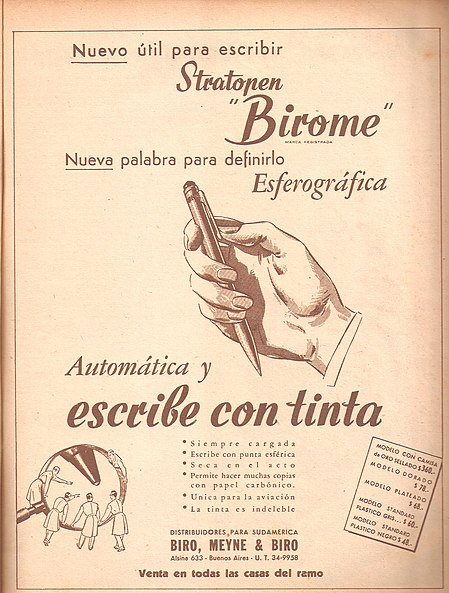
We're always unduly happy when one of our compatriots is at least partly responsible for doing something spectacular before the whole world. That should be a clear measure of our self-esteem. Ask any Argentinian what we've done for the world. "We invented the ballpoint pen" will be among the first answers, if it's not the first. Well, a Hungarian named László Bíró invented it; he moved to Argentina and (after many efforts caused by the Argentine bureaucracy) he got a patent and sold a lot of them — to the British Royal Air Force. What else? "We got some Nobel Prizes." The last one, in Medicine/Physiology, was César Milstein — who was Argentinian, unlike Bíró. He was a typical outstanding product of an Argentine university: studied hard, learned a lot, and after graduating, he moved to Cambridge, where he could research in peace and get paid properly, and stayed there until he died.

Examples abound. It's not that Argentina hasn't contributed to the world at all; it's world-famous glamorous people we lack, with the exception of Che Guevara (a bit stale by now) and possibly Diego Maradona (but overweight addicts are not glamorous anymore after Elvis). We make do with inventors and hard-working scholars, but we want more. We want to show the world we're fabulous, and we want to believe it ourselves. The latter is more difficult; we battle against reality every day, and our media are glad to help, cheering us up whenever something remotely connected to us gives us a chance to borrow a spark of glory. If you've heard the Argentine ego is so high you can commit suicide by jumping from the top of it, think twice.

13 June 2007

Circunvalación

Public works galore! I hope this isn't just pre-electoral advertising cum wishful thinking. Not only is a national route to be built between Santo Tomé (near Santa Fe City) and San Francisco, in the border of Córdoba Province, but also the national government is going to pay 300 million pesos to widen our own Avenida Circunvalación by one lane.

Circunvalación means "going around", more as in "doing a detour around". Its a mostly raised two-lane avenue that starts in the south of the city (bordering Villa Gobernador Gálvez) and does a less-than-semicircular sector around most of the urbanized area of Rosario (first west, then north, then east). It ends up there joining the roads that go to the northern metropolitan area and also sends an arm over the river, in the form of the Rosario-Victoria Bridge. It was planned to be (and used to be) like Avenida General Paz in Buenos Aires, but it was inside the municipal jurisdiction. Some neighbourhoods (like Fisherton) were outside from the outset; others spilled out.

Circunvalación must also be a textbook example of a jurisdictional conflict. It's 29 km of road that nobody likes to maintain, with 40,000 vehicles per day. Since it's peripheric and most of it inside poor, dangerous neighbourhoods, there's no popular pressure (from "important" people) to keep it safe. Being formally part of a national road, it should get maintenance (at least filling the potholes) from the national state, or more specifically, the Dirección Nacional de Vialidad (don't ask what vialidad means; it has to do with vías — a fancy way of saying "roads"). The lights and lampposts are vandalized or stolen all the time, but in this case (and by the same regulations) it's the municipal government that has to replace them. The municipality doesn't pay attention to it, in part because it has no money or human resources to change dozens of high-yield lamps a month, least of all guard them so they're not broken or stolen again. And finally, guess who's really in charge of keeping the vandals away? The Santa Fe provincial police. Yes — the ones whence the "fat cop" stereotype came from.

Trying to get these three states to work together and in coordination is like having a cat asking a wolf to cooperate with an elephant to hunt an eagle. They're all very busy and they don't like each other. We the people, in case you were wondering, are the fleas... We mean a lot to the cat, less so to the wolf, and almost nothing to the elephant. Let us hope we can still get the elephant a bit itchy.

12 June 2007

When the carrot doesn't work

I've always maintained that draconian measures, when it comes to saving lives, should be the norm in a country like Argentina, where breaking the law is a national sport and a source of pride. In this case, traffic laws.

You will remember I took the time to post about this several times. Well, I still think a person who blocks half the street with a vehicle just because s/he couldn't be bothered to park correctly deserves to be flogged in public (figuratively? I guess). But that's hardly dangerous. Skipping a red light is. The good news is that punishment is working. Thanks to a system of several automatic cameras that can take a shot of your car when you pass by a traffic light, and send you a fine afterwards, the number of red light violations has decreased greatly.

In 2001, after the first cameras were installed by the Municipality in mid-2000, an average of 40 violations were detected per day by each camera. In 2006, the number went down to 19. As of today, there are six (or seven, according to the newspaper that covers the news) cameras, in black-and-white and in colour, located in strategic places in Rosario's main streets.

Some people complain that the cameras take pictures even when the car is not in violation. The authorities explain that this is part of the normal software procedure for speed checks. Obviously, if you're passing a green light, you won't get a fine. Doubting the system is OK, of course, but this reminds me of those other people who complained that there were automatic speed radars in some interurban roads — they said they were like a trap, designed to get money from the drivers. Duh, if you aren't overspeeding, the radar won't catch you!

The head of Spain's traffic authority, Pere Navarro Olivella, visited Rosario recently, and basically said what I've been saying: "Traffic security is [both] awareness and repression." Spain, like Argentina, had a horrific record of deaths by traffic accidents, but unlike Argentina as a whole, it did what had to be done, implementing harsher punishments as well as awareness campaigns.

Traffic accidents have decreased in Rosario because people now know they will be punished (they already knew traffic violations were dangerous — they just didn't care). I don't own a car, so I haven't experienced it myself, but everybody I know who has a car is genuinely (and appropriately) terrified of taking it out if they're planning to drink (or have already drunk) so much as a glass of beer. Municipal inspectors with breath analyzers guard all the major streets, and the least a drunken driver can expect, if caught, is being forced to pay a costly bribe (yes, this is Argentina after all). There's a good chance your car will be confiscated on the spot. I understand that, if you're not drunk but only slightly over the blood alcohol limit, the inspectors will just tell you to stop and stay where you are until you've sobered up, before doing another test.

Seatbelts are also checked — I remember not ten years ago nobody used them, and now all my car-endowed friends wear it casually, and make me wear it.

Now we only have to wait for the next generation of drivers to be raised like that...

11 June 2007

Boat tour


I went on a tour boat last Saturday! The venerable Barco Ciudad de Rosario I looks like new and it's very well kept. It does a couple of tours a day on Saturdays, Sundays and holidays, departing from the former Fluvial Station (in front of the Flag Memorial). I remember going on the boat when I was a child once or twice, and then about six or seven years ago when an Argentine expat friend came from Germany to visit the old hometown. Back then I don't remember having so much fun. Saturday was different for at least three reasons: one, I had a beautiful companion (if not very talkative); two, the weather was nice as well; three, I had my camera with me, so I could indulge in my photographic vice.

The boat is medium-sized, with an open air terrace and a smaller open space on the prow, plus another open deck beneath that, and a closed space at the bottom. The guide is informative, highlighting different parts of the tour, and the music changes accordingly.

So me and Miss Enigmatic Orient paid ten pesos, climbed on the boat and waited for a while, until it was departure time (2:30 PM). It was hot under the sun, only mitigated a bit by this incredible fog we've been having at all times for like a week (not so much as in Buenos Aires, but noticeable). The boat finally left, headed for the islands, and then an old lady somewhere decided to get sick and the boat had to turn back and leave her and her worried folks on dry land. Off again we went, and once we reached the islands, the boat entered an arm of the river and then another. We saw many people in kayaks, canoes, sailboats, and motorboats; houses on wooden pillars, cows pleasantly grazing on the wild grass in tiny islets, and many, many tree tops coming out of the water, since the river hasn't gone down to the pre-flood levels. The islanders waved at us, and other boats passed by.

We exited the last arm of the river right in front of the Rosario-Victoria Bridge and went near it, passing under its shadow. I'd never been there myself. There were a few tourists, I guess, that had actually never seen any part of the bridge up close, so there were ohs and ahs all around. It's a great piece of architecture.

The boat then turned round and took us to the main course of the Paraná, along the northern coast of Rosario, and then the downtown. There are many things you can't see from land: old piers, rusty cranes, crumbling storehouses.

Well, all in all I took 120 pictures (including some nice skylines) and I spent the whole afternoon thinking in Japanese, so it was all amusing and educational at the same time. I'm still wondering what she got from it. After we disembarked we climbed along Córdoba St. and ended up in front of the Cathedral... right when the Archbishop was celebrating the open-air Corpus Christi mass. Really scary — lots of fervorous Catholics with banners and standards, chanting and clapping, and many of them young, too. Felt as if I could be burned at the stake at any moment.

So that was my day, and a very good one it was. If you come to Rosario, be sure to do this tour, or you'll be missing a lot.

07 June 2007

Politics against the people

It's been a couple of days... I'm doing some programming-for-hire during the afternoon, so I don't have the amount of spare time I'd like to have to craft long detailed posts. And the office has been busy too. So that's why. I promise (more to myself than to anyone else, because I know I'm a procrastinator) that I'll try to stick to one post a day during weekdays.

I was thinking of commenting on the ridiculous, half-childish, half-brutish behaviour of president Kirchner and his minions regarding Mauricio Macri's triumph last weekend, but there's no need — you can watch K's tirades in all their inarticulate muck-racking glory anytime you want, as he's on it all day. As much as I dislike Macri from the bottom of my guts (and the deceptively nice Iron Lady on a wheelchair that accompanies him), I'm beginning to think he's not that a terrible thing to happen. Buenos Aires can surely bear four years of plutocracy, and after that eventually porteños will either learn or repeat history, or maybe (just maybe) Macri in power will turn out not to be a horrible mistake. In the context of a local election in a district that is not really troubled, Filmus's apocalyptic warnings about a clash of ideologies is exaggerated to say the least.

But that's not what I was going to comment on. Although I did. As I said, I've been busy at the office. Yesterday, for a change, I did some fieldwork; office's Number Two and I went to Granadero Baigorria to check on a healthcare center. Now the usual idea of what a public healthcare center is like is a shabby building with workers either willing and desperately trying to do their work without basic resources, or (more commonly) undermotivated, accustomed to doing nothing, and exempt from control and punishment by their powerful union. (This description works for most of the public administration, of course.)

What we found was a group, a team, of people doing their work earnestly and diligently with modest resources, in a decent, clean building, and willing to get help to make it all better. They had everything in order, though most in dead-tree form; the computer was old but OK. The director was a nurse. The administrative staff (two women) were volunteers — members of the community who work there for free, or as we say, ad honorem, though they didn't receive any formal honours. One of them, a lady in her sixties, kept about 4,700 patient records on an Excel file; she didn't know how to do counts and filters, so I taught her. Prior to that, when the authorities needed a count of (for example) how many female patients under 15 are served by the health center, she needed to manually count them.

The authorities don't know or don't want to know that these women work hard, for free, or that they need a computer course the state should pay for, or that they would glady do a much better job if they had the tools, or that most of the structure of the state that feeds their incompetent asses is supported by hard-working people who don't get what they deserve.

Right at the entrance of the health center, a bit dusty because the street is not paved, a large painted banner read "Welcome, Rafael Bielsa". The Peronist party, which paid for this banner promoting Buenos Aires Province deputy Bielsa's campaign for governor of Santa Fe (!), is also the one in power, the one that should have paid for those two women's salaries, the one that campaigns to stay in power by noting the province has a surplus and hasn't raised taxes, the one that doesn't spend that surplus on, let's say, public works to keep the province from flooding whenever it rains more than usual. Politics is not nice, we all know that, right?

04 June 2007

The hard numbers of abortion

No less than 460,000 pregnancies are terminated each year in Argentina, most of them illegally, many under unsanitary conditions. One every eight women who abort ends up going to a hospital to deal with complications. Around 100 women a year die from abortion complications — mostly poor women, since getting a safe abortion in secret is easy but expensive.

Seventy-eight percent of women from the three largest cities in Argentina support the decriminalization of abortion up to some degree. Ninety-one percent believe that abortion should be accessible free of charge.

Rosario was the first city in the country to implement a responsible parenthood and reproductive health programme (in 1996). Santa Fe Province passed a law for that in 2001, which started working in 2002. The national state only had one in 2002, that was enforced for the first time more than a year afterwards. In 2003, Minister of Health Ginés González García said he'd support the decriminalization of abortion, and a Catholic bishop called for him to be given the biblical "millstone around the neck" treatment. A week ago, a group of pro-choice NGOs presented Congress with a project of law to legalize all abortions up to the 12th week of pregnancy.

Abortion and its legal issues have never, ever, been discussed in any form in the National Congress.

Everyone is entitled to their opinion and many are rising to voice it. It seems, however, that nobody in the high places is willing to debate those opinions, to speak their minds freely and openly present their facts and arguments. I think that silent indifference is the worst that can happen.

02 June 2007

Fueling the crisis

The producers and distributors blame it on the weather being so cold; the government says it's lack of investment and speculation and repeat that, again, there's no energy crisis. But this is not enough. People are having power cuts, sometimes lasting days, because there's not enough natural gas and diesel to power the generators and because the generators are overwhelmed by the demand. Natural gas is being denied to drivers, or sold by small quotas, and now even the compressed natural gas (CNG) cylinders that many people use to heat their homes and cook are difficult to get, and fuel oil in the south of Santa Fe is rationed.

I don't have a car, I don't have to put fuel into any machine to harvest anything, and luckily I haven't had blackouts at home. I have natural gas delivered normally through the pipes, and I've used it almost continuously since last week to get some warmth. Yet I'm hearing complaints on the radio, from several parts of the city, and I'm wondering how much this luck (because this is plainly luck and nothing more) will last.

Everybody passes the blame on to someone else, yet everybody's right in a sense: each of the accused is guilty of part of the problem...

01 June 2007

¡Salud!

(This was supposed to be posted yesterday, but ADSL was down all day at home, thanks to Telecom's noisy telephone lines.)

Rosario has a new hospital! Last Wednesday the city unveiled a new emergency hospital (Hospital de Emergencias Clemente Álvarez, HECA) that is, they say, the most modern in Latin America. (Coverage: La Capital, Rosario3, Rosario/12, El Ciudadano, Télam, La Nación, Municipality of Rosario).

There's actually an original HECA in a different place, but the building is old and has so many problems that most of it is going to be demolished once the new HECA is working, 90 days from now. Right now, the staff is getting familiar with the new layout and testing the equipment.

Getting a replacement for the old emergency hospital was a long-awaited dream for the municipal government. The works started in 1997... and then, like everything else, they stopped, as everybody's plans went down the drain. Argentina effectively lost four years or more to the recession and the economic crash, so it is only now, ten years afterwards, that HECA is ready.

The building is truly impressive, but the special touch is the light. The idea was making it more like a resting place, where patients can see the progression of day and night directly, and less like a closed box where sick people are stored. So the façade is all made of transparent glass. Besides the aesthetics, though, this is a modern hospital with top-notch equipment and much bigger than the old one: 155 beds (23 more than the old hospital), a covered area of 22,000 m² (more than double the original building), and RMI and CT scanners — and, following public health policy, accessible to everybody, no matter the cost. The hospital plus the equipment cost 45 million pesos (about US$15 million).

The location is also important: it's right on one of the city's main arterial streets (Pellegrini Avenue), a couple of blocks from its intersection with another major road (Francia Avenue). Since the HECA serves emergencies, quick access from the city and the metropolitan area is needed (most of the graver traffic accidents in Greater Rosario will end up there).

I'll leave the political gossip for another time... Suffice it to say that, while the Socialist municipal government proudly showed the new hospital to the media and the people, the Peronist provincial government was trying to explain away why pharmaceutic companies have cut provincial hospitals' credit and now demand instant payment in cash.

Also, no photos on this one for now. Check the links; some have nice pictures and even videos. Yesterday it was overcast and unpleasantly cold, so I chickened out of my original plan to go there after work and grab some shots of the hospital's façade. I suspect it takes a sunny day to look pretty, too.