Showing posts with label travel. Show all posts

10 September 2008

Vacation report: First day in Chilecito

We arrived at Chilecito on Saturday, August 30, mid-morning. The trip from Rosario lasts about 14 hours, not the least because it goes out of the straight path to reach Córdoba City and stops in two dozen little towns on the way. Although the punctuality was exceptional and the travel was fortunately uneventful, I'd like to vent my carefully preserved rancour at the General Urquiza bus company, which gave us no on-board dinner and no breakfast — a major crime if you ask me.

You get to Chilecito and the bus leaves you on the road by the new terminal station. It's not far from the city center but unless you're a backpacker you don't want to drag your stuff ten long blocks, so we took a taxi. We found our hostel quickly enough, left our bags there, went for breakfast, then back to the hostel for a bath, and then to the Cablerail Museum.

Cablecarril al cerro

The Famatina range west of Chilecito is full of valuable mineral ores, so back in the early 20th century a German company built a system of aerial cables to transport rocks from the mine up in the mountains (at some 4,600 m ASL) to the processing facilities in Chilecito (at 1,100 m ASL). The rails and the supporting towers are still in place and, according to the guide, it might still work if the parts that have been stolen were replaced (and maybe oiled a bit). The Museum is Station No. 1 of the Cablerail, its terminus, and it harbours a heterogeneous collection of tools, blueprints in German, a payroll, parts of the mineral wagons, and rust.

Junto al cactus We learned that the Famatina is being open for exploitation of its gold ore by the provincial governor, one of whose campaign promises was that he'd never allow exploitation of the Famatina. Gold extraction requires cyanide, and the snow on top of the Famatina is Chilecito's almost single source of water. Environmentalists don't know if the cyanide process is safe and they're up in arms against the government.

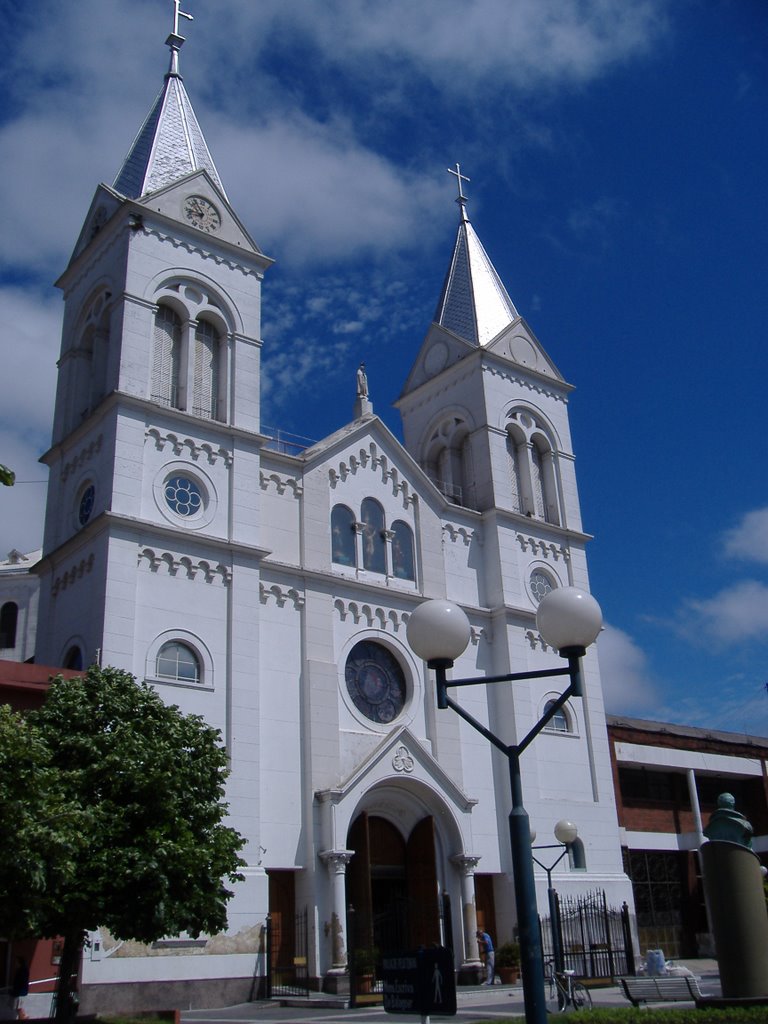
After the museum, we took a nap and then went out again, wandering, taking in the ochre-pink of walls, the blossoming lapachos, the stillness of siesta time. Carrying a thermos for mate, we went to see a white statue of a Christ on a hill and took pictures of ourselves beside a couple of tall cacti, exactly as tourist couples are supposed to do.

And those were the morning and the afternoon of the first day.

11 February 2008

Vacations: Walking with people

Una vista del Lácar

I realize I've so far written more about the landscape and the accomodation than about people. That's not right, since I met a lot of very nice people in the way. Marita and Aldo in Junín de los Andes, of course; but also Ana behind the counter in Malargüe's hostel, who got us one more day of stay by juggling with reservations; a certain backpacker and his girlfriend in Lake Huechulafquen, who gave me useful pointers and pleasurable conversation after a whole day of walking alone; a couple of guys from Buenos Aires, another couple of guys from somewhere else; a biologist from Córdoba named Gonzalo who taught me a couple of things about those curious birds I was trying to get pictures of; a girl from Quilmes (Carina) who pushed my lazy ass around in San Martín de los Andes and got me to see the Mirador Arrayán and Chapelco, as well as handing me the pamphlet that led me to my last hostel; Patricia, a girl from Spain, residing in Ireland, who must be still traveling around South America after three months away from home; a guy named Raúl and a girl named Josefina in San Martín de los Andes, who walked with me to Mirador Bandurrias on my last day there; Esteban, a guy from San Lorenzo (a mere 20 km from Rosario) who made and cooked pizza and empanadas from the basic ingredients, just for fun, while in the hostel; and others that I can't remember or whose names I can't recall.

I need to say this, because otherwise I might give the impression that it's OK for me to walk around shooting pictures and do nothing else. But the novelty of marvelous sceneries eventually wears off, and in the end it's often more satisfying to come back to wherever you're staying and have something for dinner while chatting about your adventures with people who may not have been there, and trying to describe what you saw to them, or with others who were there before and don't mind comparing notes, so to speak. Even better if you join others, or get others to join. Conversation for the time being, contacts for the future, at the very least; and the joy of sharing those things you (re)discover when you're on a trip.

People I walked, talked, stayed, had fun with

I had so much fun during this trip. I also found myself, as they say, a couple of times — and as usual it wasn't a pleasant finding, but one always learns from these.

On Wednesday, January 23, I said goodbye to the people at Ladera Norte, and took a cab to the bus terminal. With me went Esteban ("Esteban the Cook"), who by sheer coincidence had not only bought his return ticket on the same day and the same bus as me, but also on a seat on the same row as mine, and along came Josefina, one of my trekking pals of the previous day, who had to exchange a ticket and wanted to wave us bye-bye in person. We departed San Martín de los Andes at 1:45 PM.

I slept long stretches, stared at the changing landscape, ate cookies, drank water, read and re-read Susan Sontag's On Photography (that Marisa had lent me), chatted with Esteban when we were both awake, got off the bus on every stop to stretch my legs. The trip to Rosario lasted almost 25 hours. When the bus entered my home city, I realised I'd missed it. At the same time, I saw it briefly as it was under the summer sun — large, sprawling, sun-scorched concrete; dirty sidewalks, very green trees; kids on wooden carts pulled by horses, sweaty joggers along the avenues. I stepped down from the bus, spent. It was asphyxiatingly hot, not nearly as hot as it had been while I was away, they told me later. I took a bus home. I felt weak, a bit sick. Maybe it was the heat, humidity, air pressure. I slept and slept, even though I'd slept maybe 16 of the last 24 hours.

I think I came back, truly, a week later.

04 February 2008

Vacations: Our days in Junín de los Andes

The trip from Neuquén to Junín de los Andes (which you saw in pictures in my last post) took about 6 hours. First we went west, into the arid central plain of the province, where pumpjacks stand solitary here and there, bobbing in slow motion. Then southwest, towards the Andes and the Lake District.

Bus terminal, Junín de los AndesWe arrived around 2 PM into a little bus terminal with a little wooden information booth beside the platforms. There we asked about La Casa de Aldo y Marita ("Aldo & Marita's House"), our chosen place of stay, and were promptly directed there. There was no need of a taxi, because Marita's is only 6 blocks away, one block from the river.

Junín de los Andes lies mostly between National Route 40 and the Chimehuin River, which forms its eastern border. To the west is the Lanín National Park; northwest you have Lake Huechulafquen and, north of it, the volcano that gives the park its name, Lanín, and the Mamuil Malal Pass to Chile.

The city itself is small, a town of about 10,000 residents with a few blocks of well-kept urban features and some commercial activity around a nice main square, plus quiet neighbourhoods of single-story houses and streets that gradually turn to gravel and dirt roads.

Junín de los Andes - Panorámica desde el cerro

La Casa de Aldo y Marita (by pablodf)Our lodging was a residencial, that is, a kind of hostel that is fashioned out of someone's home. Residenciales tend to be more informal, cheaper, and obviously look more like houses than like hotels.

Aldo and Marita both run the place, but Marita is clearly the one in charge of the house and its temporary residents, while Aldo organizes fly fishing trips on the river and other aquatic entertainments for tourists, not necessarily the ones in the house. Marita also makes smoked trout and venison, which sell for steep prices in small amounts.

The place, as you'll see from the pictures, can only be described as "cozy" and "warm". You have all the things you can expect from a hostel (kitchen, sink, fridge, some supplies for common use, a common table), and one I hadn't seen before: an asador with parrilla, that is, a special brick oven and a grill to prepare and cook asado, inside the main room. On the other hand, Marita doesn't give you breakfast, but that's not that big a problem. The trouble with Marita's House is the wooden stairs and the upper floor in general. The whole house seems to bend and bow and it creaks loudly as you go upstairs to sleep, and once you're in your bed you can clearly hear everything in the common room. So you'd better be really tired when you go to sleep, or you won't be able to.

We stayed five nights, almost six days in Junín de los Andes, so this is only one of several posts, but I'll tell you from the start that I knew the best part of the trip was about to start as soon as I came into Marita's. People will tell you that Junín simply has too little of everything, but if you go there to rest, you'll find one of the most suitable spots for it; and if you're looking for simple adventure, you'll find it as well.

Chimehuin River, from the bus

In practical terms, this whole area and especially Junín de los Andes is suited for budget travelers and backpackers and all others who, like me, don't care for pre-packaged tours. You can find accomodation in dozens of places. Buses come and go, taking you to places where you can experience the majesty of nature firsthand, and back to "civilization", cheaply, safely and quickly. Fellow travelers will engage you in conversation and give you all the best tips and hints. You can choose to walk around, wet your feet in the crystal-clear lakes and quick rivers, climb the hills, or just lie down in the grass. Nature's realm has only recently been invaded by humanity here. True, there are signs and roads, and trash where there shouldn't be, and every now and then a car will come by along the silent road, but that's about it.

Most important for us big-city urban dwellers, who have been increasingly forced to paranoia and mistrust of our fellow citizens, is that this place is one where you can stop looking over your shoulder all the time. You can be sent into a tourist trap by an agency, and you can be scammed, but you can also stay away from that and explore by yourself.

On our first day in Junín de los Andes we just tried to get our bearings — finding out where the center, main square, cybercafés, supermarkets, etc. were. As the sun came down a bit, we hit the square and just lied there with our mate (and my camera). The next day promised to be exciting, our first trip into the real Lake District.

Plaza San Martín, Junín de los Andes' main square

Plaza San Martín, Junín de los Andes' main square

01 February 2008

Vacations: Into Neuquén

Although in my last post I said "this was our last day in Malargüe", I should've said "our last whole day". We had to go from there to Neuquén, but what should be the most direct path was unavailable — National Route 40, which goes south across the desert, has been in the same sorry state since ever, and you can't use unless you have a special vehicle. So instead of going straight south into Neuquén Province and reach Chos Malal, you have to go north-northeast to San Rafael, and then east and back south along the border of Río Negro, get to Cipolletti, cross the river and then you're in Neuquén City. That's an almost semi-circular route that takes about eight hours for a trip that should take at most five.

So, in order to avoid paying for an extra night and/or arriving at ridiculous times, we stayed in Malargüe half of the next day, then took the 3-hour bus ride to San Rafael, rested a bit there (outside that creepy bus station!), had dinner, and then at about 11 PM boarded the bus to Neuquén. The trip was unenventful. I slept through the night, and woke up at dawn as we arrived in Cinco Saltos, less than an hour before our destination.

Neuquén's bus terminal station is almost brand-new, and it looks more like an airport, with lettered embark gates and all. Everything seems to be neatly organized, if only a little sterile.

Bar at Neuquén City's bus terminal station

Neuquén itself seems to be a fairly modern city. The downtown area (where I stayed at all times) is within the limits marked by National Route 22 and the river. There are a couple of wide avenues and a lot of trees lining the streets, but no large parks (that I know of). Constant irrigation of grass in public spaces through sprinklers is conspicuous; this is still, after all, semi-arid Patagonia, and only the fact that it's at the junction of two large rivers spares it from being a bone-dry plain.

Visitors looking for historical buildings and sites will also be rather disappointed; even to the untrained eye Neuquén shows a complete lack of old architectural styles. The city looks neat, like its bus station, and much unlike Rosario or Buenos Aires with their layers and layers of new and old dirt and cracks, with their half-visible cycles of destruction and reconstruction.

Main avenue of Neuquén, facing the downtown

Neuquén was a small frontier town when the big cities of central Argentina were already metropolises. It was at the border of civilization, the equivalent of the American Far West, at the beginning of the 20th century, a couple of decades after the "Conquest of the Desert" (i.e. the government-sponsored genocide of the Patagonian natives and the subsequent occupation of their lands, in several waves), and continued to be a small city until oil was discovered in the area in the 1960s.

Well, we found our little hotel quite easily and checked in. It wasn't a pleasant experience. The owner of the hotel was a Polish immigrant who must have seen World War I with her own eyes, a bit hard of hearing to say the least, extremely methodical, rather reserved, and mindful of waste to the point of pasting newspaper articles and warning signs about water and energy conservation. She charged quite a lot for a rather basic service, though in her defence I must say all of Neuquén City is terribly expensive. No kitchen, no space for laundry, no breakfast, and no showers unless you paid an extra fee, and this was more expensive than the (infinitely better) hostel I found in San Martín de los Andes.

Neuquén City seems not to have understood its own touristic potential for budget travelers looking for a conveniently urban base for exploration. If it weren't for the outrageous prices, I would've stayed 4 or 5 days, and explored the whole Alto Valle area of Río Negro and the interior of Neuquén (such as the oil towns of Plaza Huincul/Cutral-Có and Zapala). As it was, we decided to cut it to only 2 nights.

On the first day we decided to do some reconnaisance. We walked around town, I took pictures, we got some information from the tourism office, and we came to the conclusion that trying to move around without a car and without paying ridiculous sums of money to an agency was pointless. This was just not a touristic part of the province, period.

So in the afternoon we followed the tourism office's advice and visited the beach. Neuquén has three public beach resorts, all easily accessible on foot, about 2 km from Route 22. We chose one and settled on the sand. The day was rather hot, so we bathed in the river, and then came back to dry in the sun. By pure luck we caught a kayak regatta in progress (nice colourful pictures for moi).

Neuquén - Regata de kayaks

By this time, incidentally, we'd gotten accustomed to using sunblock all the time we were outdoors. I'd taken the precaution of getting some protective tan before leaving Rosario, but still the Patagonian sun was terrible, and soon we were all quite red, sunblock notwithstanding. I'm naturally dark, so I didn't get burned, but I came back almost chocolate-brown and peeling in a couple of spots.

28 January 2008

Vacations: Getting there is half the fun

On the Chevallier bus, near San RafaelThe title is ironic, of course. The weather was oppressive the day when we departed from Rosario. We took the Chevallier bus to San Rafael, Mendoza, at 8 PM (in full afternoon glory, thanks to our crazy DST scheme). There's no direct bus from Rosario to tiny Malargüe so we had to make a combination.

Off we went, west and south. Some time afterwards it began raining lightly, and then a T-storm broke out. Nothing serious. Around 1 AM, near Venado Tuerto (I'm guessing), the bus stopped. A tree or a branch or something had fallen over the road, so all traffic was stuck.

At first nobody told the passengers what had happened, so we speculated it was a car crash. Then we learned about the tree and started waiting for whoever was in charge of removing it.

We stayed there for over an hour, possibly an hour and a half. I slept in short stretches, while the rain continued. Finally we resumed the trip, but instead of arriving at 9:15 as scheduled, we got to San Rafael around 11 AM. We missed the bus we could've boarded at 10:15, and the rest were all full. The next available bus departed at 6 PM. We were faced with the choice of taking that bus (spending 7 hours in San Rafael) or looking for emergency cheap accomodation in San Rafael for the night.

Now San Rafael is a nice city, but not particularly attractive, and we were after all carrying our huge travel bags, so we couldn't possibly just take a walk around and do sightseeing. And San Rafael's bus terminus is truly creepy, a cramped half-block with dirty platforms and unpleasant-looking little shops, with some people looking as if they either want to rob you or sell you a fake Rolex, to the point it reminded me of Paraguay.

The alternative, however, wasn't really for us. We didn't want to spend a night in San Rafael, but anyway finding accomodation was hopeless, and it entailed losing the day completely, as well as a night's expenditure. So we dragged our bags from the terminus to a nearby public square, and I set off looking for two things: a phone to call the hostel's folks in Malargüe to ask them not to cancel our booking, and something to eat for lunch. I got an OK from Malargüe, and got us the ingredients for sandwiches. After those, we sat there sipping mate, getting suntanned, and generally looking like out-of-luck bums.

The bus finally came in time, and after almost three hours of travelling south with several stops seemingly in the middle of nowhere, we reached our destination at about 9 PM (under a Patagonian sun at full blast). I was back in Malargüe at last, after a year of waiting for the peace and quiet of that little corner of Argentina, and 25 hours in the road.

27 January 2008

Back from the south

Here I am! After a three-week break I'm ready to blog again... sort of. I have so many things to recount and so many pictures to display, I don't know how I'm going to handle it. "Begin by the beginning" just doesn't work.

So this is how I'm doing it. First, a general review, and then a few individual posts, and then (if possible) a wrapup. I'll be off the local news/comment topics for a while, but this is worth it. I intend to write a post facto travel diary in Spanish for my own use in parallel, so be patient. I'm still partly over there.

The general review goes as follows: vacation trip to northwestern Patagonia, starting on the late afternoon of Sunday, January 6, ending on the early afternoon of Thursday, January 24. Places where I spent nights (except buses): Malargüe, Neuquén, Junín de los Andes, San Martín de los Andes. Other places where time was spent: the road (of course), San Rafael, Villa El Chocón and the stony beach of its reservoir, the Lanín National Park (lakes Huechulafquen and Paimún), and Hua Hum near the Lácar Lake. Companions: two, male, for most of the duration of the trip, until their desertion three days before my return. Experience gained: lots, very useful for future trips already planned. Money spent: quite a lot for my standards, but well spent and with no regrets. Pictures taken: about 2,400 (including a lot of useless shots and others merely testimonial, obviously).

This doesn't do justice to the trip, but it will do for starters. In the meantime, please check out my Flickr photoset "Vacaciones 2008". I'm uploading the pictures in small batches to avoid clogging the Internets.

29 August 2007

Return of the train

Estación Rosario Norte
Rosario Norte Station
The train's coming back!

There's currently a weekly train service between Rosario Norte Station and Retiro, operated by Trenes de Buenos Aires (TBA). I've never seen it (not strange, given its frequency) but I've been told it's not only slow (7 hours to do 300 km) but also not in good condition, and rather dirty. However, a ticket is only AR$17 in "first class" (do note the quotes!) and thus extremely cheap, compared to the luxurious, fast, comfortable, but pricey bus services given by a number of companies, notably the AR$39 service of El Rosarino.

The national government has just bought a convoy from Spain, as part of the National Railway Recovery Plan (sounds like a good plan, but this is the first time I've ever heard of it, so it mustn't be doing lots of things around here — how odd is that!). Starting in mid-September, it'll be doing the Rosario–Buenos Aires route daily. It's a three-coach train with a diesel locomotive, with a capacity of 228 passengers. It has air conditioning and reclining seats. Since the railways are not well-maintained outside Buenos Aires, after Zárate (they're prepared for cargo traffic only), the train can only reach its maximum speed of 120 km/h within a small segment of the route, and the trip will take about 6 hours (depart from Rosario at 6 AM, reach Retiro at noon, depart from there at 6:30 PM and return to Rosario Norte around midnight).

Six hours in a luxury train seems fine to me. Quite logically the ticket "will be raised somewhat", according to the diplomatic language of TBA's authorities. Considering, however, that the bus ticket will go up soon as well (to AR$44 pesos as announced), and that the train is much safer and more comfortable (and romantic, if you're into that), the price would have to triple in order not to be attractive and competitive.

I'm looking forward to travelling on this train, as I last did when I was a child, in better times.

19 July 2007

Why, why?

So why did I go? Why, indeed, does one go on vacation to places outside the main touristic routes, especially when one hasn't exhausted, or even scraped past the surface of, the treasure of worthy touristic riches of a country like Argentina?

I went to Posadas due to a simple economic fact: I can't afford hotels. I mean, I could afford a passable hotel, and even a good hotel for a few days, but it would cost me money I'd rather spend on something else, like staying more days or suddenly deciding to take a bus and leave for another place. Priorities, priorities! Posadas had a hostel, or at least something that my Hostelling International map/chart of Argentina showed as a hostel, though it was more like a storehouse for cheap tourists (you check in and get assigned a place to put your stuff and, at night, your body). Anyway, it was a fine place except for the shower, which was never hot enough, and then they have a good excuse for that, with Posadas being in a subtropical climate zone and all.

I went to Encarnación because it was close to Posadas and I wanted to see another country. It didn't disappoint me. It was quick and cheap to come and go, and there were nice surprises, and the customs bureaucracy was not that bad.

Oberá

Now why, why Oberá? Why going 100 km almost literally into the forest and land on a pension where the bed was older than me and you had to yank a chain after you went to the bathroom? Maybe because of that, precisely: because I've had enough of the big city and the complicated stuff and things that look just as home. Maybe because I got a recommendation from a friend, and I had a good feeling about it (the place indeed had good vibes). Or just because. You'd have to visit Oberá, if you can, and walk your shoes off along those hill chains they call avenues, and talk to the people, to understand why such an impulse trip paid off so much. I don't have the ability to convey why Oberá was so beautiful to me, why on my first day there I sent an SMS to my friend in Rosario to thank him for telling me to go to Oberá, and why I haven't stopped singing its praises in front of everyone I know and boring them all with pictures and stories about Oberá.

When the lady in the clothing shop asked me why, she was at first under the impression I was some kind of man-with-a-mission specimen. "Are you here for the shorts?", she inquired (meaning not clothes, but the international festival of short independent films being held in Oberá, by coincidence, at the time). "No", I said, "I'm here just to look around." "You told me you were a journalist, right?" I laughed. "Nothing of the sort. I'm a photographer... well, I just walk over here and there and take pictures." I hope she wasn't disappointed. I'm inclined to believe she wasn't. Only two days later, when I told her I was leaving in the afternoon, she said: "Oooh, but you can't leave! What a pity, now that we've started to care for you!"

15 July 2007

Back from the north


I came back to Rosario today at around 9 AM. I haven't been able to do much since then — I unpacked my mess, took a long hot shower (more on that soon), unloaded my photos, talked to a couple of friends to catch up, shared lunch with my family. I fear there won't be an end to the blogging once I start telling you about the many different things that I saw during my vacations in Misiones, but I have to start somewhere.

So I'll do more or less what I did in January regarding Mendoza. This post will be only for the general stuff. That would include the following factoids:

  • It rained or drizzled a lot most of the time, and it was unusually cold for a subtropical place. Then it also snowed in Buenos Aires. Nevertheless I had a terrific time, mostly, and came out of it without even a common cold.
  • I took a lot of pictures. Given the aforementioned bad weather, many didn't come out as I expected. There are many places that don't look as good as they are when not lit by unmitigated sunlight.
  • I was cold all the time... People in Misiones probably don't need hot showers often.
  • I think I'm in love with the city of Oberá.
  • I think I'm a luxury travel whore. I enjoyed being pampered by the bus company and would buy their overpriced tickets anytime without protest.
  • Misiones' famous red earth gives everything a nice warm touch, but red mud is not nice at all.
  • Paraguay doesn't have a café culture.
  • You can do a lot with very little money, but not without time. I need longer vacations.
Bear with me until I get myself in order, and I'll tell you about my adventures one place at a time... starting tomorrow.

24 January 2007

What vacations can do for you

These vacations did for me what the New Year does for many: they prompted me to rethink certain aspects of my life and to adopt certain resolutions with a clearer mind. Breaking the daily routine is a must for me; it's only then that I fully realize how much I'm entangled in it. I came back with a different view of time (personal time I mean). Time is not something to be worried about, but it is also not something to waste. Your opinion on what "wasting time" means may differ from mine. I consider it a waste of time to do only one or two things in your whole day. I consider it an awful waste to worry about waste. I've been guilty of both types of waste.

Cooking in Malargüe
Vacations are (ideally) a few days or weeks when you get to balance the objective need for some planning and scheduling with the subjective need for disorder and spontaneity. Too much planning, and you get your typical Argentine vacations in the Atlantic coast or the oversold parts of Córdoba, where people wander around feeling they're enjoying a leisure time when in fact they're walking paths already drawn by the huge machinery of touristic industry. Too much spontaneity, and you eventually find yourself in the middle of nowhere, with nothing to do, and you either go home or spend whole days sipping mate and/or playing cards.

In Mendoza I discovered (or re-discovered) both the pleasure of strenuous physical activity and my almost complete lack of physical aptitude, which I undoubtedly owe to bad genetics but also to a sedentary job and lifestyle. There's however much room for improvement, and that's one of my resolutions. I got back to my old gym on Monday, and went jogging with a couple of friends on Tuesday. I don't like the weightlifting exercises at the gym; I'm past the age when you can easily develop muscle mass, so I won't get suitably encouraging results. I don't like jogging either; I'll walk any number of blocks at a good pace, but my aerobic capacity is limited, and I hate being overtaken by the other guys and girls in the jogging course. I don't care. I hope I can keep my resolution up for at least a few months, but even that is a long-term commitment. If every day I manage to make my body perform some effort, I'll be glad.

In Mendoza I also found a cooking buddy in one of my companions, who was before just a going-out friend and a fellow roleplayer. He makes an excellent tomato sauce and had a few tips for me regarding that and other delicacies. I don't think he learned much from me in return, but at least he says the experience rekindled his cooking hobby (and his appetite — something I've personally never lacked). I was left with some ideas I'll be sure to inflict on my guests' palates soon.

Of the unpleasant interpersonal experiences I prefer not to speak. I'll only say I'm finally getting the idea that firmly saying "no" is good on certain occasions, that acknowledging my own whims and proceeding according to them is not necessarily bad and egotistical, and that I should not hesitate to sever ties that I don't need, want, or gain anything from.

And now I'm back home, at work, faced with the same problems and stress that I left behind merely two weeks ago. I wonder how long this feeling of relaxation and renewal will prevail over those things. One can cannot expect to walk on clouds indefinitely.

23 January 2007

Malargüe

We arrived in Malargüe on Tuesday, at noon. We'd been instructed to call the number of the tourist agency from the bus station, so they could pick us up. Soon enough, a truck sent by the agency came by and took us outside town, into the countryside, to our hostel.

In truth I knew this hostel was in the middle of nowhere, and had tried to book a room in the other one (which is near the city center), but they didn't return my mails, so we left Rosario without a place to stay in Malargüe. The recepcionist in San Rafael could not reach the hostel either, so she turned to the other one. We thought it would be a huge problem. If God existed I would thank Her for that "problem".


The Hostel Internacional Malargüe is located about 6 km from the city center, in a patch of farmland with a few horses, a few dogs, lots of alfalfa, and the usual irrigation ditches. When we got there it was made up of two cabins made of cane, mud and wood, which is always cool even under the harsh sun of southern Mendoza, and stays warm in the night. A third cabin was the home of the owners, Johnny and Gaby, who were often in the city. Their younger offspring, a 2-year-old blond imp called Lucas, runs around the place (often with no clothes on) and, surprisingly, doesn't bother anyone, politely thanks you when appropriate, and is obviously not spoiled (this is easily achieved by letting the child watch little TV, giving him lots of natural space to play, and feeding him good homemade meals; or at least that's a start). There are a few solid tables and chairs, a TV and a DVD player (we used it only occasionally to listen to music and to watch an episode of The Simpsons). Roxy and Mabel work in the kitchen. I watched Roxy prepare kilos of bread for the mud oven, and couldn't get Mabel to give me her vegetable-and-chicken soup recipe.

At the head of the hostel, receiving the passengers and arranging everything, are our three informal goddesses, an Austrian named Kim and two Swedish named Lisa and Frida. The picture doesn't do them justice at all. You don't need to be a heterosexual male to appreciate these girls; they're much more than pretty blondes, to be sure, starting by the fact that they came from Europe to a backward and desertic part of a Third World country to work. They speak excellent Spanish, they sit down after dinner and drink beer along with you, they know who to ask when you have a question, and in general they're not your typical ho(s)tel staff.


There was also this sturdy Dutch guy called Jup (Joop?), who was working at the expansion of the hostel (they're making a platform for a kind of outdoors bar, among other things); Santiago, a friend of the hostel, frequent guest, problem-solver, and self-appointed legal representative of Kim, standing between her and her numerous fleeting suitors (a half-drunk porteño actually proposed to her one night — Santiago said "You must arrange that with me first"); and Ramón, who could be seen working all day at his own slow but steady pace along Jup.

On our first day we had no food with us, no time to cook anything (we'd hastily booked a trip to Llancanelo Lagoon at 2 PM), and so we had to rely on the hostel's meals. It seemed a bit expensive to pay 15 pesos for chicken, but anyway it wasn't ready yet; however, Mabel's marvelous vegetable soup was our salvation. Off we went to the lagoon. We climbed a small hill so we could see the 60-km-long shallow salty lake, and then we went down to watch the flamingos fly before sunset.


The following day we found ourselves with nothing to eat again, so we hired a taxi to go to town and buy some food (and water). The taxi was a shabby pickup truck driven by a middle-aged woman with a nice smile, and it charged us only 8 pesos to take us to the city center. We walked around the important places (not many — Malargüe City is small), rested a bit in the shade at the main square, beside a fountain, and purchased noodles, rice, tomato sauce, cooking oil, salt, paprika, an onion, oranges, carrots, and a 5-liter bottle of water.

Malargüe is the seat of the southern section of the Pierre Auger Observatory project, which is being jointly conducted by 19 countries to study high-energy cosmic rays. I don't know why Malargüe was chosen; maybe it's because it's high in the atmosphere, in an area with little human technological interference. Anyway, a guided visit was scheduled for 5 PM, so we waited as the town dozed off (the siesta is sacred) and, when we went back to the observatory, it turned out that the guided visit was in fact a lecture, and that the seats were all taken, mainly because a group of 20 or 30 nuns were touring Malargüe all together. We cursed those nuns so bad we should've been hit by lightning. We were very tired to wait, so we left.

We'd forgotten to book anything for the next day, so we had it free, and the prospect was extremely boring. I mean, the countryside is beautiful, but you can't admire the mountains and the bushes and the wilderness passively all day. So we inquired about the renowned dam on the Malargüe River, with its trout farm. It was expensive and not fun to hire a taxi to go there. We thought it over and said, what the heck, we have lots of water, good sunscreen, and legs, so off we went, after some quality breakfast, at 9:30 PM. We walked 3 or 4 km down the dirt road and along National Route 40, got to the river, refreshed our sore feet in it, and then turned away from the road and followed a dirt path for 4 km until the Blas Brisoli Dam.


This dam, unlike those we'd seen in San Rafael, doesn't have a large reservoir; it's mainly a derivation dam. The waters are distributed to the whole Malargüe Department through irrigation canals. Part of it goes to a camping site a few hundred meters away, with a number of pools where trouts are raised. The camping site in itself is a trap — nobody sells anything to eat except trout, and it's 28 pesos per serving; you can buy 3 kg of beef or have three super-sized milanesas for that figure. We were not that hungry, and we had oranges. After that refreshment, we went back. We stopped by the river again, and with the laziest pace we finally got back to the hostel at around 3 PM.

The fourth day was our last. We went to visit the Witches' Cave (Caverna de las Brujas) and the Manqui-Malal Cascade. I can't begin to explain what the cave is like. Its entrance is in an isolated spot, custodied by provincial nature reserve rangers, at 1,800 m a.m.s.l. Our experience inside it was short both in time (2 hours) and in length (200 m?), mainly because most of the cave is now closed to tourists. The part we saw, according to our guide, is the part that is already damaged; stupid visitors have taken "souvenirs" from it, breaking the precious stalactites, only to find that the shiny and brightly-colored calcium carbonate becomes opaque and crumbles to dust when exposed to sunlight. The rest of the cave, which is not completely explored, holds marvels we'll never see (unless we become certified speleologists).


At the entrance, the guide told us to turn off our helmet lights and started telling us about the legends of the cave, its geological origin, etc. This was so we could wait for our eyes to get accustomed to darkness. Before that, the lights were useless; I could only see my hand, nothing else. After those minutes, I could discern the silhouettes of all my companions and see part of the cave, lit by the faintest sunlight entering through small natural openings. When we reached the last part of our tour, the guide told us to turn off the lights and stay silent for one minute. I heard a loud buzz (my blood rushing through my veins!), the calm breath of my companions, the gurgling sound of running water hundreds of meters away, in the depths of the cave. It was magical.

We left Malargüe for Mendoza City in a minibus at 1:30 PM on Friday; we waited at Mendoza's bus station for an hour or so, got on our bus to Rosario, and after a delay we were back by 9 AM on Saturday. That was the end of the journey, but only physically. I'll tell you my conclusions tomorrow...

22 January 2007

San Rafael

San Rafael is a city of 170,000 in the center-south of Mendoza Province. It's modern, and it has nearly no old architecture or historical buildings. I wouldn't call it a tourist trap, but in truth the town itself is not worth many visits. You can find wide avenues, supermarkets, icecream parlours, gift shops, a few parks, and tourist agencies. The real San Rafael is outside the city: the Atuel River, the lakes, the mountains.

An avenue in San Rafael
Tierrasoles Hostel is not your place if you don't care for young, active people. It looks and feels like a huge student residence: lots of beer and Fernet con Coca flowing in the tables, noisy groups of hormone-crazed 20-somethings, communal showers, packed rooms, people who stay up late at night and like to go partying, and an assortment of spoiled brats (usually porteños) with lots of time and daddy's money to spend. The communal showers were OK; the rooms were acceptable, if cramped; the breakfast medialunas were awful. The service is good, but quite logically it's not very personal.

The night after we arrived, the reception guy, Cristóbal, approached us expansively, telling us about a disco called La Barra, set up along a dam about an hour from the city. Let's party, whoo!!, drink Fernet in the van with the rest of the passengers, talk up the hostel's girls, he proposed. So we went. Bad mistake. La Barra is your classical all-purpose disco, which doesn't cater for anyone in particular, and so needs to pack each and every musical trash currently en vogue in a potpourri. The music was as varied as it was awful (with the exception of 45 minutes of classical rock nacional which me and one of my friends enjoyed wholeheartedly, knowning the rest would be worse). The local girls were too young and were mostly taken; the local boys were also young, ostentatiously gym-goers, and drunk. The place was uncomfortably packed and the drinks were not as cheap as they should have. (Do I sound like a bitter old man already? I'm 30 and I'm always fine in the company of 20-somethings. But I don't like my fun being mis-planned by someone else.) Worst of all, we couldn't leave; we were in the middle of nowhere and the van would not depart until 5:30 AM.

The Atuel Canyon
Fortunately La Barra was not our best experience in San Rafael and was soon forgotten and turned into one of those funny bad times (the way you remember when you broke your arm when you were 12). We had come for landscapes and water, and we got plenty. We did rafting in the Atuel River, which is level II only, and I bathed in Los Reyunos, formerly a private country club, now a private camping site with pools and beaches.

Los Reyunos Reservoir
Being in Mendoza we couldn't skip the wineries, so we visited two: Bianchi and La Abeja. Bianchi, founded by the obviously megalomaniacal Enzo Bianchi, has a huge estate just outside San Rafael, with buildings which look like Venetian houses (according to our guide), a fountain, and statues. They use top technology and produce quality old wines, champagne and sparkling wines. We spotted a typical unsophisticated Argentine tourist buy two bottles of rosé New Age, an overpriced bubbly soft wine that is marketed to young adults and which you can buy in any supermarket in town... You can't beat us at sarcasm. The poor guy was about 50, he had a prominent beer belly and wore a sleeveless T-shirt; he had no idea what he was doing, and we really skinned him alive.

La Abeja wineryLa Abeja was founded by San Rafael's founder, Rodolfo Iselín, a French immigrant who came to make wine and found that there were no workers and no railway to carry away his produce; so he got Italian and French families to live in his land, basically as serfs, and President Julio A. Roca to fund a railway to reach Rosario and Mendoza, so that the wine wouldn't have to endure months of travel in slow carriages. The winery is owned by a different family now, and it produces a small amount of wine of several varieties. I tried and bought a young Tempranillo-Bonarda blend and a Chenin Blanc. This visit was much more interesting than Bianchi — the old traditional flavour was better, the guide did not act like a robot, and we got a history lesson for free and a personal conversation with the wine expert.

We stayed in San Rafael four days; next we went to Malargüe... the best part of the journey. I'll tell you about that tomorrow.

20 January 2007

12 days, 11 nights

I'm back! Wow! It seemed like ages and I didn't want to return, but here I am, back from Mendoza.

I won't attempt to condense the whole experience in one blog post, or any number for that matter; it's impossible. There were highlights and a few dark spots — I promise I'll try to mark the highlights and underscore the dark spots. The latter were few, among them (1) the late night amateur recital in the hostel's bar that kept me awake in my room in Mendoza City, (2) the formerly unheard-of humid heat in said city, and (3) the time and money wasted in that horrible outdoors disco outside San Rafael where our hyperactive host lured us (most probably for a commission). Not bad for a 12-day trip amidst a maze of tourist traps!

As for the highlights... Again walking the wide, tree-lined avenues of Mendoza City, hearing the murmur of the irrigation channels in the shade... Eating the best asado on Earth at Bar Loa, a.k.a. La Casa de Papito (on San Martín Ave. north of the city, just entering Las Heras)... The scorching sun in Potrerillos as you climb the tiniest hill, feeling you're a bit closer to climbing the mighty mountains. The initiate's thrill upon encountering the novice-level rafting course on the Atuel River... The peaceful lake of Valle Grande and the four hydroelectrical power plants on the Atuel Canyon... The cold emerald-colored waters and the wind under the sun on Los Reyunos... The lonely desert, only sand and spiny bushes and basalt rock running past as the Andes get closer and climb higher... An oasis of wood and canes and mud in the arid countryside of Malargüe, tended by no less than three beautiful young women (blonde, blue-eyed, two Swedish and one Austrian) and by a Dutch guy who would make the tiny hostel's cabin grow every day... Baby goat cooked in a mud oven and served with assorted roasted vegetables, with as much wine as you wanted... The walks after dinner under the clearest Milky Way, no moon, no street lights, only the faint snowy peaks in the West... The mystery inside the Witches' Cave, the suddenly deafening rush of your blood in your ears when you turn off your lights and stay silent... The pink flamingos gathering at sunset over Llancanelo Lagoon, along the horizon... The tastiest vegetable soup, the best homemade bread, the long conversations about nothing in the night, as the wind becomes strong and chilly...

Well, I set off on the exact kind of summary that I promised I wouldn't do! I'm still in disbelief, sitting before a computer after (seemingly) a very long time, my hair and beard a complete mess, and my luggage still half unpacked. What am I going to do on Monday, when I have to go to work?

06 January 2007

Vacations!


I'm going on vacation to the province of Mendoza this Sunday — departing at 8 PM, I'll travel by bus for 12 hours and arrive in Mendoza City on Monday morning. It'll be like returning home in a way. I went there a year ago and had such a good time I wouldn't call it "being on vacation"; I simply lived there for almost 10 days, and got to know at least part of the city.

I don't think I'll be able to blog from Mendoza (I'm not sure I'll try — it depends on how much fun I get!), so this is my last post for 2 weeks. I'm also posting an issue of my language construction course, which I'm planning to release every two weeks anyway.

04 December 2006

Japanese weekend

Yesterday I finally took the Nihongo Nouryoku Shiken (Japanese Language Proficiency Test, or JLPT). In Argentina, the JLPT is taken at Belgrano University in Buenos Aires, on the same day as in the rest of the world, i.e. the first Sunday of December. Waves of Japanese students come from many places in the capital on foot, by subte (metro), by bus or taxi or whatever; many nikkei join in from La Plata, where many are settled (they even have a Japanese-language newspaper called La Plata Hochi); and of course, many others travel for hours during the previous night. Rosario Nihongo Gakkou dispatched a busload -- 23 students, including yours truly, two teachers, and one grandma.

I got up at 3 AM so I could gain some degree of composure, ate a half-breakfast (bad idea), and waited for a taxi. We left Gakkou at about 5 AM in our hired bus. I find it extremely difficult to sleep in any place other than a proper bed, preferably mine, so despite the convenience of having proper rest before an exam, I didn't even try. Fortunately there were other similarly afflicted or nervous students; while most dozed off into oblivion, four of us practised with kanji cards, discussed some grammar doubts, and after the sun came out and study was over, we played truco and a couple of other games, and drank some truly horrible ersatz coffee from the machine in the bus while lamenting the lack of a hot water thermos and a mate.

The driver was incredibly slow and didn't quite know how to get into Belgrano. I'm completely clueless when it comes to navigating the oversized metropolis that is Argentina's capital, but then I'm not for hire to do that. We got off the bus with just enough time to run for a gas station bar and get some coffee. Then we went back to Belgrano University, where a Japanese guy with a megaphone was herding the students into their appointed exam rooms, divided in groups according to their exam level and so they could fit into the elevators (Belgrano Uni has several space-age elevators that fit 36 people each, and within which Newton's laws seem to be nullified -- you almost don't feel any acceleration).

In we went, and into our room, where a teacher started to explain the procedures in quick Japanese, then paused, and asked if it was OK or we preferred Spanish (needless to say nobody dared ask for that). First part of the exam -- writing and vocabulary, 35 minutes. Break for lunch, and then back to the second part, which strikes fear into all students -- listening comprehension, 35 minutes. Short break, then the last part -- grammar and text comprehension, 70 minutes. A one-page-long text in Japanese can be a horrific sight, even if you're a step from mid-level proficiency and you've studied for it; as it happens, every language has its quirks, and Japanese is full of elliptical and illogical constructions (as in "It's OK" sometimes meaning "No"). Add to that your nervousness and the writing -- since this was to test your comprehension, it was written mostly in the phonetic syllabary (kana) rather than in kanji, which paradoxically makes it difficult to read quickly, since kanji are much more immediately recognizable, provided you are familiar with one or two hundred common ones. The usual mixed kanji-kana text also makes it easier to spot word breaks.

All in all, except for the audio part, I can't complain; I'm sure I did well. Now I have to wait until March to get the score. This was sankyuu (level 3); it wasn't much more difficult than the yonkyuu I took in 2005. Nikyuu (level 2) is not nearly as light, and might take me two or three years to prepare for it; one incentive is that the 5 top scores get a free trip to Japan. Only a handful of people take ikkyuu (level 1), and by then you're, according to one my classmates, "a Super Saiyajin of Japanese" (even native speakers sometimes fail ikkyuu, I'm told).

We headed back but, at some point, a group of students complained they hadn't been able to get lunch because they were too nervous... so we absolutely needed to stop (and make everybody late). The driver took 15 minutes to get off the highway into Campana, some 75 km from Buenos Aires City, a lovely place with a landscape full of petrochemical factories, and then left us before a McDonalds', which is the closest to "food" you can get when you're on the road on a Sunday afternoon. For a fast food place, it took ages for the girls to be served, and they in turn took almost one hour to eat a hamburger. Back in the road, me very pissed off, and my seat neighbour and I embarked in a heated discussion about Aldous Huxley's use of entheogens, the cultural assumptions of Native Americans, the Sapir-Whorf hypothesis, planified economies, the practical application of Marxism, and a project I'd heard about to replace arbitrary currency units with valuables backed up by actual energy production. I don't usually get into that sort of arguments before the first bottle of beer, so I guess I was very bored.

I got back home by 10 PM and into bed by 11 PM; I got up today at 5:30 AM and I'm trying to stay awake right now. But it was fun.

20 November 2006

Concordia, Entre Ríos

Concordia surprised me, in the positive sense. People had told me some discouraging things about it: "one of the poorest cities in the country", "not much to see", but they were wrong.

I arrived last Saturday morning at about 8, after a 7-hour night trip that really did nothing for me; I dozed off, woke up, got half-asleep, woke up, etc. in irregular intervals a dozen times in my semicama bus. Exiting Rosario, the bus takes the Rosario-Victoria bridge, jumps 600 m over the Paraná River, and then crosses over the myriad islets and streams of the river's floodplain, arriving at the tiny bus station in Victoria one hour later. Then it's east to Nogoyá, Rosario del Tala, Basavilbaso, and encountering the Uruguay River and the Argentina-Uruguay border in Concepción del Uruguay (which is not in Uruguay but in the Uruguay Department of Entre Ríos Province), it heads north to Colón, San José, and finally Concordia. Of all the important cities along the Uruguay River, Concordia is possibly the least touristy. Gualeguaychú is looks much bigger (even though it's half the size of Concordia) and has a huge carnival season and commercial movement; Colón is more small-town-minded but has a cozy Hostelling International hostel (where I had the pleasure to stay for four days back in July) and the benefit of being the "base camp" for people heading to the El Palmar National Park; and Federación (up north) is a tourist resort revolving around its hot springs.

Concordia does have hot springs but they're not as famed, and its riverside facilities are not well-developed. If anything, it has the Salto Grande Dam, but that's 20 km north of the city proper, and you only get to tour it comfortably if you're driving your own car. The huge reservoir is therefore wasted here; it's Federación (upstream) that reaps all the benefits.

However, Concordia is not a poor, backward town as I'd pictured. It has a true fairly large downtown area, with narrow streets and avenues lined with many trees (not unlike Rosario). Naturally, there are no high-rise buildings. Old architecture (mostly 1900s) abounds, though it's not that well preserved or taken care of. The streets are well-paved and the sidewalks are clean. There are two main squares, Plaza Urquiza and Plaza 25 de Mayo, and a cathedral, not really impressive but all in all nice for a comparatively modern building. There's also the impressive Arruabarrena Palace in the corner of Entre Ríos and Ramírez -- I'll let you judge from the pictures, since I lack the vocabulary to describe that luxurious façade.

So I got off the bus at 8 AM, took a taxi, and 10 minutes later I was checking in at El Quijote, a hostel-type lodging in the outskirts. Problems with El Quijote include the presence of small children who scream and cry while you're trying to sleep, and the fact that the kitchenette (where people speak loudly and said children run around playing) is next to your room (if yours is room 11). OK, I didn't pay for it so I shouldn't complain.

I took to the streets, discovered the things above about the city, and walked my feet off around town until noon. By then the sky was looking rather menacing and my legs were failing me, so I sat down with a sandwich in a bench opposite the cathedral. Then I asked around, took a decrepit urban bus (with fileteados and all), and returned to El Quijote for a nap (punctuated by the aforementioned crying child). Come the afternoon, and as my roommates had not come yet, I walked back to the city and explored a bit more, with the help of a stick of orange icecream. When I got back everybody was there already, so we took baths, changed into our suits, and off we went to witness yet another farce of Catholic wedding at the Cathedral; the priest reminded the bride that her duty was to produce her share of Catholic offspring, the groom nervously agreed to do what was necessary for that, and off again we went to an establishment in the suburbs. Everything was OK there, with the (big) exception of the timing; for some reason, the main course was served only after long hours of dancing music. By the time, me and my table companions were in a truly fearsome mood, as is to be expected for young healthy men who've had nothing to eat by 2 AM. The food was good (if you don't like fancy stuff, which is fine by me) and the drinks were nice and plenty. Come the morning, I left my friends waiting for the van to pick them up and take them to Rosario, while I walked back to El Quijote, freezing my nose off in the cold. Collapsed in bed, woke up once at 10:30, then again at 11:30. We packed, got a ride to the bus station, and then off to Rosario in another semicama. I wasn't that sleepy then, so I read a chapter of Kalpa imperial (by Angélica Gorodischer) and took pictures of a couple of places... All in all I got 200 pictures in less than 36 hours, so I'd call it a good photo safari, if nothing else.

I need to catch up with the news, so you'll be having that again soon. My post about the hail storm was referenced by another blogger who was caught right there in the middle of it, and then by another one; Accuweather covered it, and many people took pictures of it.