The topics of the day in Rosario were the heat and the daily occurrence of power cuts (which, for the nth time, don't mean there is a crisis). The "official" date of the beginning of summer is 21 December (it has to do with the traditionally fixed date of the summer solstice) but nobody feels this is spring since a month ago. When the temperature goes over 27 or 28 degrees C, everyone who has access to air conditioning turns it on and cranks it up all the way. The latter can be rather unhealthy, especially during your night sleep. Personally, I haven't been granted by nature with a generous, or even appropriate, coating of insulating hypodermic fat, so I dread temperature extremes; in some places the A/C is cranked up so much that you need to put on extra clothes to avoid catching a cold.
Well, that will be no more. Luis El Halli Obeid, the head of EPE (Empresa Provincial de la Energía, the Santa Fe state power company), has resolved that, if we play nice and collaborate by not setting the A/C below 25 C, the power grid will be relieved and we won't have so many power cuts. However, Obeid went on, the heat we're experiencing now is obviously just the first taste of a hellish summer, so the worst is yet to come (yes, he literally said that), and the crisis small problems we've been suffering will only be solved by investing about 70 million pesos.
In the meantime, of course, the employees of EPE do not pay electric bills (you read right: they get electric power for free), earn fabulous salaries, and some (not many, but everybody knows there are more than a few) routinely work as private electricians "fixing" domestic power consumption meters for a nice bribe. And Luis El Halli Obeid, cousin of the provincial governor Jorge Obeid, tells us that we must be nice and sweat while they update the grid. The situation is reminiscent of Bill Gates telling us that, yes, Windows is full of security holes, and yes, we'll be catching a virus or a trojan and losing our files and our credit card numbers every now and then, and yes, it'll be worse before it gets better, so we should probably not use the computer more than one or two hours a day. The main difference in this case is that there's a Linux, but there's no alternative for EPE. If you get a portable power generator, after a few months of lowered bills EPE will send inspectors to your house to see why. The company has never apologized for the thousands of man-hours lost because of power cuts; sometimes, when a power spike destroys appliances, you can get compensation money after months of complaints, but you will never recover the money your icecream shop lost because of a three-hour blackout in the middle of January, or the data in the hard disk you lost to repeated power failures, or the hours of sleep you didn't get in a torrid summer night because you didn't have a fan, or the carefully crafted blog post that disappeared when your PC resetted itself out of the blue because some transformer blew up here or there.
The day I see Luis El Halli Obeid paying his own electric bill and sweating in his own living room, I will believe he's not just one more despicable fruit of nepotism.

13 December 2006
Let's be nice and everything will be OK

 Stumble it!
22 September 2006
In the dark
"Argentina is growing at Chinese rates" is a favorite of many a politician and journalist, meaning Argentina's GDP is increasing at a fast pace (around 9% per year since 2004). This is good news in principle, but you do know what happens when you get a puppy -- it eventually grows into a hungry beast (more or less the same as when you get a baby, only the baby is much more problematic). Puppies need food and countries need energy.
Argentina, by an ancestral tradition, never does anything preemptively. "We need to focus on urgent matters, such as refurbishing the presidential plane", says president after president. Argentina wholeheartedly embraces the "live the moment" philosophy. We're always either in an emergency or recovering from it. Asking an Argentine ruler to do futurology is akin to suggesting tarot cards.
Argentina needs energy. You can't grow without it; even if you're not doing anything but having babies (which raise your expenses, and therefore the national GDP), you need energy to extract the oil needed to produce plastic used in toys, and feed the machines that fell down trees for nice cradles, and transport those things around. You need power to keep an increasing population warm in winter and cool in summer. Argentina, with its socio-politico-economical collapse and all, neglected energy investment and now it is suffering.
Of course that also has to do with the fact that the government has forced (through laws or price controls) oil producers and gas sellers to keep prices lower than they'd want, and burdened them with export taxes. They're still making gobs of money and they're all basically insensitive corporate crybabies ("We only made 50% profit this year!", "It's because of you that we can't we give ourselves billions in stock options!", "Of course some people won't be able to pay triple for gas, but you can't distort the market like this!") but they're still have a right not to invest, and they aren't. No oil prospection, no new refineries, no new powerlines, no new power plants, nothing.
The other day the governor of Santa Fe announced the construction of two power plants in a place north of Rosario, but those won't be ready soon. Argentina also arranged that Paraguay will pay its 11-gigadollar debt to the Yaciretá Dam project with energy (8,000 GW per year for 40 years), but that's not much, it seems.
In the meantime, while we were still suffering brief blackouts, Minister of Federal Planning Julio De Vido assured last week that "no way" there will be blackout during the summer. Maybe he didn't check the air conditioning sales stats -- everybody's getting their big cooling machine, since last summer was torrid, global warming or not. President Kirchner has been repeating, mantra-like, "There is no energy crisis", and you know you can't contradict the president, lest you want to be struck by lightning or beaten to death by penguins.
Yesterday, however, Luis El Halli Obeid, president of EPE (our horrid partly state-owned provincial electric power company), admitted that "it would be a mistake to say that [blackouts] will not occur." Talk about candor... The fact that that amounted to say "I'm not doing my job and should be fired immediately" seems not to have intimidated Obeid.
So are we to trust Obeid or De Vido? Well none of course. What I would actually do to them cannot be published in this forum, but the pillory seems like a good idea.
03 September 2007
Election Sunday
 What a weekend! I'm into politics, but I was waiting for this election in particular for personal reasons. I'm an employee of the provincial state of Santa Fe, so the governor election meant the citizenship was ultimately going to elect my boss, and the outcome could radically change my working conditions.
Well, the short version is: Hermes Binner won the election against the Rosario-born, porteño deputy Rafael Bielsa with a 10% overall difference. In Rosario, mayor Miguel Lifschitz was reelected, beating the repeatedly sold-out former Socialist mayor Héctor Cavallero by such a wide margin Cavallero didn't even bother to appear in public to protest.
The Front for Victory (Kirchner's version of the Justicialist Party) lost the governor election in great part thanks to Rosario's votes. It also took several surprising hits, losing its grip on several important cities that had been ruled by Peronists for years or decades, such as Santo Tomé (near the capital, pop. 60,000), San Lorenzo (30 km north of Rosario, pop. 45,000) and Villa Gobernador Gálvez (right south of Rosario, pop. 75,000). The biggest and quite possibly painful surprise was the provincial capital itself, where the Socialist Mario Barletta beat both the Front for Victory candidate Martín Balbarrey (seeking reelection) and the "dissident Peronist" Oscar Martínez. Starting in December, five of the seven largest cities in Santa Fe and more than half of the population will be ruled by Socialists.
Those were the objective numbers. Now the impressions... What I got from most people was simply relief, the comforting realization that a dynasty of mediocre opportunists was ending, the sudden awareness of this turn of events. Binner is the first Socialist governor in the history of Argentina, but it's obvious to everyone that he was voted by many people who wouldn't call themselves Socialist. Others don't like him very much, and many outside Rosario surely don't really know him at all, but voted against something: the crude inability of the Peronists to do anything but clinging to power (even as they fight among themselves for it), the aggressive language and derisive manners of a candidate that tried to pass for one of us when he hadn't set foot in the province for two decades, the plain realization that anything but a radical change would mean four more years of flat, uneventful decadence or, at most, vegetative growth. Four more years, after 24 years of corruption, of judges on the payroll of the party, of a police force stained with a string of unpunished crimes, of friends turned government officials who have no idea to do what they're supposed to do, of fundamental laws delayed and then passed and ignored, of callous indifference to the suffering of millions, of the State turned into a section of the Party. That was too much.
Another impression I got was that Rosario was the lever that moved the election. With almost one-third of the population of the province, the landslide victory in Rosario was important for the overall result, but I'm speaking of comparisons and imitations. People are not stupid. Rosario serves as proof that, while unable to work magic, a good administration can improve the citizens' quality of life a lot, even without help from the provincial state, and beyond the mere recovery of employment and consumption that follows automatically from a high economic cycle. Thus it shouldn't be surprising that the two largest cities in the Greater Rosario area changed hands last Sunday. San Lorenzo, an industrial port city, has an enormous untapped potential and a government that wasn't up to the challenge. Villa Gobernador Gálvez, next to Rosario, could not but watch with envy as the neighbouring metropolis flourished while a mafia government led directly or by proxy by a violent, uneducated thug continued to win elections.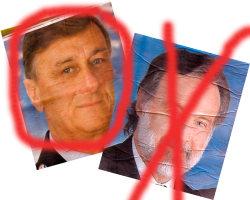 Last night, minutes before Rafael Bielsa spoke to acknowledge his defeat (which he took ages to do), a dozen of cars with people waving Socialist flags (red and white, with the fist and the rose in the center) raced along my street, throwing confetti and honking their horns. I went up the roof to wave at them. Bielsa spoke then, and rather predictably he assumed all the blame. He thanked all his political patrons, from the president down, for lending themselves to the campaign, but apparently forgetting the 360,000 citizens that voted for him. Well, at least he didn't imply the rest of us were stupid, like Filmus did in BA. Binner's speech came minutes later, after shorter admonitions by Lifschitz and by vice-governor elect Griselda Tessio. The guys with the flags were already in his headquarters at the Patio de la Madera. Binner spoke in measured tones, remembering historical characters of the parties of the Progressive Front, and attacking no-one directly; the young militants, though, booed governor Obeid's and president Kirchner's name when they came up (Binner was saying that both had politely called to congratulate him), and quite loudly told the Peronists to shove their purposefully biased pre-election surveys up their collective asses.
And then that was it. The numbers continued arriving, and as more data from the bigger cities were input in the system, the difference between Binner and Bielsa widened. It didn't matter anymore.
We now have three months to wait. Binner is meeting with Obeid today to talk about the transition. Obeid, I think, will listen, and won't do anything stupid. He's an old politician, and he's on his way out.
What can we expect? Well, first of all, autonomy for Rosario!
Media coverage in Spanish: La Capital, Página/12, Rosario/12, Rosario3, La Nación, Clarín; in English: CNN, Buenos Aires Herald
23 November 2007
Blackout count: 3
The Power Supply Fluctuation Watch recorded a new event yesterday. Blackout #3 of the 2007/2008 season has been assigned the name Carlos. It began with minor drops of voltage just after sunset, followed by recovery, and ending with a large loss of voltage that lasted until the morning.
In other news, the outgoing government of Santa Fe led by Governor Jorge Obeid continues to appoint scores of its own officials, political allies, and friends and relatives of the governor, his cabinet, and influential former governor Carlos Reutemann, to high-ranking vacant posts in the public administration, the judiciary and the Provincial Power Company (Empresa Provincial de la Energía, EPE).

Sorrento power plant
EPE is said to have serious shortages of personnel in certain areas, while others are overpopulated by (or were just created especially to harbour) unqualified people appointed there in violation of regulations just because they have family or political contacts in the management. Wages paid by EPE are legendarily high. The company will close 2007 with an estimated AR$90 million deficit, double the figure of 2006, and will have to be asisted with government (i.e. taxpayers') money.
Since the Front for Victory lost the election in September, the provincial government has been cutting supplies to its public offices, and the quality of its services has gone downhill. This hasn't prevented the government party to advertise itself using the same posters that appeared during the campaign — huge colour prints boasting "4 years of hard work, without raising taxes". The Peronists seem to be determined not to leave a single coin, a single spare printer ink cartridge or a single made-up vacant post on their way out, and are turning the judiciary and the (formally) independent control offices into a minefield for the next administration.
Boy, this will take years to fix...
02 February 2007
The 2007 campaign
The campaign for the governor election in Santa Fe is getting hotter... or should I say the pre-campaign, since there are formally no candidates yet, no parties or alliances already in the register that must be compiled months before the election.
Before you go away, I may as well explain why this is important. As anybody who's been living under a democracy for a while knows, elections almost never change anything — 99% of the times it's the same people or their clones trying to get you to vote for them with all sorts of empty promises, oblique threats, lies, lies, more lies, mud-slinging, sentimental pleas, appeals to your pocket or your ethics, etc., and once they're elected they resume their daily routine, some jobs and titles exchanged for others. Well, this might be one of the 1%.
The reasons:
- This is the first governor election since 1991 without the Ley de Lemas. I'll spare you the details here. The Lemas electoral system allowed Peronism to steal the election twice.
- The established Socialist candidate, Hermes Binner (twice mayor of Rosario), is leading the surveys. If he wins, he'll be the first Socialist governor in the history of Argentina.
- The established Peronist candidates are both linked to Rosario as well; one was born here (though he was exiled in Europe and then moved to Buenos Aires) and the other has lived and made its political career in Rosario since his youth.
- Given the two points above, the next governor of Santa Fe is practically sure to be a man of Rosario, ending (we hope) a long string of rulers that have consistently economically and politically discriminated against the largest and most important city in the province. This might lead to a better share of funds for Rosario, and to the attainment of a long sought after dream: municipal autonomy, à la Buenos Aires City.
 In 1995 came Jorge Obeid, who stole the election from the Radical Party candidate Raúl Usandizaga by adding up the votes of the sold-out ex-Socialist Héctor Cavallero to his own using the Ley de Lemas. In 1999 Reutemann was re-elected. He oversaw a horrible crisis with a straight face, survived a couple of scandals, and in 2003 again he left the post to Obeid, who has since devoted his time to visiting Cuba, inaugurating unfinished public works, and appearing in pictures with President Kirchner.
All this time the province has been stumbling through history, guided by an automatic pilot. Its much-touted record fiscal surplus is more a product of automatic taxation on its immense wealth than a sign of good administration, and its progress in later years can be directly attributable to the overall recovery of Argentina, even moreso as it's powered by the export of agricultural commodities. The public sector is bloated and inefficient, the judicial branch is full of dark, corrupt judges protected by the political establishment, the ministries and secretaries are occupied by political operators without skills, policies and their application are irregular, episodical, never fixed, and oriented to the spectacular and to the populist.
Is that different from any other provincial administration in Argentina, or from other local and national governments in the Third World? Probably not. Can it be easily improved? Undoubtedly yes. Will it improve if the party in power changes? Probably, judging by the results that the Socialist administrations have produced in Rosario since 1989, and especially since the degradation brought about by almost a quarter of a century of Peronist rule is due mostly to stagnation and to the naturalization of bad habits.
The two main Peronist candidates are now at each other's throats, as usual; it's not that they have ideological disagreements or fight over policies (what?), but they want power and they can't both have it. Binner watches from afar and has but completely forced the hardliners of the Radical Civic Union, his allies, to choose the vice-governor candidate that he likes, the extra-party Santa Fe federal prosecutor Griselda Tessio. Isn't that nice?
11 April 2007
What the governor giveth
John asks how the approximately US$10 million assigned to Rosario by the provincial government for the emergency will be spent. Coincidentally, La Capital publishes an article today about that (and so does Rosario/12 as well). It's calculated that 65% of the city's streets are in bad shape and need total or partial repaving — this wasn't caused by the storm exclusively, but the days and days of rain finished off many streets that were damaged by years of lack of maintenance. This work will take 15 to 20 million pesos.
The ravine of the Paraná River was eroded and collapsed in several spots, notably in the north end of the coast (the place called Costa Alta, where there's an open-air elevator) and in the parks located in the center-north coast (Parque Sunchales and Parque de las Colectividades). The ravine must be reinforced and walls must be built. That will take 2 to 3 million pesos. There are many neighbourhoods were water is drained by open ditches. These can be more or less sanitary, but not in cases where the street and the sidewalk are not paved as they should. About 3 million pesos will be spent on fixing those ditches, so they don't clog or overflow.
The shanty towns (villas miseria) scattered in the periphery of the city get flooded very quick because they're built along irregularly traced unpaved streets and passages. Whenever it rains, those passages turn into muddy trenches. The city has been working for years building proper streets, with curbs, signs, lighting, etc., so as to "open up" the villas, as a quality of life issue and for security. The municipality will now intervene in 30 irregular settlements, using 4 million pesos.
Another 3 million pesos will be employed to repair the power grid and street lights and to handle waste. And finally, a yet-undetermined amount will be used to aid poor residents whose homes were damaged by the storm. This is a good opportunity for the city to renew itself and for the government to implement and complete certain projects in a short time, instead of putting them off indefinitely as ideas for the coming generations. It's inconceivable, even in our country, that a prosperous city with a progressive government still leaves thousands of people without basic infrastructure and protection against weather phenomena that are (unfortunately) becoming more frequent in our region. And in a province that is swimming in cash!
I really have to credit governor Obeid — even if I've criticized his government countless times, the man knows how to deal with a crisis personally. The problem with him is the corrupt, inefficient, anti-meritocratic, nepotist structure imposed on his administration by a quarter of a century of Peronist rule, which he willingly defers to 99% of the times (the only exception I can remember was the repeal of the Ley de Lemas, which will almost certainly cause the defeat of the Peronist party next September). Outside of the restrictions of party politics, the man has collaborated with Rosario — as he did in his previous term (1995–1999) when Hermes Binner was the mayor, and until Binner started campaigning for the governor's office... This immense grant of funds will undoubtedly be beneficial to the Peronist campaign, but only tangentially, as Obeid has more or less tried to remain above it, and he's not running for reelection (he can't).
Will all the promises become reality?
03 August 2009
Primary election results
A few weird numbers came out of yesterday's election. The main thing was that the opposition represented by the Justicialist Party (that is, the Peronists) won in Rosario, where it usually loses by a wide margin, and the Progressive Front won in Santa Fe City, where it usually doesn't do that well and was vanquished in the latest legislative election. What happened?
You need to remember this was a primary election and, although it was compulsory, many people didn't turn up. It was a local election and in Rosario, also, it was a local election pitching a diverse (some would say promiscuous) opposition party against a fairly monolithic government party whose administration is showing some wear after 14 years in office. People who are more-or-less OK with the Socialist administration didn't vote for it because the main list of candidates was seen as a bunch of yes-people ready to raise their hands on the mayor's command. I myself voted for Nire Roldán, one of the minor, dissident candidates of the Progressive Front, instead of the "loyalist" Clara García (currently a top municipal official), because I don't want a Deliberative Council with an absolute majority of the government's faction.
In any case, the Progressive Front had differences in opinion among its factions, basically regarding the closeness of the candidates to the mayor's power. On the other hand, the Peronists are profoundly divided, and so they went to the primary election: a Kirchnerist faction led by extra-partisan, former Socialist and Menemist sell-out Héctor Cavallero, with the explicit support of the now disgraced Kirchnerist mouthpiece Agustín Rossi; a faction led by one Diego Giuliano, a political unknown who answers to formerly fervent Kirchnerist, now right-wing anti-Kirchnerist Carlos Reutemann; another one led by Osvaldo Miatello, the only one with a current and established legislative career, backed by former governor Jorge Obeid; and an assortment of no-names. These will have to get along somehow — they'll all be together in a single ballot in September.
My analysis is that many people just took the Progressive Front for granted and refused to show extra support for the mayor's faction (that's what I did after all) as a way of letting them know they'll have to work harder to stay in power, while each of the various competing Peronist candidates conducted an aggressive campaign just to make themselves noticed, and their wide differences encouraged their supporters to go out and vote.We'll see what happens with those figures in September. I really can't see a traditional, conservative Peronist voting for a former Socialist with Kirchnerist backing, or viceversa.
05 September 2007
Santa Fe, Córdoba, Misiones
(I'll stop the politics after this. Promise.)
The election was Sunday, today's only Wednesday, and everything already seems to be upside down. Some people who were overconfident to the point of hubris are desolate. The parachuted former candidate Rafael Bielsa is going to resign from his deputy chair because "it wouldn't be ethical to represent the city of BA after I was candidate for governor of SF" (what, you mean now?). Governor elect Hermes Binner met with governor Obeid in the government house and the employees left their posts to go and greet him. The factions of Peronism in Santa Fe are at each other's throats, as they see their power structure crumbling like a house of cards. The President hasn't uttered the words "Santa Fe" (or "Córdoba") since Sunday.
And Binner is already laying out his plans, which include giving more money and more power to the municipalities, avoiding the discretional management of funds by the central provincial state, fighting tax evasion without raising taxes, ensuring that school classes start on schedule next year, and cancelling the construction of a new provincial hospital only 10 blocks away from a municipal hospital (a project that vice-governor, councilmember elect and well-connected architect María Eugenia Bielsa made up and is now defending with such foamy rage that it seems rather obvious she was going to make dirty money for herself out of it).
The situation in Córdoba after the election is a mess. Only 17,000 votes (out of more than 1.5 million valid votes) separate the two main candidates. The vote count was abnormally slow, the handling of the information was horrible, and the fraud is obvious; the only issue is whether it was a general effort, planned from the top down, or just minor tricks on the local scale (the latter are a certainty).
And, thanks to the Ley de Lemas, the elections in Misiones next Sunday will most likely be even messier: besides the board-kicking effect caused by the rejection of the constitutional reform allowing the governor's re-election, the Ley de Lemas, which allows parties to combine the votes of any number of minuscule factions and candidates, means 18,000 candidates will be running for something — one every 36 voters.
Anyway, we're done over here for now. There have been many interviews and articles about Binner's achievement, and in most of them one can realize that the media have caught the general vibe of the people and, besides the natural journalistic interest for "the first Socialist governor in history", there's a serene awareness that change for the better is coming. Nobody expects a lot, but then everybody expects something — even those who voted for Bielsa, who (for the most part, if you ask me) aren't so sure that they should be sad about the loss.
30 November 2007
"We were so good I don't get why we lost"

(Post-election advertising poster for the outgoing government,
almost identical to posters used in the campaign to boost
the government party candidate, who lost anyway.)
Reporter: "[Governor] Jorge Obeid said he'll leave you [enough] money to pay salaries and bonuses to the public employees in December, 200 million pesos from the anti-cyclical fund, 80 million from the public works fund, and 300 million for ongoing works, adding up to 1,400 million. What do you think?"
Governor-elect Hermes Binner: "That we're going to have to pay for a lot of advertising."
20 June 2007
Flag Day
Phew! It's been mad since Sunday, when I started Flag Week by going to the former Rural Society (now a Municipal Fair Site) and then on Monday when I went with the Rosarigasinos photographers' group to check on what was happening prior to the celebrations. The whole city's been like crazy, and the photographers (press, private professionals, amateurs, me!) were buzzing around, grabbing picture after picture of the new Flag Memorial lighting, the crowds, the tenor José Cura (a Rosarino living abroad, who sang for everybody last night), the flags, Alta en el Cielo...
So today was Flag Day proper. I was truly wrecked yesterday when I came back from the wet cold night after listening to Cura and signing the Flag March along, but I woke up today at 8 AM, and together with my brother got a quick breakfast and headed for the Monumento. There weren't many people still. There were, to be sure, many flag peddlers, and others; by noon the smell of chorizo and praliné mixed with the sight of white-and-blue flags and hats and the voice of people selling Coke and coffee in plastic glasses.
 Contrary to my earlier post (my sources were wrong), President Kirchner did come. He came late, to be sure, though given his legendary tardiness at every meeting, it was almost OK. The civic-military parade started before he arrived, as scheduled. There were the usual speeches by the mayor and the governor, and then K came and spoke — again, it was a pleasant surprise not to hear him speak of magnificent macroeconomic numbers and denouncing dark conspiracies against the country we all want, etc. etc.
The only letdown, politically speaking, was the presence of professional bootlickers. It was these bootlickers, on behalf of governor candidate Agustín Rossi, who defiled a corner of Plaza 25 de Mayo by installing a crude campaign ad in the form of an inflatable penguin before the Cathedral. Others preferred to go with the traditional stuff and brought Argentine and Santa Fe flags superimposed with the faces of Juan and Eva Perón. These and others, with standards and banners proclaiming their loyalty to (whoever runs) Peronism, set themselves at the strategic spot right before the mast of the Memorial, in front of the authorities' stand, and brought uncalled-for drums (commonplace in Argentina's political demonstrations and protests) to "complement" the military bands. I couldn't grab a good picture of the prez, since I couldn't get close to the stand, of course, and my puny camera only has 4 megapixels and a 3x optical zoom. Considering my shaking pulse and the fact I was lifting the camera in the air over rows and rows of other people, though, I got a nice result. You can see the Emperor Penguin clearly; to the picture's right (sitting) are vice president Daniel Scioli, and governor Jorge Obeid. The lady in pink/purple to the far right (!) is Senator and First Lady Cristina Fernández (quite possibly the first woman to be elected to the presidency in the history of Argentina), and if you know the guy, you'll recognize the dreaded Alberto Fernández by his moustache, to the left.
 There were a lot of people, but not so many as last year. Maybe they were all exhausted, like me. Right at the end of the parade, when traditional associations were parading in horses and carriages, it started to rain, and many left. Yours truly took shelter under a tree, and then I noticed a crowd had climbed on the stand, that the powers that be had deserted. So I got to be right where K had given his speech.
 There's a lot more to say. I'm going to post pictures during the following days, here and in Vista Rosario. Check my Flickr pictures and the Rosarigasinos group pool as well. I've taken over 700 pictures since Sunday and I'm sure I'm not the only one. Just one more, taken a bit later than the first:

04 April 2007
What the waters are leaving behind
The rains are over for now, but the consequences are still visible. There are still a few hundred evacuees in Rosario, as the water has not drained from certain places. More than 60 towns and cities were affected by the floods, as well as three million hectares (30,000 km²) of crops. Important roads throughout the province are unusable, either because they're blocked by the water, or damaged, or because bridges have been damaged or destroyed. In the city of Santa Fe there were almost 20,000 people displaced from their homes, pickets demanding emergency aid are popping out, and there have been several episodes of looting, mainly supply trucks assaulted by groups of people as they headed for affected areas. Several pickets are also blocking important peripheric streets in Rosario.
The political maneuvering and eye gouging is starting as well. The province is asking the national government for a 20-million-peso aid package (and one has to wonder, where's the province's fiscal surplus they've been advertising ad nauseam?). A full estimate is not yet done, but in Rosario alone the cost of the emergency and the repairs that need to be done on the infrastructure climbs to more than AR$30 million (US$10 million). That's only to pay for the evacuees' food, mattresses, and all manners of logistics, plus the damage done by the storm to the streets. The figure is completely out of reach of the municipal budget, so the mayor is demanding that it be provided by the province and the nation, half and half, using special Treasury funds and a monetary stipend that the national government provides for metropolitan areas. As with all funds distributed through the provincial government, these are usually not distributed evenly: for political reasons, Rosario is discriminated in favour of the municipalities ruled by the Justicialist Party, and in particular, the capital city of Santa Fe. A few hours ago the Coordinator Minister of Santa Fe told mayor Lifschitz that they won't send all of the money towards Rosario because there are others in need as well, but the province "will be there with the rosarinos, as always". Hmm.
The mayor of Santa Fe, Martín Balbarrey, is facing serious opposition. Governor Obeid himself removed him from the command of the emergency operations, and 400 people who flooded in 2003 demonstrated demanding his resignation. Balbarrey is running for reelection; he's the same who was in charge during the 2003 flood, and it seems neither he or the provincial government have done anything to prevent another one during these four years. Santa Fe City is built in the worst possible place, on low-lying terrain in the junction of two large rivers, so it's vulnerable to both rain coming down from higher lands and to rises in the level of the rivers. When these hazards combine, as they did, the result is that the barriers that keep the water out on one side also keep it in on the other side. Santa Fe had to wait several days for pumps to reach the city and begin working at full capacity — while common sense indicates that those pumps should've been available and ready in a matter of hours, as soon as the water started coming.
Rosario is not vulnerable to river flooding, as it sits on top of a ravine — most of the city is at least 5 or 6 meters above the maximum historical level of the Paraná. The western periphery of the city is vulnerable to flooding because there are two streams and two canals there that may overflow. In the case of the Ibarlucea Canal, which caused most of the trouble this time, it should've been widened years ago, but there were bureaucratic delays, as with the Salvat Canal. One major problem is the relocation of the poor people that are occupying the lands. It's practically impossible for them to settle elsewhere; the cost of land and construction is exhorbitant and many of these people make barely enough money to eat. They'll be offered new homes, paid by the state, but they know very well that, once removed from their miserable huts in the worst possible part of town, they'll be at the mercy of the politicians that decide when to grant the funds. Many have already returned to their homes, even as the water hasn't gone away completely, because it's all they have and they know their possessions will be looted by their own neighbours if nobody's watching.
The anti-flooding works already in place worked remarkably well, mainly because they were planned with extremes, rather than averages, in mind. And this rain (almost 500 m in a week, half the average precipitation expected for a whole year) was truly extreme. Or so we think. We'd like to blame this bizarre weather on bad luck, and hope that this is (like the experts say) a one-in-a-hundred-years occurrence, but climate change is a reality and it's very likely that these things will be more and more common in the future.
19 June 2007
Flag Day is tomorrow!
These have been atypical days. First of all, it was a long weekend; and then also, in Rosario it's a very short working week. You see, most public holidays are moveable in Argentina. In order to produce long weekends, which are good for tourism, holidays that fall are moved back to the prior or next Monday. The exceptions are the fixed religious festivities (such as Christmas), the New Year, and the two main patriotic holidays: May 25 and July 9. No matter where in the week they fall, they're never moved. One would expect public displays of outrage if the government decided to play around with those two sacrosanct dates just to please tourists and raise the profits of the tourism industry. Yet, one would also expect Flag Day to be a very patriotic date, but Flag Day (June 20, the anniversary of the death of Manuel Belgrano, creator of the Argentine Flag) is moveable. May it be because it's a celebration linked specifically to Rosario and not to Buenos Aires? Belgrano, after all, crafted his flag and hoisted it for the first time in two artillery batteries located on both sides of the Paraná River, one in Rosario and one in an island directly opposite the village. And he did it in violation of direct orders of the central government of Buenos Aires (the same government which, a few years later, ordered General José de San Martín to attack the province of Santa Fe, that was beginning to oppose the centralism of the capital — an order which San Martín, too, disobeyed).
But that mustn't be it. After all, the Declaration of Independence was written and proclaimed in Tucumán, and Independence Day (July 9) is not moveable, and the President usually celebrates it there.
Must be that national governments, one after another, have never found Flag Day very important. We rosarinos, supported by the provincial government, have asked the federal government to fix Flag Day at June 20, but to no avail, for years. June 20 continues to be a public holiday for the public administration and for all the schools in Rosario, but for no-one else and nowhere else, so many people in the city and from other places cannot attend the celebrations.
This makes it, in principle, easier for the President to bring a parade of applauders for hire, as especially Peronists like to do, but historically that hasn't been a good idea. When Carlos Menem did that, he was left with his minions and a minuscule group of followers in what amounted to a badly organized party meeting. It was so pathetic and sleazy that he didn't want to come to Rosario anymore. He always had excuses: his plane was broken, it was too foggy, it was too windy... Besides, Rosario was hit very hard by anti-industrial Cavallonomics, so Menem stayed away. President De la Rúa never came in his two years. He wasn't a Peronist but I bet he was a Menemist... Duhalde didn't come either. Kirchner came in 2003, and then in 2005; he had appropriate excuses.
Kirchner is not going to come for the main celebration this year; he announced he'll be here "late" (that's 3 hours after the beginning) and just do a speech. Now I understand a president's agenda is always full, but didn't anyone notice June 20 was in there? If a president skipped the celebration of any other major patriotic date, he would be burned at the stake by the media, the opposition, and many common folks. I don't like the guy; I was even guessing he was going to turn his speech into a campaign rant like he always does; but leaving the person aside, there's the symbol, the authority. This is the commemoration of the death of one of the very few true patriots this country has seen in its history, and the celebration of its flag.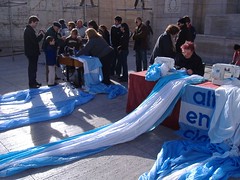 Well, I'll tell you tomorrow (or Thursday) how it was like, with or without K. Vice governor Bielsa is not happy the president isn't coming (maybe because her brother, the candidate, won't be able to grab a campaign picture next to K? — though she says it's because people were looking forward to parade in front of the president, which is true). Governor Obeid excused Kirchner, though... I'm sure there won't be much of a difference.
It's the 50th anniversary of the Flag Memorial, and the Municipality is, as we say over here, throwing the house out the window (or "throwing butter to the ceiling"). There have been concerts, a professional reenactment of General Belgrano's entrance into Rosario in 1812, rodeo-like traditional events, and a national artisans' fair; the Memorial has a new and revolutionary lighting system installed (which will be inaugurated tonight), and in general, the city is bustling with flaggy activity. Before the mast of the Memorial, a group of volunteers is sewing up the parts of Alta en el Cielo, the longest flag in the world (and longer each year!), so as to march with it tomorrow. I saw them yesterday when I passed by with the Rosarigasinos to take pictures. There were still people at the Memorial, listening to a guide narrating the life of Manuel Belgrano, at 8 PM, just as I returned there after a tour of Rosario's historical cupolas. I was tired and freezing, but the old ladies in scarves listening to the guide were just warming up.
14 December 2007
The politician's mind
I often say that the politician's mind is beyond my comprehension, beyond any understanding on the part of we the people. Politicians (especially when they're only politicians, and even more so when they've been for a long time) are not people, they move on different rules, and they see the world with different senses, moral values, and filters.
That's why I can't understand, for example, the resistance of the national government to acknowledge the obvious problem of creeping inflation, with the pathetic stream of doublespeak that results from the public expression of this denial, and why I could never understand the failure of the Santa Fe provincial government to do the very simple things it should've done to ensure victory for its candidate. There were many, many dark spots in the Peronist administration, but the largest obstacles to their removal (as I see it) were the maddening entanglement of personal loyalties and personal feuds, ridiculous bureaucratic delays, and sheer tradition — the tradition of just going on as before even as the people more and more loudly demand for things to change.
On his first day as governor of Santa Fe, Hermes Binner had the police fences around the Grey House removed (they'd been set up to deter demonstrators from trashing the government house), used the front door to get into his office (where the previous governor entered through the back door), and went around the other offices introducing himself to the employees, who were both terrified and very pleased. None of these marks Binner as an outstanding human being or even a good politician; all can be interpreted as plain inexpensive PR and nothing else.
Binner then signed his first decree, cutting his own powers to appoint judges at whim; in this he followed Néstor Kirchner's example, and he took good care of noting this explicitly. And then he announced he'll set aside 30 million pesos, effective immediately, to repair public schools during the summer, so that they're fit for use when the school season begins next March.
Both of these things are minor expenses (political in the former case, economic in the latter), and they were never beyond the powers of former governor Obeid. Why did he let schools turn into dirty, decrepit traps, while public opinion grew indignant by the day after each news report showing their pitiful state? Why did he not impose limits on his own powers to appoint judges, seeing how society distrusts the judiciary for its undue political ties? Why did he spend millions in advertising things no-one actually saw or cared about?
You've already read here about tons of other awful things the previous government did or did not, apparently not noticing or willfully ignoring the political consequences. I can only guess that politicians' minds are alien to our shared reality. If this the case, let's hope Hermes Binner doesn't get caught up in that, after this start off on the right foot.
27 February 2007
Presidential largesse
Rosario has a long strip of green areas and parks by the river, from the port northward. One of these is the Parque España. In March 2005 a section of the park's pavement, which was built over old wooden foundations, collapsed. Only four people were slightly wounded, but it was evident that the area would be unsafe until the foundations were redone, so a 500-meter-long section of the park was closed to the public. The park is administered by the municipality, but it was originally made with funds of the Spanish Crown and the national government. Such joint architectural projects involving foreign governments are fairly common, as tokens of friendship between other nations and Argentina; this was simply especially big.
The collapse of the park was a disaster. It was way beyond the means of the local government (and well outside its priorities as well) to supply millions of pesos to repair it. However, President Néstor Kirchner vowed that the federal government would provide the funds; he would announce this during the celebration of Flag Day, which is traditionally held in Rosario because it was here where Manuel Belgrano created and first flew our flag. Flag Day is June 20, the anniversary of Belgrano's death, as we have the bizarre custom of commemorating deaths rather than births; the flag was first flown by the Paraná River on February 27, so the anniversary (by mere coincidence) is today, but it's not a holiday. Well, months went by, and words remained words.
Just yesterday, governor Obeid was told to announce that the national government would, at last, call for bids to repair the park, supplying the approximately 40 million pesos that will require. This was abrupt and unexpected, and I'm glad it finally happened. However, in today's dead-tree edition of La Capital I'm seeing a full-page full-colour ad, paid for by the government of Santa Fe, getting a bit of credit for itself and thanking President Kirchner. It reads exactly like this: "Thank you, our dear Peronist father and political patron, for fulfilling the promise you made and then forgot two years ago, sharing an infinitesimal part of the wealth in the government's overflowing coffers, and only coincidentally before election season!" (I'm paraphrasing a bit here and there).
Politicians have always used public works as propaganda. Sometimes it's obvious, other times it's forgivable, others it's even appropriate. In Argentina, announcements of public works don't carry a lot of weight but they're used a lot, like inaugurating partially completed projects. The Socialist administration of Rosario is well-known for naming every conceivable square of grass "Plaza (whatever)", and for staging costly and completely useless outdoor artistic performances for the public. But only Peronists are capable of such gross self-advertising and such fake-emotional displays of loyalty.
(I'm listening to the radio now. "Thanks, President Kirchner, for keeping up the help to Rosario." They paid for a radio ad too!)
I might add that the cost of the repairs was about AR$27.5 million back in 2005, while it's now around AR$40 million, so the delay was also a waste of money... but I don't want to sound ungrateful.
23 December 2006
Urban safari: into the West
What a title, huh? I had the day off work yesterday, thanks to governor Obeid's demagoginsistence that public employees should be happy and free of stress in the days before Christmas, even if that means paralyzing half the public healthcare system (and following Kirchner's similar measure on the national level), so I woke up late (that would be around 9 AM for me), had a very lazy, drawn-out breakfast, and decided that I'd go on a photo safari to one of the places in Rosario that I hadn't visited yet: the northwest of the city, which is west from my home, and particularly Barrio Fisherton. I was especially interested in getting to Estación Antártida Argentina, one of the several old train stations scattered throughout Rosario, often in places that are not so very populated today. I won't go into details about the history of the Argentine railways, which is like a summary of Argentine history in general -- enthusiasm, rapid development, faltering, abandon, and timid recovery. Our Amigos del Riel have written a lot about that. The logistics of the safari was troublesome, since I don't have a car, my bicycle is awaiting repairs, and no single bus was good for the trip, even as Fisherton is no more than 10 minutes away from my barrio. I don't know all the lines, anyway, so making a combination was risky -- I could end up anywhere. Walking was viable, but tiresome, and I didn't want to be caught walking under the sun after 11 AM if possible. Eventually I took my little map (a clipped version of the one available at www.rosario.gov.ar), got a bus to take me to Provincias Unidas & Córdoba, and then headed west, admiring the... hmm... well, there's nothing to admire over there. As you cross Circunvalación Avenue (see above), you enter Fisherton and things start getting fancier. Along Córdoba Ave. (which is called Eva Perón Ave. in this part of town) nice bars and restaurants start to appear, along with businesses selling typically tasteless upper middle-class home decoration and quality furniture, brand clothing, and the like.
But the real Fisherton is farther west and far from the avenues: nice small houses and more than a few larger estates, silent streets lined with tall trees, sidewalks with well-groomed, intensely green grass, squeaky clean brand-new cars here and there, and nobody in sight except maybe someone walking their dog and the occasional door-to-door salesman of cheap items (those things that la señora can't be bothered to go to the super for). In Fisherton, as in the even wealthier Barrio Alberdi, common courtesy is extended only once you're ushered inside your host's home, since while you're outside walking beside those mansions you're invariably greeted by the mad howling of packs and packs of seemingly starving guard dogs (and nobody bothers with a CAVE CANEM). An adult knows enough not to approach gates and fences patrolled by such monsters, but a kid who doesn't fear the doggies appropriately will end up with one hand less should s/he try to pet them.
So I walked and walked and got to the train station. The place was abandoned for ages, but it was then restored and preserved (our Municipality likes to do that), and now there's something going on in there. From the outside, though, it looks like a British-style station transplanted into the American Wild West; the dusty solitude and the almost vertical sunlight at the time I got there reinforced that feeling.
I've grown to love old train stations; in Argentina, they encapsulate many aspects of our history in a unique way. The railways were built for the port of Buenos Aires to receive the meat, cow hides and grain coming from the Pampas and beyond, so they could be exported; that model of development defined the country and continues mostly unchanged. British companies brought the trains, inaugurating a period of dependency on foreign investment for our infrastructure, which again, remains like that today. The trains took the immigrants disembarking in Buenos Aires City to the interior of the country. In many cases, towns sprang up spontaneously around train stations and received their name; how the stations were laid out thus defined the distribution of large populations. The south of Santa Fe was (except for Rosario of course) almost completely rural up to the 1880s, and then there was an explosion of dozens of new towns around train stations, as the lines reached farther and farther west. After that there were a few decades of good economy... and then Argentina did its usual thing... and of course, when the 1990s came, what little useful infrastructure remained was swept away by the "modernization" conducted by the Predator-in-Chief and his evil bald minion. That trend can be reversed, maybe, but in the meantime the charm of the old stations remains, even as they lie dark and silent.
18 April 2007
Men at work
 The Municipality is already re-paving the streets, including some that look like they've been in need of re-paving since the time of horse-pulled carriages (cobblestones and all). Fast as it goes, it may be ready just in time for the next freak rainstorm... which was announced for today, hail included, but was cancelled later. Buenos Aires caught the tail of it and, if we were to believe the media, it was barely short of a humanitarian catastrophe.
In the meantime, this must be the hottest April in years. Everything and everyone is sticky. Yesterday it was over 31° C and it looks like the same for today. (Just checked the newspaper: yesterday it was 31.5; the historical record was 33.7.) The provincial power company EPE (a curse unto its board of directors) announced that yesterday also marked the record of electrical consumption — as hundreds of thousands of nearly-suffocating santafesinos turned on their ACs all at once. We also learned that EPE lost between 9 and 11 million pesos in infrastructure and equipment during the Great Rains, which will have to be replaced, and, according to its head (the governor's cousin Luis El Halli Obeid) "the only way to face such expenditure would be to raise the power fees". And maybe your salary as well, Luis, wouldn't you like that as well, you useless parasite?
So the municipality is working already with the money promised by the province; machines are clearing dumpsters, spreading fresh asphalt on our battered streets here and there, and planning how to sanitize or relocate irregular settlements... This year is the 50th anniversary of the inauguration of the National Flag Memorial, and there are multiple celebrations planned for the whole year, centered around Flag Day (20 June), so the local authorities want the city (or the visible part of the city) to be as beautiful as possible.
Most of this should've been done ages ago, but this is a provincial state that takes and doesn't give (except as grants of good will or in emergencies such as this one — and remember this is an electoral year). Then the same repeats on the federal level, especially since the retenciones (export taxes) are in place. Other taxes are partly redistributed to the provinces, but the retenciones are not. If Rosario were an autonomous city, it could collect its own taxes, instead of sending its wealth north to support the useless bureaucracy of Santa Fe. (I'm thinking of starting a campaign about that.)
Besides the renewal of the city (which should've included the refurbishment of Peatonal Córdoba, now delayed until 2008), we're having our Feria del Humor (Fair of Humour). This is one of those light cultural things that I mentioned in an earlier post; the Socialist administrations of Rosario have always loved to have them. This one is a bit special because it will last more than a week and it's not just a couple of comedians in a culture center downtown, but many humour-related activities for children and grownups in every district of the city, even the poor neighbourhoods of the northwest that got flooded only weeks ago. Decentralization started more than a decade ago and it's been slow, but it's wonderful when you see it at work.
Last Saturday, for example, I went to see an exposition of the magazine Barcelona (remember the cover about Argentine middle-class fascism?). Magnified covers were pasted on the walls. Two guys and a girl from the editorial team presented a dictionary of insults called Puto el que lee. Now that's the kind of thing you wouldn't take your child to hear... Though I'm fortunately way past the time when mere bad taste or obscenity sufficed to make me laugh (therefore rendering immune to the temptation of watching Bailando por un sueño, Gran Hermano, or most of Argentine prime-time TV for that matter), you can't but giggle a bit at the spectacle of three 30-somethings reading out loud perfectly serious definitions of such useful terms as tragasable, careta and comegatos.
21 April 2008
Another villa miseria (followup)
Last October I wrote a couple of posts about the Qom ethnic group (also known as the Toba) and their migration from Chaco to Santa Fe and Rosario, where they ended up in villas miseria (slums), marginalized from the rest of society and subject to discrimination. A blogger called mdiana found those posts and left a comment asking about Father Arturo Paoli and his work among the woodchoppers of the La Forestal logging company (the British-owned company which felled most of the quebracho trees of the Chaco, where the Qom tribe lived, and turned it into a desert).
Paoli, a missionary priest, came and settled in Fortín Olmos, in the north of Santa Fe, and organized a fraternity and cooperative with the woodchoppers and small local producers who were left without a job when La Forestal closed down in 1960. In November 2007 a section of Santa Fe's Provincial Route 40 was named after him in homage, and then-governor Jorge Obeid noted he had known Paoli when he was a young man, in the 1960s. At that time Paoli was over 90 years old and living in Italy, from where he sent a letter speaking of the strength of those woodchoppers as a symbol of Latin American endurance.
Well, I just learned that. My original intent was to post a video I took a few days ago, from the bus. It shows the expansion of the villa miseria I mentioned back then in those posts. The settlers have decided to occupy the neighbouring terrain, a large lot that was mostly vacant, though parts of it were devoted to vegetable gardens. The owner has never done anything with the lot, and the municipality, which long ago should have expropriated it for some purpose, looked the other way. Now a sprawling slum is forming, the neighbours are upset, and that's all for nothing, because the poor people who've illegally settled on the land will eventually be pushed away later, when the tortuous bureaucracy of the judicial system decides to command their eviction. This is a sad way for a free people to end.
The video is bumpy and the sound is that of the bus; you can turn it off if you want to. It's only a short stretch, maybe two blocks, along the street where I live (but 10 or 12 blocks from my house), just before and after the railway tracks. On the first part you can see precarious homes that were already there years ago; the rest is all new, a small shanty town assembled almost overnight.
I don't know how this can be solved. You can't let those people set up their huts anywhere; you can't build them houses in the short term; you can't bulldoze them; you can't send them back to their ancestral lands; but the thing you absolutely can't do is ignore them.
14 February 2007
Mayor Lifschitz goes to San Francisco
Rosario's mayor Miguel Lifschitz travelled to San Francisco, California, United States. Besides the exchange of ideas and vague promises of cooperation, San Francisco's mayor promised he'll work on making Rosario and San Francisco sister cities... whatever that means... as long as both he and Lifschitz are reelected this year (we have elections in September; San Francisco has them in November). It turns out, also, that San Francisco's Secretary of Transport is a rosarino! Lifschitz had mentioned that he wanted to bring back the trolleybus to Rosario; there's one (the K line), operated by the municipal state-owned transport company, going east–west all across town, but that's just the last remains of a grid of electric trams that used to cover the city. The municipality wants the trolleybus to have a place in it, by restoring the M line, going north–south.
It's been years since Rosario's bus system has had increasing problems coping with a larger urban area and a larger population. Long ago the municipality planned a new system which would replace the many unconnected bus lines with a hierarchy of district-based lines, transfer lines between nearby areas of the city, and main lines that would cross the whole city. The system was discussed, debated, studied, reformed, and presented to the private companies; it failed to gather investments, then there came an economic crisis, then another, then it failed again... The last attempt succeeded, so we're waiting, sometime during 2007, for the buses to be reorganized. The trams would be an interesting addition to the mix.
The opportunity is unique. The city of Vancouver, Canada, is liquidating its fleet of old trams, which are nevertheless working fine, and it's vowed to donate them to Córdoba, Mendoza and Rosario — we're going to get 70 of them, provided we can pay for the shipping, which is minor compared to the cost of the units. We'll then need 15 million pesos to mount the infrastructure. The K line serves a lot of people and is remarkably quiet, so I hope the M line will be OK as well. What I'd like to see is a picture of Vancouver's trams (Wikimedia Commons has a picture of a TransLink trolley bus, but I doubt that's it).
Besides the tram, it seems Lifschitz liked San Francisco's touristic cable car. There was a project, once, to set up a railway along the coast of the Paraná so that passengers could watch the view. Again, it was one of those things easier said than done. With the city now decidedly going touristic and economically improving, the mayor is pondering the idea of a cable car in Rosario. That would be a major attraction. The municipality has worked hard to make the shoreline accessible and available; from the center northward you can stroll (or jog) along pedestrian paths by parks and beaches for some 7 km with almost no interruption, admiring the river and the islands in the east, and the skyline of the city in the west. A way to do the same for those not keen on walking, or to enjoy the view comfortably in the hottest times of day in the summer, or during rainy days, would be extremely welcome, and if not touristically expensive, also quite useful in itself. Pathetic attempts at criticizing Lifschitz's administration routinely pop up in the walls of certain parts of the city. Lifschitz is a Socialist and a former official of the Binner administration, and though he's kept his low profile and a cautious distance from the campaign for the governorship, Binner and Lifschitz are linked in the popular sentiment, and the Peronist operators of Rafael Bielsa's campaign are taking advantage of that. "Lifschitz, enough with the travels, Rosario needs solutions", I read today in a wall — this, as governor Obeid is in Cuba presenting a book of his, admiring a replica of Che Guevara's home and sucking up to the Castros. Not that that's wrong in any sense; mayors and governors often travel abroad to showcase their lands and promote trade and cultural exchange. "Lifschitz = Bus fee raise", on a poster, too, with a picture of Binner on one side, explaining that the Socialists don't have a solution for the city's problems. (The Peronist leader in the city council made a public display of disapproval when the mayor was forced to raise the fee after the bus drivers got an outrageous salary raise. They also complained when the municipality rose the real estate tax to make upper-middle-class homes pay more than a few pesos. This is all useless since they can't block anything in the council — it's just for show.)
The Peronists have been unable to win in Rosario since 1983; since 1989 we've had Socialist mayors, and Lifschitz is practically sure to win this time again. The Peronist candidates over the years have all been ridiculous... low-level party cronies with a history of living off political favours, opportunists with no idea how to run a city, a foul-mouthed mediocre yellow journalist, the leader of a pharmacy chain suspected of supplying his business with stolen medicine... anyone, absolutely anyone who could bring even a single vote to the cause, under the legal fraud of the Ley de Lemas, tailor-made for the benefit of the pragmatic Justicialist Party. All of them put together, on three consecutive elections, could not come close to Binner or Lifschitz running alone. The city has terrible problems, but people aren't that stupid. So maybe next year, if mayor Newsom of San Francisco is still there, Rosario will have a new sister.
29 March 2007
The Deluge III
I'm wondering whether these days will be known as "The Great Rains" in the future...
It's the fourth day of rain here in Rosario. Yesterday afternoon the precipitation stopped for some hours and the clouds became less dense, but the sun didn't appear. Today it rained during the morning, then stopped, then drizzled, da capo.
Yesterday's alert in my barrio was just a scare, but it was justified by the menacing appearance of the rising water in the streets. When the rain stopped, many people went to do an eye check of the Ludueña Stream, where it emerges from four large underground pipes into its mouth, a few hundred meters before merging with the Paraná. Based on the pictures I saw in today's paper, the pipes were barely sufficient, but the water didn't go over the brim. The water in my street was the result of a sewage system that is relatively new but hasn't been maintained and was overwhelmed by the amount of water and trash; a few hours after the rain stopped, it had drained completely as expected.
 (The above is an old scanned picture of the part of the Ludueña Stream I was talking about. The water was much lower, stagnated and polluted. Currently the water covers the pipe exits and reaches up to the inner brim.)
There's a delay dam in the upper course of the Ludueña, and derivation channels, built in the 1990s, after decades of fighting against the politicians' indifference. Populous areas of the city, including my neighbourhood, suffered episodic flooding every time exceptional rainfall caused the Ludueña Stream to overflow its banks. The last one, in 1986, was truly catastrophic, and everyone from my age up remembers it, so we were on edge. At 6 PM there was a meeting in the community center (I was there waiting for my doctor!) and it was explained that the Ludueña's works had proven our salvation. Back then we would've been up to our necks in water after only half of the precipitations we've had since Monday.
Anyway, many others didn't have such luck. The rain soaked up the soil in the countryside and overflowed canals and streams all around the city and in several other parts of the province. Consider that our region is almost completely flat and it's traversed by so many shallow watercourses that until the 19th century it was known as Pago de los Arroyos, i.e. "Land of the Streams". The Carcarañá River, a tributary of the Paraná north of Rosario, also overflowed its banks yesterday. The Saladillo Stream, which forms part of the southern limit of Rosario, is close to overflowing too. The level of the Paraná River reached 5.29 m, only one centimeter below the official evacuation level — i.e. the level at which the river itself (not its tributaries, not the rain) may overflow and force the evacuation of low-lying areas.
As the rain subsided around Rosario, the situation worsened near the provincial capital, Santa Fe. There are now about 20,000 people evacuated in Santa Fe Province: 12,000 in Santa Fe City, 3,200 in Rosario (where they're being sent to a third evacuation center), and at least 600 in Carcarañá. Santa Fe City is finding it hard to drain all that water; it's maybe historically significant that in colonial times it had to be moved a few years after its foundation because the terrain was too floodable, and the choice of a new site was not very good. Santa Fe is much more vulnerable to river flooding than Rosario, and now the coastal defenses built to contain the river's rising water are keeping the rain water inside.
The picture is not brighter elsewhere. The city of Rafaela (pop. 84,000) is under 1 meter of water in parts. Many small towns have been completely flooded or stand literally isolated, their access roads covered by the waters. National Routes 7, 9, 33 and 34 were partly submerged and blocked in several segments, as was the Rosario–Santa Fe Highway and smaller Provincial Routes; NR 9 and 33 are working again now.
The vice governor of Santa Fe, María Eugenia Bielsa, declared a state of "hydrical emergency", while governor Jorge Obeid, who is on an official trip in Venezuela, is trying to get back as soon as possible (I was expecting that, only two days ago!). The Santa Fe Ministry of Interior got AFA to suspend the local football tournament schedule for this weekend, in part because the authorities and the police are too busy, and in part because there are roads, towns and stadiums under water. (By the way, and again showing the porteño view, La Nación has a space for this horrible catastrophe only to note that the River–Colón football match has been suspended. Clarín has a better coverage, focused on the also worrying problems of Entre Ríos, with videos and all.)
The executive branch of the Municipality of Rosario asked the City Council for a 2-million-peso (US$660,000) emergency aid package, which was approved this afternoon; this is to cover the cost of mattresses, bed sheets, food, medicine, and the logistics of handling thousands of evacuees. Right now, as I told you, there are three emergency centers ready: the Communications Battalion No. 121 and the gyms of the Newell's Old Boys stadium and the Náutico Avellaneda club. These are already full, so one more site is being readied at the Military Lyceum in nearby Funes.
The National Meteorological Service has renewed its weather alert (rain, localized storms, possibly hail) for the nth time, and says the bad weather might continue until Friday.