I often say that the politician's mind is beyond my comprehension, beyond any understanding on the part of we the people. Politicians (especially when they're only politicians, and even more so when they've been for a long time) are not people, they move on different rules, and they see the world with different senses, moral values, and filters.
That's why I can't understand, for example, the resistance of the national government to acknowledge the obvious problem of creeping inflation, with the pathetic stream of doublespeak that results from the public expression of this denial, and why I could never understand the failure of the Santa Fe provincial government to do the very simple things it should've done to ensure victory for its candidate. There were many, many dark spots in the Peronist administration, but the largest obstacles to their removal (as I see it) were the maddening entanglement of personal loyalties and personal feuds, ridiculous bureaucratic delays, and sheer tradition — the tradition of just going on as before even as the people more and more loudly demand for things to change.
On his first day as governor of Santa Fe, Hermes Binner had the police fences around the Grey House removed (they'd been set up to deter demonstrators from trashing the government house), used the front door to get into his office (where the previous governor entered through the back door), and went around the other offices introducing himself to the employees, who were both terrified and very pleased. None of these marks Binner as an outstanding human being or even a good politician; all can be interpreted as plain inexpensive PR and nothing else.
Binner then signed his first decree, cutting his own powers to appoint judges at whim; in this he followed Néstor Kirchner's example, and he took good care of noting this explicitly. And then he announced he'll set aside 30 million pesos, effective immediately, to repair public schools during the summer, so that they're fit for use when the school season begins next March.
Both of these things are minor expenses (political in the former case, economic in the latter), and they were never beyond the powers of former governor Obeid. Why did he let schools turn into dirty, decrepit traps, while public opinion grew indignant by the day after each news report showing their pitiful state? Why did he not impose limits on his own powers to appoint judges, seeing how society distrusts the judiciary for its undue political ties? Why did he spend millions in advertising things no-one actually saw or cared about?
You've already read here about tons of other awful things the previous government did or did not, apparently not noticing or willfully ignoring the political consequences. I can only guess that politicians' minds are alien to our shared reality. If this the case, let's hope Hermes Binner doesn't get caught up in that, after this start off on the right foot.

14 December 2007
The politician's mind

 Stumble it!
02 October 2007
The Toba, from Chaco to Rosario
The other day I was visiting Rob's blog and I saw he'd posted a video about poverty in the province of Chaco. It was really strange to watch this report of something that's happening quite literally in our backyard... in English, by an Argentine journalist, via Al-Jazeera. I knew the reporter, Teresa Bo — I think I saw her once before but I didn't remember who she worked for.
Rob subtitled his post "Another thing I had no idea about", which is not surprising given he's just gotten here from a different country and he hasn't left Buenos Aires (that I know of). What is surprising and disappointing is how Argentinians themselves seem to ignore this as well.
Chaco is a province located north of Santa Fe. It belongs in a larger biogeographic zone called the Gran Chaco, and within it, in the Humid (or Low) Chaco, which is humid only relative to the arid High Chaco.
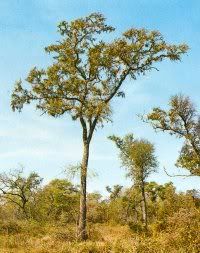 Red quebracho (Schinopsis balansae)
Without government control, and given the lack of knowledge of basic ecological facts at the time, La Forestal destroyed the Chaco forest. When it left, in 1960, the quebracho trees were gone, the soil was absolutely degraded, the land had become a desert, and the population was desperately poor.
The main aboriginal group in Chaco are the Qom tribe, who are known as Toba — a derogatory term imposed by the technological more advanced and aggresive Guaraní. The Qom started migrating south as economic conditions worsened in the 1950s, establishing themselves in the outskirts of larger cities. There's evidence that, in the 1980s and 1990s, the government of Chaco encouraged them to abandon their lands and went as far as paying them a one-way ticket to Santa Fe and Rosario, where they joined their previously settled relatives in villas miseria (shanty towns). It was better for them to live in precarious homes made of corrugated iron and cardboard, scavenge for food in someone else's garbaga and work long hours in unqualified jobs in the big city than starving without hope of assistance or enduring alternating drought and floods in the middle of their desertified forest. In Rosario they found a robust public health system, an abundance of free schools for their children, and jobs.
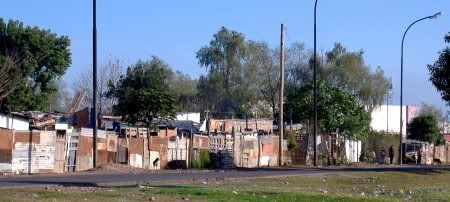 Villa miseria (shanty town) in Rosario, originally a Toba settlement
What they didn't find was a return to their ancestral ways, which worked fine for them before their lands were ravaged. Like most of the rural poor that migrated to the cities, they fell prey to the political clientele system, and their children became accustomed to beg in the streets, to use alcohol and illegal drugs, and to expect nothing from the future.
This post is getting too long and sad, so I'll reserve the rest of what I'd written for tomorrow or the day after that. It concerns the local Qom and their involvement with one of those power-hungry religious characters that seem to be attracted to poverty and despair (not, not Padre Ignacio).
03 September 2007
Election Sunday
 What a weekend! I'm into politics, but I was waiting for this election in particular for personal reasons. I'm an employee of the provincial state of Santa Fe, so the governor election meant the citizenship was ultimately going to elect my boss, and the outcome could radically change my working conditions.
Well, the short version is: Hermes Binner won the election against the Rosario-born, porteño deputy Rafael Bielsa with a 10% overall difference. In Rosario, mayor Miguel Lifschitz was reelected, beating the repeatedly sold-out former Socialist mayor Héctor Cavallero by such a wide margin Cavallero didn't even bother to appear in public to protest.
The Front for Victory (Kirchner's version of the Justicialist Party) lost the governor election in great part thanks to Rosario's votes. It also took several surprising hits, losing its grip on several important cities that had been ruled by Peronists for years or decades, such as Santo Tomé (near the capital, pop. 60,000), San Lorenzo (30 km north of Rosario, pop. 45,000) and Villa Gobernador Gálvez (right south of Rosario, pop. 75,000). The biggest and quite possibly painful surprise was the provincial capital itself, where the Socialist Mario Barletta beat both the Front for Victory candidate Martín Balbarrey (seeking reelection) and the "dissident Peronist" Oscar Martínez. Starting in December, five of the seven largest cities in Santa Fe and more than half of the population will be ruled by Socialists.
Those were the objective numbers. Now the impressions... What I got from most people was simply relief, the comforting realization that a dynasty of mediocre opportunists was ending, the sudden awareness of this turn of events. Binner is the first Socialist governor in the history of Argentina, but it's obvious to everyone that he was voted by many people who wouldn't call themselves Socialist. Others don't like him very much, and many outside Rosario surely don't really know him at all, but voted against something: the crude inability of the Peronists to do anything but clinging to power (even as they fight among themselves for it), the aggressive language and derisive manners of a candidate that tried to pass for one of us when he hadn't set foot in the province for two decades, the plain realization that anything but a radical change would mean four more years of flat, uneventful decadence or, at most, vegetative growth. Four more years, after 24 years of corruption, of judges on the payroll of the party, of a police force stained with a string of unpunished crimes, of friends turned government officials who have no idea to do what they're supposed to do, of fundamental laws delayed and then passed and ignored, of callous indifference to the suffering of millions, of the State turned into a section of the Party. That was too much.
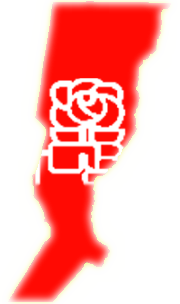
Another impression I got was that Rosario was the lever that moved the election. With almost one-third of the population of the province, the landslide victory in Rosario was important for the overall result, but I'm speaking of comparisons and imitations. People are not stupid. Rosario serves as proof that, while unable to work magic, a good administration can improve the citizens' quality of life a lot, even without help from the provincial state, and beyond the mere recovery of employment and consumption that follows automatically from a high economic cycle. Thus it shouldn't be surprising that the two largest cities in the Greater Rosario area changed hands last Sunday. San Lorenzo, an industrial port city, has an enormous untapped potential and a government that wasn't up to the challenge. Villa Gobernador Gálvez, next to Rosario, could not but watch with envy as the neighbouring metropolis flourished while a mafia government led directly or by proxy by a violent, uneducated thug continued to win elections.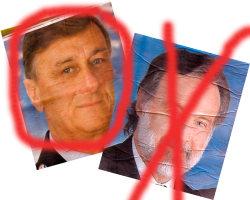 Last night, minutes before Rafael Bielsa spoke to acknowledge his defeat (which he took ages to do), a dozen of cars with people waving Socialist flags (red and white, with the fist and the rose in the center) raced along my street, throwing confetti and honking their horns. I went up the roof to wave at them. Bielsa spoke then, and rather predictably he assumed all the blame. He thanked all his political patrons, from the president down, for lending themselves to the campaign, but apparently forgetting the 360,000 citizens that voted for him. Well, at least he didn't imply the rest of us were stupid, like Filmus did in BA. Binner's speech came minutes later, after shorter admonitions by Lifschitz and by vice-governor elect Griselda Tessio. The guys with the flags were already in his headquarters at the Patio de la Madera. Binner spoke in measured tones, remembering historical characters of the parties of the Progressive Front, and attacking no-one directly; the young militants, though, booed governor Obeid's and president Kirchner's name when they came up (Binner was saying that both had politely called to congratulate him), and quite loudly told the Peronists to shove their purposefully biased pre-election surveys up their collective asses.
And then that was it. The numbers continued arriving, and as more data from the bigger cities were input in the system, the difference between Binner and Bielsa widened. It didn't matter anymore.
We now have three months to wait. Binner is meeting with Obeid today to talk about the transition. Obeid, I think, will listen, and won't do anything stupid. He's an old politician, and he's on his way out.
What can we expect? Well, first of all, autonomy for Rosario!
Media coverage in Spanish: La Capital, Página/12, Rosario/12, Rosario3, La Nación, Clarín; in English: CNN, Buenos Aires Herald