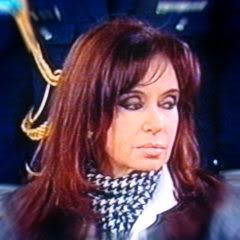
 Just an example of why it's so difficult to believe in Cristina Kirchner's "redistribution programme": the chairman of the Rosario branch of the Argentine Construction Chamber notes that, of 4,000 popular homes the national government had vowed to pay for in Rosario during 2007, not a single one has been built so far. First they were cut down to 1,400, then the funds never arrived, and as of now "we haven't yet obtained a clear answer from the national government regarding the reasons for the delay… all we have is a promise, without details, that the construction of those homes will begin in the second half of this year." And of course, the budgeted prices of supplies and labour are completely outdated; updating them is a bureaucratically slow process and uses INDEC's fudged (and therefore useless) inflation figures. Considering the expediency shown by the Kirchners to deal with other matters bypassing Congress, the Constitution, and basic attempts at dialogue or consensus, it's hard to see why Cristina can't speed this up.
This report comes after Cristina granted an audience to Santa Fe governor Hermes Binner, who had criticized the handling of the farmers' crisis and asked for a better redistribution of federal funds. Yesterday, after the audience, Cristina gave a speech next to Binner noting that Santa Fe has received a lot of funds for public works, and how that shows in Rosario's growth and prosperity. Well, while it's true that we've received funds, we're still waiting for the national government to pay for the repair of a section of our coastal park that Néstor Kirchner promised to deal with in 2005 (!) and that will be finished no sooner than 2009 (hopefully). And most of Rosario's recent prosperity, as everyone over here above kindergarten age knows, is due to the money coming in from the nearby countryside, the construction boom being just one example. Put simply, when people have money to spend, they come to the big city and splash.
Yesterday, the President rubbed her figures on Binner's face noting that federal money transfers to Santa Fe had increased 30% in a year — which is true of all provinces, because that's how much tax collection increased in nominal terms, mostly due to inflation. She also claimed Santa Fe had received over AR$42 billion since 2003. However, according to our Finance Minister Ángel Sciara, the books only show AR$15 billion on all accounts. And the federal government is behind schedule by about AR$1 billion.
The national government has legal obligations — by law Santa Fe must receive 8.84% of the federal taxes, and that's not a grant, a gift, or in any sense something we must thank for to our most gracious Cristina Kirchner.

11 June 2008
I want to believe but...

 Stumble it!
14 December 2007
The politician's mind
I often say that the politician's mind is beyond my comprehension, beyond any understanding on the part of we the people. Politicians (especially when they're only politicians, and even more so when they've been for a long time) are not people, they move on different rules, and they see the world with different senses, moral values, and filters.
That's why I can't understand, for example, the resistance of the national government to acknowledge the obvious problem of creeping inflation, with the pathetic stream of doublespeak that results from the public expression of this denial, and why I could never understand the failure of the Santa Fe provincial government to do the very simple things it should've done to ensure victory for its candidate. There were many, many dark spots in the Peronist administration, but the largest obstacles to their removal (as I see it) were the maddening entanglement of personal loyalties and personal feuds, ridiculous bureaucratic delays, and sheer tradition — the tradition of just going on as before even as the people more and more loudly demand for things to change.
On his first day as governor of Santa Fe, Hermes Binner had the police fences around the Grey House removed (they'd been set up to deter demonstrators from trashing the government house), used the front door to get into his office (where the previous governor entered through the back door), and went around the other offices introducing himself to the employees, who were both terrified and very pleased. None of these marks Binner as an outstanding human being or even a good politician; all can be interpreted as plain inexpensive PR and nothing else.
Binner then signed his first decree, cutting his own powers to appoint judges at whim; in this he followed Néstor Kirchner's example, and he took good care of noting this explicitly. And then he announced he'll set aside 30 million pesos, effective immediately, to repair public schools during the summer, so that they're fit for use when the school season begins next March.
Both of these things are minor expenses (political in the former case, economic in the latter), and they were never beyond the powers of former governor Obeid. Why did he let schools turn into dirty, decrepit traps, while public opinion grew indignant by the day after each news report showing their pitiful state? Why did he not impose limits on his own powers to appoint judges, seeing how society distrusts the judiciary for its undue political ties? Why did he spend millions in advertising things no-one actually saw or cared about?
You've already read here about tons of other awful things the previous government did or did not, apparently not noticing or willfully ignoring the political consequences. I can only guess that politicians' minds are alien to our shared reality. If this the case, let's hope Hermes Binner doesn't get caught up in that, after this start off on the right foot.
12 December 2007
Strike me down
The municipal public employees are on strike since yesterday, and for the nth time, asking for a raise. I've been wanting to see a photo exhibition at the Museo de la Ciudad, but since it's run by those very municipal employees, it's impossible. Last week on Tuesday I went to the museum, and only after ten minutes of looking around did I remember the employees were on strike. It wasn't a waste, because the museum is after all within a beautiful park and I was accompanied by a beautiful lady, but the exhibition (which I'm told is large and very good) remains unseen to me.
I don't know what the municipal employees are trying to do here. I understand that prices have gone up and the Christmas/New Year season brings even more expenses than usual, but everyone in the government offices has half their things packed for vacations already, and they're going to get a customary "adjustment" salary raise first thing next year.
On the other hand, I don't get why (besides tradition) government offices have to change at this time of the year. Nobody wants to dress up and hear long speeches, everyone wants to leave town and flee the scorching summer for the beach or the mountains, and no-one wants to start anything that demands work. The general consensus at my workplace is that the heavy restructuring that governor Hermes Binner will surely effect on the provincial public administration will not begin until March, which means four lost months just because the office-taking was done in December.
Binner will face troubles soon too, since now that there's a Rosario Socialist in the Grey House (the government seat, in Santa Fe City) and many Rosarinos will be moving there from the municipal administration to become provincial officials, information and gossip will travel faster, and already the news is that (as everyone suspected) the municipal employees of Rosario are much better paid than us, their counterparts in the province, and much better treated. One of the subtly stated campaign devices of Binner's was that he could do for the province what he had done for Rosario, which everyone agrees has turned into a much nicer city during the past Socialist administrations (Cavallero, twice Binner, and Lifschitz). So we (or our union) will surely be joining the municipal workers in Rosario, asking not only for a raise, but for a raise that brings us closer to them.
And of course, looming above the whole country, there's union leader Hugo Moyano, already facing up to the Presidenta — in fact saying "If you don't give us what we want, we may not continue to be your allies". Cristina K really seems to be more comfortable around industrial moguls and other businessmen than close to Moyano and his vociferously thuggish supporters, who can strike Cristina in both figurative senses of the word, since they de facto command the distribution of goods throughout the country.
And that ends today's political rant. Useless, I know. At the end of it all, I still can't go see my exhibition...
10 December 2007
Cristinian Era
 So today's inauguration day! Cristina Fernández de Kirchner is going to take office, after receiving the presidential band and the presidential cane and, I suppose, the customary presidential hug, and we're starting four more years of Kirchnerism.
Things haven't been that bad, to be sure. When you consider we could've been treated to a third serving of Carlos Menem, and then you see how much things have improved partly thanks to Kirchner's disregard for "orthodox" economics, we should all be kissing the ground Mr. K walks, if only it weren't so disgusting to kiss a ground sticky with the slime of Alberto Fernández, Julio De Vido et al.
Mauricio Macri took office in the Autonomous City of Buenos Aires (pop. 2.7 million) yesterday, and Hermes Binner will take office as governor of the Province of Santa Fe (pop. 3 million) tomorrow. A right-wing businessman without a real party, and a moderate Socialist politician with a party that gets to have a governor elected for the first time in history, are going to rule the third and fourth most populated districts in Argentina alongside Cristina, and one should be concerned how this will work out for federalism, seeing how the national administration has concentrated power and money lately.
But enough of politics. We're going to see endless discussions about this. Cristina's inaugural speech (I foresee), and also her dress, shoes, hairdo and makeup, are going to be dissected and thoroughly analyzed by self-proclaimed experts in... whatever it takes to do that analysis. The international media will remark the extraordinary election of a female president in a typical sexist Latin American country, ignoring the generalized feeling (confirmed by surveys) that most Argentinians couldn't care less if the president is a man, a woman, or a hermaphroditic chimpanzee-orangutan hybrid, as long as she/he/it solves some of the pressing problems that Néstor Kirchner has left us, or has left unattended.
So Cristina, I didn't vote for you, but we're on the same boat, and if you can't sail it right, we're sinking together (I know you won't do the "captain stays with her boat" thing, though — too practical for that). Good luck to you. You're going to need it.
05 December 2007
All hail la Presidenta
It seems that both our presidents (current and elect) want to celebrate, and they're going to give everybody (well, national public employees) a day off work on December 10, so they can attend, or at least watch live, the inauguration of Queen Cristina of the Unwrinkled Visage. There'll be a suggestion to the provincial governments and to the Buenos Aires City administration as well, to do the same with their own employees.
I haven't heard anything from the outgoing governor in that respect yet, but I doubt he'll resist the temptation of one last populist measure, and one that pleases the Supreme Leader in the best Peronist tradition, to boot.
Governor-elect Hermes Binner will take office the next day (Tuesday, December 11) since he, too, will be attending the Presidenta's inauguration on Monday, when he formally gets his turn. Binner has been careful not to criticize the K administration, which is a disappointment for many of us, though it's true that he's been elected to rule a province that both profits and badly needs the K economic model to continue running, and that the Socialist Party to which he belongs does in fact criticize and oppose Kirchner's policies, in Congress when it's supposed to. (Of course, opposition in Congress is a joke, since K has an "automatic majority" and the Front for Victory legislators merely do as they're told.)
I really couldn't care less about Cristina's inauguration, and I can safely bet most of my compatriots, including those who voted for her, feel the same. Who can be enthusiastic at what seems to be merely an administrative change, after a hollow campaign and a boring election with a result that was foreseeable months before?
On a last note, I hear public transport fees in Buenos Aires are going up, finally, because the incoming government wants to save on those massive subsidies that we all pay. I hear porteños complaining because a bus ticket will cost 90 cents, and all I can say is: Rosario's bus fee will be increased to AR$1.40 just before or after the year ends, so please, get real and stop whining.
30 November 2007
"We were so good I don't get why we lost"

(Post-election advertising poster for the outgoing government,
almost identical to posters used in the campaign to boost
the government party candidate, who lost anyway.)
Reporter: "[Governor] Jorge Obeid said he'll leave you [enough] money to pay salaries and bonuses to the public employees in December, 200 million pesos from the anti-cyclical fund, 80 million from the public works fund, and 300 million for ongoing works, adding up to 1,400 million. What do you think?"
Governor-elect Hermes Binner: "That we're going to have to pay for a lot of advertising."
05 September 2007
Santa Fe, Córdoba, Misiones
(I'll stop the politics after this. Promise.)
The election was Sunday, today's only Wednesday, and everything already seems to be upside down. Some people who were overconfident to the point of hubris are desolate. The parachuted former candidate Rafael Bielsa is going to resign from his deputy chair because "it wouldn't be ethical to represent the city of BA after I was candidate for governor of SF" (what, you mean now?). Governor elect Hermes Binner met with governor Obeid in the government house and the employees left their posts to go and greet him. The factions of Peronism in Santa Fe are at each other's throats, as they see their power structure crumbling like a house of cards. The President hasn't uttered the words "Santa Fe" (or "Córdoba") since Sunday.
And Binner is already laying out his plans, which include giving more money and more power to the municipalities, avoiding the discretional management of funds by the central provincial state, fighting tax evasion without raising taxes, ensuring that school classes start on schedule next year, and cancelling the construction of a new provincial hospital only 10 blocks away from a municipal hospital (a project that vice-governor, councilmember elect and well-connected architect María Eugenia Bielsa made up and is now defending with such foamy rage that it seems rather obvious she was going to make dirty money for herself out of it).
The situation in Córdoba after the election is a mess. Only 17,000 votes (out of more than 1.5 million valid votes) separate the two main candidates. The vote count was abnormally slow, the handling of the information was horrible, and the fraud is obvious; the only issue is whether it was a general effort, planned from the top down, or just minor tricks on the local scale (the latter are a certainty).
And, thanks to the Ley de Lemas, the elections in Misiones next Sunday will most likely be even messier: besides the board-kicking effect caused by the rejection of the constitutional reform allowing the governor's re-election, the Ley de Lemas, which allows parties to combine the votes of any number of minuscule factions and candidates, means 18,000 candidates will be running for something — one every 36 voters.
Anyway, we're done over here for now. There have been many interviews and articles about Binner's achievement, and in most of them one can realize that the media have caught the general vibe of the people and, besides the natural journalistic interest for "the first Socialist governor in history", there's a serene awareness that change for the better is coming. Nobody expects a lot, but then everybody expects something — even those who voted for Bielsa, who (for the most part, if you ask me) aren't so sure that they should be sad about the loss.
03 September 2007
Election Sunday
 What a weekend! I'm into politics, but I was waiting for this election in particular for personal reasons. I'm an employee of the provincial state of Santa Fe, so the governor election meant the citizenship was ultimately going to elect my boss, and the outcome could radically change my working conditions.
Well, the short version is: Hermes Binner won the election against the Rosario-born, porteño deputy Rafael Bielsa with a 10% overall difference. In Rosario, mayor Miguel Lifschitz was reelected, beating the repeatedly sold-out former Socialist mayor Héctor Cavallero by such a wide margin Cavallero didn't even bother to appear in public to protest.
The Front for Victory (Kirchner's version of the Justicialist Party) lost the governor election in great part thanks to Rosario's votes. It also took several surprising hits, losing its grip on several important cities that had been ruled by Peronists for years or decades, such as Santo Tomé (near the capital, pop. 60,000), San Lorenzo (30 km north of Rosario, pop. 45,000) and Villa Gobernador Gálvez (right south of Rosario, pop. 75,000). The biggest and quite possibly painful surprise was the provincial capital itself, where the Socialist Mario Barletta beat both the Front for Victory candidate Martín Balbarrey (seeking reelection) and the "dissident Peronist" Oscar Martínez. Starting in December, five of the seven largest cities in Santa Fe and more than half of the population will be ruled by Socialists.
Those were the objective numbers. Now the impressions... What I got from most people was simply relief, the comforting realization that a dynasty of mediocre opportunists was ending, the sudden awareness of this turn of events. Binner is the first Socialist governor in the history of Argentina, but it's obvious to everyone that he was voted by many people who wouldn't call themselves Socialist. Others don't like him very much, and many outside Rosario surely don't really know him at all, but voted against something: the crude inability of the Peronists to do anything but clinging to power (even as they fight among themselves for it), the aggressive language and derisive manners of a candidate that tried to pass for one of us when he hadn't set foot in the province for two decades, the plain realization that anything but a radical change would mean four more years of flat, uneventful decadence or, at most, vegetative growth. Four more years, after 24 years of corruption, of judges on the payroll of the party, of a police force stained with a string of unpunished crimes, of friends turned government officials who have no idea to do what they're supposed to do, of fundamental laws delayed and then passed and ignored, of callous indifference to the suffering of millions, of the State turned into a section of the Party. That was too much.
Another impression I got was that Rosario was the lever that moved the election. With almost one-third of the population of the province, the landslide victory in Rosario was important for the overall result, but I'm speaking of comparisons and imitations. People are not stupid. Rosario serves as proof that, while unable to work magic, a good administration can improve the citizens' quality of life a lot, even without help from the provincial state, and beyond the mere recovery of employment and consumption that follows automatically from a high economic cycle. Thus it shouldn't be surprising that the two largest cities in the Greater Rosario area changed hands last Sunday. San Lorenzo, an industrial port city, has an enormous untapped potential and a government that wasn't up to the challenge. Villa Gobernador Gálvez, next to Rosario, could not but watch with envy as the neighbouring metropolis flourished while a mafia government led directly or by proxy by a violent, uneducated thug continued to win elections.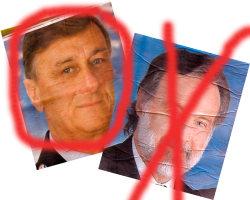 Last night, minutes before Rafael Bielsa spoke to acknowledge his defeat (which he took ages to do), a dozen of cars with people waving Socialist flags (red and white, with the fist and the rose in the center) raced along my street, throwing confetti and honking their horns. I went up the roof to wave at them. Bielsa spoke then, and rather predictably he assumed all the blame. He thanked all his political patrons, from the president down, for lending themselves to the campaign, but apparently forgetting the 360,000 citizens that voted for him. Well, at least he didn't imply the rest of us were stupid, like Filmus did in BA. Binner's speech came minutes later, after shorter admonitions by Lifschitz and by vice-governor elect Griselda Tessio. The guys with the flags were already in his headquarters at the Patio de la Madera. Binner spoke in measured tones, remembering historical characters of the parties of the Progressive Front, and attacking no-one directly; the young militants, though, booed governor Obeid's and president Kirchner's name when they came up (Binner was saying that both had politely called to congratulate him), and quite loudly told the Peronists to shove their purposefully biased pre-election surveys up their collective asses.
And then that was it. The numbers continued arriving, and as more data from the bigger cities were input in the system, the difference between Binner and Bielsa widened. It didn't matter anymore.
We now have three months to wait. Binner is meeting with Obeid today to talk about the transition. Obeid, I think, will listen, and won't do anything stupid. He's an old politician, and he's on his way out.
What can we expect? Well, first of all, autonomy for Rosario!
Media coverage in Spanish: La Capital, Página/12, Rosario/12, Rosario3, La Nación, Clarín; in English: CNN, Buenos Aires Herald
31 August 2007
The end is near
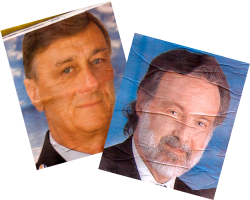
My Japanese calligraphy teacher's view of the candidates for the governor election: "There's the guy with all that beard... and the other guy who looks like Hitler." I had to laugh. It's very difficult to discuss politics in a language you're just starting to understand beyond the basics, and explaining Argentine and local politics to a foreigner from a vastly different culture is absolutely impossible. We left it at that. (Watanabe-sensei also inquired about Cristina Kirchner. I just said no.)
OK, that was just comic relief. We're right on top of the election, and that's a good thing, because I was getting tired of the incessant TV and radio ads, the childish taunts among grown men, the unsubtle campaign moves. If I hear the President is coming again to unveil yet another one of those hypothetical or half-finished public works that abound these days, I will lose it.
In case you didn't notice, I'm starting a news blog. I'm going to take news from local media and classify them with graphical labels according to their type... morbid, boring, useless filling, paid-for ads disguised as news, etc. It's en español and it's called Etiquetame todo ("Label Me All Over"). If you read Spanish, check out it.
02 July 2007
Out of dark rooms
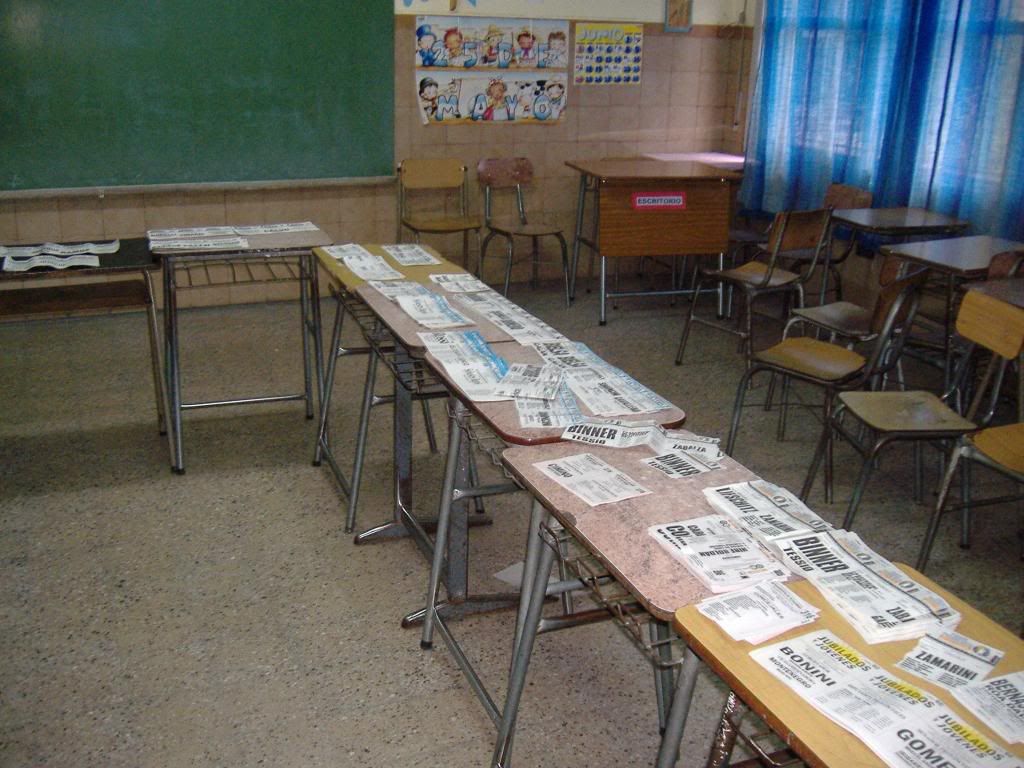
Yesterday's election brought some unexpected things. A lot of people went to vote, more than 70%. You'd think a compulsory election (under the threat of jail for those who don't attend) should not be skipped by 30% of the voters, but given the complete lack of enforcement of the electoral law and the fact that many people didn't actually know who or what they were voting for (the system is new, a bit confusing, and a lot of people are indifferent to politics when not simply dumb), it was a success — the rate of attendance was about the same as in most main elections in the recent past. On the other hand, blank and voided votes were a lot as well, about 17%. The profusion of ballots of different lengths and the possibility of cutting them to combine candidates from different parties and factions probably contributed to the confusion.
The real surprise, however, was Binner's loss. The Socialist governor candidate believed (as we all did, based on surveys) he was going to get more votes than the two Peronists combined, which would make victory in September almost a certainty; but he gathered about 30,000 votes less than the total of Rafael Bielsa and Agustín Rossi. Worse, he went public before the official figures were out saying he'd won over both, and even the papers got it wrong. Rossi was crushed — Bielsa got double the votes. So it's going to be Binner vs. Bielsa, and the result will depend on whether people who voted for Rossi did so out of Peronist loyalty or focused on the personal qualities of the candidate. If the former is true, Binner could very well lose the main election by a few thousand votes.
Then there are also the smaller parties and the people who chose them. This is not a ballotage as in Buenos Aires, but it's likely that, now the real numbers are in place, the September elections will be much more polarized and people will resort to what's called voto útil, the useful vote — a vote for someone whom you may not like but who has at least some chance to win. There's a Peronist candidate running outside the Front for Victory, and there's a Radical candidate running outside the Progressive Front; the former got 28,000 votes, the latter got 41,000. Not much in a province with 2.3 million voters, but enough to tip a close-tied election.
In Rosario, the Socialist component of the Progressive Front practically mopped the floor with its competitors, both internal and external, but that was pretty much expected. The Peronists should take note that their best candidate for mayor, Héctor Cavallero, is a former Socialist mayor (who sold out to Carlos Menem), and he got more votes for mayor than the votes Bielsa got for governor in Rosario — i.e. a significant number of people wanted to vote Cavallero, who was a good mayor in his time, and a good mayor in the line of Binner and Lifschitz, but didn't want to vote for Bielsa, and took the time to manually cut the ballot.
In case you're getting lost, remember this was all for almost nothing except for the Justicialist Party to decide which candidate will run. The real election for mayor and governor is in September, and the final numbers may differ greatly.
Yours truly won't tell you who he voted for, though it shouldn't be difficult to guess if you check my many earlier posts about politics. I'm hoping for the end of the 24 years of Peronist mediocrity in power. Worse, Bielsa is basically a Rosario-born porteño sent to Santa Fe by the President to win an election, and he takes pride in saying he's nothing but a representative of the President's national project. I believe a province with 3 million inhabitants who generate a large part of the total wealth of the country deserves a strong local government and independent ideas.
Some of the people who didn't vote yesterday will go to vote in September. And I'm now hearing people on the radio some people who say they voted for Rossi but won't vote for Bielsa, for the same reasons as me, but for Binner. There's hope.
10 February 2007
The Socialist, the independent and the two little Radicals
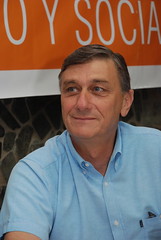 Hermes Binner's governor candidacy was launched last Thursday. So far the one and only Socialist in Argentina with chances to become a governor in the foreseeable future has gotten away with everything — he ignored the demands of his Radical Party allies to name his companion (the vice-governor candidate), stubbornly ignored the appointment of Carlos Fascendini, got Fascendini to submit, step aside and sing Binner's praises, and gathered the support of a whole lot of Radicals, including the mayors and communal authorities of many a small town in the heart of Santa Fe, where the battle may be thoughest (Binner has Rosario, with more than one third of Santa Fe's population, practically in his pocket already, and Santa Fe City is going that way too).
Topping it off, he got Griselda Tessio, a respectable federal prosecutor (she's just resigned) and a daughter of the last Radical Party governor of Santa Fe, to be his running mate, and he launched the campaign, with her on one side and Fascendini on the other, in a meeting in Esperanza, the prosperous city in central Santa Fe where both Fascendini and Tessio were born.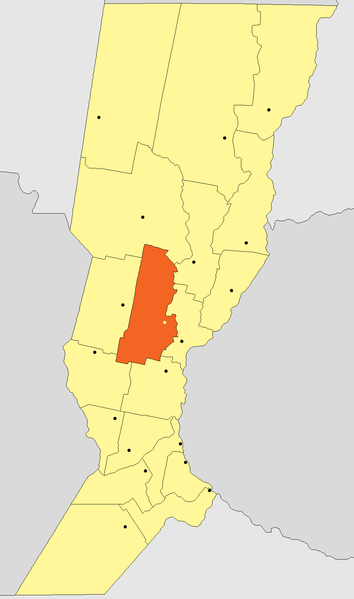 Esperanza was the first town in Argentina to be founded as an agricultural colony with immigrants from Europe, sponsored by an official colonization program. Colonies like this brought waves of Germans, French and Swiss to Entre Ríos, while Justo José de Urquiza was the local caudillo and the President of the Argentine Confederation, and then to the central area of Santa Fe, which is dotted with little towns. The name "Esperanza" even looks intentionally auspicious — it means "hope". Nowadays Esperanza is the head town of the Las Colonias Department, a rich area that produces a sizable proportion of Argentina's dairies.
A faction of the Radicals, led by a couple of political parasites who've never been elected to anything or had any political power outside the party bureaucracy, are against Binner and Tessio. They need Binner but they wanted their own candidate — first they appointed Fascendini, now they want another one elected in primaries. They may take the issue to court so that Binner and Tessio are forbidden to use the name "Progressive Front" in their ballots. Strictly speaking, Binner did violate an agreement with the Radicals; it turned out OK, the campaign is going ahead and all, but the formal Radical Party structures did not accept the fait accompli.
Santa Fe's Radicals have a tendency to split over small matters, basically following individual leaderships. Will these guys, with legal but not consensual authority, end up proclaiming a governor candidate of their own? The poor guy would be doomed to wither in solitude and lose, but he would divert some votes from the Socialist-Radical alliance. The Peronist candidates are more than a few votes behind, but not impossibly far behind.
The Peronist provincial government has started throwing money around — millions and millions to repair schools, to upgrade hospitals and healthcare centers, to pave roads, to beautify small towns — things that should've been done during the three years since this administration took office, in a consistent, regular way, not as a extraordinary pre-electoral show. It's disgusting, this spectacle of a governor and officials appearing in a virtual partisan rally to deliver a large check to a hospital so it can buy a few shiny expensive items while HIV+ patients can't get their drug cocktails in that very same hospital because the provincial bureaucrat in charge is on vacation, and while the healthcare centers that send patients to the hospital don't have computers, full-time nurses, or a regular supply of toilet paper.
I can't say for sure this is going to change if the politicians change; I can't believe it might be worse than this.
18 December 2006
Schizo politics
Inspired by the curious characterization of Buenos Aires as a blue province in Good Airs, motivated in turn by Mike's push for an Argentine branch of Democrats Abroad, my mind turned to politics (again) and I decided to write about politics (again). Bear with me. I'll leave you Argento-Democrats alone. Just keep a low profile and try not to get Kirchnerized.
A visual image can be helpful understanding current Argentine politics. Imagine a political party is like an icecream flavour. You visit the United States, check the fridge, and there you have a chunk of icecream, half strawberry and half chocolate. The chocolate is strong, bitter, and has a lot of nuts in it. The strawberry is creamy, with a diversity of suspicious sparkles on it, and (until very recently) rather soft. Go to the Vatican, and you have a splendid white cupful of a single flavour, which might or might not be lemon-based; somewhere at the bottom of the cup there's a chunk of strawberry but the flavour is mostly lost. Go to Israel, and you have a huge cup mostly filled by two types of chocolate (these can be found also in Palestine, although of course both will deny they are the same brands of chocolate). Take Bolivia, and your icecream consists of a portion of mixed flavours topped by (and buried under) a gigantic serving of something that looks like chocolate but smells of old money; it's melting, but the bulk of it remains firm.
Argentina as an icecream is like one of those oversized frozen desserts you get for a child one he's being naughty and demands to have the largest icecream on Earth or else..., one of those supercups he'll attack with enthusiasm as first, then play with, and then abandon once his tummy is half-full and his lust for sugar is quenched or diverted to less sedentary pursuits. Picture one of those super-desserts, half-eaten, mixed and turned over, and then left to melt for several minutes in the summer. That's Argentine politics icecream-style.
You may think that this humorous portrait focuses on the chaotic nature of politics and ignores important factors such as ideology, pragmatism, and opportunism. I think it simplifies the issue. It's crucial to understand that no two political parties or factions in Argentina are guaranteed to stay apart forever. Moreover, most individual parties are like ever-active amoebas, their contours malleable and shifting all the time, and their selves always ready to divide, usually with some mutations.
Note, though, that unicellular organisms divide when they've grown enough, while many political parties in Argentina seem to do exactly the opposite. In particular (since we're doing the similes now) the Argentine left can be equated to a box filled only with electrons: everyone in there has a negative charge and seems unable to stay close to the rest. Some leftist parties seem content to exist in the highly scattered state that results (popularly known as ser cuatro gatos), while others do the evaporating black hole act: they emit increasingly louder complaints as they become smaller, and finally explode.
A few right-curious leftists are attracted by the other political forces and end up there, usually serving as decoration (cf Chacho Álvarez) or doing the dirty work (cf Luis D'Elía). As they speak up or prove uncontrollable, they either get fired or leave in a righteous spasm of honesty.
So why am I writing about the left after all? It's a very special day when two leftists meet, stick together and don't attack one another over minor interpretations of abstract concepts nobody cares about in real life. This is the case, for example, of Hermes Binner and Elisa Carrió. One understands that Binner, the Socialist former mayor of Rosario, national deputy and candidate for governor of Santa Fe, has nothing to lose and maybe a few votes to win by getting the support of Carrió's ARI, which she founded as (basically) a way to tell all other politicians in Argentina that they're immoral, corrupt and UNCLEAN!!; Carrió is moderately strong only in Buenos Aires City, where people actually have the time to listen to her ramblings, so it is a bit ridiculous of her to come with open arms to Binner saying that she'll support him "in exchange for nothing". Binner, who hasn't yet chosen a vice-governor candidate or formally started the campaign, leads the surveys and seems ready (without outside help) to become the first Socialist governor in the history of Argentina, and the first non-Peronist in Santa Fe after 23 years of a series of truly horrific administrations, with rulers whose best achievements have been to escape justice, to do nothing, to appoint relatives as judges, and to cut the ribbons of unfinished public works.
This was supposed to be a short post... But I'm not done! I'LL BE BACK!!
28 September 2006
Politics personals
"I want someone from Santa Fe -- and if it's a woman, that's better." Sounds like a bi-curious personal ad, but no: it's Hermes Binner, candidate of the Progressive Front for governor of Santa Fe Province in the upcoming 2007 elections. Binner, a national Deputy and former mayor of Rosario (twice), is the figurehead of the Socialist Party and knows that he calls the shots, being the only one with real chances to win now since the Peronists (in a long-awaited but still surprising self-foot-shooting act) allowed the Ley de Lemas to be repealed. However, the Socialist Party is not extremely strong outside Rosario, which with 1/3 of the voters in the province is not enough to win the election; therefore, they've had to ally with the Radicals. These guys, who by now only deserve their name because of the radically messed-up state in which they left Argentina in recent times when they were in power (twice), have a few characters among them who feel cocky enough to challenge Binner to accept that they, and only they, will choose Binner's companion candidate for the vice-governor's office.
When Binner first stated his choice, the Radicals ignored him. Radical Senator Carlos Fascendini said that, regardless what Binner "may have said", they'd choose. Then he also said "The candidate to vice-governor is me." Fascendini is a man, which is not that important given Binner's bi-ness, but he's from Esperanza, not from Santa Fe City, so maybe there'll be trouble. Or maybe not; it's still a year from the elections, and that's close to eternity for ever-changing Argentine politics...