Inflation, sir? No, thanks. The media are gloating over the scandal caused by the government's alleged interference in the measurement of January's inflation rate by INDEC (the National Institute of Statistics and Censuses). But first, some history.
Inflation is the historical archenemy of the Argentine economy. Back in 1989, president Raúl Alfonsín was forced to resign after food riots caused by hyperinflation. In 1991, Carlos Menem brought Domingo Cavallo to the Economy Ministry to fight inflation; Cavallo froze all bank accounts for 180 days, and thus halted the multiplication of money in circulation and stopped financial speculation and inflation, causing some prices to drop by 50% overnight. Then Cavallo came up with Convertibility, which effectively turned over the control of monetary policy to the U.S. Federal Reserve... and brought 12 years of almost zero inflation, and a few instances of deflation. Inflation exploded again when Convertibility was abolished in 2002, but it was just that — not a hyperinflationary catastrophe.
From 2003 on, the government decided that it wouldn't "cool off" the economy, which was expanding at an accelerated rate, so Argentina's inflation rate has been greater than that of most other Latin American countries and "normal" stable economies, around an annual 10–12%. Workers' salaries and companies' profits have recovered; the downside is that there's so much money flowing in the system and so little incentive to save (interest rates are ridiculously low) that everybody except the poorest of the poor is spending like crazy: cell phones, air conditioners, cars, clothing, plasma TVs, tennis shoes, home theaters, MP3 players, tourism packages...
So what's the problem now? Ten-percent inflation is rather high in international terms, but it's not that much when GDP is growing at an annual 9%. The labour unions are strong and the government is prodigal, so private and public sector wages are keeping up, more or less (in fact they recovered 8% over inflation last year). Price controls leave holes everywhere but they're effective overall.
The problem is, Doña Rosa feels that the inflation rate as measured by INDEC is not real. INDEC goes around each month, looking at the prices of a basket of 8,000 products that (ideally) make up a representative sample of citizens' consumption patterns. If a product's price doesn't increase during a given month, it'll bring down the rate in proportion to its statistical weight — and the basket includes items like tourism and canine grooming, which are not exclusive of the filthy rich but are certainly not within reach of many lower-middle class families. Naturally, the weight of such items is very small, but the media and the opposition made so much out of it that Doña Rosa is now convinced that the IPC (Price Consumer Index) is fabricated. Luxuries like canine grooming and imported LCD screens are expensive, but they've been expensive for a while, so their prices won't move, while basic needs like tomatoes, jam, chicken and T-shirts go up and down all the time (always more up than down) following seasonal effects, unjustified maneuvers of the producers, and a myriad other causes.
The last stroke was the sudden replacement of the head of INDEC by another person, just before the announcement of the January inflation index. The opposition, the media (even abroad), and the consumer organizations pounced on that — why was a long-time, respected official of one of the few government organizations with a reputation of flawless political independence replaced overnight without a clear cause by someone chosen by the national government? Could it be because private analysts were foretelling that the January rate would be over 1.5%? In 2006 it was 9.8% — was that because the government pressured INDEC to produce a number below the (psychologically important) 10% that the Economy Ministry had publicly set as a target? For how long exactly had the government tried to fool the public? And so on.
INDEC has, as I said, a reputation of independence and of methodological quality that has been acknowledged here and by international organizations. That reputation has been now tainted. After the dismissal of its top official, a number of employees denounced the government's interference and announced they'd monitor the figures closely, warning that they wouldn't let them be tampered with. The vociferous de facto speaker for the president, Minister Aníbal Fernández, spoke of "mafias" and accused the employees of having an agenda. Security personnel surrounded the seat of INDEC and the figures of inflation (the PCI and the inflation on a basket of basic products) were released later than usual.
The Kirchner administration reacts to accusations with paranoia and verbal excess; the inarticulate and generally sleazy opposition, and our lowest-common-denominator mass media, arguably deserve such a treatment... but I believe that someone should strive to stay in the high moral ground, so I can't justify that, no matter how much in agreement I may be with K in other issues. If you're right, you don't need to scream about it — reality will prove you right in the end.
The net result of this is that now nobody believes INDEC's inflation rate. This is serious not only in itself. We've emitted inflation-indexed debt bonds; those bonds fell abruptly after the scandal, as consultants recommended holders to sell. The country risk index assigned to Argentina by JP Morgan jumped more than 6% — that means Argentina will pay more interest for loans, as it's a riskier investment to lend to us.
Prices will continue to rise, as ever, independently from the fate of INDEC and the meddling of the national government. The possibility of runaway inflation seems remote now. Ultimately it's us consumers who can exercise control, by not buying obviously overpriced goods. Why don't we see that is a mystery.

08 February 2007
Inflation inflated

 Stumble it!
07 February 2007
Joggin'
One of my jogging buddies dropped off for more than a week as he suffered and recovered (he's still recovering, in fact) from an intestinal infection (nasty stuff — I'd never seen such a big guy forced to dine on just two cereal bars)... and there are only two of us left now, so we changed the route to better suit our comfort. The path that went along the coast around the city center was closer to poor Mr. Quick Guts' home, which we used as a base; now that's he's not with us (temporarily) we've moved to the north. The first time we jogged by a recently opened avenue that communicates the northwest part of Rosario (including my neighbourhood) diagonally with the center-north coast of the river, bordering the (also relatively new) Scalabrini Ortiz Park, and then we continued north along the Costanera up to the Contemporary Art Museum (MACRo), a simple structure built on former grain silos painted in several hues of blue, pink and purple. A lot of people go jogging or take a stroll for sport, or for fun, or walk the dog, in this circuit.
The next time we started directly at the coast and went past the MACRo until the area near the old Rosario Central train station and the Parque España. This was all abandoned railway and port facilities a couple of decades ago, but the station and its annexes have been refurbished, turned into exhibition rooms, museums, a children's entertainment center, and a Municipal District Center. The park has a huge parking lot, statues of famous musicians, a promenade, a private school and a culture center; it was all sponsored by the Spanish government. A couple of years ago part of the paved elevated shore broke and sank into the river, so a wide strip of the park is closed off pending full repairs (which will cost gobs of money — the national government promised it'll pay, and we're still waiting).
Finally, yesterday we went jogging again, and this time I chose the place: the coastal circuit starting at the Leandro N. Alem Park, near the Gigante de Arroyito (Rosario Central's football stadium).
This time there were really crowds — lots of younglings and a miscellanea of young couples holding hands, veteran athletes, older guys and girls trying to recatch their health, a few groups of teenagers and 20-somethings training (football semi-pros?), some running around, others stretching in the grass. Further north we entered Alberdi and passed by a couple of hip bars, a stylish gym next to a disco that I used to attend, and a few nautical clubs. The river was not crowded, maybe because the sun was already setting and the wind was considerable; in better conditions the wide Paraná is dotted by kayaks, sailboats, windsurf tables, jet-skis, and the occasional yacht, sometimes watched from above by gliders. We stopped at the Bajada Puccio (the place where Puccio Avenue goes down to meet the Costanera, and the focal point of young summer fun in Rosario), caught our breath, stretched a bit, then went back jogging to the park, and then a bit more around the Gigante stadium. Fortunately for us, it hasn't been terribly hot lately; before the sun sets, a cool breeze blows from the river.
It's still difficult for me to keep a suitable jogging pace. I paused and walked in mid-way for about a block's distance, half because my legs were tired, half because I had no breath left. In general, for someone as un-athletic as me, I'd say that's perfectly OK. As a plus, my legs don't hurt at all, and I'm not excessively tired — it seems it's more a problem of resistance and metabolism than actual physical inability. The only "downside" is that I feel ravenously hungry all the time since I started the gym+jogging routine. That's certainly not a problem for me!
06 February 2007
Everybody hates oil?
 Biofuels are suddenly all the rage. Even the Dumbest Texan has acknowledged that the United States needs to research fuels produced from crops rather than extracted from ancient fossile reservoirs. Maybe he realized already that investing in the invasion of oil-rich countries does not yield the returns everybody thought they would. The U.S. is also engaged in talks with Brazil and other countries (not Argentina) to coordinate the production and trade of ethanol made from corn..., and stop paying astronomical fuel fees to the Venezuelan state oil company and from there to Hugo. In the meantime, some are already warning that the U.S. may begin importing corn from us to make ethanol.
Back down here, it just so happens that South America may be the place everyone will look to when thinking about fuel... just as Argentina is close to becoming a net importer of oil. We do have a lot of it buried somewhere, but the oil corporations haven't bothered to explore and/or extract it for years, since exportation is taxed and restricted, and the internal prices of oil derivatives have been frozen since the economic collapse of 2002. Of course, this can't last much, but big corporations are dominated by short-term interests. On the other hand, all that untapped oil may come in handy one or two decades from now...
Anyway, with oil being so expensive worldwide and local reserves unavailable, it was only a matter of time until people here had the idea that our veritable oceans of vegetable matter could serve to purposes other than feeding our cows, us, or the Chinese. Soybean is a good source of oil that can be used as fuel, but it may not be commercially sensible to burn it, and there are environmental costs along with it. There are alternatives, though.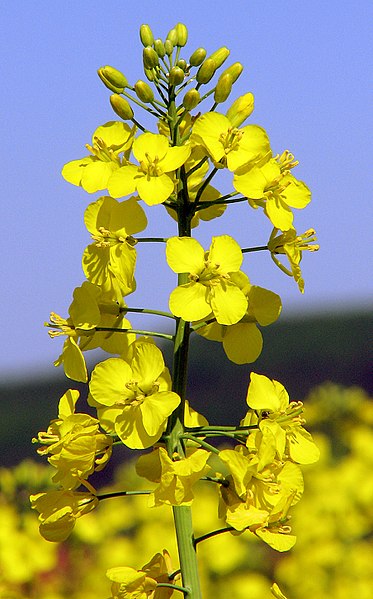
In Salto Grande, central Santa Fe, a rapeseed-based biofuel plant is about to open. The idea is mixing rapeseed oil with regular diesel (fuel oil) and save 30–40% in fuel costs. It has the added blessing that it will encourage the plantation of rapeseed, avoiding the monoculture of soybean.
Several companies in Santa Fe (petrochemicals, vegetable oil processors, even the former state-owned ensign oil company Repsol-YPF) are planning to build new facilities or even to open new production departments. Smaller companies are already producing biodiesel from various sources (such as sunflower oil) to supply the local markets.
You know how I like to speak badly of our disastrous provincial government (see? I just did). This commitment with biofuel production is auspicious and I hope it turns out right, because it's one of the very few good things this administration has done. Of course, it's rather late, the new biofuel-promoting bureaucracy will cost much and do next to nothing, and the actual effort will be that of the private sector, which is (fortunately) dynamic enough to catch and ride this wave, if only it receives a few tax breaks and soft loans.
You may say I sound too optimistic and overly pessimistic at the same time. That's perfectly logical. These are prospects nobody has presented in science-fiction movies and books about the near future. Instead of cold fusion, cooking oil? At least we already know it burns.
05 February 2007
El laberinto del fauno

(By the way, if you're in Rosario and you want to see a movie at the Showcase cinemas in the Alto Rosario shopping mall, consider the time and day, and be there one hour in advance. The ticket desk is slow and understaffed, and brand-new films are assigned to only one projecting room, which naturally fills up quickly. The projection times tend to be awfully distributed during the day, too. I have other complaints to nag about; be patient.)
My original intention was watching Babel, which has just been released here. I have no idea what it's about yet, so don't tell me, but the trailers seemed interesting. But the room was almost full, so me and my friends decided to wait and watch El laberinto… one hour later. Since Alto Rosario is located in the middle of nowhere and it was beginning to rain, we had no choice but to sit down in one of the bars inside the mall.
(Shopping malls are bubbles of artificial shiny wealth filled with people wandering glossy-eyed among overpriced merchandise and avidly eating junk food with their children. Did I already mention I hate them?)
El laberinto del fauno is about (don't worry, no major spoilers) a little girl's story during the Fascist-Republican struggle after the Spanish Civil War, as her pregnant mother takes her along to live with her new husband, a Francoist military, in a countryside camp. Little Ofelia loves fairy tales and believes in them. She's contacted by a faun, who serves as a messenger of the Fairy King, her real father. The faun gives her instructions so as to fulfill her destiny as a princess. In the "real" world, her cruel stepfather seeks to destroy the Communist resistance in the woods and cares for his wife only as a vessel for his unborn son, who'll carry his name. The two stories are joined by a coincidence of place and time (if there's a deeper relationship in the plot, it's so well hidden I didn't notice), but they mingle well and the result is spectacular without resorting to excessive special effects, sentimentalism, or uncalled-for dramatic dialogue (i.e. the Hollywood standard). The actors are strong, their characters well-defined, the plot firm and easy to follow.
The movie is rated PG13 (or rather its equivalent). There are more than a few graphic scenes of physical violence (beating, torture, killing) and purposefully unsubtle instances of psychological violence. Regrettably, it's nothing a 13-year-old in a "normal" environment in today's society hasn't probably witnessed before. These scenes are well-placed, mainly underscoring the inhuman character of the Francoist commander and of war in general. Some of the "fairy world" scenes are rather creepy as well.
A number of truly dumb parents took their kids (ages 8 to 12, I reckoned) to the movie. Now, it's a terrible thing that movie theaters in Argentina don't exercise any sort of control over who's allowed to see what, but ultimately it's the parents' responsibility not to expose a 10-year-old to such things as graphic depictions of the results of a torture session. Besides that, don't you morons read the movie summary or a review before you choose to watch it? How do you choose? Are you so stupid you see a funny-looking goat-faced monster in the movie poster and you automatically assume it's a kids' movie? I hope you witless parents at least had the sense to leave when the blood started.
El laberinto… finished rather late, which was good since the rain had stopped. All in all the movie was very well done and I don't regret I had to substitute it for Babel..., which I'm going to watch during the week, I guess. I'll tell about it then.
04 February 2007
Here comes the water
With all the fuss about the recognition that climate change is man-made, the Argentine media manufactured their usual lightweight news to alert the people that, indeed, we've been so careless that pollution is suddenly causing Buenos Aires (and some other less important places, such as the rest of the country) to be hot as hell. Doña Rosa* feels reassured, since this is what she's been saying all along.
* "Doña Rosa" is Bernardo Neustadt's mildly elitist personification of (the lowest common denominator of) public opinion. If you weren't in Argentina and at least in your teens during the 1980s, just forget the reference.
The good news is that the IPCC's report has been so widely publicized that nobody can ignore it anymore (we hope). Of course the denial freaks up there in the United States (mainly), who insist that global warming is a pinko/hippie myth created by the New World Order minions of the UN, will keep to their belief, but sensible governments, and even George W. Bush, will now have to respond to extra pressure on the issue.
On the local front, climate has indeed been erratic and tending to the extreme, as you can see by reading some of my posts.  If you allow me to sink to the level of anecdotic evidence (Telenoche passes that for evening news all the time, so why not me?), I'd never seen such weird weather before the 1990s. Back in school, we were told that Rosario was in the Humid Pampa, a fertile plain with temperate climate and four distinct seasons. That seems to be changing now. Winters are shorter, with a few scattered occurrences of week-long cold spells, and no rain at all. In the summer, you have several days of increasing temperatures up to a point where hell breaks loose and terrible storms bring winds, rain and hail in massive amounts; then the sky clears and the cycle repeats. Spring is prone to rain and hot as well, and autumn is brief, windy, unstable, but much less rainy that it used to (ten years ago in April and May, you couldn't go out without an overcoat and/or an umbrella). The whole region seems to be shifting toward a subtropical climate with two seasons: dry and rainy.
As of now, the north of Argentina is getting a lot of precipitation. People got flooded in Salta and Tucumán, and downstream along the course of the Salado River, in Santiago del Estero, a dam broke, apparently not because it was badly built (as it always happens) but because it simply wasn't designed to contain that much water. It's also been raining a lot in the upper course of the Argentine portion of the Paraná River (around the Iguazú Falls), and all that water is coming down. In Corrientes, the capital of the province of the same name, 1,000 families in 17 barrios of the city have been affected, 100 people have had to be relocated, and the level of the river is expected to increase even more. The experts down here estimate that that flow will reach our area in about three weeks, and the level will rise by 40 cm, enough to cause some trouble in the islands off the coast of Rosario in the flood plain of the Paraná (see? that's why they call it a flood plain). The farmers are already moving their cattle to safer places, since the islands are rather low-lying. On this side, the river will flood half the sandy beach of La Florida, but nothing more. The good thing about Rosario is that the Paraná cannot flood it because it's built on higher terrain; rain flows naturally away from the center and off an abrupt natural ravine.
In the meantime, a heat wave has been hitting us for a week, and it was supposed to end today with a heavy rainstorm, but yesterday afternoon the sky turned overcast, cool gusts of wind blew for a couple of hours, and only a few drops fell here and there — we're cloudy today, and rather hot again, though it's bearable. My parents got married around this time of year, 31 years ago; I guess nobody would set that date today — you might get a scorching sunny day just as well as a tropical storm...
02 February 2007
The 2007 campaign
The campaign for the governor election in Santa Fe is getting hotter... or should I say the pre-campaign, since there are formally no candidates yet, no parties or alliances already in the register that must be compiled months before the election.
Before you go away, I may as well explain why this is important. As anybody who's been living under a democracy for a while knows, elections almost never change anything — 99% of the times it's the same people or their clones trying to get you to vote for them with all sorts of empty promises, oblique threats, lies, lies, more lies, mud-slinging, sentimental pleas, appeals to your pocket or your ethics, etc., and once they're elected they resume their daily routine, some jobs and titles exchanged for others. Well, this might be one of the 1%.
The reasons:
- This is the first governor election since 1991 without the Ley de Lemas. I'll spare you the details here. The Lemas electoral system allowed Peronism to steal the election twice.
- The established Socialist candidate, Hermes Binner (twice mayor of Rosario), is leading the surveys. If he wins, he'll be the first Socialist governor in the history of Argentina.
- The established Peronist candidates are both linked to Rosario as well; one was born here (though he was exiled in Europe and then moved to Buenos Aires) and the other has lived and made its political career in Rosario since his youth.
- Given the two points above, the next governor of Santa Fe is practically sure to be a man of Rosario, ending (we hope) a long string of rulers that have consistently economically and politically discriminated against the largest and most important city in the province. This might lead to a better share of funds for Rosario, and to the attainment of a long sought after dream: municipal autonomy, à la Buenos Aires City.
 In 1995 came Jorge Obeid, who stole the election from the Radical Party candidate Raúl Usandizaga by adding up the votes of the sold-out ex-Socialist Héctor Cavallero to his own using the Ley de Lemas. In 1999 Reutemann was re-elected. He oversaw a horrible crisis with a straight face, survived a couple of scandals, and in 2003 again he left the post to Obeid, who has since devoted his time to visiting Cuba, inaugurating unfinished public works, and appearing in pictures with President Kirchner.
All this time the province has been stumbling through history, guided by an automatic pilot. Its much-touted record fiscal surplus is more a product of automatic taxation on its immense wealth than a sign of good administration, and its progress in later years can be directly attributable to the overall recovery of Argentina, even moreso as it's powered by the export of agricultural commodities. The public sector is bloated and inefficient, the judicial branch is full of dark, corrupt judges protected by the political establishment, the ministries and secretaries are occupied by political operators without skills, policies and their application are irregular, episodical, never fixed, and oriented to the spectacular and to the populist.
Is that different from any other provincial administration in Argentina, or from other local and national governments in the Third World? Probably not. Can it be easily improved? Undoubtedly yes. Will it improve if the party in power changes? Probably, judging by the results that the Socialist administrations have produced in Rosario since 1989, and especially since the degradation brought about by almost a quarter of a century of Peronist rule is due mostly to stagnation and to the naturalization of bad habits.
The two main Peronist candidates are now at each other's throats, as usual; it's not that they have ideological disagreements or fight over policies (what?), but they want power and they can't both have it. Binner watches from afar and has but completely forced the hardliners of the Radical Civic Union, his allies, to choose the vice-governor candidate that he likes, the extra-party Santa Fe federal prosecutor Griselda Tessio. Isn't that nice?
01 February 2007
Curious Argentine exports
Argentina is doing extremely well in the field of international trade since the end of the fixed peso-dollar exchange era (we might as well call it "Post-Convertibility Era", or PCE, as opposed to "Convertibility Era", or CE). This is due to several factors, first of all to the high exchange rate, with an extremely devalued peso that the monetary authority (the Central Bank) struggles to keep that way (as I explained in an earlier post). The second factor is the ever-increasing demand of commodities from the monstruous Chinese economy, whose GDP is growing at an annual rate of 10% (that means about 7 years to double its size).* China demands precisely one of the things we're best prepared to produce in large amounts: soybean. Other developing countries are doing well and buying our stuff, again, especially soybean (one quarter of our foreign trade by value is made up of that!), so that's the second reason.
The third reason is that Argentine producers and exporters have made an effort to upgrade their facilities and processes, to meet international regulations, and in general to increase their quality. Of course, they're doing it now because it pays to do so, unlike before. Also it's not like quality is less important than price — it's just that, without a good price, nobody will buy your products no matter how well made.
The above is not surprising. What I found interesting is that Argentina is in fact exporting other stuff. We all know about the wine, made possible by the special climate of Mendoza. The small cities in the fertile plains of southern-central Santa Fe (places like Armstrong and Las Parejas) have succeeded in finding a foreign market for agricultural machines. When someone lives in a sea of cereal crops, you tend to pay attention to how they take advantage of that. The north-eastern provinces (especially Misiones), of course, export yerba mate not only to places where Argentinians (and Uruguayans, Paraguayans and Brazilians) may abound, but to the Far East. I heard of a small shop in Buenos Aires Province that exports frozen medialunas (not croissants, but Argentine-style medialunas) to the United States.
The weirdest things are the ones not paid for in foreign currency, the ones that are not commodities or manufactured goods, but services and ideas. Argentina was the initiator of the Cascos Blancos ("White Helmets"), a humanitarian force that works with the UN. Our country has always exported and promoted initiatives about human rights, peacekeeping, and international conflict resolution... Ironically it seems we exported so much of it that we left none of that for ourselves, but that's another matter. Recently I learned that the government of Argentina is about to send economic experts to Ecuador, to help that poor country refinance its external debt, using the experience gained by Argentina. (I refer to Ecuador as "poor country" not condescendingly but with sympathetic pity — they went through problems similar to ours, and their president was a Carlos Menem clone who actually got his way.) The idea is that Ecuador can be empowered to reject part of its debt as usurary and unpayable, like we did. With a new president that is not a Harvard-trained puppet, things may be better for them.
And there's no need to tell about Argentina's copious exports of young brains, which end up often discovering or inventing really interesting stuff, turning into honoured scientists, and even getting Nobel Prizes. Ah well...
* In case you want to know how I calculated this: GDP growth accumulates over the growth of each year, much in the way your savings grow if you add the interest you get from them to the main account. This growth is expressed by the mathematical formula of compound interest: r = (1 + i)^n, where r is the number you have to multiply the initial amount by, i is the interest rate (expressed as e.g. 0.03 = 3%), and n is the number of periods you count (if the period is in years, the rate should be an annual rate, of course). We want to find n, the number of years for a given amount to grow by a certain factor. Since it's a power exponent, we have to use logarithms and apply one of its common properties:
log(r) = log((1 + i)^n)
log(r) = n * log(1 + i)
n = log(r) / log(1 + i)
Now, since we want to find out the time it takes for the amount to double (r = 2) under a rate of 10% (i = 0.1), we can get this immediately (using a calculator for the logarithms):
n = log(2) / log(1.1) = 7.27
31 January 2007
The secrets of Isabel Perón
If you've been following the news, you'll undoubtedly know that judicial proceedings are being started (or resumed) to investigate and punish criminals of the Dirty War, particularly a number of military and police officers that did such nice things as running illegal detention centers, overseeing and conducting torture sessions of political prisoners, and the like. The first of these was Julio Simón, aka "El Turco Julián"; the second was Miguel Etchecolatz. The trial of Cristian Von Wernich, a torturer priest and chaplain, is another example, as well as the arrest of the former Navy officer Alfredo Astiz, "the Blond Angel of Death".
The Dirty War, however, did not only include the crimes committed under the dictatorship that began in 1976. Its preliminaries can be located already under the third term of Juan Domingo Perón, which began in 1973 after his return from exile and was interrupted by his death in 1974. Peronism had a populist-corporatist ideology that could and did host extremely diverse factions, ranging from the far-right to the leftist-Catholic Montoneros. Perón played the political game with these factions more-or-less easily, even as he became old and physically weak. When he died, however, government was left in the hands of his wife Isabel Martínez, a spineless idiot who was easily manipulated by the dark characters in Perón's inner circle. To cut a long story short, as the rule of Isabel unfolded, right-wing death squads (beginning with the AAA or Argentine Anticommunist Alliance) took their conflict with left-wing movements and their fight with politically subversive elements to the streets. The result was (from both sides) bombings, kidnappings, and a general sense that the country was going nowhere — since Isabel was incapable of handling it. Thus, the solution: a coup d'état, led by the military, supported by the upper classes, the right-wing nationalist Catholic establishment, and the forces in Argentina and abroad that feared Socialist/Communist expansion, such as the local landowners and the U.S. government. The lower classes were persuaded by the threat of increasing violence, and later distracted using the circus of the 1978 FIFA World Cup, among other things.
After the restoration of democracy, the military have often demanded that "the others" be judged as well. In truth, the misleading word "war" in "Dirty War" was coined by them, implying that the military and the police (the forces of order) were conducting a war against a formally defined enemy, the subversives (the forces of anarchy and lawlessness). The term has stuck, even though it's incorrect, and even as the left has often directed its verbal attacks toward supporters of the so-called "theory of the two demons". It's clear that this wasn't a war, but a systematic plan of extermination of dissidence and a scheme of state terrorism to subdue the masses (getting to that "officially", out of the mouth of a judge in a formal sentence, took no less than 30 years). "The others", the leftist insurgents that blew up buildings, kidnapped, tortured and assassinated people, had been in some cases tried by justice.
The news here is that a recent investigation has been directed at the role of Isabel Martínez de Perón in the beginning of the "war" against insurgency. Not long after Perón's death, Isabel and her cabinet signed a decree ordering Argentina's security forces to "annihilate" subversion. In view of some, this was a thinly veiled authorization (and certainly a clear post facto legitimation) of the illegal repression that ensued. The decree did not mention the AAA, of course, though its ties with the Peronist establishment were notorious. However, it's interesting that the military who overthrew Isabel pretended to do so not for ideological reasons (anti-Peronism, as in 1955) but under the guise of bringing back order that Isabel was "unfortunately" unable to maintain; that's why they dubbed their dictatorial rule "National Reorganization Process".
Since Isabel signed the decree and it was José López Rega, one of Isabel's ministers who organized the AAA, judges are now investigating her responsibility. In Argentina, the Constitution expressly forbids using the Armed Forces to repress breaches of law and civil unrest; the military exist to provide defense against external threats. Isabel's decree, besides violating that principle, in a way equalized internal violent dissidence (which it was) with a threat to the state (which it definitely wasn't).
Isabel Perón lives in Madrid, Spain, since she chose to exile there. Two different judges are investigating her, on a forced disappearance case that took place before the coup and in connection with the Triple A. One of the judges has required that she be extradited to Argentina. As an interesting (if pathetic and depressing) display of Argentine political culture, signs with the inscription NO JODAN CON PERÓN ("DON'T MESS WITH PERÓN") have appeared in Buenos Aires; they're attributed to a certain Peronist labour union, whose leaders are offended by the idea that anything related to their unofficial saint patron, Juan Domingo Perón, could be tainted by association (or proof of involvment) with the extremists of the beginning of the Dirty War.
Quite tellingly, the national government, led by a leftist-populist Peronist who has consciously rejected the liturgy of Peronism (big posters with the faces of Perón and Evita, constant quotations of Perón's sayings, untuous expressions of loyalty to Perón's mythical figure), has stayed almost silent on the matter. This is an executive branch that has an opinion about everything, even if it means notoriously intruding in the turf of other branches of government, but it's understandable. With the re-opening of old, unhealed wounds of Argentine history, Kirchner's administration has also re-kindled political debate inside its own party; better wait and see what that can of worms holds.
PS: An interesting article by Héctor Olivera in La Nación, 2 Feb 2007: En los años de plomo, no hubo dos demonios ni santos inocentes. I'm not sure what to make of it, but it's worth a read.
29 January 2007
Hail in Mendoza
Latest news of Argentina include a weather gone absolutely crazy. In the northwest of Argentina (provinces of Salta and Tucumán) it's been raining an awful lot, and the Salado River downstream in Santiago del Estero broke a dam and overflowed its banks, prompting many to evacuate (the Salado is a very long river — it starts up there and ends 1,500 km later in the Paraná River, near Santa Fe City, which it flooded in 2003). Last Wednesday 170 mm of rain fell in Reconquista (northern Santa Fe), flooding several parts of the city, its surroundings and many neighbouring towns in a matter of hours.
Last Friday, the city of San Rafael in Mendoza (a hot, sunny paradise when I was there two weeks ago) was hit by a hailstorm. Anti-hail nets protecting the vine crops were useless against the reportedly fist-sized hailstones that fell for about 25 minutes, and many saw their crops partly or completely ruined less than a month before the National Festival of the Vendimia (grape harvest). This, plus the damages in the city, may add up to about 50–60 million pesos (US$17–20 million). (Incidentally, if you want to know more about Mendoza's hail and wine, try Argenvino. I just discovered it — I was linked from it without my knowledge!)
 (The above is a vineyard besides the Valentín Bianchi winery, not far from San Rafael City, as it was before the storm... I presume it doesn't look like that now.)
Deadly hail seems to have become more common everywhere lately (as you'll remember if you were in Rosario during November's hail hell). San Rafael had been hit already on 31 December 2006 and I seem to remember the area of Mendoza City had had its share a few days before my trip in early January.
Nobody died in San Rafael then or now, fortunately, but the mendocinos are clearly concerned to the point of having developed their own anti-hail rockets. The scientists of the Civil Institute of Space Technology created this rocket to replace the Russian-made devices that were in use before the devaluation of the Argentine peso made them unaffordable — and which were not very useful anyway, since they were designed to target clouds at a height of 8 km, while the typical clouds in Cuyo are above 15 km.
PS: As of 2 Feb, the national government has pledged to help Mendoza with AR$25 million, to be used to repair infrastructure and rebuild homes. Besides the immediate damage, the storm destroyed the fertility of 4,000 hectares of soil, which will be unproductive for 3 years.
26 January 2007
Getting physical
As part of my personal remake, as I told you already, I decided to counter my forceful sedentary habits (6 hours a day before a computer at the office, and maybe 1 or 2 more hours at home) with physical activity. It's a real pain. I'm too old for this, I've never done any sports consistently, and my body is plainly not made for that. I did a fair amount of workout at the gym more than a year ago for many months, with interesting but not spectacular results. I have no gym buddy to keep me from staying home when I should be sweating.
Anyway, I did start the gym (I'm in constant pain!) and decided to go jogging with two friends of mine who also go to another gym every other day. Now these are people who've had training and consistent physical activity at some point in their lives, and they're younger than me, so obviously I can't follow them for long. Fortunately we're friends enough that I can tell them "don't even think of slowing down because of me" and get "we for sure won't!" for an answer, no offence taken. We're doing a short course starting at number 0 of Pellegrini Avenue, going down to the south-eastern tip of the city center, then left (north and north-west) following the curve of the riverside Belgrano Avenue, and ending right in front of the National Flag Memorial. We're supposed to walk then, but yesterday the guys decided they'd try jogging our return as well. So far I've joined the party twice, on Tuesday and Thursday, and that's it for the week.
If I can't go jogging I'll be doing a slightly different aerobic exercise by using my bicycle. I tried going from home to the Japanese Association at a slow relaxed rhythm; it took me 25 minutes, probably more than it should, but considering my state and the horrible traffic, it was excellent; I didn't stop once except at the traffic lights, and then I returned home immediately without resting in about the same time. Moreover, 25 minutes is what it takes me by bus to go Japanese school, if I count an average of 5 minutes waiting at the bus stop. Therefore I think I'm going to use the bike for that when classes resume in March.
Security is a concern; people on bicycles are easy targets for opportunist thieves, and I have to cross a raised railway line surrounded by a small villa miseria. I don't think this will be a problem, though; I'm more worried about my composure when I enter class all sweaty and with a messy hair. Anyway, this can help my health and save money, so I'll make the effort to train during February.
All in all it's clear I can't set my goals too high, or set goals at all, in the manner that other people train to achieve ever longer distances. My goal is to stop the deterioration that is sure to happen at an accelerated pace if I'm sitting at the office, travelling in buses and at home for 10 hours a day. Any kind of physical exercise is appropriate for that... I only need to achieve a balance.
25 January 2007
Rosario bus fee raised

This is not exactly news, though it was unexpected. The municipality just raised the urban bus fee from 0.95 to 1.20 pesos; the 6-trip prepaid card rose from 5.40 (each trip for AR$0.90) to 6.90 (AR$1.15/trip); all in all it's over 25%, quite a brutal hack to one's pockets. The political cost is going to be high. The executive branch (mayor Miguel Lifschitz) asked the Socialist-dominated legislature of Rosario to grant it the power to raise the fee. The Deliberative Council complied at once, eager to shift the political cost to the mayor, who has kept a low profile and a high approval rate. Lifschitz conditioned the fee increase to the results of a study of the costs of public transportation, but it was obvious that the fee was going to go up regardless. The opposition was quick to point out that the delegation of legislative powers was done too fast, during the holiday season (everybody knows nobody pays attention to the news during the summer holidays!), and denounced a previous secret agreement between the mayor and the companies that own the bus line concessions (and that will participate in the re-designed public transportation scheme to be implemented a few months from now). Basic knowledge of realpolitik tells me this is probably true; the companies will not invest in a system that doesn't give them enough profit.
The root of the problem, however, is the combination of last year's huge salary raise for bus drivers (that was presented to the media as the resolution of a conflict between the drivers' union and the companies, but was rather clearly, except for the most naïve, a mis-en-scene to appease the drivers and to get the companies an argument to push for a fee increase) and the national parliament's preference for Buenos Aires City in the issue of subsidies to fuel for public transport — which is why bus tickets in Buenos Aires remain at around 80 cents while the big cities in the rest of the country (Córdoba, Mendoza, and now Rosario) have had to raise them to over AR$1.10, from previous values around 90 cents.
Buses in BA carry a lot of passengers from the impoverished metropolitan area, to be sure, but the cost of living in that area is considerably higher than that of the rest of the country (I'm told a cup of coffee can be around 4 pesos in BA — you can get a medium cup of coffee with milk plus two medialunas for less than 3 pesos in Rosario). Why is the bus fee kept artificially low in BA? BA has trains and a subway, and of course people there have many more cars and many more taxis available in proportion (BA has a taxi per 80 people — Rosario has about 1 per 350 people). Moreover, with a national government that constantly pressures private companies and interferes with the market to keep the prices of basic products depressed, what sense does it make to let public transportation become so expensive? An average worker in Rosario may now spend between 6 and 8% of his or her monthly salary just to get to and back from work.
I use the bus a lot (maybe 90 bus trips a month when I'm going to Japanese class); despite my willingness to exercise, I just can't go to work on foot or by bicycle; it's too far away and I can't possibly wake up even earlier than I do now. I can pay for the difference, but I shouldn't. My bike got out of repairs just yesterday and I think I'm going to start putting it to use...
Meanwhile, the transport officials of the municipality say the bus system is working fine and will be even better, the everyday bus users are complaining about the quality and frequency of the service, the taxi drivers want their own fee to be increased even more to compensate, and at least one person is attempting to block the fee increase by a judicial interdiction. The taxi owners are also complaining that they will have lots of work because the bus won't be advantageously cheap enough (what do you call a businessman who complains because his product has a large demand?).
24 January 2007
What vacations can do for you
These vacations did for me what the New Year does for many: they prompted me to rethink certain aspects of my life and to adopt certain resolutions with a clearer mind. Breaking the daily routine is a must for me; it's only then that I fully realize how much I'm entangled in it. I came back with a different view of time (personal time I mean). Time is not something to be worried about, but it is also not something to waste. Your opinion on what "wasting time" means may differ from mine. I consider it a waste of time to do only one or two things in your whole day. I consider it an awful waste to worry about waste. I've been guilty of both types of waste.
Vacations are (ideally) a few days or weeks when you get to balance the objective need for some planning and scheduling with the subjective need for disorder and spontaneity. Too much planning, and you get your typical Argentine vacations in the Atlantic coast or the oversold parts of Córdoba, where people wander around feeling they're enjoying a leisure time when in fact they're walking paths already drawn by the huge machinery of touristic industry. Too much spontaneity, and you eventually find yourself in the middle of nowhere, with nothing to do, and you either go home or spend whole days sipping mate and/or playing cards.
In Mendoza I discovered (or re-discovered) both the pleasure of strenuous physical activity and my almost complete lack of physical aptitude, which I undoubtedly owe to bad genetics but also to a sedentary job and lifestyle. There's however much room for improvement, and that's one of my resolutions. I got back to my old gym on Monday, and went jogging with a couple of friends on Tuesday. I don't like the weightlifting exercises at the gym; I'm past the age when you can easily develop muscle mass, so I won't get suitably encouraging results. I don't like jogging either; I'll walk any number of blocks at a good pace, but my aerobic capacity is limited, and I hate being overtaken by the other guys and girls in the jogging course. I don't care. I hope I can keep my resolution up for at least a few months, but even that is a long-term commitment. If every day I manage to make my body perform some effort, I'll be glad. In Mendoza I also found a cooking buddy in one of my companions, who was before just a going-out friend and a fellow roleplayer. He makes an excellent tomato sauce and had a few tips for me regarding that and other delicacies. I don't think he learned much from me in return, but at least he says the experience rekindled his cooking hobby (and his appetite — something I've personally never lacked). I was left with some ideas I'll be sure to inflict on my guests' palates soon.
Of the unpleasant interpersonal experiences I prefer not to speak. I'll only say I'm finally getting the idea that firmly saying "no" is good on certain occasions, that acknowledging my own whims and proceeding according to them is not necessarily bad and egotistical, and that I should not hesitate to sever ties that I don't need, want, or gain anything from.
And now I'm back home, at work, faced with the same problems and stress that I left behind merely two weeks ago. I wonder how long this feeling of relaxation and renewal will prevail over those things. One can cannot expect to walk on clouds indefinitely.
23 January 2007
Malargüe
We arrived in Malargüe on Tuesday, at noon. We'd been instructed to call the number of the tourist agency from the bus station, so they could pick us up. Soon enough, a truck sent by the agency came by and took us outside town, into the countryside, to our hostel.
In truth I knew this hostel was in the middle of nowhere, and had tried to book a room in the other one (which is near the city center), but they didn't return my mails, so we left Rosario without a place to stay in Malargüe. The recepcionist in San Rafael could not reach the hostel either, so she turned to the other one. We thought it would be a huge problem. If God existed I would thank Her for that "problem".
The Hostel Internacional Malargüe is located about 6 km from the city center, in a patch of farmland with a few horses, a few dogs, lots of alfalfa, and the usual irrigation ditches. When we got there it was made up of two cabins made of cane, mud and wood, which is always cool even under the harsh sun of southern Mendoza, and stays warm in the night. A third cabin was the home of the owners, Johnny and Gaby, who were often in the city. Their younger offspring, a 2-year-old blond imp called Lucas, runs around the place (often with no clothes on) and, surprisingly, doesn't bother anyone, politely thanks you when appropriate, and is obviously not spoiled (this is easily achieved by letting the child watch little TV, giving him lots of natural space to play, and feeding him good homemade meals; or at least that's a start). There are a few solid tables and chairs, a TV and a DVD player (we used it only occasionally to listen to music and to watch an episode of The Simpsons). Roxy and Mabel work in the kitchen. I watched Roxy prepare kilos of bread for the mud oven, and couldn't get Mabel to give me her vegetable-and-chicken soup recipe.
At the head of the hostel, receiving the passengers and arranging everything, are our three informal goddesses, an Austrian named Kim and two Swedish named Lisa and Frida. The picture doesn't do them justice at all. You don't need to be a heterosexual male to appreciate these girls; they're much more than pretty blondes, to be sure, starting by the fact that they came from Europe to a backward and desertic part of a Third World country to work. They speak excellent Spanish, they sit down after dinner and drink beer along with you, they know who to ask when you have a question, and in general they're not your typical ho(s)tel staff.
There was also this sturdy Dutch guy called Jup (Joop?), who was working at the expansion of the hostel (they're making a platform for a kind of outdoors bar, among other things); Santiago, a friend of the hostel, frequent guest, problem-solver, and self-appointed legal representative of Kim, standing between her and her numerous fleeting suitors (a half-drunk porteño actually proposed to her one night — Santiago said "You must arrange that with me first"); and Ramón, who could be seen working all day at his own slow but steady pace along Jup.
On our first day we had no food with us, no time to cook anything (we'd hastily booked a trip to Llancanelo Lagoon at 2 PM), and so we had to rely on the hostel's meals. It seemed a bit expensive to pay 15 pesos for chicken, but anyway it wasn't ready yet; however, Mabel's marvelous vegetable soup was our salvation. Off we went to the lagoon. We climbed a small hill so we could see the 60-km-long shallow salty lake, and then we went down to watch the flamingos fly before sunset.
The following day we found ourselves with nothing to eat again, so we hired a taxi to go to town and buy some food (and water). The taxi was a shabby pickup truck driven by a middle-aged woman with a nice smile, and it charged us only 8 pesos to take us to the city center. We walked around the important places (not many — Malargüe City is small), rested a bit in the shade at the main square, beside a fountain, and purchased noodles, rice, tomato sauce, cooking oil, salt, paprika, an onion, oranges, carrots, and a 5-liter bottle of water.
Malargüe is the seat of the southern section of the Pierre Auger Observatory project, which is being jointly conducted by 19 countries to study high-energy cosmic rays. I don't know why Malargüe was chosen; maybe it's because it's high in the atmosphere, in an area with little human technological interference. Anyway, a guided visit was scheduled for 5 PM, so we waited as the town dozed off (the siesta is sacred) and, when we went back to the observatory, it turned out that the guided visit was in fact a lecture, and that the seats were all taken, mainly because a group of 20 or 30 nuns were touring Malargüe all together. We cursed those nuns so bad we should've been hit by lightning. We were very tired to wait, so we left.
We'd forgotten to book anything for the next day, so we had it free, and the prospect was extremely boring. I mean, the countryside is beautiful, but you can't admire the mountains and the bushes and the wilderness passively all day. So we inquired about the renowned dam on the Malargüe River, with its trout farm. It was expensive and not fun to hire a taxi to go there. We thought it over and said, what the heck, we have lots of water, good sunscreen, and legs, so off we went, after some quality breakfast, at 9:30 PM. We walked 3 or 4 km down the dirt road and along National Route 40, got to the river, refreshed our sore feet in it, and then turned away from the road and followed a dirt path for 4 km until the Blas Brisoli Dam.
This dam, unlike those we'd seen in San Rafael, doesn't have a large reservoir; it's mainly a derivation dam. The waters are distributed to the whole Malargüe Department through irrigation canals. Part of it goes to a camping site a few hundred meters away, with a number of pools where trouts are raised. The camping site in itself is a trap — nobody sells anything to eat except trout, and it's 28 pesos per serving; you can buy 3 kg of beef or have three super-sized milanesas for that figure. We were not that hungry, and we had oranges. After that refreshment, we went back. We stopped by the river again, and with the laziest pace we finally got back to the hostel at around 3 PM.
The fourth day was our last. We went to visit the Witches' Cave (Caverna de las Brujas) and the Manqui-Malal Cascade. I can't begin to explain what the cave is like. Its entrance is in an isolated spot, custodied by provincial nature reserve rangers, at 1,800 m a.m.s.l. Our experience inside it was short both in time (2 hours) and in length (200 m?), mainly because most of the cave is now closed to tourists. The part we saw, according to our guide, is the part that is already damaged; stupid visitors have taken "souvenirs" from it, breaking the precious stalactites, only to find that the shiny and brightly-colored calcium carbonate becomes opaque and crumbles to dust when exposed to sunlight. The rest of the cave, which is not completely explored, holds marvels we'll never see (unless we become certified speleologists).
At the entrance, the guide told us to turn off our helmet lights and started telling us about the legends of the cave, its geological origin, etc. This was so we could wait for our eyes to get accustomed to darkness. Before that, the lights were useless; I could only see my hand, nothing else. After those minutes, I could discern the silhouettes of all my companions and see part of the cave, lit by the faintest sunlight entering through small natural openings. When we reached the last part of our tour, the guide told us to turn off the lights and stay silent for one minute. I heard a loud buzz (my blood rushing through my veins!), the calm breath of my companions, the gurgling sound of running water hundreds of meters away, in the depths of the cave. It was magical.
We left Malargüe for Mendoza City in a minibus at 1:30 PM on Friday; we waited at Mendoza's bus station for an hour or so, got on our bus to Rosario, and after a delay we were back by 9 AM on Saturday. That was the end of the journey, but only physically. I'll tell you my conclusions tomorrow...
22 January 2007
San Rafael
San Rafael is a city of 170,000 in the center-south of Mendoza Province. It's modern, and it has nearly no old architecture or historical buildings. I wouldn't call it a tourist trap, but in truth the town itself is not worth many visits. You can find wide avenues, supermarkets, icecream parlours, gift shops, a few parks, and tourist agencies. The real San Rafael is outside the city: the Atuel River, the lakes, the mountains.
Tierrasoles Hostel is not your place if you don't care for young, active people. It looks and feels like a huge student residence: lots of beer and Fernet con Coca flowing in the tables, noisy groups of hormone-crazed 20-somethings, communal showers, packed rooms, people who stay up late at night and like to go partying, and an assortment of spoiled brats (usually porteños) with lots of time and daddy's money to spend. The communal showers were OK; the rooms were acceptable, if cramped; the breakfast medialunas were awful. The service is good, but quite logically it's not very personal.
The night after we arrived, the reception guy, Cristóbal, approached us expansively, telling us about a disco called La Barra, set up along a dam about an hour from the city. Let's party, whoo!!, drink Fernet in the van with the rest of the passengers, talk up the hostel's girls, he proposed. So we went. Bad mistake. La Barra is your classical all-purpose disco, which doesn't cater for anyone in particular, and so needs to pack each and every musical trash currently en vogue in a potpourri. The music was as varied as it was awful (with the exception of 45 minutes of classical rock nacional which me and one of my friends enjoyed wholeheartedly, knowning the rest would be worse). The local girls were too young and were mostly taken; the local boys were also young, ostentatiously gym-goers, and drunk. The place was uncomfortably packed and the drinks were not as cheap as they should have. (Do I sound like a bitter old man already? I'm 30 and I'm always fine in the company of 20-somethings. But I don't like my fun being mis-planned by someone else.) Worst of all, we couldn't leave; we were in the middle of nowhere and the van would not depart until 5:30 AM.
Fortunately La Barra was not our best experience in San Rafael and was soon forgotten and turned into one of those funny bad times (the way you remember when you broke your arm when you were 12). We had come for landscapes and water, and we got plenty. We did rafting in the Atuel River, which is level II only, and I bathed in Los Reyunos, formerly a private country club, now a private camping site with pools and beaches.
Being in Mendoza we couldn't skip the wineries, so we visited two: Bianchi and La Abeja. Bianchi, founded by the obviously megalomaniacal Enzo Bianchi, has a huge estate just outside San Rafael, with buildings which look like Venetian houses (according to our guide), a fountain, and statues. They use top technology and produce quality old wines, champagne and sparkling wines. We spotted a typical unsophisticated Argentine tourist buy two bottles of rosé New Age, an overpriced bubbly soft wine that is marketed to young adults and which you can buy in any supermarket in town... You can't beat us at sarcasm. The poor guy was about 50, he had a prominent beer belly and wore a sleeveless T-shirt; he had no idea what he was doing, and we really skinned him alive. La Abeja was founded by San Rafael's founder, Rodolfo Iselín, a French immigrant who came to make wine and found that there were no workers and no railway to carry away his produce; so he got Italian and French families to live in his land, basically as serfs, and President Julio A. Roca to fund a railway to reach Rosario and Mendoza, so that the wine wouldn't have to endure months of travel in slow carriages. The winery is owned by a different family now, and it produces a small amount of wine of several varieties. I tried and bought a young Tempranillo-Bonarda blend and a Chenin Blanc. This visit was much more interesting than Bianchi — the old traditional flavour was better, the guide did not act like a robot, and we got a history lesson for free and a personal conversation with the wine expert.
We stayed in San Rafael four days; next we went to Malargüe... the best part of the journey. I'll tell you about that tomorrow.
21 January 2007
Mendoza's water craze
Mendoza, like most of the places just east of the Andes, is extremely dry. The humidity that blows in from the Pacific Ocean mostly causes precipitation in Chile and doesn't make it across the nearly 7,000-meter-high Andean ranges. However, there are a number of important glacial rivers that grow when the ice melts up there. The people of Mendoza have taken advantage of these rivers: they've dammed them in several points, forming reservoirs (artificial lakes), deriving water for irrigation, and generating hydroelectricity. I visited several of these reservoirs during my vacations.
The first one is the largest dam, called El Nihuil. It is the first dam on the Atuel River, near the city of San Rafael. The dam is located at about 1,250 m above mean sea level, just at the point when the river enters a canyon.

El Nihuil traps the waters and derives the flow through a series of tunnels excavated in the mountains (they took 25 years to complete!), to a series of four hydroelectrical power stations downstream. The original course of the Atuel along the canyon is barely visible; the river vanishes completely in many places.
Then you have the Valle Grande reservoir:

The rock formations in the center of the lake receive the name of El Submarino ("The Submarine") and, according to our tour guide, they're in every touristic pamphlet about San Rafael.
Once the Atuel has fulfilled its duties as a hydropower generator, it can be used for other activities, such as rafting. We did some of that, though it was only level II in the scale of river difficulty (with a maximum of VI for rivers that cannot be navigated at all).
Besides these huge engineering works, the importance of water can be seen throughout Mendoza. All the cities have ditches running along each side of the street that serve as irrigation channels; every now and then you find a system to manually stop the flow. The ditches (acequias) turn into channels and more ditches in the countryside. Of course, there aren't many thing that can grow there easily — mostly grapes and olives. I assume there must be some control as to how each farmer gets his or her water from the collective ditches.
In Mendoza City people are already complaining that the recently-built Potrerillos dam, with its 14-km-long reservoir, is making the town more humid. There are actually mosquitoes in Mendoza now; I spent two nights there with a humid heat that reminded me of Rosario. Further south the problem is not that big, and in Malargüe the aridness of the landscape was impressive. The Malargüe River, which is the most important in an area of more than 30,000 km², would be called a little stream here in the Argentine littoral, but it manages to serve a small city... provided you don't take long showers. In the places I stayed, the toilets didn't flush a large discharge automatically — you needed to keep pressing the thingy in order to keep the water flowing.
20 January 2007
12 days, 11 nights
I'm back! Wow! It seemed like ages and I didn't want to return, but here I am, back from Mendoza.
I won't attempt to condense the whole experience in one blog post, or any number for that matter; it's impossible. There were highlights and a few dark spots — I promise I'll try to mark the highlights and underscore the dark spots. The latter were few, among them (1) the late night amateur recital in the hostel's bar that kept me awake in my room in Mendoza City, (2) the formerly unheard-of humid heat in said city, and (3) the time and money wasted in that horrible outdoors disco outside San Rafael where our hyperactive host lured us (most probably for a commission). Not bad for a 12-day trip amidst a maze of tourist traps!
As for the highlights... Again walking the wide, tree-lined avenues of Mendoza City, hearing the murmur of the irrigation channels in the shade... Eating the best asado on Earth at Bar Loa, a.k.a. La Casa de Papito (on San Martín Ave. north of the city, just entering Las Heras)... The scorching sun in Potrerillos as you climb the tiniest hill, feeling you're a bit closer to climbing the mighty mountains. The initiate's thrill upon encountering the novice-level rafting course on the Atuel River... The peaceful lake of Valle Grande and the four hydroelectrical power plants on the Atuel Canyon... The cold emerald-colored waters and the wind under the sun on Los Reyunos... The lonely desert, only sand and spiny bushes and basalt rock running past as the Andes get closer and climb higher... An oasis of wood and canes and mud in the arid countryside of Malargüe, tended by no less than three beautiful young women (blonde, blue-eyed, two Swedish and one Austrian) and by a Dutch guy who would make the tiny hostel's cabin grow every day... Baby goat cooked in a mud oven and served with assorted roasted vegetables, with as much wine as you wanted... The walks after dinner under the clearest Milky Way, no moon, no street lights, only the faint snowy peaks in the West... The mystery inside the Witches' Cave, the suddenly deafening rush of your blood in your ears when you turn off your lights and stay silent... The pink flamingos gathering at sunset over Llancanelo Lagoon, along the horizon... The tastiest vegetable soup, the best homemade bread, the long conversations about nothing in the night, as the wind becomes strong and chilly...
Well, I set off on the exact kind of summary that I promised I wouldn't do! I'm still in disbelief, sitting before a computer after (seemingly) a very long time, my hair and beard a complete mess, and my luggage still half unpacked. What am I going to do on Monday, when I have to go to work?
06 January 2007
Vacations!

I'm going on vacation to the province of Mendoza this Sunday — departing at 8 PM, I'll travel by bus for 12 hours and arrive in Mendoza City on Monday morning. It'll be like returning home in a way. I went there a year ago and had such a good time I wouldn't call it "being on vacation"; I simply lived there for almost 10 days, and got to know at least part of the city.
I don't think I'll be able to blog from Mendoza (I'm not sure I'll try — it depends on how much fun I get!), so this is my last post for 2 weeks. I'm also posting an issue of my language construction course, which I'm planning to release every two weeks anyway.
03 January 2007
The Art of Language
Believe it or not, I used to be a well-known character in a certain community. It was a small, focused community with a few luminaries (no, not me), a lot of shared knowledge and expertise, and an e-mail list which was old and respectable. It was the worldwide community of artistic/experimental creators of fictional languages, and the e-mail list was CONLANG — one of those old-time lists that were actually based on a physical listserver, at a time where the World Wide Web was a novelty, and which sent messages to your POP mailbox instead of to a forum-like website. Moreover, CONLANG was full of respectful individuals from all walks of life, people who'd never insult other members, people who (unlike those populating most open forums today) have a good grasp on English spelling and grammar, and a good disposition to either humbly learn or selflessly share what they knew about the most abstruse topics, from ergativity to the history of Germanic strong verbs. I can count myself an amateur linguist (specializing in trivia) thanks to those people.
CONLANG is still all of those things. I stopped writing sketches and grammars and phonologies for fictional languages years ago, and I stopped reading CONLANG (though I'm still subscribed to it). I was doing other things, such as having not-so-healthy fun, working under highly variable amounts of stress, and studying Japanese. Not long ago, someone approached me in a different place and told me he knew who I was — I was the guy who had written a long tutorial called How To Create A Language and kept it updated in a free website for years, then abandoned it, then moved it to a different free website, then lost it (if you need to know, Geocities and Angelfire don't let you upload many files at once comfortably using FTP — I was royally pissed by that), then placed it on a borrowed web space, and finally lost it again when the owner of said space decided not to re-register the domain for another year. Apparently my little tutorial had been linked from many places and now all those links were gone, and well, a tiny part of humanity had lost that valuable information.
So I thought it over and decided I'd start a different thing. How To... was based on the Language Construction Kit, by Mark Rosenfelder. The LCK was very good but I wanted to add my own stuff to it, so I gave due credit and then proceeded to steal parts of it, changing and expanding, giving more examples or alternative ones, and adding entirely new sections. In the end it was very difficult to maintain. Maybe a blog would be better, I thought. I could post a series of short issues covering increasingly complex topics, and I'd have the benefits of easy edition and quick feedback.
You can read the prologue issue of The Art of Language right now, and give your opinion. I realize this is probably not the least bit interesting to most of my readers, but hey, this is a personal blog as well, so why not let you know I have this secret vice...
02 January 2007
Happy New Year

I hope my loyal readers had a great New Year. Over here it was so hot that we went relatively light on food and focused on cold beer... which didn't stay cold for long. We ate outdoors (a round of sandwiches around 10 PM, main course starting 11 PM) but the air was absolutely still. The first day of 2007 was even worse. Amidst the constant feed of non-news that fills TV from mid-December until March, great headlines warned us that the temperature was above 35 °C and the sensación térmica (lit. "thermic sensation", a kind of heat index, only it takes the wind into account as well) was almost 42 °C. With the sun hanging high and unmitigated by clouds, the streets were deserted. The media from Buenos Aires reported a catastrophic scenario of empty avenues and the usual massive exodus of porteños towards the Atlantic coast of Buenos Aires Province..., a nightmarish migration of millions of middle-aged men with beer bellies and fat suntanned women carrying along screaming little children and bored teenagers pouring into the very same places they visit and get ripped off at every year since the 1980s. (Who endures a 4-hour traffic jam on a hot road to stay in a hotel room and go to a casino?)
Not that rosarinos don't do the same, of course. The less favoured, however, turn to the public pools, the beach of La Florida, or the islands. I read the other day that Rosario has the largest amount of public pools in the country, where you just get a physical, pay a small fee (AR$5 tops), and stay as much as you want; plus there are more than a few clubs with such facilities. La Florida is a barrio that stretches along the river in the north of Rosario, east of Barrio Alberdi proper, and La Florida is also the name of the beach — which has two parts: a beach resort where you pay, and a free area. La Florida is lined with pubs and bars; at night they tend to get full, since boliches (discos, disco-bars) move to the coast. Finally there's the islands in front of Rosario, which have always been popular but have been greatly developed in the last few years. Boats leave at regular intervals from a few piers taking eager passengers equipped with summer gear.
I'm not a fan of going elsewhere for the day just to keep cool; you have to have equipment and you have to spend a significant time going to and back from the place, all the time sweating while you carry your backpack or whatever. I'm just patiently waiting to get away from Rosario for two weeks. Mendoza is not necessarily cooler (in fact it's hotter at times) but it's much less humid; you can get by just drinking lots of water and staying in the shadow.
I'm wondering whether I should stick to a less-than-daily posting rhythm in this blog. I've been having less visitors lately, probably because they're on vacation. I'll be away for two weeks anyway, and I don't think I'll be posting much (if anything) from Mendoza. I have interesting plans for after the summer, though. Just wait!