Today's the anniversary of the Hail Hell. On November 15, 2006, a storm with hailstones big as golf balls brought Rosario to its knees. The effects are felt even today. You can still see its marks in some cars, whose owners could not or would not repair, and the hysteria that ensues every time hail is mentioned in a weather forecast as a slight possibility shows that people haven't forgotten.
I've always said that having a car is like having a child. A very dumb child who never grows up and demands constant attention and lots of expensive food and gear. Some actually treat their cars as they would treat their children (or better). A car will never learn to avoid hail, and so people who can't be bothered to walk ten blocks every morning and choose to clog the streets with their cars are doomed to be always on the alert, so they can run to their little babies and put them under a roof if the need arises.
(If you think the above rant is a personal digression of mine aimed at specific people, you're right. But it may apply to you, so think about it. For the most part a car is not needed for everyday activities here in the big city. You know that.)
As befitting the anniversary of a weird weather event, today's weather is also messed up. There's not a cloud in sight and no hail is possible, but the morning looks and feels like it was June instead of November. I've never seen a mid-spring season like this, with temperatures falling below 10 degrees Celsius as soon as the sun goes down. Yesterday, though the sun was blasting, it was cold and windy even at noon. Half the people I know (including myself) caught a cold or something worse last week.
Up until a few years ago, there used to be a certain day in the year (it could be September, it could be October) when your mother said "Well, kids, let's take all the warm winter clothes out of the drawers and off the hangers, fold them and put them away neatly in the closet's top drawers which you have to use a chair to reach. We'll take them down next year when the cold season comes. We won't need any of it until March." Such a thing is impossible today. We live by cold fronts and heat waves today — no seasons.

15 November 2007
Anniversaries and natural rhythms

 Stumble it!
29 January 2007
Hail in Mendoza
Latest news of Argentina include a weather gone absolutely crazy. In the northwest of Argentina (provinces of Salta and Tucumán) it's been raining an awful lot, and the Salado River downstream in Santiago del Estero broke a dam and overflowed its banks, prompting many to evacuate (the Salado is a very long river — it starts up there and ends 1,500 km later in the Paraná River, near Santa Fe City, which it flooded in 2003). Last Wednesday 170 mm of rain fell in Reconquista (northern Santa Fe), flooding several parts of the city, its surroundings and many neighbouring towns in a matter of hours.
Last Friday, the city of San Rafael in Mendoza (a hot, sunny paradise when I was there two weeks ago) was hit by a hailstorm. Anti-hail nets protecting the vine crops were useless against the reportedly fist-sized hailstones that fell for about 25 minutes, and many saw their crops partly or completely ruined less than a month before the National Festival of the Vendimia (grape harvest). This, plus the damages in the city, may add up to about 50–60 million pesos (US$17–20 million). (Incidentally, if you want to know more about Mendoza's hail and wine, try Argenvino. I just discovered it — I was linked from it without my knowledge!)
 (The above is a vineyard besides the Valentín Bianchi winery, not far from San Rafael City, as it was before the storm... I presume it doesn't look like that now.)
Deadly hail seems to have become more common everywhere lately (as you'll remember if you were in Rosario during November's hail hell). San Rafael had been hit already on 31 December 2006 and I seem to remember the area of Mendoza City had had its share a few days before my trip in early January.
Nobody died in San Rafael then or now, fortunately, but the mendocinos are clearly concerned to the point of having developed their own anti-hail rockets. The scientists of the Civil Institute of Space Technology created this rocket to replace the Russian-made devices that were in use before the devaluation of the Argentine peso made them unaffordable — and which were not very useful anyway, since they were designed to target clouds at a height of 8 km, while the typical clouds in Cuyo are above 15 km.
PS: As of 2 Feb, the national government has pledged to help Mendoza with AR$25 million, to be used to repair infrastructure and rebuild homes. Besides the immediate damage, the storm destroyed the fertility of 4,000 hectares of soil, which will be unproductive for 3 years.
27 November 2006
Ripples of 11/15
The hailstorm brought out a lot of things, and the repercusions and associations keep coming in waves. This will be history.
Remember the accusations that people benefitted with relief packages were reselling their corrugated metal sheets? Well, yesterday I said there was only one such incident confirmed. The person in question was arrested. But it appears there were more than a few others, and not only metal sheets but also mattresses were sold for a few pesos by avivados, mostly to other poor people who lost their roof and their bedroom furniture too, but who were forgotten by the authorities. To make things worse, it continued to rain today. The storm brought out the worst from the sewers and from some of the people.
On the other hand, good ideas can also come from catastrophes. Rosario has a municipal program of organic vegetable gardens, grown in small lots in the suburbs, by hand and without any pesticides. These gardens were severely affected by the hail, so the Urban Agriculture Programme launched the Vale Verde, a bill worth 10 pesos in vegetables from these gardens (at 2 pesos per kilo). The Vale Verde is sold at Rosario's Vegetable Fairs and will be exchanged between 15 February and 15 April 2007; by buying beforehand, you can help the gardeners cope with the lack of cash during the summer months.
Yet on the other hand, the taxi drivers (and more so the taxi owners) are showing their complete lack of empathy with the rest of the population of Rosario in not one, not two, but three different ways. First, they got mad at the idea of the municipality of licensing 500 more cabs to increase the offer (this after they judicially blocked a bill forcing taxi owners to hire new employees so as to work the service 16 out of 24 hours per day). Second, they demanded a fee increase of 50% (@#!?), mere months after getting a 30% increase, taking it to the levels of Buenos Aires (though in BA taxis do work). And third, they had the gall to ask for government money to repair the cabs damaged by the hail, and they're complaining that they didn't get it. Of course, they want a higher fee and free repairs not to provide a better service, but to stay as they are, comfortably living off a high-demand market.
Finally, the latest "ripple effect" of the hail is something I'd mentioned briefly before, which is that it's become easier to start a conversation with anyone, provided you haven't seen them since before that Black Wednesday. You only have to ask casually, "So, what did the hail do to you?". It's not a pick-up line or anything but it does break the ice... No pun intended.
26 November 2006
The first victim of the hail
A bit more about the aftermath of the hail. It appears that the blockades set up in the streets to demand "disaster relief" are now mostly gone, and the government's strategy of doing nothing (save keeping some policemen in the distance), which I criticized in a previous post of mine, was eventually correct. With the rain that's been falling since yesterday night and all through Sunday (it's 6:20 PM now), and since relief has been provided and the problems caused by the blocks have been addressed, they became pointless and unsustainable.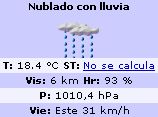
Some had suspected that there are political and pseudo-political movements out there trying to incite disorder; the mayor said it, and now the provincial police has obtained proof of at least one such attempts: several calls were made by two men last Friday to provincial and city government offices, to four schools, to radio stations and other places, warning that looting had started in parts of southern Rosario (rekindling the fears of 1989 and 2001). Fortunately, this disinformation campaign failed, mostly. If this had been 1989 (with hyperinflation and shortage of food in supermarkets) or 2001 (with peak unemployment, recession and a crippling shortage of cash), it might have worked. Mind you, the news about Argentina's spectacular economic recovery are all written from the advantageous POV of middle-class society and up; but the poor are not that many or that desperate today.
More disinformation was spread by the media (I'm not blaming them, as they're only as good as their worst sources) in the last few days. For example, there was the repeated denunciation that some recipients of relief were selling their new corrugated metal sheets -- which was true, but so far I've only read one proven account of this. There was also the radio announcement (multipled by word-of-mouth) that there had been hail in several small towns and cities around Rosario, the idea being that we were in for another catastrophe while the mess was still incompletely cleaned up; it was all false.
We had some, light hail yesterday afternoon (nothing like the other day), and then after dark there was a lot of rain that continued thorought the night. I had to brave it for four blocks as I went from a friend's house to the bus stop, hopping over puddles and over streets turned rivers, but it was nothing serious. We're going to have much rain this summer, I guess.
24 November 2006
Good news in short
Last week's news are like a parade of horrors, and I haven't mentioned half of them. So we need some good news.

- Tomorrow it will be (according to the National Meteorological Service) hot as hell in Rosario, but Sunday it will be cool (cooler than spring should be, but let that be a lesson on how we mustn't put away coats and long-sleeve shirts).
- Argentina will earn more from foreign tourists coming to the country than it loses from Argentinians spending money abroad for the first time this year, since those statistics are compiled (1992).
- In a brave display of imagination that we almost never witness in a politician, Deputy Mónica Prato of Córdoba will protest the lack of compliance of Córdoba Province's government with the national law that mandates free (as in beer and as in speech) tubal ligation for all women. She will do this by going to two public hospitals and requesting that her tubes are tied, threatening to go to court if her request is not granted. Good for her.
- Yesterday the sky turned ominously dark and people got scared. Everybody drove their cars under cover and lowered their blinders, waiting for the coup de grace..., but it didn't hail again.
- Bailando por un sueño will have a "blond vs. brunette" dancing duel live with Eliana Guercio and Evangelina Carrozzo, which is good news for some, but more importantly, I can watch another channel -- I don't have to stupefy my brains to endure such a horrid display of bad taste, and I can see non-paid girls far more beautiful and less disgracefully slutty than those two by just taking a walk downtown.
23 November 2006
Aftermath of the hail
This is the story of a still unfolding tragedy. You've already watched the first act, but there's sadly much more.
Act 1: a horrible hail storm hits Rosario. People get hurt, windows get smashed, precarious homes get destroyed. Damages for US$270 million.
Act 2: While people with cars and windows line up before glass shops and get charged suddenly increased prices, people with no cars and no windows desperately ask for help from the government (tin roofs to repair their homes, mattresses to replace those ruined by the rain, etc.).
Act 3: Government workers are sent to assess the damages in the poor neighbourhoods, and the requirements of their residents are recorded and forewarded to the authorities. Surprisingly, the goods are delivered more or less in time.
Act 4: Unsatisfied because they want more or angry because they've been ignored, groups of poor people set up pickets blocking important roads in the peripherical areas of Rosario. Other groups move from their old homes and squat on abandoned public and private lands.
Act 5: A policeman trying to redirect traffic at a busy intersection blocked by a picket is hit by a car and dies a few days later. People in charge of the emergency relief operation report that the pickets are making it impossible to distribute the goods. Indignant neighbours denounce that some are selling their relief packages instead of using it.
This is about the point up to where this tragedy has devolved. Mayor Liftschitz said today, probably with reason, that the picketeers are being (at least) encouraged, if not led, by minority political factions. We've come to know those; they're the kind that always emerge when it's time to burn tires, and who pass as defenders of the poor, when they're in fact borderline criminals with nothing better to do and a very, very skewed left-wing ideology.
The provincial government, which manages the police, has stated through the Government Minister Roberto Rosúa that the street blocks will be handled "through consensus and peaceful means", only employing police force in the case of crimes committed by the picketeers, such as charging cars with a "toll fee" to let them pass unscathed through the blockades. Rosúa, who has excelled at being useless in several ministries under two administrations, seems not to notice that blocking a street with burning tires is a crime. Like the national government in the case of Gualeguaychú, the Santa Fe Provincial Government prefers to look away, fearful of legitimate repression (maybe because they did engage in illegitimate repression not so long ago and were exposed). Or may it be because problems in Rosario make the ruling Socialist Party administration look bad?
In case you haven't noticed already, I consider myself a leftist. I was born under the shadow of the latest dictatorship, which used violence against popular dissidence of any kind, and I hate the use of force against the weak and the poor. I also know that the Argentine police, all of it, is corrupt, brutal, tainted with all sorts of human rights abuses not committed then, but being committed now, everywhere. And I, yes, I want the police to suffocate those pickets, to look for their leaders and bring them to justice. This is not a protest, it's some greedy lowlife politician wannabe rallying the ignorant to see if s/he can get money and goods from the government. This could be done today or tomorrow in an hour, without firing a single bullet, and the money and the goods could reach those who really need it -- 10% of the population of Rosario lives in shanty towns, and they're not all disrupting traffic and threatening drivers. Why do we still put up with this?
16 November 2006
Hail hell in Rosario
Rosario woke up today licking its wounds after the worst hailstorm anyone can remember. After days of abnormally high temperatures, yesterday the weather turned overcast, then wind started to blow. Faraway thunder could be heard, and lightning flashed behind a veil of black clouds. My cat came up sniffing the air intently, her body tense and ready to escape, and then disappeared somewhere... At about 5:30 PM, before any rain had fallen, hail the size of billiard balls started pounding roofs and windows. That lasted 10 minutes. Rain joined in soon, winds up to 115 km/h propelling it (and the hail) almost horizontally at times. It stopped soon enough, and then, an hour or so later, it started again.
Right before the beginning of the storm, power went out in my house and around. We took out candles and matches, unplugged all the electrical appliances, and waited. The hail was a surprise, though. I initially heard some horrific pounding on nearby roofs, a sound of broken glass here and there, and then it come in full force; I had just enough time to lower all the metal blinders to protect the windows.
La Capital gave it a special cover and titled it Tarde de terror ("Afternoon of terror"). El Ciudadano, somewhat more imaginatively (if with a bit of misplaced humour) Ira de hielo ("Wrath of ice", a play on Era de Hielo, "Ice Age"). Rosario/12 named it Ciudad azotada ("Scourged city").
So today there are no classes in public and private schools, as many are without power, others are being used to held refugees, and some got all their glasses broken and/or were flooded. The mayor, the vice-governor and other authorities gathered a Crisis Committee. The mayor commented that his office's windows were broken and he'd never seen anything like this in 50 years (my father claims "this was nothing compared to the storm I saw when I was 20", but then, he says that about everything). Even Buenos Aires newspapers mentioned the storm, which is extremely unusual (given that anything beyond Greater Buenos Aires is considered less than their backyard by porteños).
The hail was up to 10 cm in diameter, and we can count ourselves fortunate that the storm laster only 10 minutes. I feel fortunate in particular because if my Japanese class had started two hours before, I would've been caught right in the middle of hell. My brother came home after it; it took him one hour (rather than the usual 40 minutes) in an over-full bus that had to take detours and drive very carefully.
I left home this morning for work (still without power) and I found the sidewalks covered with Platanus leaves. A couple of windows in my office had broken and some rain got into a monitor and a power plug, so we waited a bit before trying to turn anything on. One of my co-workers got her appartment's windows shattered; another one, who teaches in a university, says a roof there collapsed. Nobody got hurt, fortunately.
I wrote this in my office, I power has not returned at home (I just checked with my brother -- at least the phone works!). We often have these blackouts, but they usually last only a few hours. It's entirely possible that this may last a lot more. I'm now uploading at a cybercafé. (Sounds like a battlefield report, doesn't it?). I have some pictures taken at home yesterday, but they'll be locked up in my camera for a while.
PS: Power's back! Wow, 10 hours without electricity seems like eternity. I'm adding some pictures of mine and others.
PPS: And here's a video: