We're suffering a drought, as is most of the country, especially the agricultural productive areas. It rained last night, and might rain again today a bit, but it was an isolated phenomenon. Right here in Rosario it's still not as bad as it was last year, when grass everywhere was reduced to brittle, desiccated brown fragments and finely-powdered dirt was blowing from exposed patches everywhere, but there are serious problems in the north.

Upstream, in the dry north of Santa Fe, the situation is dramatic. Neither people nor cattle have enough water for themselves, and the crops are dying. Ironically, northern Santa Fe used to be an area of wetlands and forests, but already in the late 19th century logging companies felled a lot of trees (quebracho, mostly) and then the wetlands were drained by canals to avoid floods. After 2002, when soybean became the star crop, agriculture expanded to the area, and cattle were also moved there from the south. But when you remove a forest, you leave the terrain subject to erosion, and without major watercourses you're tied to rainfall.
The drought will reduce the production of most crops. Maize and soybean were planted late because of this, and coupled with a lower yield, that means Argentina will produce a lot less of both (making things worse, the government continues to place administrative obstacles on crop exports, and the international price of agricultural commodities has decreased dramatically). Wheat production has plummeted to about half of the 2007–2008 harvest. Cattle farming is also suffering; the animals languish and die of starvation or thirst, and often farmers prefer to slaughter cows and sell them for what they might be worth. This year there will be one million less calves.
Hmm... still no rain over here.

13 January 2009
Hot and dry

 Stumble it!
06 February 2007
Everybody hates oil?
 Biofuels are suddenly all the rage. Even the Dumbest Texan has acknowledged that the United States needs to research fuels produced from crops rather than extracted from ancient fossile reservoirs. Maybe he realized already that investing in the invasion of oil-rich countries does not yield the returns everybody thought they would. The U.S. is also engaged in talks with Brazil and other countries (not Argentina) to coordinate the production and trade of ethanol made from corn..., and stop paying astronomical fuel fees to the Venezuelan state oil company and from there to Hugo. In the meantime, some are already warning that the U.S. may begin importing corn from us to make ethanol.
Back down here, it just so happens that South America may be the place everyone will look to when thinking about fuel... just as Argentina is close to becoming a net importer of oil. We do have a lot of it buried somewhere, but the oil corporations haven't bothered to explore and/or extract it for years, since exportation is taxed and restricted, and the internal prices of oil derivatives have been frozen since the economic collapse of 2002. Of course, this can't last much, but big corporations are dominated by short-term interests. On the other hand, all that untapped oil may come in handy one or two decades from now...
Anyway, with oil being so expensive worldwide and local reserves unavailable, it was only a matter of time until people here had the idea that our veritable oceans of vegetable matter could serve to purposes other than feeding our cows, us, or the Chinese. Soybean is a good source of oil that can be used as fuel, but it may not be commercially sensible to burn it, and there are environmental costs along with it. There are alternatives, though.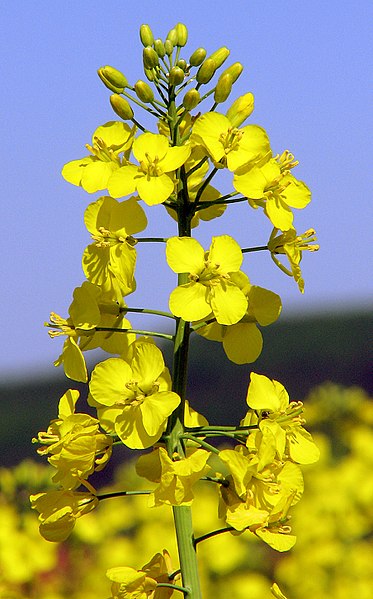
In Salto Grande, central Santa Fe, a rapeseed-based biofuel plant is about to open. The idea is mixing rapeseed oil with regular diesel (fuel oil) and save 30–40% in fuel costs. It has the added blessing that it will encourage the plantation of rapeseed, avoiding the monoculture of soybean.
Several companies in Santa Fe (petrochemicals, vegetable oil processors, even the former state-owned ensign oil company Repsol-YPF) are planning to build new facilities or even to open new production departments. Smaller companies are already producing biodiesel from various sources (such as sunflower oil) to supply the local markets.
You know how I like to speak badly of our disastrous provincial government (see? I just did). This commitment with biofuel production is auspicious and I hope it turns out right, because it's one of the very few good things this administration has done. Of course, it's rather late, the new biofuel-promoting bureaucracy will cost much and do next to nothing, and the actual effort will be that of the private sector, which is (fortunately) dynamic enough to catch and ride this wave, if only it receives a few tax breaks and soft loans.
You may say I sound too optimistic and overly pessimistic at the same time. That's perfectly logical. These are prospects nobody has presented in science-fiction movies and books about the near future. Instead of cold fusion, cooking oil? At least we already know it burns.
05 December 2006
Countryside on strike
The agricultural producers of Argentina are on strike since last Sunday, and boy, the spits of venom are flying all over us. Minister Miceli gave a press conference calling the strike "ideological and political", and dismissed the claims of the producers regarding their contribution to the wellbeing of the country. The government has been intervening in (some would say interfering with) the beef market and, to a lesser extent, with the wheat-flour-bread markets, in order to keep prices from rising; and of course there are the retenciones, or export taxes, in place since the economic crisis exploded.
The economic juggling act is as follows:
- Exporters take advantage of the high exchange rate (over 3 pesos/dollar) to sell at internationally competitive prices and gather a good profit. The ones most benefitted by this exchange rate are the agricultural producers.
- The Central Bank sucks up the incoming dollars, keeping the exchange rate artificially high (over 3 pesos/dollar), so as to maintain the competitiveness of the exporters.
- The government taxes exports, differently according to what exactly is being exported (some things are not taxed, others are taxed 20%). This is how it gets a sizable part of the total tax revenue.
- The very success of the above strategy places it in danger, since the more competitive exports are, the more dollars enter the local market, thus pushing down the exchange rate.
- Not only that, but the Central Bank has to emit pesos in order to buy dollars. This effectively devalues the peso and expands the monetary base, indirectly fueling inflation.
The agricultural sector in Argentina, as a whole, has no reason to complain about profits. During the 1990s, when the exchange rate was fixed at 1:1, many invested in imported machines and increased their productivity, but then they went broke as their exports were uncompetitive. Now they have a government that keeps the exchange rate high for them, making it prohibitively expensive for most of us to get certain imported goods, but they still complain.
One of the points of contention is the government doesn't have a plan for the agricultural sector and doesn't help the smaller producers, who are being bought up by their larger fellows. Indeed, the soybean boom has created a depressing landscape in which a few hundred landowners with huge plantations employ sophisticated machinery and very few people to plant any available patch of dirt over millions of hectares with a transgenic monoculture, then to harvest it and sell it to China (mostly), while producers of less-favoured crops (including many regional specialties in the poorer parts of the country) are struggling to keep up, and falling back.
For some reason, the conservative wealthy elite of the countryside have managed to present this strike as a just cause, as the fight of the economic saviours of the country for a free, undistorted market. The truth, of course, is that if they had their way, the national budget would run a huge deficit and we'd be having milk, bread and beef at three times the current price -- those of us who could afford them, and even then, only as much as the producers did not manage to sell abroad (the EU, for example, buys quality Argentine beef at a very good price, but only a small fixed quota; and both the EU and the US burden their imports with tariffs and regulations to protect their own producers). The controversial Secretary of Internal Commerce, Guillermo Moreno (the price control czar, so to speak, of the Argentine government) put it bluntly: "We can't have food at international prices."
The last cause of anger for the countryside folks was the announced decission of the government to employ force should the roads be blocked by the strikers to prevent the traffic of grain and cattle from their sources to the markets (a threat the strikers have already made -- and they already blocked the Rosario-Buenos Aires Highway for a while). The opposition pounced on it, calling it a double standard (which it is), since the government refuses to clear the road blocks set up by the piqueteros in Buenos Aires and by the pulp mill protestors on the roads before the international bridges linking Argentina and Uruguay, which are arguably causing as much trouble, though of a different kind.
This certainly looks like it will be a rough year's end.