Did I tell you already I'm freakin' cold these days, all day?
This is not normal. Sure, those cold waves from freezing airmasses coming from Antarctica are not uncommon at all. Just not like this, in mid-autumn, and lasting a week, and featuring those lovely sub-zero temperatures every day. It's almost 10:00 PM and we're still under freezing point, and it's terribly humid, and yet this weather is so ill-behaved that it's not snowing as predicted. It hasn't happened in Rosario since 1973, but it may this winter, though. It's already snowed in places of Córdoba Province and in Mendoza — both on the same latitude as Rosario. So, no adorable pictures of snow-white parks for you.
People are dying as a result of the cold, and there are serious problems with the power generation and distribution, and the supply of natural gas. Those who don't live in Argentina may not fully appreciate what that means for us. Electricity, except for lighting, is comparatively expensive, and so are most fossil fuels. Natural gas (as a real gas, or compressed and liquefied) is employed for home heating, to heat our bathwater, to cook, and to power cars (Argentina has the greatest absolute number of LNG-powered vehicles). Industries use loads of natural gas for all sorts of processes, and power stations burn it to generate energy. When there's not enough, they have to use fuel oil, which is four times the price (and that, only thanks to Mad Hugo up there).
Now, we produce a lot of gas and export a lot of it to Chile, but when demand is high the flow is stopped so as to supply internal consumption first. Since this is the case now, the Chileans are mad at us. Chile made the mistake of planning its energy future based on Argentina's abundante supply of cheap gas (we all know you can't pin your future to Argentina's anything!). Interestingly, Bolivia, which sits atop a veritable ocean of liquid and gasseous hydrocarbons, provides us with a lot of extra gas, and has more than enough for Chile too, but due to a territorial dispute they refuse to sell it to them (and only sell to us on the condition that we don't re-route it to Chile!). The dispute could be solved if only Chile gave back to Bolivia a strip of land that reaches up to the Pacific Ocean, which it stole ages ago; but that won't happen soon.
Back to Argentina and to Rosario and to me: I'm cold (did I tell you already?) and I also officially have a nasty cold as of today, which is a pity since these days are so sunny they motivate you to go outside, but I can't risk catching something worse. On the other hand, better get some antibodies now than during my winter vacations.

30 May 2007
So cold

 Stumble it!
06 February 2007
Everybody hates oil?
 Biofuels are suddenly all the rage. Even the Dumbest Texan has acknowledged that the United States needs to research fuels produced from crops rather than extracted from ancient fossile reservoirs. Maybe he realized already that investing in the invasion of oil-rich countries does not yield the returns everybody thought they would. The U.S. is also engaged in talks with Brazil and other countries (not Argentina) to coordinate the production and trade of ethanol made from corn..., and stop paying astronomical fuel fees to the Venezuelan state oil company and from there to Hugo. In the meantime, some are already warning that the U.S. may begin importing corn from us to make ethanol.
Back down here, it just so happens that South America may be the place everyone will look to when thinking about fuel... just as Argentina is close to becoming a net importer of oil. We do have a lot of it buried somewhere, but the oil corporations haven't bothered to explore and/or extract it for years, since exportation is taxed and restricted, and the internal prices of oil derivatives have been frozen since the economic collapse of 2002. Of course, this can't last much, but big corporations are dominated by short-term interests. On the other hand, all that untapped oil may come in handy one or two decades from now...
Anyway, with oil being so expensive worldwide and local reserves unavailable, it was only a matter of time until people here had the idea that our veritable oceans of vegetable matter could serve to purposes other than feeding our cows, us, or the Chinese. Soybean is a good source of oil that can be used as fuel, but it may not be commercially sensible to burn it, and there are environmental costs along with it. There are alternatives, though.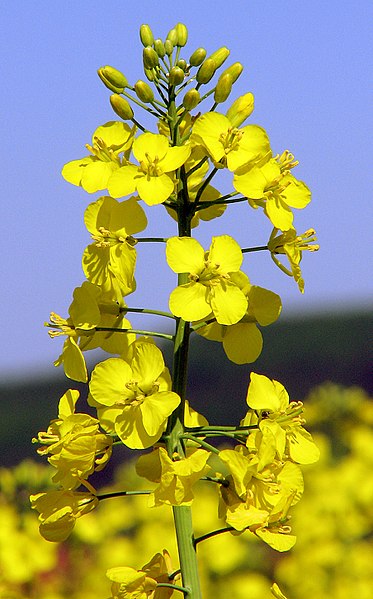 As a national biofuel law has been approved, Santa Fe is now about to follow the trend and exempt biofuel-related investments from taxes. The government is currently creating administrative structures to promote the development of biofuels based in rapeseed (Brassica napus), which is not strong here but is planted extensively in Buenos Aires Province, and a project of cooperation with Cuba to produce ethanol from sugarcane is in the works. The Cubans are experts in sugarcane, and the underdeveloped, underpopulated north of Santa Fe seems to be a good place to plant it, with appropriate irrigation techniques.
In Salto Grande, central Santa Fe, a rapeseed-based biofuel plant is about to open. The idea is mixing rapeseed oil with regular diesel (fuel oil) and save 30–40% in fuel costs. It has the added blessing that it will encourage the plantation of rapeseed, avoiding the monoculture of soybean.
Several companies in Santa Fe (petrochemicals, vegetable oil processors, even the former state-owned ensign oil company Repsol-YPF) are planning to build new facilities or even to open new production departments. Smaller companies are already producing biodiesel from various sources (such as sunflower oil) to supply the local markets.
You know how I like to speak badly of our disastrous provincial government (see? I just did). This commitment with biofuel production is auspicious and I hope it turns out right, because it's one of the very few good things this administration has done. Of course, it's rather late, the new biofuel-promoting bureaucracy will cost much and do next to nothing, and the actual effort will be that of the private sector, which is (fortunately) dynamic enough to catch and ride this wave, if only it receives a few tax breaks and soft loans.
You may say I sound too optimistic and overly pessimistic at the same time. That's perfectly logical. These are prospects nobody has presented in science-fiction movies and books about the near future. Instead of cold fusion, cooking oil? At least we already know it burns.