Prompted by an anonymous comment in my post about the 31st anniversary of the last coup d'état, I'll do my best to expound what I know and think about the manner in which things are developing.
During the 1980s, after the end of the military government, it was not at all clear that Argentina had left behind any possibility of falling under their boots. The last junta left the Casa Rosada with a promise that they wouldn't be called to answer for their crimes in the trials to be held soon after. The Trial of the Juntas in 1984 was a major achievement for the new democratic government and they should be considered a source of national pride; Argentina is the only country in the world to have tried and jailed its own dictators almost immediately after they left power, when there could still be a backlash from the military. Then came the embarrassment, the humiliating laws called Punto Final (Full Stop) and Obediencia Debida (Due Obedience), which forced the ongoing investigations to stop.
These laws (some call them the Pardon Laws, others the Impunity Laws) were a terrible blow to the human rights cause. President Alfonsín, who propelled them, was and is still criticized for them. My opinion is mixed. Alfonsín himself has stated that he regrets bowing to the pressure of the military, and acknowledges that the laws were passed basically at gunpoint, He could've been braver. And he could've been overthrown. The former dictators and their minions were invited to conservative TV programmes and defended their hideous acts in magazine interviews. It was still rather acceptable for anyone to ponder on the military as an alternative to a democratic government which was, admittedly, failing. Alfonsín resigned in July 1989; inflation reached a monthly 200% and in Rosario people were rioting and looting for food.
Carlos Menem campaigned on a populist discourse and promised a new beginning, and boy did he deliver. After two years, Domingo Cavallo took up the Ministry of Economy, and Menem started implementing the policies that would change Argentina into a "modern" country. National companies became more productive, exports grew, and everybody was possessed by a consumerist fever. Unemployment started going up, as local industries were brought down by unchecked, and often disloyal, foreign competition. The middle class got indebted in dollars. Economic stagnation and political conformism were celebrated as part of a magical "stability". Nobody wanted to hear about the horrors of the past. When in 1990 Menem pardoned the military leaders of the dictatorship, only a few organizations complained. There were no massive demonstrations protesting the pardon, and nobody in the judiciary coming out forcefully to question the legality of the measure or the ethics of the presidential faculty of pardon itself.
When the illusion of stability vanished in December 2001, something broke. Argentina saw itself as a divided country. The government against the people, the poor against the rich, the politicians and the police against the public. The government ended up led by a strong Peronist leader, Eduardo Duhalde, a man of questionable practices but with a pragmatic vision. Like Alfonsín, he might have done better, and he might have failed disastrously. As it was, he left Argentina in the hands of another president in a better condition that he had found it. He managed the social unrest with appeasement, losing a lot of political capital in the eyes of many who wanted old-style repression. The claim for respect of dissidence and human rights was out in the street.
It was Néstor Kirchner who finally brought a revolutionary change. From the very beginning, he set himself at the fore of the public fight for the punishment of the crimes of the dictatorship. Even his own party companions was surprised. Kirchner was impolite, messy, unashamedly populist, excessively candid regarding certain sacred cows, disrespectful of basic principles of realpolitik.
Note I said "public". Many people have been quietly working for human rights for a longer time, people with much more to lose and much less influence, often trying fruitlessly to be heard. And here we come to the crux of the matter. Many in the human rights camp were delighted to count on the support of no less than the president, who dragged along a lot of legislators and other influential figures who'd never done anything for human rights but had enough cunning to smell the political profit of embracing a popular cause. A few, especially in the far left of the human rights movement, reacted as if human rights were their exclusive property and paradoxically reacted by demanding more and more of the president. The president, of course, cannot and will not cleanse Congress, the judiciary, his own party, and the local institutions of the whole country of all people suspected of not being extra-pure left-wing nutjobs. (The practise of making continuous demands for more extreme ideologically-motivated measures is known as "correr por izquierda" or "correr por derecha", depending on the direction.)
A third camp, represented typically by mildly conformist right-wing people and by critics of Kirchner, like the one that writes that article in La Nación, pretends to be horrified about Kirchner's abuse of power. It's a scandal to hear the president complain that the judges are being slow — the executive asking more of the judiciary is against the constitutionally mandated republican separation of powers. Clarín quotes several other reactions — from the (unfortunately pathetic) opposition and from well-known conservative law experts. Of course, the real reason is they dislike Kirchner and disagree with his ideology.
Not that Kirchner doesn't have a lot of things to dislike. Half the time he's speaking, he should be shutting up. He doesn't tolerate dissent near him, and seems to thrive on adulation. Some of his closest allies should be in jail. Yet if it weren't for him, the investigation of the crimes of the dictatorship may still be paralyzed. One has to have priorities.
Under Kirchner the laws that protected the military from legal persecution were repealed, and the trials began again. Menem's pardons were struck down as well. The Supreme Court, with a majority of new justices appointed by the president, has stated that the heinous deeds of the military, the police forces and their collaborators during the dictatorship are crimes against humanity and do not, therefore, prescribe — that is, they will not be extinguished by the passing of time and can continue to be investigated indefinitely. It's true that the general social and political climate brought these amazing changes to the human rights landscape; but it's also true that much of it has to do with having a strong, vociferous, ill-mannered, meddling president in command. It shouldn't be like that.
The article in La Nación complains about Kirchner's criticism of certain judges that are, it seems, purposefully delaying the processes of investigation and trial of human rights abuses. Four of these judges are now facing the possibility of impeachment. They have well-known personal and ideological connections to members and defenders of the dictatorship. It's terrible to see the president being disrespectful of the Constitution, but I submit that the sight of judges protecting horrible criminals is disgusting and much more a violation of republican principles than a presidential speech. As I said to the anonymous poster that started me thinking on this, never let perfect stand in the way of very good.
By the way, dear Anonymous, if you want to contribute, use a name (any name, as long as it's always the same name) and do it on topic. I'm trying to do serious work and you're dumping Noticias here.
PS: More about Kirchner's speech and the reaction: La Nación, La Nación, Página/12, La Capital, La Capital.

26 March 2007
Kirchner vs. the judges

 Stumble it!
24 March 2007
Remembering the coup: 31 years

Today is the 31st anniversary of the coup d'état that brought to power the bloodiest dictatorship Argentina has lived in its history. It lasted from 1976 to 1983, four military juntas succeeding each other, taking advantage of the fear, the conformism, and the shallow patriotism of many Argentinians.
I don't remember much about those times. I was born 6 months after the coup. My early childhood was spent under the repressive rule of these monsters, but I was too little to understand anything. This was not a topic you spoke about during the family dinner. Even after it formally ended, it was not taught in schools, and it was not critically analyzed in the news. In 1990, Carlos Menem pardoned the leaders of the juntas, as if all wounds were healed, for the benefit of "national reconciliation". Yet once the "forgive and forget" camp had to face the atrocities unearthed by deeper and deeper investigation, change began. In 2002, Congress declared March 24 a date of commemoration for the victims of the dictatorship. In 2005, the laws protecting the military from being judged were overturned — "I was following orders" was no longer an excuse. In 2006, March 24 was declared a national public holiday.
The picture that begins this article is just one of the many official acknowledgements of the brutal repression of the juntas. The poster's central title reads Oíd el ruido de las cadenas, "Hear the sound of the chains", based on the third verse of the Argentine national anthem, Oíd el ruido de rotas cadenas ("Hear the sound of broken chains"). On the left, in smaller print, there's the list of the dictatorship's crimes: "they kidnapped, tortured, raped, murdered, stole babies, humiliated mothers and grandmothers, mortgaged the country, took us to war".
23 March 2007
Media Watch
Folks, I'm starting a new blog to complement this one: Rosario Argentina Media Watch. It's exactly what it seems, a news aggregator. It's intended for quick review of news. Read the intro post to learn more.
My leg goes to the doctor
This is an update on my leg, and a response to some questions posted by a reader about the medical system in Argentina.
First things first: the cause of the problem seems to be not my leg, but my spine. A couple of X-rays of my lower back shows that one tip of my last lumbar vertebra (L5) is too close to the top of the sacrum (S1), "pinching" the L5–S1 space (I don't know what this is called in English; it's a pinzamiento in Spanish). The numbness in my right leg and my other symptoms seem to correspond to a sciatica, possibly caused by compression of the nerve that comes down from the spine and goes into the leg. In order to confirm that, the doctor told me to get an electromyography. That'll be next Tuesday.
Besides this, and quite possibly because of it, I've developed a slight functional scoliosis, which means my spine is curved a bit laterally, with a convexity to the right. That may be the cause of a small but persistent pain I'd been feeling in the right side of my middle back. In addition, the vertebrae of my lower back are aligned horizontally, while above them, the upper lumbar and dorsal vertebrae are going up in a straight line. That is, when you see my spine from one side, instead of the proper elongated, smoothly curved S-shape, what you see in the bottom half is a horizontally-flipped "Z". Neither of these abnormalities are permanent. The scoliosis will be corrected once the leg is fine again; the other problem is most likely the fruit of a sedentary life and can be fixed by strengthening my lower back and abdominal muscles.
Regarding local medicine, here are the questions:
- "How was your visit to your local medical center?" — I actually went three times: first to see the doctor (it's a first come, first served system), next day to have the X-rays, and next day to see the doctor again. The doctor should've arrived at 5 PM but both times he came at around 5:20... The first time I was the second patient; the other time I was #5 and had to wait for more than an hour. My mistake for not being there before. The X-ray was very quick. The X-ray machine was made in Britain and must have been 25 years old, but it worked fine. The radiographer kept the films, and the radiologist had the report ready the next day when I fetched them before seeing the traumatologist. Apart from the waiting, everything went OK. The waiting room and the doctor's room were a bit cramped, but clean and comfortable. The doctor was nice and the clinical exam was thorough enough.
- The question you didn't ask: how much? Well, I had to pay a fee (AR$8) each time I saw the doctor, and I had to pay AR$26 for the X-rays. In a public hospital or another common healthcare center I'd probably get both things cheaper. This is at the neighbourhood's medical center, so it's like an association or club and you have to pay to stay in — only AR$13/month, per family. Not all neighbourhoods have such association, and most don't have such facilities, but mine is an old-time poor-but-hard-working-class barrio of 80,000 residents, give or take.
- "When you go to a public facility, are the doctors you see all internists? What happens if you need to see a specialist?" — It depends. At the most basic, a public primary healthcare center has an internist and maybe an emergency doctor all the time. The specialists don't work full time in a single place; they come at certain times and certain days of the week, see the patients and leave (for example, the doctor I'm seeing comes Monday, Wednesday and Friday at 5 PM, and leaves at 7 PM). In a public hospital you typically have an office where you can schedule an appointment with the specialist, as in private facilities.
- "How readily available are diagnostic tools such as MRIs and ultrasounds in public healthcare?" — Ultrasound is widely available, even in primary care centers, since public health serves predominantly poor patients, and those include many pregnant women. CT and MRI are available as well, in hospitals, at least in the developed areas (such as Rosario). I'm not sure about the municipal hospitals here, but of the 3 large provincial ones in the metro area, two have CT, one of those has MRI, and the third has a gamma camera. The cost varies according to the economic possibilities of the patient — the full price is significantly less than the one you must pay in a private hospital, and if you can't pay it, you can state your problem and the hospital's auditing office will decide what to do.
- "If you need extensive treatment in a public facility, does the government (city, provincal etc.) pay for everything? How would you imagine that the cost may influence how good the treatment is in such a situation." — In certain cases (patients that clearly cannot pay) the government will pay for everything, though it might take long, humiliating days or weeks for the patient to go past the bureaucratic barriers. Based on my inside experience, however, the quality of the treatment doesn't suffer. The bureaucracy separates the physicians from the monetary issues. The medical staff may come and do their job without even knowing whether the patient has paid for the treatment. At least in Santa Fe, you can get dialysis, cancer drugs and chemo, HIV drugs, insuline and diabetes medication for free and forever, though there are occasional delays in the provision of drugs.
- "If you have an medical emergency, can you go to the ER of any hospital and get treatment?" — Yes. This is common even for patients with private health insurance or with union-based healthcare systems. In theory, when you go to a public hospital the administrative staff takes care of checking whether you have insurance, so as to send them the bill later. In practice, many small emergencies are taken care of and the patient goes without anybody paying for anything.
22 March 2007
日本パーティー
I forgot to note down that I started my Japanese classes a week ago! This is the fourth year for me. The first three years were 初級 shokyuu, elementary level; this is 中級 chuukyuu ichi, the first year of the middle level. (Yes, it takes you three years, nine months a year, 3 hours a week, plus additional courses, to achieve a basic mastery of Japanese — 1,500 words only. You can't compose a children's dictionary with that.)
We're going to use a new book from now. Vale-sensei, who was my teacher during my first year in the Japanese Association, is again with us. She showed us the book, noting with barely disguised glee that it has almost no furigana, i.e. the small syllabic characters (kana) used for phonetic spelling that appear next to ideograms (漢字 kanji). Our old book always had furigana. By now we should know at least 300 kanji, from the simplest ones like 山 "mountain", 人 "person" and 中 "inside" to the ones representing concepts like "sick" (病) and "electricity" (電). It's actually simpler to read a mixture of kanji and kana, but only if you're absolutely familiar with the kanji.
I also received the results of the Japanese Language Proficiency Test I took in December. I passed this sankyuu (third level) with a very good score, though not as easily as I'd passed yonkyuu (fourth level) the previous year. The next step, nikyuu, is still a faraway dream; the requirements are much higher. I'll need the three years of intermediate level to prepare for it. That includes learning another 300 kanji. I'm going to need a study method for that; quick visual recognition is only OK for characters with eight or nine strokes at most.
The original Chinese characters (hànzì) usually have one and only one reading, but Japanese kanji typically have two or three, depending on what is attached to them. When the same character was borrowed from different dialects of Chinese (separated geographically or chronologically) the result is several completely arbitrary readings. On occasion the only way to guess a reading is by the semantic context; the kanji 一日 ("one" and "day") put together can be read as ichinichi "all day" or as tsuitachi "first day of the month". The Japanese simplified the kanji several times (the Chinese did the same independently), and even invented a few characters (like 込 "to crowd, congestion, full"). The characters also drifted from their original meanings. The extremely simple ancient Japanese phonology tried to accomodate the Chinese pronunciation, but despite several interesting developments, it failed miserably. (Chinese has changed a lot since then, so anyway you can't guess one based on the other.)
Vale-sensei treated us to a preview — or better, a pre-hearing — of the book's aural comprehension exercises: a girl speaking at just the average Japanese machine-gun rhythm for about two minutes. I got about half of what she said. Boy this will be hard.
21 March 2007
By bicycle in Rosario
 A reader asks about bikes and traffic in Rosario. I replied in brief in a comment yesterday, but I thought it'd be more useful and visible to expand on that now.
You've surely all heard that driving in Argentina is complete madness. That's partly true... It's not that drivers are mad; they just feel free to ignore or bend the rules, re-interpreting them according to the occasion. Some of them are truly mad, in the sense that they don't seem to perceive reality in the same way as pedestrians and other drivers; for example, they see an empty parking space where in fact there is a bus stop, or they fail to see other vehicles except those larger than their own.
Bikers are a special case. There are some who drive reasonably well, but most (including me) ignore the traffic lights and zebra crossings whenever possible. A bicycle can't get fined for crossing a red light. Truth be told, these minor violations often make up for the physical disadvantage of bicycles faced with motor vehicles much faster and sturdier, but in turn they work against the next weaker ones in the scale — pedestrians. Bicycles appear from nowhere at lightning speeds, trying to stay ahead of the mass of cars, and often miss overconfident pedestrians by mere inches. Bikers make U-turns seconds before the light turns to red in their lane in a two-way avenue, turn left where they shouldn't, zigzag between buses and trucks, and in general they (we) barely use the brakes.
I love my bike and the sense of freedom it gives me, but at times I get a bit afraid of it as well. I like the fact that it's free (as in beer), comparatively small (don't need a special place to park it!), and much faster than going on foot, even if not all that flexible for urban exploration (you can get almost anywhere on foot). Anyone who's ever grown accustomed to a vehicle knows about "the zone", that trance-like state when you feel completely in tune, one with the machine. You must be in "the zone" when you're driving a bike in Rosario, even as it's awfully dangerous, because otherwise you'll get crushed the first time you get distracted.
Bicycles have traditionally been the poor's vehicle in Argentina. This, of course, made it popular by necessity in the 1990s. In 2002, right after the Big Crunch, you'd get out to catch the bus at dawn and see swarms and swarms of construction and factory workers in their overalls, pedalling like crazy, all in synch so as to remain grouped — for a lone biker was (is) an easy prey for thieves. According to a study, there were 340,000 bicycles in Rosario in 2002, about one per three inhabitants.
There are still many people going to work every day by bike. Others use it to transport their partners or their whole family. Three people (two adults, one child) in a single bicycle is a terrible thing — unstable and very dangerous — but some have no alternative. Consider that a round bus trip for three costs AR$7.20 — less than 3 dollars, yet enough to buy a kilo of acceptable-quality beef. Needless to say, most bikers don't bother to wear helmets or any other protective devices (motorbikers, who are obliged by law, usually don't wear them either).
I don't go to work by bike, because it'd take me an hour to get there and I'd arrive hecho sopa (soaked), and because I can (still) afford the bus. The Japanese Association, however, is only 20 minutes away, and its informality makes it a bit more acceptable for me to be a bit sweaty when I arrive, so I'm considering going to Japanese class on two wheels. Better for my health, better for my budget, and better for the environment.
Rosario has many places acceptable for bicycle riding, but comparatively very few bike paths. For reasons of space, the whole downtown area can't have paths at all, since there's barely room for cars and buses as it is. There are no wide avenues across Rosario's compact center, but a grid of very narrow streets that may have been fine for carriages and horses in 1900, but get congested easily with 21st century traffic. Driving a bike there is tantamount to suicide.
The municipal policies encouraging the use of bicycles often collide with other local policies or turn out to be just declarations of good will, soon forgotten. Lately, though, newly-opened sections of major avenues do usually come with good bicycle paths.
You may have heard of Argentina's horrific traffic accident record. The media have been focusing on this for some time now, with spectacular, dramatic pleas for better traffic laws and monitoring technology, when every now and then a handful of people die on the road. Argentinians generally drive very badly, but always place the blame elsewhere. I intended to write about this today, but I'll leave that for tomorrow or next week, as this post has gotten too long.
20 March 2007
News flashes
PS, yet important: As of today, I'm moderating comments. This will surely detract from the dynamic nature of this blog, as your comments will be visible hours after you posted them, but then I don't like being made fun of. This is not a matter of free speech — this is my blog, so there's no such thing as free speech here. This may last for a week or two, or forever. Thanks.
This is just a quick glimpse at the news today, since I haven't had the time to compose a post... Going from international to national to local to personal:
- Theologian Jon Sobrino, who was recently notified by the Pope about certain mistakes in his works (such as making Jesus look too human, or not spiritually removed from the world enough), said he won't acknowledge the note and won't correct his books, because the correction is just part of a persecution against Liberation Theology that has been going on for 30 years.
- Just as Argentina was about to pick up another fight with Uruguay, the Uruguayan minister of Health denied that she'd said Argentina is withholding information about the dengue fever within our territory. She was apparently surprised that we had so few... It seems that the littoral of the Uruguay River is full of Aedes aegypti larvae. There are now over 200 cases of dengue in Argentina, 7 of them autochthonous (locally infected, not brought from Paraguay or Brazil).
- The public teachers of Santa Fe Province are back to negotiating with the government for a raise. They made the children lose a week of classes already, and they were told those days will be discounted from their salaries this month, so they won't go on strike again for now.
- The taxi fee in Rosario is going to rise, if everything goes well, this Thursday, when the Deliberative Council approves a bill. It will be closer to the cost of a taxi in Buenos Aires, only of course most of our taxi drivers don't work nights, Sundays, or holidays. The Council is going to require taxis to implement some sort of security measure (yes, they have to make it a requirement — taxi drivers complain they're being mugged and robbed all the time but you have to force them by law to adopt a simple security measure such as a bulletproof glass or a "panic signal") and the owners of the taxis will be required to have properly registered employees as drivers.
- As a result of the above, I'm taking even fewer taxis. My leg problem is apparently not caused by my knee, but by something else, according to the doctor, so once fixed I'll get back to my bike, I guess.
19 March 2007
Elections afoot
 Provincial elections are already on the run. Since every province is an autonomous state regarding authorities, each has its own rules and schedule. Most often the provincial elections are held on the same day as the national ones (presidential and legislative), but this depends mainly on two factors: whether the province was intervened or had its government otherwise removed prior to the end of the usual term, and whether its government chooses to manipulate the schedule (within a limited timeframe dictated by its own electoral laws). When people vote for a party's candidate (say, for president), a significant part tend to vote also for the other candidates (e.g. for governor and legislators).
This "dragging effect" can be advantageous or disadvantageous for the people in charge to call for elections. A governor is typically obligated to name a day for the election of his successor based on the day of the end of his term — e.g. between 90 and 120 days before. That leaves him some room to play.
President Kirchner is nowadays extremely popular, so he's viewed as a touchstone for electoral success by many a politician. The Radical Civic Union, the long-time rival of the Justicialist/Peronist Party, has de facto broken into many local factions; the rest of the opposition is also mostly localized (for example, the Socialist Party is strong in Rosario, less so in Santa Fe as a whole, and definitely not anywhere else; Mauricio Macri's right-wing PRO is strong in Buenos Aires City and to a much lesser extent in the metropolitan area; fronts made up of provincial parties dominate in several jurisdictions but have no national projection at all). Local political groups with even the slightest ideological affinity with the Kirchner administration seek approval and support from the president, and the president happily gives it if it looks like it might be a net gain.
With most of the provinces burdened by poverty, lack of infrastructure and growing budget deficits, the national government has the tools to co-opt provincial governments. This leaves provinces in the hands of fleeting minions (fleeting, because they're always ready to change masters) and makes Argentina's federalism a joke. Unfortunately, it's in the politicians' best interest to keep the people poor and continue plundering their budgets, as long as the national government comes to the rescue with political and economic support before the elections.
The electoral calendar has already begun. In Catamarca a Peronist governor won the election against another Peronist — the word "Peronist" is really not used anymore, being replaced by "Kirchnerist" or "non-Kirchnerist". Granted the loser is a veritable mob leader... Luis Beder Herrera, the new governor of La Rioja after ousting his own fellow Peronist companion (who was formerly a fanatic supporter of the right-wing neoliberal Carlos Menem, then swiftly turned into a fanatic supporter of left-wing populist Néstor Kirchner) is calling for elections 180 days from now, or so he says. Of course he will run for governor; that was his goal all the time. How low can you go? Yesterday two Kirchnerist candidates came in first and second in the governor's race in Entre Ríos; the winner is a minister of the current administration. Governor Jorge Busti, in a rather vulgar (and uncalled-for) confrontational style, saluted the victory of his faction as a victory of his own and of President Kirchner, by calling his opponents "losers", and by telling politicians of other parties to go home to their own territories.
In Santa Fe we'll have primaries in July, provincial and municipal elections in September, and the national presidential election in October. Santa Fe, unlike most of the provinces, is awash with money, and the likely winner, Hermes Binner, is a Socialist who carefully doesn't... officially... dislike... a priori... with Kirchner... all the time... in general. Kirchner looks the other way and has left the campaign in the hands of the local Peronism, whose leaders are understandably worried, if not a little pissed off by the lack of presidential support. So unlike the situation in other provinces, the outcome (besides the sheer numbers) is a mystery.
16 March 2007
Healthcare this way
My right leg has been behaving strangely as of late, which I blame on my new jogging habit, though I knew there was something wrong with it before. My knee feels a bit hurt all the time, and a kind of weakness propagates upward from there. I let it pass for a while since it looked like a simple adjustment from sedentarism to a regime of consistent exercise, although weirdly it didn't bother me at all while jogging. But now it's bothering me even as I stand or walk. I can give up jogging, but I go everywhere on foot.
Given that, I need to go to a doctor, and I thought it'd be interesting to speak of medicine in Argentina. I've read a lot of reports of foreign visitors and expats marvelling about the quality and price of health care here, and especially the existence of universal socialized medicine. The latter is not something you usually hear much about, since people with $$$ don't really need to go there. The most expensive quality medical treatment you can find in Argentina is still a bargain compared to the costs of medicine in the United States or Europe.
If you have a good salary, you can pay for a private health insurance plan. They're not cheap, and they've become extremely restricted — you can get away with emergency service and basic treatment, but not surgery or other complicated procedures, for which you have to pay additional money. Alternatively, if you're working en blanco (formally registered), you may have a health plan associated with your union. It won't get you everything you need for free, but you can get away with simple medical matters for a few pesos.
However, if you don't have money or a job, or you don't have a unionized healthcare plan, or your plan is insufficient, you'll have to brace yourself and go look for attention in the public health system. There's a provincial system, with hospitals in large towns and cities, smaller health centers in small towns, and little primary care centers everywhere, covering the entire area of Santa Fe. Overlaid with it there are local (municipal) health centers, which are usually coordinated with the provincial system. Rosario, being much larger than any other city, is a special case, and even more so because of the constant competition and bickering between the provincial and the municipal governments. The municipality manages several major hospitals on its own, including one for emergencies and one for children, and a multitude of primary centers.
The provincial health system is divided for administration into several Health Zones, each divided in turn into Programmatic Areas, each one having one base hospital and several primary care centers. The main difference regarding patient attention is that the provincial centers accept people from anywhere in Santa Fe (and even outside), while Rosario's municipal centers tend to send non-rosarinos elsewhere. I worked in one of the three largest provincial hospitals in Argentina and I can tell you that the quality of medical attention can range from very good to atrocious, depending on luck and on the good will of the doctors and employees; I don't know about the municipal hospitals. There's an unspoken assumption (acknowledged by the provincial officials) that Rosario's public health is better managed, though I couldn't tell for sure; conversely, the handling of internal jurisdictions, finance and large amounts of patients in the provincial system's hospitals is completely chaotic, in part because the hospitals were left to their own devices during the Reutemann administration.
Picture this: a large organization, self-ruled, with huge expenses, led by an unelected political official appointed by a faraway authority and with lesser authorities partly elected by votes of its employees (usually bought or pressured by a politically-connected union, if not entirely forged), which receives money from its higher authority but must not answer for it, and needs to gather extra money to work but cannot formally ask the patients for that money since in theory the public health system is free and the government is proud of that. This mess could be maybe corrected by re-centralization and enforced by tight controls, but that would make the central Health Ministry accountable for each little fault. With formally autonomous, self-managed hospitals, that responsibility is diluted.
Anyway, tens of thousands of people seek public health care in Rosario every day, and they get it, maybe after long waits or in less-than-optimal conditions, but usually from decently good professionals. If you want to become a doctor, you need to do your residence in a public hospital, and everybody knows that those young, eager residents are the ones that really do the grunt work in hospitals. Moreover, it's still a source of status for a doctor to serve in a public hospital, if only for short periods, even while he or she has a private practice; and hospitals are also schools, so residents always receive advice from qualified specialists. It's possible to give birth to a child, to have a serious fracture mended, or to get years of treatment for cancer in a public hospital for nothing, or at the very least for a fraction of the cost of private medicine, in any major public hospital in Santa Fe.
This is sadly not true of all of Argentina. Many patients in the interior of the country don't have a half-decent coverage, and need to travel long distances to their provincial capitals or even to other provinces. Some end up here in Rosario, others go to Buenos Aires. (I remember once a patient from Paraguay got a mammography in my hospital. She travelled once a year to Argentina to visit her extended family, and it was cheaper for her to pay a few pesos and get a decent study while she was staying here.) Some complex and expensive treatments, such as the ones surrounding pediatric bone marrow transplants, are only available in Buenos Aires. All in all, this makes it more attractive to live in a big city... and it's one of the reasons why poor small-town and countryside residents migrate here. The only way to fix that is simply to take good health care closer to them.
In the meantime, I'm going to take care of myself... My leg's going to see a doctor in the neighbourhood's community center, four blocks away — the 'hood is poor but the community center has at least a few specialists and, importantly, an X-ray machine!
15 March 2007
Fun with the mayor
Just two pictures to show the pathetic status of Rosario's political debate regarding the administration of mayor Miguel Lifschitz.
The first one shows Lifschitz next to Arnold Schwarzenegger as a "Terminator of Cities". Lifschitz visited San Francisco and other places in California, U.S., last month, along with local officials and businessmen. He was received by the mayor of SF and the lieutenant governor of California, but he didn't actually meet Arnold. The distinctly cartoonish quality of California's chief elected official is easy to make fun of, and prompted great hilarity this side of the border, though it's really not that fun. However, this unsubtle, childish poster was paid for by a university faction of the local Peronist party.
The second picture is merely one example of the similarly-themed graffiti that have popped up in the whole city as of late. It blames Lifschitz for the two last raises in the urban bus fee, which went from AR$0.75 to 1.20 in a year. The blame is to be placed in the outrageous demands of the bus drivers (backed by a powerful union), who now have initial monthly wages equal to two or three times what a policeman or a teacher gets. In truth, Rosario had a very cheap fee compared to most cities in the country, and the bus fee has been raised in most of them as well, except Buenos Aires, after the national subsidies to diesel for public transport were redistributed.
Lifschitz has kept a low profile and a good public image for more than three years. He's running for reelection in September, and it looks like he'll win by a landslide. The Peronist party has resorted to picking on every little fault and inventing problems — for example, that Rosario is driving out manufacturing industries due to its lack of industrial policies and its preference for sissy Socialist quality-of-life-inducing green spaces and its promotion of culture and tourism. I for one would rather see more green and less industry. Anyway industrial facilities are being set up in the neighbouring towns, and they produce wealth for everyone around.
The only mature choice the Peronists have made regarding the political contest is the decission of governor pre-candidate Ángel Rossi to enroll the "K Radical" Juan Héctor Sylvestre Begnis as candidate for mayor of Rosario. Sylvestre Begnis was a fine Minister of Health of Santa Fe in the past, a supporter of proactive policies regarding sex education and contraception that are much needed here, and one who worked very well with the national Health Minister. His father was governor of Santa Fe in the 1960s, and a very good one. S. B. is surely the best mayor candidate that his party has put forward since... well, ever. For a change, he began by acknowledging that Lifschitz is doing a good job overall, which suggests he'll campaign on doing more things and doing better, rather than focusing on the negatives.
Of course I prefer Lifschitz to win. With his former mentor Hermes Binner as the governor, as the election is likely to turn out, there should be less friction between the province and the city, and Rosario might finally gain its long requested autonomic status. That might mean reforming the provincial constitution, which Binner has vowed to do, and which must be done anyway to keep it in line with the national constitution in several matters (including, precisely, the issue of autonomous municipalities).
14 March 2007
Lament for La Rioja
Argentina is a federal country. Most of the power resides (in theory) in the provincial states, which delegate some functions in the national federal government. The opposite would be a unitarian country. Since its independence in 1816, and until its final unification around 1860, Argentina was torn by civil war led by proponents of these two opposing systems.
In truth, many of the federalists were caudillos, powerful provincial chieftains, and they couldn't care less for the concept of decentralized government as an ideology. They just wanted to be left alone by the central power, residing in Buenos Aires, to continue ruling their lands like feudal lords.
This is still true for most of Argentina outside the provinces of Buenos Aires, Santa Fe and Córdoba, not coincidentally the ones most populated and the most productive. The north of Argentina is, in practice, ruled by hereditary successions of heirs linked by blood ties or lifelong political association; these dynasties are only broken every now and then, when the political establishment is shaken by strange coincidences or major crises. These days the whole country witnessed, without so much as a mild outrage soon forgotten, the pathetic, dreadful spectacle of such a crisis in La Rioja. Twelve years ago, governor Ángel Maza succeeded his political patron, Carlos Menem, who had stayed in power for several terms before becoming President of Argentina. Maza himself got re-elected three times. In the meantime, the once all-powerful Menem became politically meaningless and Néstor Kirchner's rising star gathered a large following of opportunists. Maza realigned with Kirchner, as expected. In 2005 he ran for Senator of La Rioja against Menem, without resigning as governor. He won and, having beaten Menem as intended, resigned from his senatorial bench and continued ruling as governor. This is absolutely unethical but not illegal.
Now vice governor Luis Beder Herrera had an agreement with Maza: when the time came, Maza forfeit re-election so that Beder Herrera (who's been vice governor of three different governors, totalling 15 years) could run for governor. Something went wrong, however, as Maza ignored the agreement and prepared to run for a fourth term. Beder Herrera turned against him, and the Legislature he presides reformed the provincial constitution and got it to forbid indefinite re-election (which had been introduced years ago to favour Carlos Menem's own appetite for power). Maza protested. Beder Herrar accused Maza of a series of misdeeds, and got the Legislature to vote a suspension for Maza, pending the formal investigation known as juicio político that is reserved for elected officials. This took some time, which Maza employed to cry foul and denounce an "institutional coup". Furthermore, the national government hinted at the idea of federal intervention to La Rioja. Upon hearing of the legislature's decission, Maza formally asked for the intervention.
Now the national government is faced with a tough choice. Federal intervention is not a minor thing. It is used in cases where a provincial state's power has been overtaken or dispersed. It means the federal state coming over, ending the local executive's terms and dissolving the local legislature. To fill this political blank slate the president must then appoint an interventor, who will have a certain time (typically 180 days) to re-organize the province and call for elections again. An intervened province is like an open wound in a federal country, and failure to choose a good interventor means a huge political cost for the president.
Worst of all, this is not a mission to repair injustice. When the government intervened Santiago del Estero in 2004, the province was a nightmare: it had been the fiefdom of the Juárez family for 50 years, a half-senile governor and his wife ruling a mass of poor peasants, held by welfare and public jobs granted in exchange for votes, with a police force that had carte blanche to harass and suppress dissidence, and a judicial branch completely subservient to the executive. Santiago was completely rotten, and yet the national government hesitated to intervene a Peronist-ruled province. The intervention at least brought the corruption into the light.
La Rioja is not like Santiago del Estero. The province has a lot of problems, to be sure, but it's not in the hands of a dark evil leader with a secret police. The mess was caused entirely by two ambitious men fighting for power. It's a catch-22 situation: if there's not an intervention, the national government will be validating Beder Herrera's "coup", which was legal but embarrassing and hardly legitimate; if the intervention takes place, it will be seen as the president using an extremely unsubtle approach to come to the rescue, not of a province in chaos, but of one of his protegés.
By the time you read this, the decission may have been made already. It needs to be ratified by Congress. We know how that works, but in any case, legislative debate will only make this look even more disgusting.
13 March 2007
If you can't beat 'em... just close your eyes
 The problem with a planned economy is that you can't keep holding all the threads in your hand. Some you will forget, some will tangle, some will stretch and stretch and finally snap and lash against you.
As inflation started creeping into public opinion as a growing concern, the Argentine government started talks with a few economic agents (producers, distributors and sellers). The talks soon turned into "agreements", then negotiations under pressure, and finally de facto price controls. Even then, the loopholes were so many and so big that the price of most products continued rising.
The government restricted exports of beef and other sensitive products. Many cattle farmers, unsatisfied by their profits, turned their pasture land into soybean and corn crops. The slaughter and export fell. The government started monitoring the Liniers Cattle Market, which has long been the largest in Argentina. The livestock producers turned to private one-on-one transactions and to the black market, as the prices in Liniers were much lower.
The controls finally started leaking massively because of those little things that lie outside our abilities (and even President K's abilities). The price of corn rose internationally after Wargame Boy decided that the U.S. should move from dependency on foreign oil to dependency on foreign ethanol, which is produced (among other methods) by fermenting corn. Feedlot cattle in Argentina therefore became more expensive (the government is subsidizing feedlot corn). The weather in the north-center of Argentina turned rainy at the worst possible time, so the Paraná River started to rise, flooding a lot of low-lying islands in its delta, mostly in Entre Ríos, which were used as pasture for hundreds of thousands of cows; those cows are being moved at great cost to higher regions, and many are drowning or getting sick. Up goes the price again — no less than 10%, according to worried butcher shop owners, and this while the meat arrives with a noticeably lower quality.
At some point during the last year, also, the Argentine government concluded that, if you can't control the economy, you can invent it and get away with it. 2006 finished with an inflation rate suspiciously just beneath the highly symbolic mark of 10%. Fine enough. We went on vacation and everything was much more expensive than that, but hey, vacations are a luxury item, like a car. Surely beef, chicken, fruit and vegetables were more-or-less the same? Wrong. The result of meddling with the census bureau are evident. INDEC (I've already seen the spelling IndeK in the papers!) has hastily changed the methods used to calculate inflation, and nobody would be surprised to see similar changes for unemployment, GDP growth, and other figures. The scandal has given way to practical, typically Argentine skepticism — INDEC has become political and thus irrelevant. Nobody believes politicians will keep their promises; we know their job is trying to deceive us.
When the scandal first broke out, I guessed it was largely an invention of the media, because I thought things would be made clear soon; it was in the best interest of the citizenry and the government. I must correct myself now. Another high-ranking official of INDEC has just resigned, the third since December. IndeK is fast turning into a new Ministry of Plenty. Everybody, get a firm hold on your beef rations and pretend to be happy!
12 March 2007
George and Hugo, sitting on a tree... NOT!
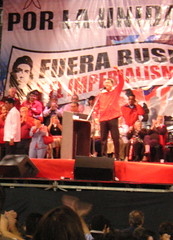
Bush, in the meantime, was being received in Uruguay, across the Río de la Plata, with angry demonstrations. Same as in Brazil and in Colombia. Uruguay is courting disaster, I think, by welcoming G. W. Bush to discuss a free trade agreement. The U.S. is clearly trying to use Uruguay as a wedge to break the Mercosur; the (by now only nominally) leftist presidential administration of Tabaré Vázquez, opposed by part of its own party and its own constituency, must be trying to use the U.S. to ring some alarm bells in Brazil and Argentina.
 Uruguay is understandably enraged by the Argentine government's lack of action regarding the outrageous blockade of the international passes over the Uruguay River due to the conflict of the cellulose plants. Signing a FTA with the U.S., however, would violate the Mercosur's statutes, and send Uruguay into the voracious maw of the world's largest economy, with little hope of surviving (as an independent country, that is, as opposed to a cheap-labour agricultural colony).
Brazil's Lula can be all cozy with Bush because Brazil is a huge country with many resources, including a lot of land where sugarcane and corn can be grown, later to be transformed into ethanol for fuel-hungry U.S. motorists, if only the U.S. would lower its import tariffs and drop internal agricultural subsidies. That won't happen — a Democrat-controlled U.S. Congress won't stop subsidizing the American corn farmers.
Uruguay, on the other hand, doesn't have anything the U.S. cannot get elsewhere, which is why most analysts say that Bush's visit was either useless or a provocation. Going to Colombia was simply a political gesture of support to his puppet Álvaro Uribe (when George says that the U.S. send a lot of aid to Latin America, remember most of it comes in the form of weapons for anti-drug squads in Colombia).
Both Hugo and George are gone now. George didn't even say "Argentina" during his tour, and of course didn't set foot here. In the supposedly friendlier countries he visited, he had to send a small army before him, and his presence caused massive disruption. He hadn't come so close to Argentina since the disastrous Mar del Plata Summit of the Americas, in November 2005, and it's quite likely that he won't waste any more of his time this side of the Equator until he finishes his term (unless he visits Australia, maybe, to check whether water flushed in a toilet rotates the other way — though he doesn't seem to have such scientific need for empirical tests of anything).
09 March 2007
Página/12 does sarcasm
Página/12 had two very good articles last Wednesday (I was going to blog this on Thursday but I thought dengue was more important). One was a delicious sarcastic commentary about the rate of inflation, which according to the government-influenced census bureau (INDEC) was only 0.3% in February. The other was a light philo-psycho-sociological piece about the use of a certain word by a candidate for mayor of Buenos Aires City. In the article titled "INDEC and the happy man", Maximiliano Montenegro speaks of "the "official tourist" who, according to the Argentine census bureau, had cheaper vacations this year than the previous season; the "official health insurance people", whose health is so robust that they never need to pay the heavy extra fees that became associated with many treatments last month; and the consumers that only need to stop being lazy and should simply walk down to the "official neighbourhood", where 1 kg of lettuce costs AR$2.88 as reported by INDEC, and not the 5, 6, or 7 pesos that it costs in other stores and supermarkets.
In the second article, Sandra Russo analyzes the use of the imperative verb form Retirate by BA chief-of-government candidate Mauricio Macri, the millionnaire president of the Boca Juniors football club. Macri, in the crudest display of demagogy, launched his campaign from a garbage lot in a poor neighbourhood, with a 10-year-old girl under his arm, who had (he claims) simply asked to be with him as he spoke. Macri wanted to show he wasn't the spoiled brat turned dark businessman that he really is, and obviously also took advantage of the location to mark how the center-left Telerman administration doesn't care for the poor peripheric barrios.
After the wave of criticism he aroused, Macri said he might've made a mistake: "[If I'd known this would happen], I'd've told her: Retirate que estoy por empezar" — which is supposed to mean "Kindly leave, because I'm about to start [and I don't want to use your presence as a propaganda device]", but sounds exactly like "You are dismissed". Russo points out that nobody except people like Macri (rich guys who grew up surrounded by armies of uniformed maids) would use that verb; middle-class housewives who have somebody come over to help with everyday chores will use simpler, less formal expressions like Andate "Go", Listo "That's fine", etc. Macri's choice of words thus betrays his instinctive view of those under him in the social scale.
You won't find anything like this in any major paper outside Página/12. There are meaty editorials in La Nación, to be sure, but they tend to be boring rants against President Kirchner by Joaquín Morales Solá, or rambling, purposefully vague criticisms of Argentine realpolitik by Mariano Grondona, a well-known collaborationist of the last dictatorship that likes to quote Plato and Aristotle to speak against democracy. Clarín simply doesn't understand satire, parody, or any kind of humour except simple puns; when you have to keep the distinction of being the most read newspaper in Argentina, you have to sacrifice that kind of subtleties... Página/12 has several columnists that are experts in satire, and I swear they must have a team of editors specialized in funny and shocking titles. It's more of my kind of paper, ideologically speaking, so I never, ever, read it in isolation — self-complacency is a permanent temptation.
08 March 2007
Mosquito Coast
It's coming, finally, as we'd feared. Tropical weather, and now a tropical disease! An epidemic outbreak of dengue fever has infected 16,000+ people in Paraguay (that's more than 1,000 km closer to the Equator than here) and killed hundreds. The first cases started appearing in the northeastern provinces of Argentina and soon Paraguayans coming to Argentina and Argentinians returning from a visit to Paraguay brought it to the central areas. There are more than 126 confirmed cases in the country, half of those in Buenos Aires City and around. In Rosario we have (I think, today) seven suspected cases and one confirmed. Dengue is a disease similar to a strong flu, which causes headaches, muscular and joint aches, nausea, and fever. It's transmitted by Aedes aegypti, a species of mosquito. A. aegypti is not commonly found on this latitude, but I believe at least three of the cases in Buenos Aires are autoctonous, i.e. were contracted by human-mosquito-human transmission there, and not brought from Paraguay. The confirmed case in Rosario was infected during vacations in Buzios, Brazil (there are thousands of cases in southern Brazil as well).
Dengue has no specific treatment: people simply have to rest and keep drinking fluids, while the fever and the pain are treated with paracetamol-related drugs (paracetamol is known as acetaminophen in the U.S.), since the disease can have a haemorrhagic variant and you can't use the usual non-steroidal anti-inflammatory drugs (paracetamol is also much cheaper — but it can kill your liver). Patients must be isolated in order to prevent transmission, i.e. so that mosquitoes don't bite them and carry the disease elsewhere.
I haven't seen Aedes aegypti here, though I haven't been looking; they say it's noticeably different from the common local mosquitoes. There are a lot of those anyway. You have to consider that the Paraná River has a huge floodplain, full of shallow canals, marshes and other places with lots of vegetation and stagnant water, a perfect breeding ground. We've always had a lot of mosquitoes in the summer, but lately they're appearing in October and lasting until April or even May, and they're big and nasty.
 Topping it off, the level of the Paraná is increasing, overflowing its banks. Rosario is not going to get flooded, but its beaches are already mostly gone. The river is forcing people in its islands to abandon them, and carrying aquatic plants that are left to rot in the shores. In Santa Fe City, 200 km north, 230 people have been evacuated, and some are worrying the population (unjustifiedly, according to the government) that there might be a flood like in 2003 (that one was not caused by the Paraná, but by the Salado River, which comes from the northwest of the country).
The mosquitoes are not going away. Pharmacies and supermarkets have noted that mosquito repellents have flown from the isles and the manufacturers are seemingly unable to cope with the demand. You can apply some cream or use an airborne repellent in your room at home, you can close off all openings with physical barriers, but you can't do anything while you're outside. Jogging along the coast the other day, my buddy and I observed that the moment we stopped to stretch, we were attacked by swarms of little bloodthirsty monsters. There are mosquitoes inside my office, and in the bus, and in the street while you're having a cup of coffee in a café.

The municipality has been spreading insecticide around, but it's not enough. Somebody in the radio today proposed we should breed dragonflies to eat the mosquitoes. Dragonflies, which are traditionally considered a sign that a rainstorm is about to come (at least that's what my parents passed down from my grandads), are repulsive when you see them up close, but they don't bite. I saw one flying inside the bus this morning as I went to work. I don't know if they actually feed on mosquitoes, but I know the weather tradition is grounded in reality, as it's been raining on and off for four of five days in a row.
So we have constant rain, mosquitoes and a tropical disease. What's next? Women wearing as little clothing as possible, pineapple drinks in the beach, a world-class carnival? You wish.
07 March 2007
¿Por qué in English?
¿Por qué escribo este blog en inglés?
La pregunta no me sorprende. Mi idioma nativo es el castellano, y vivo en un país y una ciudad donde no son mayoría los que pueden entenderme si escribo en otro idioma. Me juego en contra, se diría además, al escribir en inglés desde y sobre una ciudad que no es internacionalmente conocida, que no es un destino turístico, que no tiene fama excepto la muy difusa de ser la cuna del Che Guevara.
Fueron precisamente esas cosas las que me decidieron a escribir en inglés. La comparación con Buenos Aires es inevitable. La capital de nuestro país tiene muchos bloggers, y más que unos cuantos son extranjeros angloparlantes. Se hace y le hacen también mucha publicidad a Buenos Aires para un público internacional. Rosario tiene comparativamente pocos bloggers, y ninguno, que yo sepa, en inglés, salvo yo. Creo que lo que pasa en el interior de Argentina es tan importante como lo que pasa en la capital, que ya tiene demasiados privilegios como para concederle, además, que sea la única visión de Argentina que llegue al exterior. Creo también firmemente que el futuro de Rosario como ciudad turística está en juego en estos años, y que hay que ayudarla; que también vale la pena difundir lo que pasa en esta provincia, tan rica en recursos y en emprendedores y a la vez tan pobre en instituciones y en representación ante el mundo.
En cuanto a lo personal, supongo que si puedo escribir de mis convicciones y opiniones, no está mal escribir sobre mis hobbies y distracciones. Si puedo hacerlo sin traicionar mis raíces como argentino hispanoparlante, llegar a un público amplio y de paso practicar mi segunda lengua, ¿por qué no?.
Why do I write this blog in English?
The question does not surprise me. My native language is Spanish, and I live in a country and a city where the ones who can understand me if I write in another language are not a majority. I'm going against my interests, you could say, by writing in English from and about a city that is not internationally known, that is not a tourist destination, that has no fame except the vague claim of being the craddle of Che Guevara.
It was precisely those things that prompted me to write in English. The comparison with Buenos Aires is inescapable. Our country's capital has a lot of bloggers, and more than a few are English-speaking expatriates. Buenos Aires also gets lot of advertising targeted to an international public. Rosario has relatively few bloggers, and none in English, that I know, except myself. I think that what happens in the interior of Argentina is as important as what happens in the capital, which already has too many privileges and shouldn't be additionally granted the one of being the only view of Argentina that reaches the world abroad. I also firmly believe that the future of Rosario as a touristic city is at stake these years, and that it has to be helped; and that it's worth making things known that happen in this province, so rich in resources and enterprising people and at the same time so poor in institutions and in representation before the world.
As for the personal stuff, I suppose if I can write about my convictions and opinions, it can't be wrong to write about my hobbies and pastimes. If I can do that without betraying my roots as a Spanish-speaking Argentinian, reaching a wider audience and in passing practise my second tongue, why not?
06 March 2007
The incredible shrinking inflation
Remember the scandal about the inflation rate of January 2007? Well, the February rate has just come out: 0.3%. Needless to say, nobody believes it. Either the statistical sample is not representative, or the figure has simply been tweaked. Página/12's article, which I'm linking to, explains that both have happened in a way — to outrageous extremes. In some cases it's almost the case of one department of government telling shops to display certain prices so that another department records those prices, and not the real ones; in the case of tourism, it's literally one office asking another one what the prices are in their area of control, without actually checking reality at all. Less than a third of one percent is less monthly inflation than any other since 2004, and it's difficult to trust INDEC when so many things you buy almost every day seem to be so much more expensive. Is the government truly and so evidently manipulating the figures? That would be, as we say, peeing outside the can — a big stupid mistake.*
First of all, you can't enrage people more than they are already by presenting them with numbers that mean nothing. Less than 1% is simply not "true" for Doña Rosa.† Second, if you start rewriting reality like that, when will you stop? Third, and most importantly, regardless of whether this ridiculously low figure is real (no matter how twisted the method used to calculate it), trust has already been lost, and the Argentine State has already issued bonds indexed by inflation to refinance its debt. For every 1% of increase in the inflation rate, the government's debt increases by 1,500,000,000 pesos (about 500 million dollars); and the symbolic value of an index is one of those things that shortsighted politicians like Néstor Kirchner delight in.
Today I'm hearing in the radio (I'm having trouble finding the info online) that Merrill Lynch is offering "low inflation insurance": if you have an Argentine inflation-indexed bond and our annual inflation is less than 9.5% on average over the next five years, M-L will cover your losses. They may or may not believe that the rate reported by INDEC is fake, but that's not important for them or for financial speculators.
Speaking of speculators' fear, you probably heard that the Chinese government decided to cool their economy and stop short-term speculation, and screwed up the whole world's stock markets. Like Argentina, China is experiencing problems due to its fast growth. However, while Argentina may happily sink into the Atlantic Ocean with nobody else noticing, China is the engine of the world's economic growth, since its huge population is waking up to the joy of consumerism. If China stopped buying soybean completely (unlikely, but let's take an extreme case), Argentina would see its foreign trade surplus go down to zero, and its fiscal surplus would get a noticeable dent as well (because soybean exports pay taxes). Maybe we should ask the Chinese to send some of that growth our way, since we, unlike them, can handle it so well we're having less and less inflation every month.
Yeah, right.
* Mear fuera del tarro ("peeing outside the can"): doing something in a context where it's not appropriate at all to do it, such as offering an uninformed opinion in a delicate matter without being invited. You don't want to use the verb mear in a formal situation, but other than that, it's pretty harmless.
† Doña Rosa: the lowest common denominator of public opinion; the lady next door who comments on every piece of news as she were an expert.
05 March 2007
Rosario in the news
I peruse several local and national newspapers almost every day to get my news..., which of course would be useless to look for on TV (too much time lost waiting for pseudo-news to finish). The main local news source is La Capital, a venerable paper founded in 1867 that is Argentina's oldest of those still published. La Capital is objective enough not to pass op-ed for news, and its online version is fairly good. There's also El Ciudadano, but it's a "popular" paper so its quality is atrocious, and its website looks like something you could've designed using HTML 1.0. Then there's Rosario3.com, an online newspaper property of the same media group that owns Canal 3, Radio 2 (the main AM station in Rosario) and several major FM stations. Rosario3 is a recent addition and, though amateurish at times, it does cover certain items that the other neglect. Finally, there's Rosario/12, a short supplement to the Buenos Aires-based Página/12 written by a local staff.
I also read the "national" papers La Nación and Página/12 to get an ideologically broad coverage. I use scare quotes because Buenos Aires-based papers are invariably biased towards Buenos Aires coverage. They're distributed throughout the country but, quite logically, most of their public is concentrated in one hypertrophic metropolitan area that thinks of the country as one Important Place plus a vast, undiferentiated hinterland that provides the capital with food and football players. Página/12 does often take a look at important issues of "the interior", especially those related to social and political conflicts, which it attacks with undisguised ideological zeal; La Nación deals with national and local issues using the same pseudo-objective uptight treatment it employs with Buenos Aires news. I generally don't read Clarín, mainly because it's usually 75% sports non-news, though its supplements and journalist blogs are sometimes very interesting.
Rosario appears in Buenos Aires news almost only when something horrible or bizarre happens. Since we don't usually have floods or strange animal attacks or resonant small-town displays of misery, it's not often (there was these guys eating a cat in a villa miseria once in the 1990s... hence the epithet comegatos applied to rosarinos). However, reading Página/12's tourism supplement last Sunday, I was positively surprised by an article about Rosario.
The article speaks of Rosario as a passing weekend destination, which may be OK for people who only want to follow pre-set paths, but doesn't do justice to the city. Granted, most visitors wouldn't be caught dead outside certain areas (I myself would rather not) but the visitor may leave with the impression that Rosario is a medium-sized block of old houses plus a strip of river beaches and a few parks. The article does mention the amazing changes Rosario has had since the disastrous riots of 1989, where people looted supermarkets and stores, and the crisis of 2001–2002. Rosario was at one time the country's "capital of unemployment", and became at parts as dirty, desolate and unsafe as the poor parts of Greater Buenos Aires. This same city, however, emerged from the last crisis with fewer permanent wounds and recovered fast. It earned a recognition for its advances in governance and development, leading to a better quality of life, by the UN Development Programme, and a recent study (which I covered) also placed it at the top of the quality of life ranking of Argentine metropolitan areas.
Página/12 humorously notes that Rosario views itself as "an independent city-state", so "if we take this seriously... a trip to Rosario is like going abroad". It and speaks of a "new Rosario" which has opened up public access to its river, something that Buenos Aires lost long ago, and notes that long-term urban planning has been at work. Despite two economic crises (with a full decade of neoliberal adjustment in the meantime), the local administrations have shared a common vision of Rosario and struggled to make it real. They've failed in many respects, or they've been forced to downsize certain promises, but an urban strategy exists. The municipality is drafting the plan for the period 2007–2017 (I read about this in Rosario/12, by the way). It includes a project to build a multi-modal public transport node at the Cruce Alberdi, the place where the northeast of the city meets the border of the peripheric downtown area, now occupied by the Patio Parada, a railway node administered by the Nuevo Central Argentino. The project would have a small bus terminus, a stop of the BA–Rosario–Córdoba "bullet train" (which, by the way, nobody's heard of again), and (oh such delight!) a tramway station. The area will form an axis of communication within the city, with access to the airport and links with the metropolitan area.
At the same time, the municipality is presenting its urbanistic plans for this year. This will outline a number of large-scale changes to key areas of the city, design certain areas for residential use, preserve historical corridors with architectural homogeneity, prevent the disruption caused by tall towers popping out in certain areas (as is happening in Buenos Aires), and other more complicated goals. Such foresight is often marred by the harsh realities of negligence, corruption, bureaucratic delays and sheer lack of personnel... but anything is better than nothing.
01 March 2007
Down with unemployment
The unemployment figures measured as of the last quarter of 2006 just came out, and it seems we should all be merry and cheerful: 8.7%. In almost any country such a figure would be rather high, but in Argentina employment has been a concern since the last military dictatorship.
Employment had its ups and downs... usually downs. The quality of the jobs, the rate between workers' wages and companies' profit, and the purchasing power of those wages, have all consistently decreased since the National Reorganization Process started implementing the policies which were already in practice in Pinochet's Chile, under the auspices of the late Nobel Prize Milton Friedman (may Satan pay special attention to his soul) and the IMF. When Carlos Menem began his "structural reforms" Argentina increased its exports, stabilized the value of its currency, stopped inflation, and gained productivity as it opened its markets to foreign technology. Menem's master plan had an oh-so-minor flaw: it left millions unemployed and forced many others to work under the near-slavery conditions that only a deregulated job market can offer. As the economic model, based on the ridiculous idea that the value of currency in a free market can be fixed by law, collapsed in a matter of months, unemployment and poverty skyrocketed. Inflation was eventually contained, but at the beginning of 2003 unemployment was 25%.
One of the symbolical targets chosen by the Kirchner administration was lowering the unemployment rate to a single digit. The target was nearly reached last year but then unemployment increased again. The census bureau (INDEC), currently facing popular suspicion after the government removed its head because she allegedly refused to manipulate the inflation figures, has just announced that we're finally under the target 10%. People receiving the federal welfare plan are not counted as unemployed; if they were, the rate would be 10.1%. The government counters that we should count only those welfare recipients who are actively looking for a job (unemployment means you want to work and you can't, after all), which would give 9.3%. Anyway, that's too close to 10% for comfort, so the official line will stick to 8.7%.
The announcement comes just in time for President Kirchner to congratulate himself (using the royal "we") during the opening speech of this year's Congress, as he did with remarkable consistency in 2004, 2005 and 2006. The reduction in unemployment is indeed impressive, and the expansive policies of this government have undoubtedly helped; if only they could be more modest...
Millions remain unemployed or under-employed. The striking difference between the unemployment and poverty rates show that many people who have a job (even a stable, registered job) are poor. There's been a surge of union demands, as some unions have regained power. Leaders of strong unions such as the truckers' syndicate, Hugo Moyano, are historically close to the Peronist quasi-corporatist tradition and close to the national government; others simply have found they have pressure power and have decided they won't be bought or co-opted (as they happily did for a handful of dollars in the 1990s). Those workers labouring outside their protection, however, tend to be exploited. While mob-like union bosses get outrageously high salaries for their workers, many workers scattered within the service sector (such as supermarket and shopping mall employees) lag behind, trapped in abusive jobs.
Soon, as the unemployment rate goes down a bit more every quarter, the elephant in the middle of the room that nobody in the government wants to acknowledge will be impossible to ignore: so-called structural unemployment, the mass of mostly young people who'd like to work but have zero chance to get a job, because they grew up without a half-decent education, they have no specialized skills, and (in some cases) have had a decreased intellectual development due to slight or severe malnutrition during their childhood. These guys and girls never attended school on a regular basis, or were forced to work or scrounge the trash for a living when they should be studying, and may have already turned to drug addiction or thievery; their parents and even their grandparents have always lived off state welfare, and none of them has any idea what to do with their future, or any faith in the possibility of social advancement.
One of the highlights of old-time Argentina, the one that attracted immigrants and that gave rise to a vigorous middle class, was that you could always advance with hard work and a bit of luck; if you couldn't go to college, your children would be able to, and if not, they could at least learn some technical skills and earn a decent living in a factory, or set up their own modest business, and hope that their own children would outdo them. But that dream died long ago. There are now too many poor who know they'll always be poor. Barring a real paradigm change, they'll be around forever, no matter how small figures the stats guys come up with.