As promised, I'll summarize the rest of my vacations in Junín de los Andes, and then on a different post I'll try and do the same with San Martín de los Andes, and be done with it (I kinda want to start writing about local news again!).
After our visit Lake Huechulafquen, the only other thing we did outside Junín was a couple of visits to San Martín. There are buses every other hour that take you there in about 50 minutes. We walked around the city a lot, and I visited Cerro Chapelco and its ski resort (obviously in the low season), but I'll speak of San Martín's main features later.
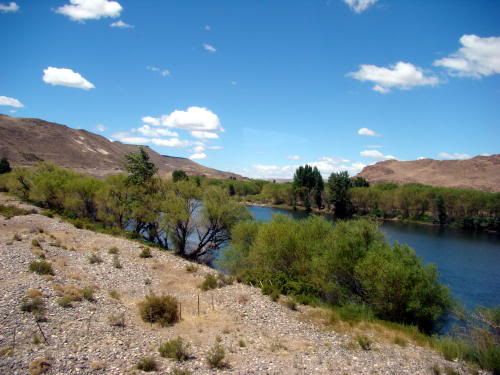
In Junín we took advantage of the river, which runs only a block and a half from Marita's. There's a little bridge that spans the river and takes you to the banks on the other shore.
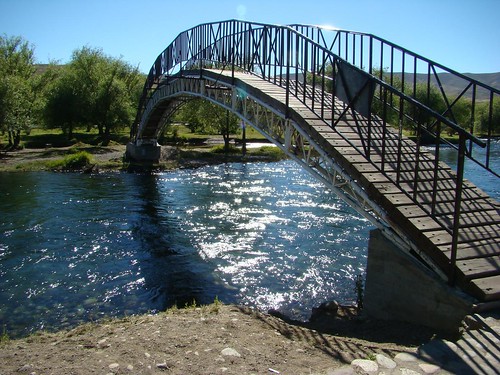
The Chimehuin, as expected of Patagonian rivers, is shallow, with a pebbly bottom, very cold, and very fast. I tried to swim in it — but to my dismay I caught a strong current and had to surrender to it, until I was left on a bed of pebbles about 30 meters away.
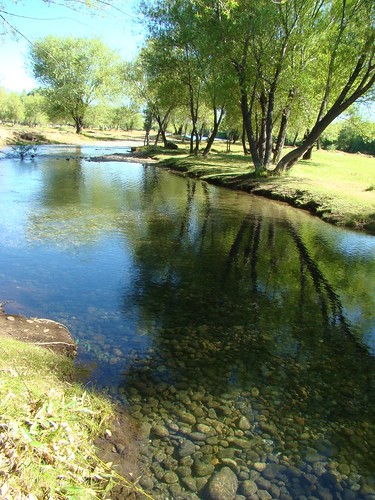
My embarrassment was compounded by the sight of many children and teenagers who repeatedly jumped into the river, ignoring the certain danger of hitting the bottom, and then proceeded to maneuver easily following the swirls and eddies of the river, and getting (it seemed to me) exactly where they wanted. Needless to say I didn't try swimming again. Of course, these guys were all local people, so they knew the river from long experience; and being young and restless, they weren't afraid of anything.
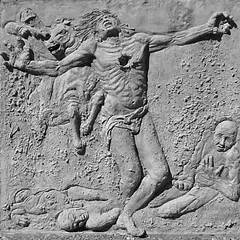 The other thing we did in Junín was visiting the Via Christi, which is a kind of Via Crucis with sculptures and plaques representing and describing Jesus Christ's path to the place where he was crucified according to the Christian myth.
The special thing about this Via Christi is that it combines images and motifs of the Passion with local spirituality, focused on the Blessed Laura Vicuña and the (also recently Blessed) Ceferino Namuncurá, the latter being the first member of a native Argentine tribe to be on the road to Catholic Church-declared sanctity... plus a lot of ecumenical, or syncretic, references to aboriginal spirituality, a vindication of the indigenous tribes, and a retelling of the Spanish Conquest (which didn't reach Patagonia) and the so-called Conquest of the Desert in the late 19th century. The "desert" was Patagonia, which was indeed the frontier of European-Argentine civilization at the time, although it was by no means uninhabited. The Argentine Army, under the command of a typical plutocratic government, advanced over Patagonia and systematically drove away or slaughtered the native tribes it found, or turned the natives into virtual slaves, who were forced into military conscription or sent to work as servants of wealthy families of Buenos Aires; after the land was cleared of its original inhabitants, it was divided in huge fiefdoms and given away to ranchers belonging to the oligarchy who (directly or indirectly) ruled the country.
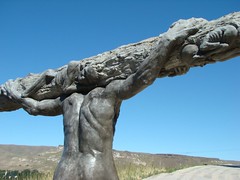 The Via Christi had elements of this story, as seen from the point of view of modern revisionist history and by recent popular Catholic leaders such as Bishop Jaime de Nevares (1915–1995). I found the whole mix quite funny in its heterogeneity, not because the story was funny in any sense, but because the story of liberation theology is so pathetic — educated folks, with the best of intentions, trying to reconcile modern views about human rights and the struggle of oppressed peoples with the teachings of a church that is fiercely hierarchical and misogynistic, that has supported oppressive governments and countless massacres in the name of its god, and is even today a major obstacle to certain basic human rights in large parts of the world. You have to admire and pity these people for the effort of weaving their version of history into Christian doctrine, even as their own Church stops short of calling them heretics.
The Via Christi also had certain obvious, and to me, rather distasteful hints of anti-abortion propaganda, with abortion compared to the genocide of the natives, and figures looking like small children or late-term fetuses embedded into the beam of Christ's cross.
This funny/creepy tour was very well kept, anyway, and it served as good exercise. When we reached the top of the hill, we could see most of the urban area of Junín de los Andes. The pictures were no good, unfortunately, due to the harsh lighting, but I managed to rescue some.
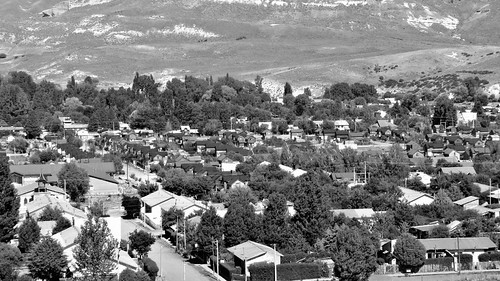
Our last days in Junín de los Andes were relaxed and festive. We had asado once, and the last night, after spending the afternoon by the river, my friend Gabriel pulled out his finest tricks and made us matambre a la pizza, which is a massive slab of flank steak with cheese and tomate sauce on top, cooked on a grill over charcoal embers (like asado, but not for so long). After that we went out to a noisy bar, and drank just enough to make fools of, but not so much as to endanger, ourselves. No pictures of that, thank you.
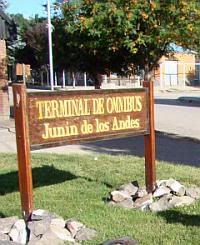
Sunday came. Mauro and Gabriel had bought tickets for a direct trip back to Rosario, a bit tired of vacations. I decided to make the most of my time and booked a place in a hostel in San Martín de los Andes. Somehow we woke up after 4 hours of sleep, and after some light breakfast, the guys escorted me to the bus terminal and waited until I left. Their bus departed later that day, at 2 PM — but by that time I was already in my next, and last, destination.

 Stumble it!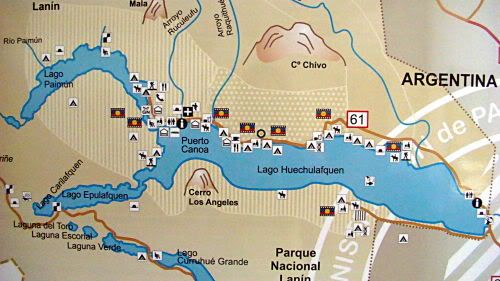
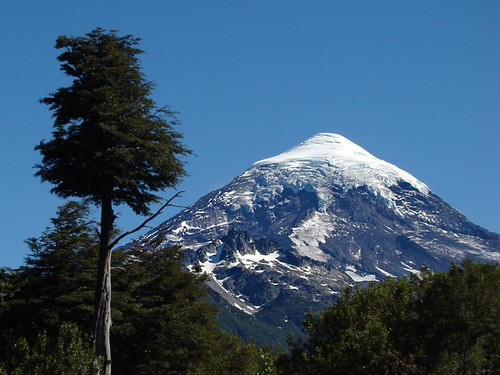
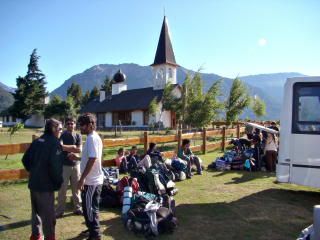 Well, the bus left us a few hundred meters after Puerto Canoa, beside a nice church in an isolated spot of intense beauty. We walked back, marveling at the scenery, until we got to the house of the park rangers. We had to pay a small fee of admittance, and we were given a few instructions and tips. There's a path that takes 4 hours to reach Lanín's base and 3 hours to return, and if you want to go that way you have to notify the park rangers and start before 11 AM; otherwise you can go anywhere as long as you don't violate the rules.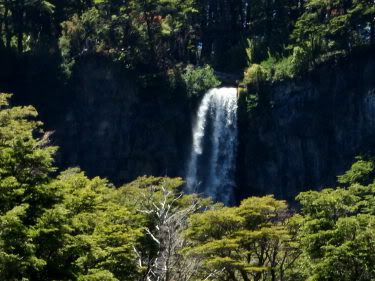
 We arrived around 2 PM into a little bus terminal with a little wooden information booth beside the platforms. There we asked about